

Lead Generation: From First Contact to a Successful Sale

Lead generation is the marketing process of identifying people who are genuinely interested in your product and capturing their contact details so you can guide them from first touch to a paid sale. Every day a website may attract thousands of visitors, but only a small fraction buy on their first visit. Without a way to capture and stay in touch with the rest, that traffic is largely wasted. Lead generation solves this by turning anonymous visitors into identifiable prospects you can nurture over time, and it sits at the heart of predictable, scalable revenue for any modern business.
Key takeaways
- A lead is a prospect who has shared contact information (email, phone, or a social profile) in exchange for something of value, signalling potential interest in your offer.
- Leads vary by intent and readiness: cold, warm, and hot on the interest scale, and MQL versus SQL on the sales-readiness scale.
- The strongest channels combine reach and measurability: SEO, content marketing, paid search and social, email, referrals, and increasingly AI search visibility.
- Lead magnets and focused landing pages are the mechanics that convert traffic into contacts.
- Speed and qualification decide outcomes: respond fast, score leads honestly, and nurture the ones who are not yet ready.
- Two metrics anchor performance: cost per lead (CPL) and conversion rate, read together rather than in isolation.
What lead generation actually is
In plain terms, lead generation is everything you do to attract interested people and collect a way to reach them again. When a visitor leaves your site without buying, you lose the ability to influence their decision unless you have captured their details. That single fact explains why lead generation matters so much: it converts fleeting attention into a relationship you can develop.
Done well, it delivers four practical benefits. It lets you manage traffic efficiently, filtering out casual browsers and keeping the people who could realistically buy. It ensures your marketing budget is spent wiselydriving more visitors is pointless if they bounce after two pages, so lead generation holds them inside the funnel. It builds a usable database you can email, segment, and re-engage. And ultimately it increases sales: the more qualified contacts you gather and the better you communicate with them, the more revenue you generate.
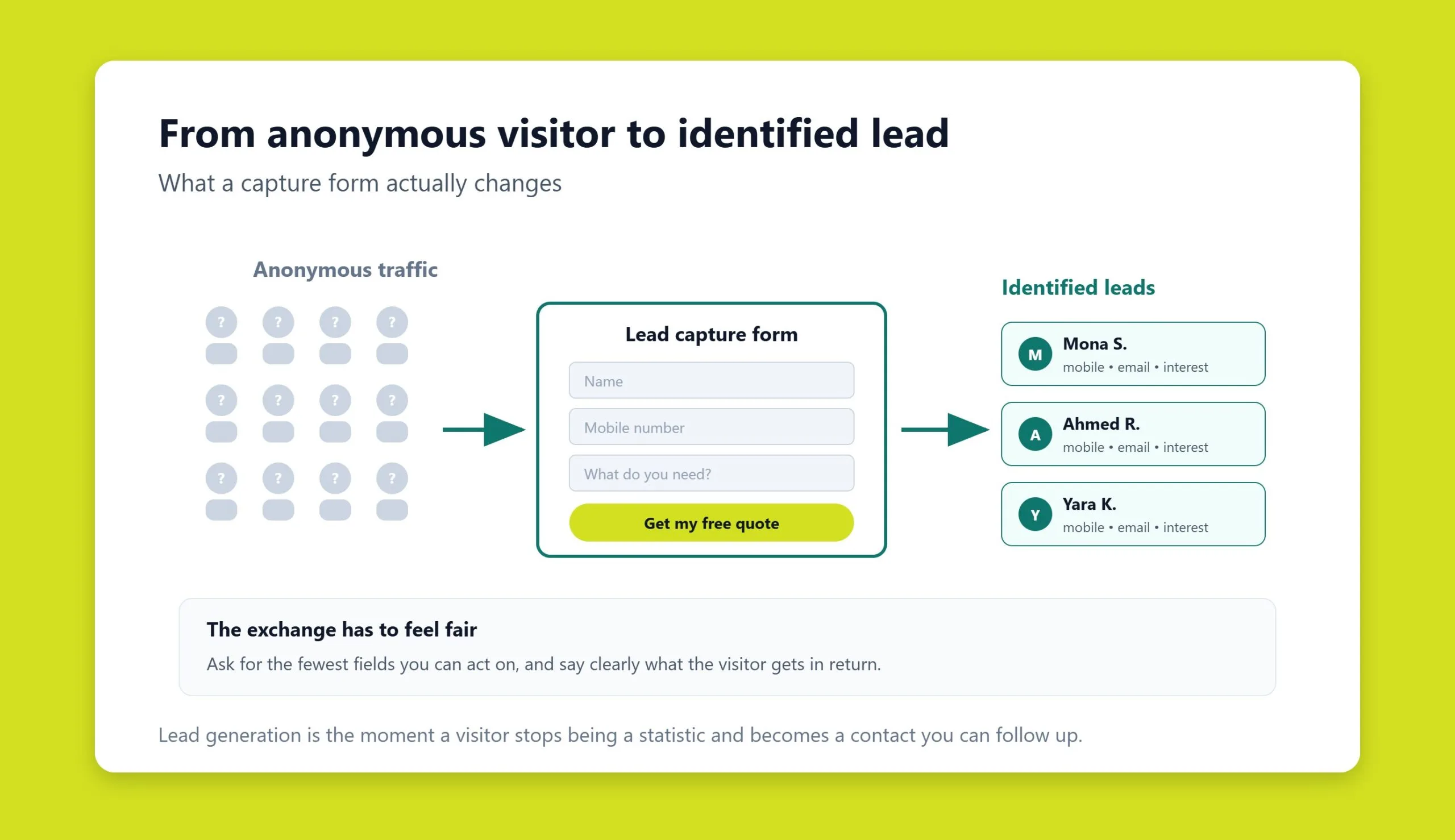
The mechanics usually follow a simple sequence. A person discovers your brand through some channel, search, social, an ad, or word of mouth. A call to action (a button, banner, or message) invites them to take the next step. Clicking it sends them to a landing page where they exchange their contact details for something valuable: a guide, a template, a free consultation, a discount code. The offer must carry real value; people only hand over personal information when the trade feels worthwhile.
Types of leads: from cold to hot, MQL to SQL
Not every lead is equal, and treating them as if they are is one of the fastest ways to waste a sales team’s time. There are two useful ways to classify them.
By interest: cold, warm, and hot
- Hot leads are ready to buy. They understand the value of your product, have no major objections, and often just need a frictionless path to purchase.
- Warm leads are interested but still hesitating. They see the appeal yet want reassurance: a comparison, a case study, or a conversation with sales to overcome lingering doubts.
- Cold leads have little or no active interest. They may not even realise your product solves a problem they have, so they need education and nurturing before any sales conversation makes sense.
By sales-readiness: MQL and SQL
Marketing and sales teams also share a common vocabulary for handoff. A marketing qualified lead (MQL) has shown enough engagement, downloading an asset, attending a webinar, revisiting pricing pages, to suggest genuine interest, but is not yet ready for a direct sales pitch. A sales qualified lead (SQL) has been vetted further and matches your buying criteria closely enough that a salesperson should reach out. Clear MQL and SQL definitions prevent the classic friction where sales complains that leads are weak and marketing complains that good leads are ignored.
It is also worth naming the leads you do not want: off-target contacts who submit a form on impulse but have no real need, and junk submissions with fake phone numbers or email addresses. Filtering these out early keeps your metrics honest and your team focused.
Main lead generation channels
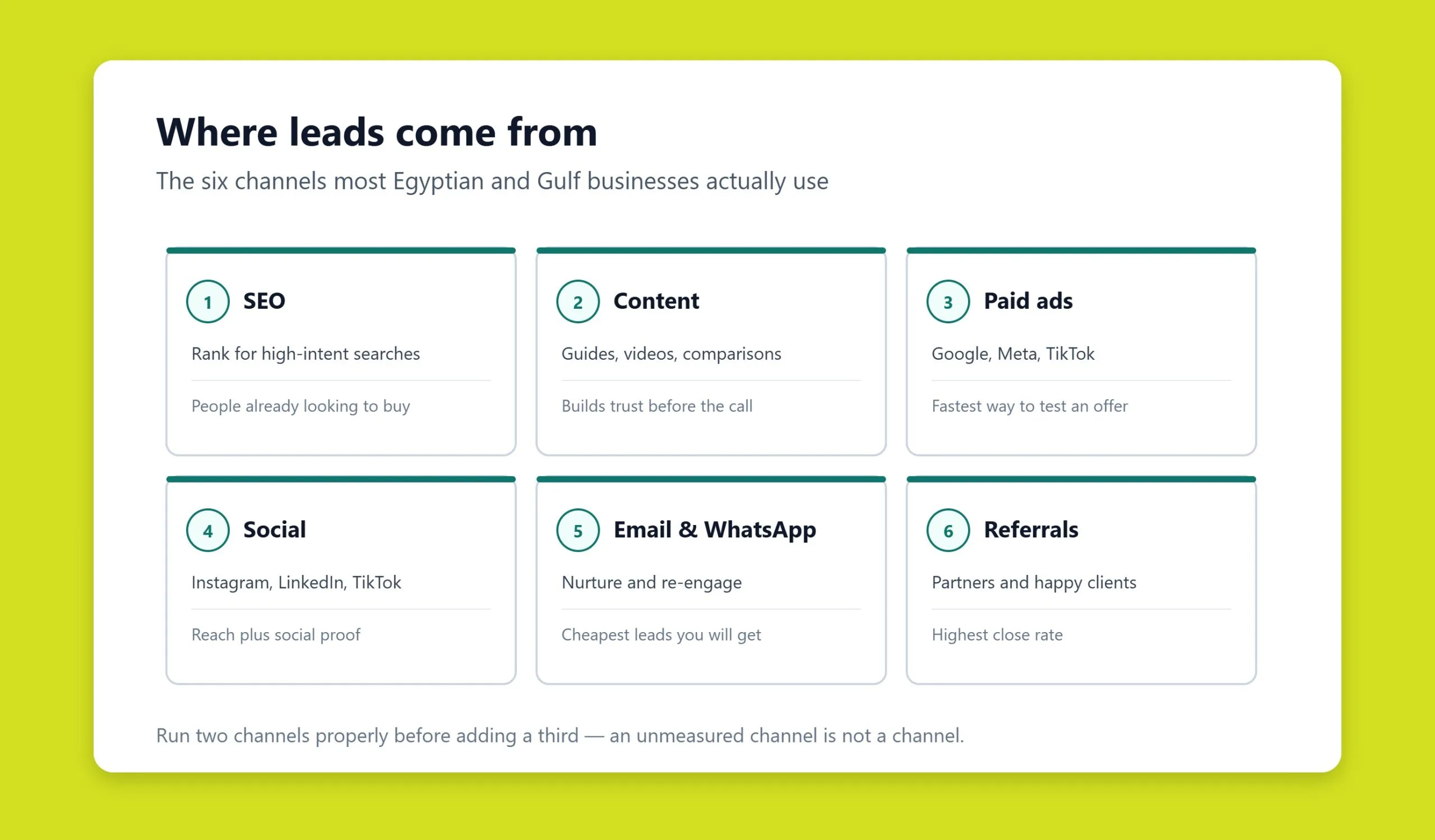
Lead generation is not a single tactic but a portfolio of channels, each suited to different audiences and buying stages. The best programs blend several so that no single point of failure can stall growth.
SEO and organic search
Search engine optimization attracts people at the exact moment they are looking for a solution, which makes organic search one of the highest-intent channels available. Ranking for the queries your buyers type builds a compounding stream of leads that does not reset when an ad budget runs out. A structured SEO strategy, technical health, keyword targeting, and authoritative content, turns your site into a durable acquisition engine.
Content marketing
Content is the fuel that most other channels burn. Guides, comparisons, tutorials, and original research answer buyer questions, build trust, and give people a reason to share their details. A deliberate content marketing program feeds SEO, powers email nurture, and supplies the lead magnets that convert. Industry surveys consistently rank email and content among the most effective methods for building a customer base, which is why the two are usually paired.
Paid search and PPC
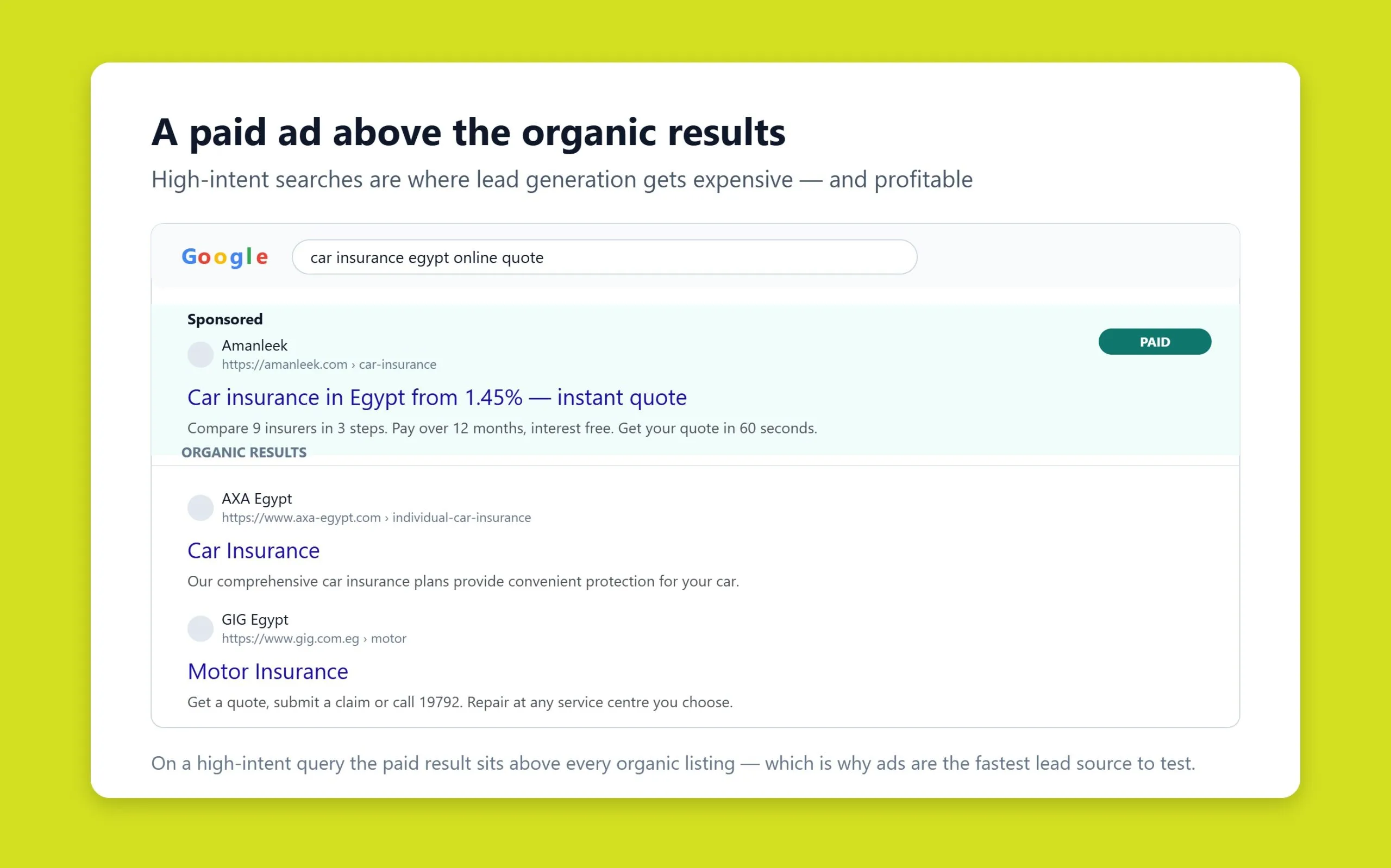
Where SEO compounds slowly, paid channels deliver leads immediately and with precise control. Platforms such as Google Ads match your adverts to specific keywords and buying intent, letting you appear the instant someone searches. A well-run PPC campaign is highly measurable, you can attribute spend to leads and calculate return down to the individual click, which makes it ideal for testing offers quickly.
Social media and paid social
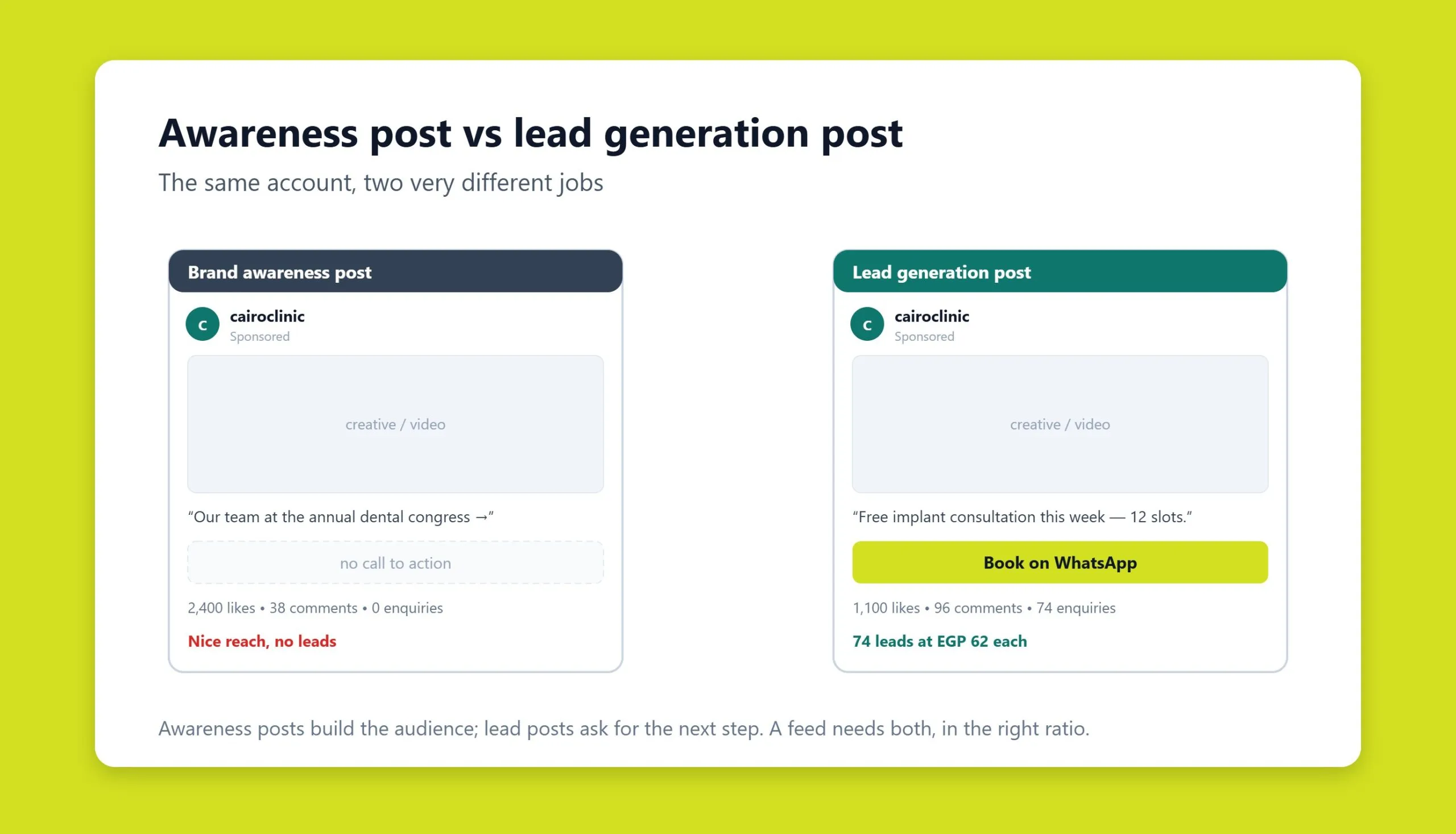
Social platforms build awareness and loyalty, and with the right approach they generate leads directly. Networks such as Meta (Facebook and Instagram) and LinkedIn let you target audiences by interests, behavior, job title, and demographics, then capture leads without users ever leaving the app through native lead forms. A consistent social media marketing presence combines organic content that earns trust with paid campaigns that drive action. LinkedIn in particular has become a workhorse for B2B lead generation, where professional targeting aligns closely with buyer profiles.
Email marketing
Email remains one of the most reliable channels for working warm leads, because these people have already opted in. A promotional email with a targeted incentive, a discount code, an exclusive offer, nudges interested subscribers toward a purchase. The key is automation: a welcome message should arrive the moment someone subscribes, setting expectations for frequency and value.
Referrals and partnerships
Referred prospects arrive pre-warmed by someone they trust, which is why referral leads often convert faster and at higher value. Formal referral programs, affiliate partnerships, and co-marketing arrangements extend your reach into audiences you could not easily buy. Events and industry conferences serve a similar role, capturing contact details from people who engage at a stand or session.
AI search and answer engines
A newer channel deserves attention: buyers increasingly ask AI assistants and answer engines for recommendations before they ever reach a traditional search results page. Optimizing to be cited in those responses, often called generative engine optimization, is becoming a genuine source of high-intent leads. A forward-looking GEO (AI SEO) approach positions your brand where these conversations now begin.
The lead funnel
Channels feed a funnel, and understanding its shape helps you diagnose where prospects are lost. At the top, a broad audience becomes aware of your brand. In the middle, a call to action invites them to engage, and a landing page captures their details in exchange for value. Toward the bottom, nurtured leads are qualified and handed to sales, and a share of them convert into customers.
The funnel narrows at every stage, which is precisely the point, it concentrates effort on the people most likely to buy. Your job is to reduce unnecessary drop-off between stages: a confusing landing page, a slow follow-up, or an irrelevant offer each leak prospects who could have converted. Mapping your funnel and measuring the transition between each step reveals exactly where to focus improvement.
Lead magnets and landing pages
If channels bring traffic, lead magnets and landing pages are the machinery that turns that traffic into contacts. A lead magnet is free content offered in exchange for contact information: a recorded webinar, an ebook, a practical checklist, a template, or a free consultation. The best magnets are genuinely useful, creating them takes effort precisely because they must deliver real value to earn a stranger’s details.
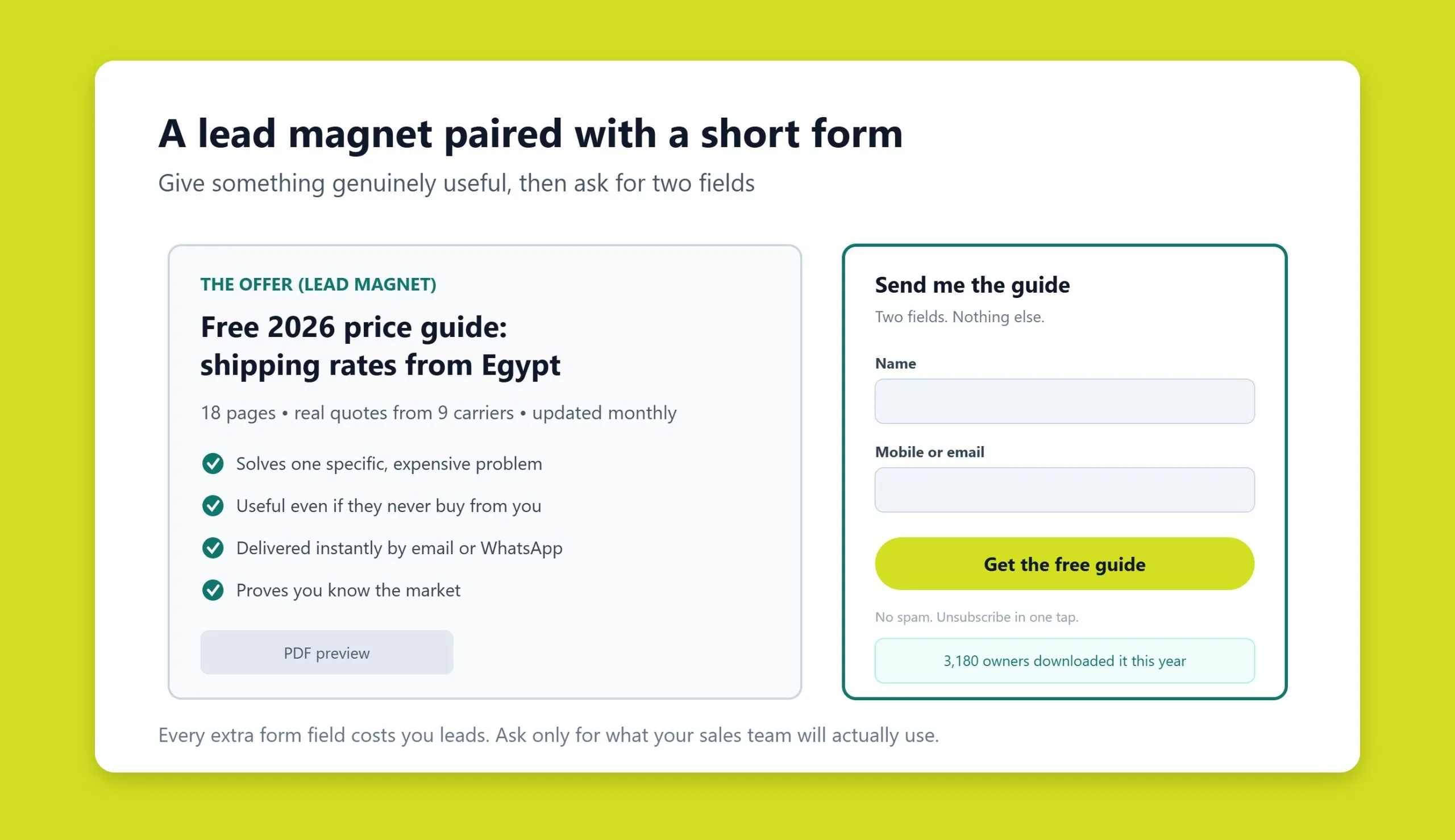
The landing page is where the exchange happens, and its design decides whether visitors convert. A few principles apply consistently:
- Keep the form simple. Ask only for what you truly need, typically a name, email, and perhaps phone and location. Every extra field lowers completion rates.
- Make the offer visible immediately. Visitors should be able to act from the first screen without hunting through other pages.
- Load fast and work on mobile. Most traffic in many markets comes from phones and tablets — check your own analytics for the split — and slow or unresponsive pages bleed leads.
- Match the message. The offer wording and visuals must align; a mismatched or unattractive form undermines even strong traffic.
Supporting tools amplify these pages. Lead forms adapt to any goal, from newsletter sign-ups to callback requests. Chatbots answer common questions around the clock and collect details as they go. On-site chat, usually connected to your CRM, helps visitors decide while capturing their contact information. And native lead ad formats on social platforms gather details directly inside the feed.
How to qualify and nurture leads
Capturing a lead is the beginning, not the end. What happens next determines whether it becomes revenue.
Respond quickly. Speed is decisive. A purchase enquiry should be contacted within hours at most: the longer a prospect waits, the more likely they are to cool off or turn to a competitor. For automated channels, the welcome email or requested lead magnet should arrive instantly; where automation is not possible, such as some social submissions, send the promised material manually and fast.
Qualify honestly. Score each lead against your ideal-customer criteria, need, fit, budget, and timing, to separate MQLs from SQLs and to filter out off-target and junk contacts. Good qualification protects your sales team’s time and keeps your pipeline realistic.
Nurture the rest. Most leads are not ready to buy immediately, and that is normal. Add them to a subscriber base and stay in regular contact, gradually warming their interest. Share relevant offers, highlight new products, explain the benefits of your service, and provide useful content. Consistent, valuable communication moves warm leads toward a decision and keeps your brand top of mind when they are finally ready.
Key metrics: CPL and conversion rate
Two numbers sit at the center of any lead generation program, and they are most useful when read together.
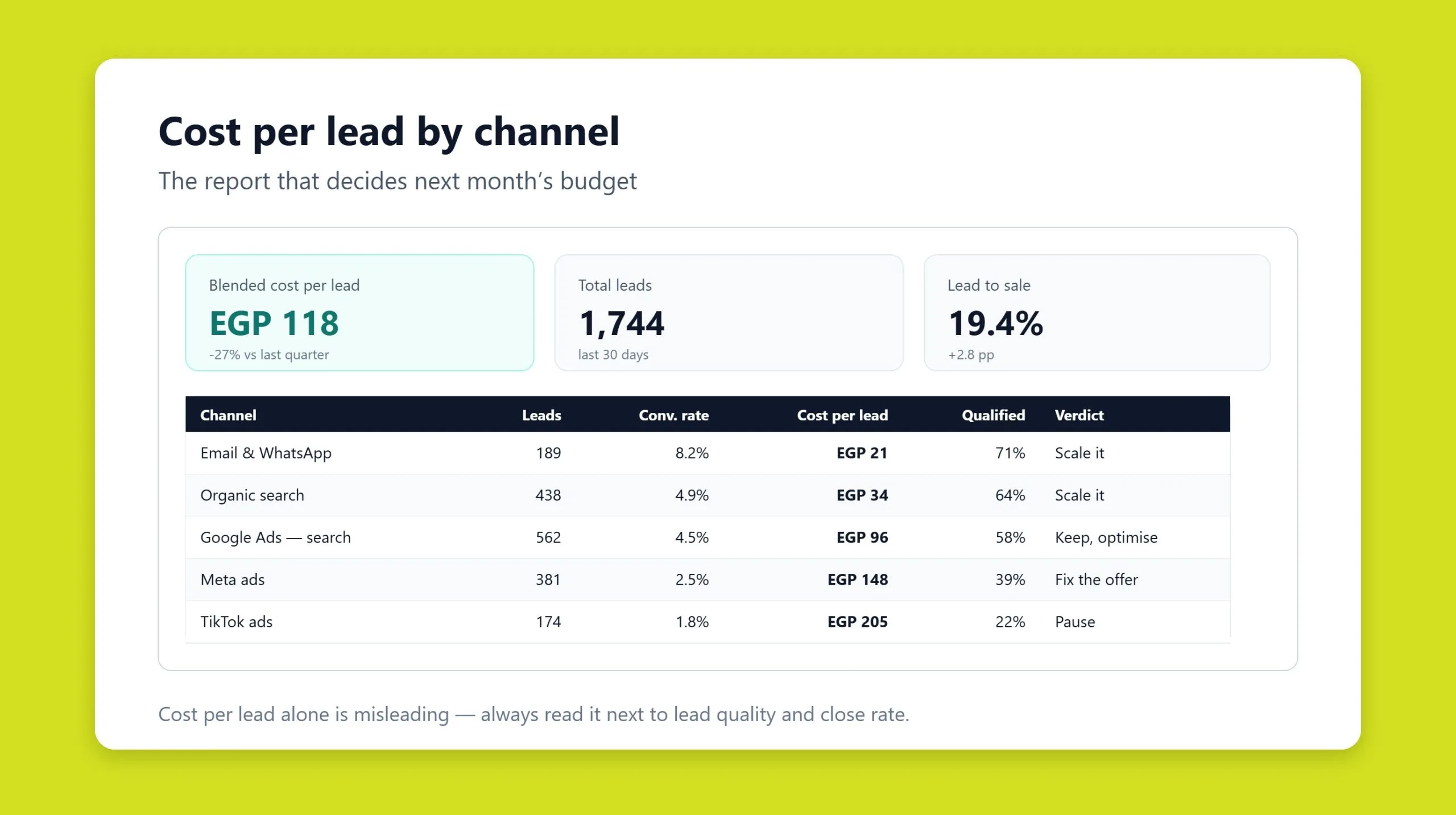
Cost per lead (CPL) tells you what each lead costs to acquire. Divide your total acquisition spend by the number of leads generated. Suppose a month-long campaign cost roughly £3,000 in agency fees plus £400 in media and produced 82 usable leads after removing 15 off-target contacts from an initial 97. The CPL works out to about £41 per lead. If that exceeds your target ceiling, it is a signal to investigate, but not automatically a failure.
Conversion rate measures the percentage of visitors, or of leads, that take the desired next step, submitting a form, or ultimately buying. It reveals how efficiently your funnel turns attention into action, and it is often where the biggest gains hide: a small lift in landing-page conversion can lower your effective CPL without spending an extra penny on traffic.
Crucially, judge these metrics in context. A CPL that looks high may still be profitable if those leads convert to sales at a strong rate and a healthy order value. Always evaluate a campaign across the full picture, lead quality, conversion rate, cost per sale, and revenue, rather than fixating on any single figure.
Lead generation, in the end, is the disciplined practice of collecting visitor data, qualifying it, and preparing it for your sales team to convert. Choosing the right mix of channels, building offers people actually want, and following up fast is what turns ordinary website traffic into customers, and steady conversions into predictable growth.
Lead generation in the Gulf and Egypt: the chat-first funnel
The funnel described above assumes a form submission followed by an email sequence. In the Middle East that model captures only part of the demand, because a large share of buyers open a chat instead of filling in a form. WhatsApp reaches more than 83% of internet users in Saudi Arabia and above 80% of the population in the UAE. In much of the region it is the default way to contact a business.
What breaks when you run a Western funnel here
| Assumption | What actually happens | Consequence if ignored |
|---|---|---|
| Leads arrive through a form | Many arrive as a chat message | Your reported cost per lead is wrong, and usually too high |
| Email is the follow-up channel | Email open rates are weak, chat is read | Nurture sequences quietly fail |
| Attribution ends at the form | The conversation happens off-site | You cannot tell which channel produced the sale |
| Response within 24 hours is acceptable | Chat sets an expectation of minutes | Leads go to whoever replied first |
| Business hours are Monday to Friday | The working week runs Sunday to Thursday in most Gulf states | Two days of leads sit unanswered every week |
Making chat leads measurable
The single most valuable fix is also the simplest. Most teams here cannot answer the question “which page produced this lead” because the conversation starts outside analytics. Three steps close that gap.
- Tag every chat link with its source. Add a parameter identifying the page, so the opening message tells you where the person came from. A visitor arriving from a product page and one arriving from a pricing page are different leads.
- Record the click as a conversion. Fire an event when the chat button is used. Without it, your highest-intent action registers as an exit.
- Log the outcome against the source. Whoever handles the conversation records whether it closed. That is the only way to compare channels on revenue rather than on volume.
Qualification changes too
A form gives you fields. A chat gives you a conversation with no structure, which means qualification has to happen inside the thread. Build a short opening script that establishes budget range, timeline and decision authority within the first few exchanges, and record those answers in your CRM the same way you would record form fields. Without that discipline, chat leads look plentiful and convert badly, and teams wrongly conclude the channel does not work.
One practical note on staffing. Because response speed decides who wins the lead, coverage matters more than headcount. A single person available during the hours your audience actually messages will outperform a larger team that is only reachable on a Western working week.
Platform reach figures from DataReportal 2026 digital reports for Saudi Arabia and the UAE.
Frequently asked questions
What is the difference between a lead and a prospect?
A lead is anyone who has shared contact details and shown some level of interest in your product. A prospect is a lead who has been qualified as a realistic fit for what you sell, they match your buyer profile and have a genuine need. Every prospect starts as a lead, but not every lead becomes a prospect.
Which lead generation channel is best?
There is no single best channel; the right mix depends on your audience, product, and buying cycle. High-intent channels like SEO and paid search tend to convert well, while content, social, and email build awareness and nurture demand over time. Most successful programs combine several channels so that results do not depend on any one source.
What is a good cost per lead?
A good CPL is one that leaves room for profit after those leads convert into sales. It varies widely by industry, product price, and channel, so there is no universal benchmark. Rather than chasing the lowest possible CPL, compare it against lead quality, conversion rate, and the eventual revenue each lead produces.
How quickly should I follow up with a new lead?
As fast as possible, ideally within minutes for automated responses and within a few hours for personal follow-up on purchase enquiries. Interest fades quickly, and every hour of delay increases the chance a prospect goes cold or contacts a competitor. Speed of response is one of the strongest predictors of conversion.
What is the difference between an MQL and an SQL?
A marketing qualified lead (MQL) has engaged enough to signal interest but is not yet ready for a direct sales conversation. A sales qualified lead (SQL) has been vetted further and matches your buying criteria closely enough that a salesperson should reach out. Clear definitions for each keep marketing and sales aligned on when to hand a lead over.
Related guides
Don't miss the chance to
make your website more visible!
Initial consultation and
audit of the current situation

Read also

Article Behavioral Factors in SEO: What They Are and How to Improve Them
Article JavaScript Links Are Hiding MENA Sites From ChatGPT and Claude

Article VOCTOS Is a Top SEO, PPC and SEM Company in Egypt on Clutch for 2026
Article Commercial Ranking Factors: The Complete List

Article The Title Meta Tag: What It Is and How to Write It
Article The Role of Meta Tags in Search Engine Optimization
Article Can You Sue an AI for Defamation? Where the Law Stands

Article Cloudflare’s 15 September AI Crawler Defaults: The Check Gulf and Egypt Brands Should Run Today



Real Results
More Wins
SEO & GEO for Delta Medical Labs
 GEO
GEO
1M+ monthly organic visits, 159,200 ranked keywords, 5,570 pages cited by AI engines, and 1,186 #1 rankings in KSA.

Arabic SEO, GEO & guest posting for VPNly
 SEO
SEO
65K peak monthly organic visits, 55 guest posts, and 149 pages cited by AI engines.

SEO & GEO for Ogaei Virtual Care
GEO
From 3 to 7,931 monthly organic clicks in 7 months, 2.9M+ impressions, and 40+ keywords in Google’s Top 10.

SEO for Eduverse
SEO
12× search traffic in 10 months, 45% of target keywords in the top 5, and 55% in the top 10.
Trusted by