

Behavioral Factors in SEO: What They Are and How to Improve Them
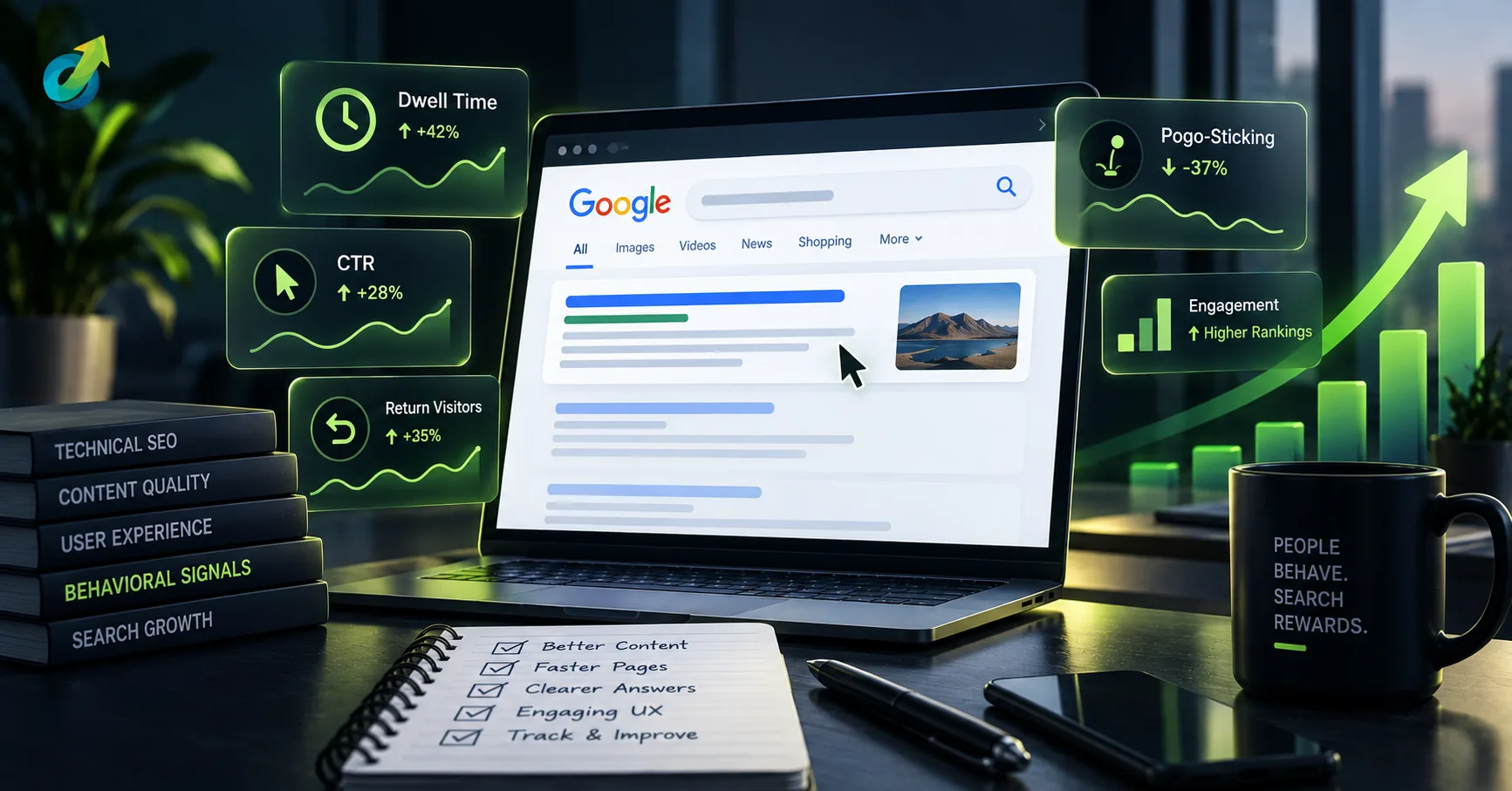
Behavioral factors are the collective actions real users take before, during and after visiting your site, and search engines read them as a proxy for quality. When people click your result, stay to read, and leave satisfied, Google interprets that as a signal your page deserves its ranking. When they bounce back to the results and click a competitor instead, that signal works against you. You cannot fake these signals safely, but you can earn them, by building pages that answer intent quickly, load fast, and are genuinely pleasant to use.

Key takeaways
- Behavioral (engagement) factors reflect how users interact with your listing in search and with your pages once they land, and search engines use them to validate relevance and quality.
- The signals that matter most are click-through rate (CTR), dwell time, pogo-sticking, bounce and pages per session, plus direct and returning visits.
- You can measure engagement in GA4 (engaged sessions, engagement rate, average engagement time) and in Google Search Console (impressions, clicks, CTR, average position).
- Improving these factors comes down to content quality, fast pages, clean UX, strong internal linking and compelling titles and descriptions, not tricks.
- Never buy bots or click farms to inflate signals. Google detects artificial patterns and penalizes them, and fake engagement never converts.
What behavioral factors are in SEO
Behavioral factors, sometimes called engagement or user-experience signals, are the sum of actions your audience takes in relation to your website. Search engines know that owners can manipulate links and over-optimize text to reach the top, so a large part of modern ranking analysis focuses on how people actually behave. If real users consistently prefer, engage with and return to a page, that is very hard to fake and therefore very valuable as a signal.
The exact weightings, the full list of factors and the precise thresholds Google uses are not public. But through years of experiments and public statements from search engineers, SEO specialists have identified the core metrics that reliably move alongside rankings. It helps to split them into two groups.
External signals: how users behave in search results
- Click-through rate (CTR). The percentage of people who click your result out of everyone who saw it. A high CTR tells Google your listing looks relevant for that query. There is no universal benchmark, because CTR varies by niche and by position, and a well-crafted snippet can occupy a large share of the first screen.
- Direct visits. When people reach you by typing your URL or using a bookmark, search engines read it positively. It suggests your content is useful enough that users seek you out directly instead of hunting for alternatives.
- Return to search (pogo-sticking). This shows whether visitors were satisfied. If someone opens your page and does not go back to the results, they likely found what they needed. If they bounce straight back to the SERP and click another result, that pogo-sticking suggests your page did not match intent.
Internal signals: how users behave on your pages
- Bounce and engagement. A bounce broadly means a visit with no meaningful interaction. Context matters enormously. For a landing page that answers everything above the fold, a high bounce rate can be perfectly healthy. For an information hub, the same number may mean poor design, confusing navigation or wall-of-text content pushed people away immediately.
- Pages per session (browse depth). The number of pages a user views in one visit. Generally, deeper browsing signals engaging content, two to three pages is typical for content sites, while ecommerce catalogs run higher. But depth alone is not proof of quality: a visitor might click around endlessly because they cannot find the answer.
- Session duration and dwell time. How long a visitor spends on a page. Longer is usually better, yet not always: people may linger because the structure confuses them, or simply walk away from the screen. Read duration together with the other metrics, never in isolation.
How Google uses engagement signals
Google has been careful about how directly it claims to use click data, but the practical picture is consistent: signals like CTR, dwell time and pogo-sticking act as validation. Rankings are set primarily by relevance, content quality and links, and user behavior then confirms or challenges those positions over time. A result that earns clicks and keeps people engaged tends to hold or improve its spot. A result that everyone skips, or bounces away from, sends a message that it is not the best answer, and competitors that satisfy users better can move ahead.
The important nuance is that these factors do not work in isolation. Push browse depth and session time too aggressively with a confusing, click-heavy structure and you can raise your bounce rate as frustrated users give up and return to search. The job is to find the right balance across all of them.
Which metrics matter and how to measure them
Because the raw ranking signals are hidden, you work with the closest observable proxies in your own analytics. Two Google tools cover almost everything you need.
Measuring in GA4
Google Analytics 4 replaced the old bounce-rate-first model with engagement-based metrics, which map more naturally to behavioral factors:
- Engaged sessions and engagement rate. A session counts as engaged if it lasts longer than ten seconds, fires a conversion event, or includes at least two pageviews. Engagement rate is the share of sessions that qualify.
- Average engagement time. The time your page was actually in focus, a cleaner read on attention than raw duration.
- Views per session and events. Use the Pages and screens report under Engagement to spot pages with weak engagement, then dig into why.
- Path and funnel exploration. The Explore workspace lets you trace how users move from the entry page onward and where sessions end.
Segment by landing page and by device so you can isolate the pages and experiences that underperform, then prioritize fixes on the ones that get the most impressions.
Measuring in Google Search Console
Search Console shows the external side of behavior, what happens in the results before the click. In the Performance report you get impressions, clicks, CTR and average position for every query and page. Sort by impressions to find pages that rank well but earn few clicks, a classic sign that the title or description is not compelling enough. The URL Inspection tool and enhancement reports also help you confirm that rich results and structured data are being read correctly. Pair GSC with GA4 and you can follow a query from search impression all the way through on-page engagement, which is exactly the loop behavioral factors describe. A structured SEO audit ties these data sources together into an action list.
How to improve behavioral factors
The goal is simple to state and harder to execute: build pages that solve the visitor’s task quickly, effectively and pleasantly. Here is where to focus.
Write compelling titles and descriptions
Your snippet is your first, and sometimes only, chance to earn the click. Keep the visible part of the title tag to roughly the first 55-60 characters, make it readable, and include a clear benefit or call to action for commercial pages. Use the meta description to surface what makes you worth the click, current offers, advantages, a concrete promise, while knowing Google may rewrite it with whatever page text it finds most relevant. A URL that includes the target phrase reads as more relevant and tends to attract more clicks, and breadcrumb markup makes it cleaner in the SERP.
You can also enrich your listing with structured data. Product and review markup (Schema.org, JSON-LD) can surface star ratings, and a clear, logical site structure encourages Google to generate sitelinks automatically. Just be realistic about impact: research on expanded snippets suggests the CTR lift is often small, and occasionally giving away too much answer in the SERP can even reduce clicks, because the user already has what they came for.
Improve content quality and relevance
Useful, original content is what keeps a visitor on the page and brings them back. Map your pages to keyword clusters, match search intent, and give thorough, genuinely helpful answers. This applies to blogs and to product pages alike: when buyers get complete information, conversion rates can climb meaningfully. Keep content current, too. Nothing drives someone back to the results faster than realizing your guide or instructions are out of date. Ongoing content marketing keeps your library fresh and intent-aligned.
Speed up your pages
Most users want the answer, not a slideshow of animations while they wait. Pages should feel near-instant. Practical wins include serving assets through a CDN so content loads from the nearest server, compressing and right-sizing images, GIFs and video, avoiding oversized media and heavy embeds, tightening caching, and removing unnecessary scripts (a tag manager can help you keep third-party code from dragging load times down). Fast Core Web Vitals directly reduce the bounces caused by impatience. If speed and stability are recurring problems, ongoing technical support keeps performance from sliding back.
Get the UX and mobile experience right
More than half of searches now happen on phones and tablets, so a layout that is not fully responsive simply loses traffic. Beyond mobile, usability comes down to a logical structure where any important page is reachable in about three clicks, a clean design where media supports rather than distracts, and interactive blocks that reward exploration. Related-posts modules, recommended products, calculators, comparison tools, contact forms and quizzes all raise browse depth and time on site when they are genuinely helpful, not when they force users to click endlessly.
Strengthen internal linking
Internal links are one of the most reliable ways to lift pages per session and guide users, and crawlers, to your most valuable content. Contextual links inside the body, “read next” suggestions and clear navigational hubs help visitors move deeper into your site instead of returning to search for the next step. Thoughtful internal linking also distributes authority across your pages and reinforces topical relationships. Our SEO services build this into a repeatable structure rather than a one-off pass.
Build a loyal, returning audience
Direct and returning visits are strong positive signals, and they lower your cost of acquiring the same traffic again. Webinars and talks position you as an expert people trust and recommend. Email newsletters keep you top of mind, provided you send genuinely useful content, product explainers, answers to common questions, not just repeated offers to buy. Over time this loyal audience becomes a steady stream of direct traffic that reinforces the rest of your behavioral profile.
Never fake behavioral signals
Some owners are tempted to buy artificial engagement, bots, click farms or paid “users” who deliberately click listings and pad session times. Avoid it. Even if it produces a brief lift, the underlying site has not improved, so real visitors still leave and no customers appear. Worse, search engines are good at spotting manufactured behavior: algorithms analyze interaction patterns, including heatmap-style and templated movements, and flag them as manipulation. The realistic outcome is wasted budget followed by penalties and lost positions. The durable path is the slower one, make the site better and let real users signal that on their own. This is doubly important as search shifts toward AI answers, where GEO (AI SEO) rewards genuinely authoritative, well-structured content that both engines and language models can trust.
Frequently asked questions
Are behavioral factors a direct Google ranking factor?
Google is cautious about saying click data is used as a direct ranking factor, but in practice engagement signals act as validation. Relevance, content quality and links set your position, and user behavior over time confirms or challenges it. Pages that earn clicks and keep users engaged tend to hold or improve their rankings.
What is pogo-sticking and why does it hurt SEO?
Pogo-sticking is when a user clicks your result, quickly returns to the search page, and clicks a different result instead. It suggests your page did not satisfy the query. Frequent pogo-sticking is a signal that a competing result is a better answer, which can erode your position for that query.
Is a high bounce rate always bad?
No. Context decides. A landing page that answers everything the visitor needs can have a high bounce rate and still be successful, because the user got what they came for. On a content site meant to encourage further reading, a high bounce rate more often points to poor structure, slow load times or content that failed to match intent.
How do I measure behavioral factors with Google tools?
Use GA4 for on-site behavior, engagement rate, engaged sessions, average engagement time and views per session, segmented by landing page and device. Use Google Search Console for the in-search side, impressions, clicks, CTR and average position by query and page. Together they let you follow a user from search impression through on-page engagement.
Can I safely buy traffic to improve my metrics?
No. Bought bots or click-farm traffic do not convert and do not fix the underlying experience, so real users still leave. Search engines detect artificial interaction patterns and can penalize the site, costing you rankings and budget. Invest in content, speed and UX instead so genuine users generate the signals for you.
Related guides
Don't miss the chance to
make your website more visible!
Initial consultation and
audit of the current situation

Read also

Article JavaScript Links Are Hiding MENA Sites From ChatGPT and Claude

Article VOCTOS Is a Top SEO, PPC and SEM Company in Egypt on Clutch for 2026
Article Commercial Ranking Factors: The Complete List

Article The Title Meta Tag: What It Is and How to Write It
Article The Role of Meta Tags in Search Engine Optimization
Article Can You Sue an AI for Defamation? Where the Law Stands

Article Cloudflare’s 15 September AI Crawler Defaults: The Check Gulf and Egypt Brands Should Run Today

Article What ChatGPT Optimization Guides Still Get Wrong in 2026







Real Results
More Wins
SEO & GEO for Delta Medical Labs
 GEO
GEO
1M+ monthly organic visits, 159,200 ranked keywords, 5,570 pages cited by AI engines, and 1,186 #1 rankings in KSA.

Arabic SEO, GEO & guest posting for VPNly
 SEO
SEO
65K peak monthly organic visits, 55 guest posts, and 149 pages cited by AI engines.

SEO & GEO for Ogaei Virtual Care
GEO
From 3 to 7,931 monthly organic clicks in 7 months, 2.9M+ impressions, and 40+ keywords in Google’s Top 10.

SEO for Eduverse
SEO
12× search traffic in 10 months, 45% of target keywords in the top 5, and 55% in the top 10.
Trusted by