
VOCTOS Is a Top SEO, PPC and SEM Company in Egypt on Clutch for 2026
Clutch issued VOCTOS six Top Company badges for 2026. Three of them cover the work we actually sell in Egypt: SEO, PPC and SEM. We also sit at number 3 on Clutch’s Top SEO Companies in Egypt directory, and at number 3 on Top Digital Marketing Agencies in Egypt.
That is the announcement, and it would normally be the whole post.
The more useful thing we can do with the space is explain what the badge measures and what it does not. The same check works on whoever else is on your shortlist.
Key takeaways
- A Clutch Top Company badge means you rank in the top 15 of a directory. It is a position, not a prize.
- Clutch Global and Clutch Champion are a separate tier, issued twice a year. Champion requires a Global win plus three or more new verified reviews inside a year.
- Clutch scores two things, industry expertise and ability to deliver, across nine inputs it publishes openly.
- Top 15 of a national directory and top 15 of a global one are both “top 15”, and they are not the same achievement.
- Every claim on this page resolves on our public profile in about two minutes.
The six badges, named in full
Top SEO Company Egypt, Top PPC Company Egypt, Top SEM Company Egypt, Top SEO Company Media, Top Business Plan Writing, and Top Technical Writing Company. All six carry 2026.
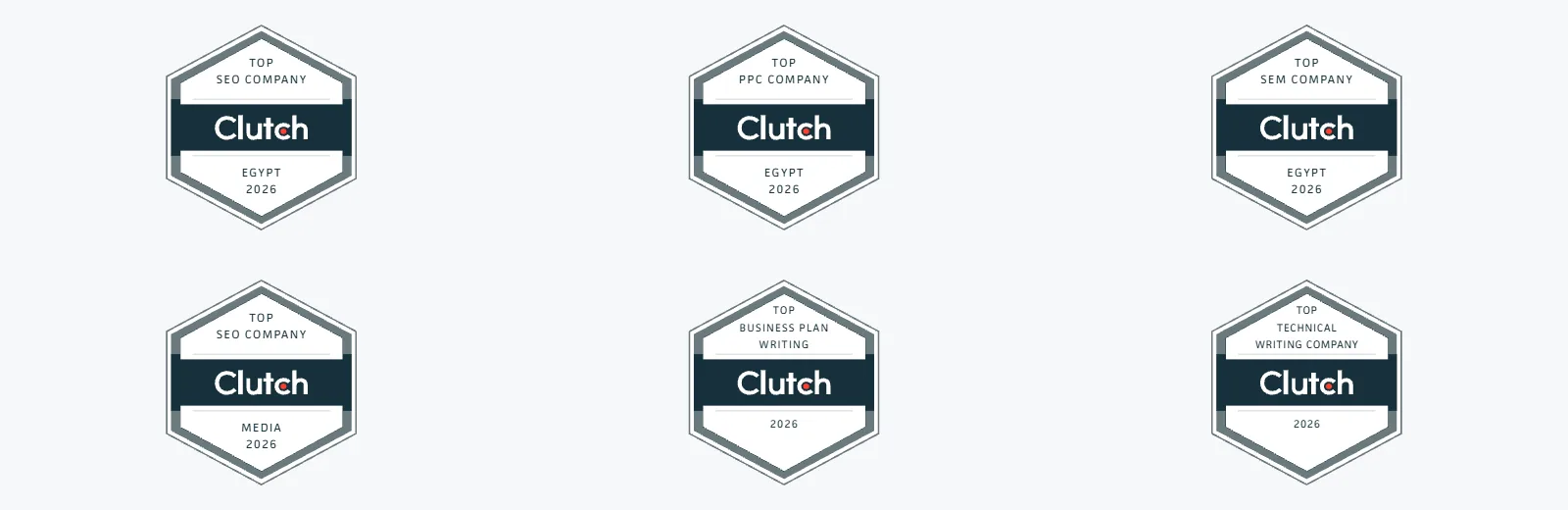
The three Egypt badges cover our core services. The other three reflect the breadth of categories our profile is listed under on Clutch.
Two directory positions sit alongside the badges: number 3 in Top SEO Companies in Egypt, and number 3 in Top Digital Marketing Agencies in Egypt. The profile holds a 5.0 average across 8 verified client reviews, each of them collected by a Clutch analyst rather than by us.
What does a Top Company badge certify?
Directory position, and that is the whole rule. Clutch writes it in a single line inside the vendor dashboard: you qualify for a Top Company badge if you rank in the top 15 on Clutch.
So a badge is a snapshot of where a company sat in one list, on one date. No jury, no panel, no assessment of any particular project.
The confusion comes from the artwork. The 2026 design sets the category name inside a shield, and a buyer scanning your footer at speed reads a shield as a trophy.
A badge tells you a company ranks and gets reviewed inside a category. The reviews underneath it are what tell you whether that company has solved a problem like yours.
How is that different from a Clutch Global Award?
Global and Champion are the award tier, and they run on a different clock. Clutch recognises companies twice a year, in spring and in autumn, scoring them on industry expertise and on ability to deliver. Winners are named in press releases by service line and by region.
Champion sits above Global, and Clutch’s documentation is specific about the threshold. All Clutch Global winners who received at least three new verified reviews within a year are considered Clutch Champions, which Clutch calls its highest achievement on the platform.
So the ladder runs listed, then top 15 in a directory, then Global, then Champion. When an agency page says “award-winning on Clutch”, that phrase currently covers all four rungs, so it is worth asking which one they mean.
| Top Company badge | Clutch Global | Clutch Champion | |
|---|---|---|---|
| What it measures | Directory position | Expertise and ability to deliver | Global win plus review velocity |
| Threshold | Top 15 of a directory | Scored, announced by category | 3 or more new verified reviews in a year |
| Cadence | Ongoing, by directory | Twice a year | Twice a year |
Two scores, nine published inputs
Industry expertise is built from five things: services offered, clients, case studies, awards received, and social media presence.
Ability to deliver is built from four more. The recency, number and quality of Clutch-verified reviews on the profile. The types of client the company works with. The services it offers and its experience providing them. Its reputation and visibility in its target market.
Two of those nine are worth knowing about before you read anybody’s badge as a quality signal.
Recency carries weight, so a profile holding eleven reviews from 2023 can sit below a profile holding four from this year. And social media presence sits inside the expertise score, which means part of every directory position reflects marketing as much as delivery.
Neither of those makes the score useless. They make it a specific measurement, which is the only kind you can do anything with.
Why read an Egypt badge differently from a global one?
Because pool size changes what a position means, and almost nobody says so out loud. A country directory holds the providers Clutch lists for that one country. A global service directory holds thousands of companies competing for the same fifteen slots.
Our Egypt badges put us among the top-ranked and best-reviewed providers in our own market, which is the list that decides anything if you are buying here.
If you are buying in Egypt or the Gulf, the national directory is arguably the more useful of the two. It filters down to providers who can work your market, your language and your timezone. If you are buying globally, read the global directory and ignore the national one.
Comparing agencies this week, read our Clutch reviews before you read anybody’s badge wall.
My read on agency badges
I have watched agencies build entire homepages out of directory badges, and I think the practice has quietly stopped working on the people it was built for. Buyers have seen too many shields.
What survives is the specific claim: which directory, which year, what position, and a link that still resolves when somebody clicks it.
There is a second thing worth saying, because it changes what a directory listing is for. Clutch has started reporting AI citation data to providers, through a dashboard it says is powered by Conductor. It tracks how often a profile gets used as a source by ChatGPT, Gemini, Perplexity and Claude.
Its own pitch for paid verification states that verified companies receive citations an average of 8.6 times more often than unverified ones.
I would treat that figure the way I treat any vendor’s number about its own product. Clutch has not published the method, the sample or the window behind it. It is an interesting claim from a company that can see the data, and it is not evidence yet.
What is harder to argue with is the direction. Directory pages rank, and they get quoted in AI answers, which means a listing now does something it did not do two years ago.
How do you check any agency’s Clutch claim?
Two minutes, three steps, and it works on any agency you are weighing up.
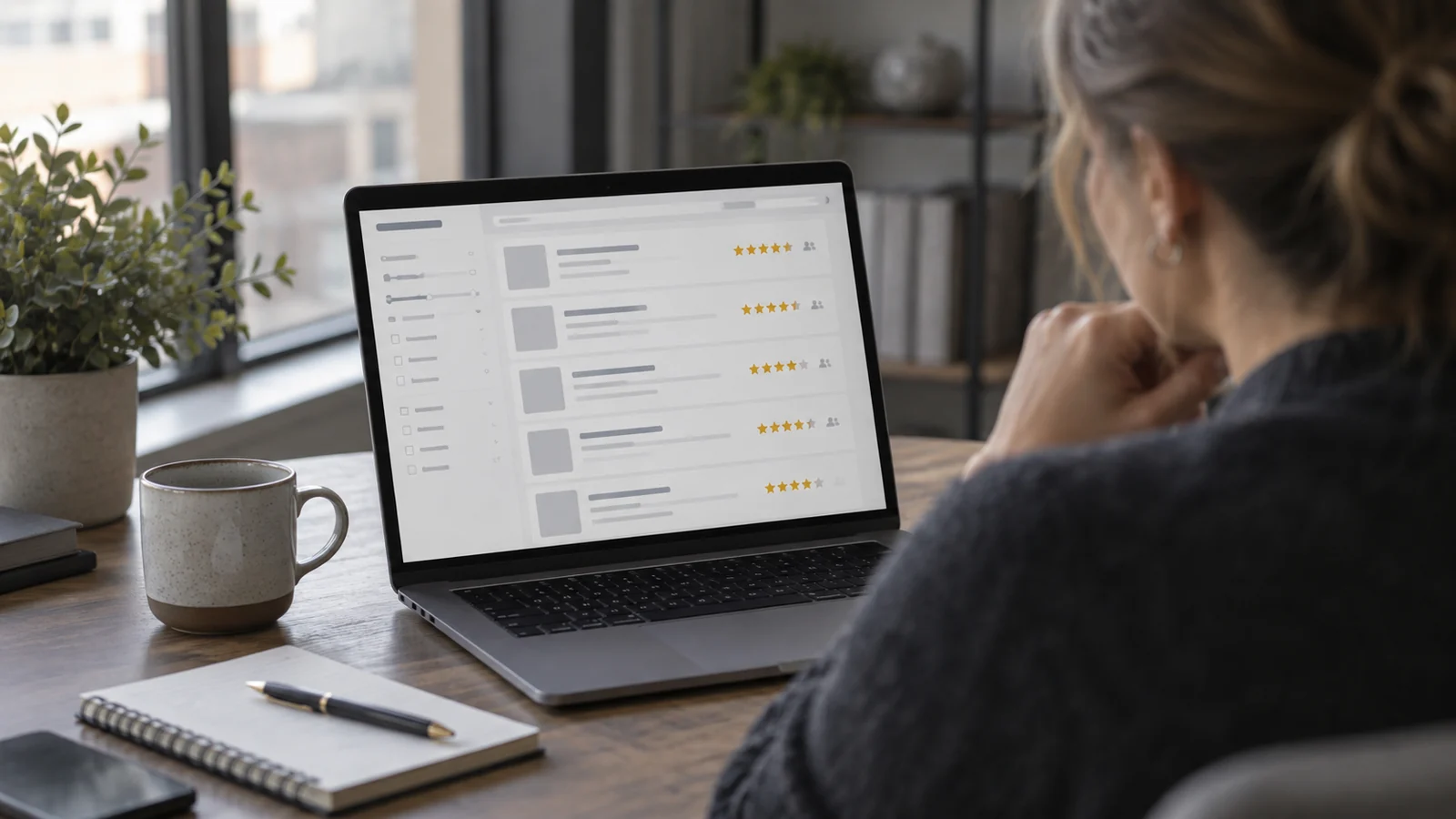
Open the agency’s Clutch profile. Check the review count and the date of the most recent review, because recency is where most profiles quietly fail while the star rating stays flattering.
Then open the directory being claimed and find their position today. A badge carries a year on it, and directories are not frozen.
Ours is at clutch.co/profile/voctos, holding eight reviews at a 5.0 average, most recent one verified within the last quarter.
If a claimed badge does not resolve to a directory you can open and read for yourself, you already have your answer.
Questions we get about directory badges
“Every agency on my shortlist has a Clutch badge. How is this a differentiator?”
Not every badge carries the same weight, and that is the part most shortlists miss. Two agencies can both show a top 15 badge while one sits at number 3 with current reviews and the other sits at fifteen with nothing since 2023.
So check the directory, the position inside it, and the date on the most recent review. Then judge whoever is left on the things a badge cannot capture: whether they have worked your category, what their reporting looks like, and what they refuse to promise you.
“Can an agency just buy these?”
Clutch sells advertising, sponsorship and verification, and it is open about all three. The Top Company badge itself comes from directory position rather than from a purchase.
The honest caveat is that visibility is one of the nine scoring inputs, and spending influences visibility, so on any given profile the paid and unpaid signals are not cleanly separable.
Worth knowing on ours: VOCTOS is listed on Clutch’s free tier. The number 3 positions came from reviews and profile completeness rather than from spend.
“Why would I trust reviews the agency collected itself?”
Because Clutch verifies them by interviewing the client, and its own analysts run those interviews. The weak point is selection.
An agency picks which clients to put forward, which is why the count and the recency tell you more than the score ever does. Almost every score on the platform is high.
“Does any of this touch AI search?”
It is starting to. Directory pages rank and get quoted, which means a listing can carry you into answers you never wrote yourself.
That runs on different mechanics from your own pages being cited, so it needs measuring separately.
What to ask on the first call
The thing worth asking on a first call is not how many badges an agency holds. It is whether they will show you the mechanics behind every claim they make, before you sign anything.
Comparing agencies in Egypt or the Gulf? Open our profile and read the eight reviews behind the badges.
Want to see how we report the things a badge cannot cover? Our answers to Seer Interactive’s 27 GEO agency questions are published in full.
And if you already know what you need built, the SEO services page lists the eight disciplines we run as standalone engagements.
Don't miss the chance to
make your website more visible!
Initial consultation and
audit of the current situation

Read also

Article Commercial Ranking Factors: The Complete List

Article The Title Meta Tag: What It Is and How to Write It
Article The Role of Meta Tags in Search Engine Optimization
Article Can You Sue an AI for Defamation? Where the Law Stands

Article Cloudflare’s 15 September AI Crawler Defaults: The Check Gulf and Egypt Brands Should Run Today

Article What ChatGPT Optimization Guides Still Get Wrong in 2026

Article Two Lists Named 37 GEO Experts in 2026. None of Them Publish in Arabic
Article Seer Published 27 Questions to Ask a GEO Agency. Here Are Our Answers, Including the Ones We Fail


Real Results
More Wins
SEO & GEO for Delta Medical Labs
 GEO
GEO
1M+ monthly organic visits, 159,200 ranked keywords, 5,570 pages cited by AI engines, and 1,186 #1 rankings in KSA.

Arabic SEO, GEO & guest posting for VPNly
 SEO
SEO
65K peak monthly organic visits, 55 guest posts, and 149 pages cited by AI engines.

SEO & GEO for Ogaei Virtual Care
GEO
From 3 to 7,931 monthly organic clicks in 7 months, 2.9M+ impressions, and 40+ keywords in Google’s Top 10.

SEO for Eduverse
SEO
12× search traffic in 10 months, 45% of target keywords in the top 5, and 55% in the top 10.
Trusted by