
The VOCTOS Method: Prompt-Gap Analysis and the Four Pillars of AI Visibility

Getting named by an AI engine is an engineering problem, not a content problem.
In July 2026 Semrush scored our client Delta Medical Labs at 18 on AI Visibility in Saudi Arabia, against 14 for Al Borg Diagnostics, 14 for Wareed and 0 for Alfa Lab.
Only the Saudi Ministry of Health scored higher, at 22. That gap was built deliberately, across 9 years and 500+ projects in 22+ countries, and this page explains exactly how.
The method has one diagnostic step and four delivery pillars.
The diagnostic identifies which questions actually decide revenue in your category, and the four pillars then make your brand the easiest correct answer to those questions while our dashboards measure whether it worked.
What is Prompt-Gap Analysis?
Prompt-Gap Analysis is the reverse engineering of the questions your buyers put to ChatGPT, Perplexity and Gemini, and of the reasons those engines currently answer with somebody else.
We run the questions ourselves, capture the verbatim answers, and record 3 things: which brands appear, which sources the model leaned on, and where you were absent.
Keyword research tells you what people type into a search box, but it does not tell you what they ask a model, and the two are rarely the same sentence.
A buyer types “best medical lab riyadh” into Google. That same buyer asks a model which Riyadh lab runs hormone panels fastest, reports in English, and can be trusted with a diagnosis.
Three intents behave differently, so we test all 3 on every engine.
The commercial shortlist asks for a ranked list, the guided recommendation pushes the model to commit to one name, and the competitive comparison ranks you against rivals on price, quality and reliability.
A brand can survive the first and vanish from the third.
We run this before we quote.
The output is a gap map: the exact prompts where a competitor owns the answer, the sources the model cited to get there, and the shortest path to displacing them.
Everything after this point runs against that map rather than against a keyword list, which is why the work looks different from an SEO retainer.
Pillar one: does the model know what your brand actually is?
Entity Authority is whether an AI system holds a confident, unambiguous record of who you are, what you sell and where you operate.
Models retrieve passages from documents rather than ranking a results page, then resolve the entities those passages describe, and a brand the model cannot resolve into a stable entity is a brand it will not risk naming.
We build the entity before anything else, starting with 1 canonical description of the business that is used everywhere without variation.
Then comes unambiguous category assignment, consistent handling of legal name against trading name, and disambiguation from the similarly named organizations competing in your market.
Next we make the record corroborate itself.
The same founding year, head office, service list and contact details have to appear on the site, in structured data, on third-party profiles and everywhere engines cross-reference.
Our audits start here, because contradiction is the enemy.
A model that finds 2 different answers to a simple factual question about you will route around you and name a competitor whose record is clean.
Arabic brands carry an extra failure mode, because transliteration variants of one company name fracture the entity into several partial records instead of a single strong one.
We consolidate those deliberately. In Arabic-first markets it is often the change that moves visibility fastest.
Pillar two: who else says you are good?
Citation Engineering is the deliberate construction of third-party evidence inside the exact sources an engine retrieves from, rather than inside the sources a media list happens to contain.
Models do not take your word for it, they corroborate.
Ovasave earned 12,300 backlinks from 252 referring domains during our engagement, and appeared as a cited source on 140 pages, measured in Semrush in July 2026 across AI engines.
This is where digital PR stops being a brand exercise and becomes infrastructure, judged on whether it changed an answer rather than on coverage volume.
We work backwards from the gap map. If the model cited 3 specific publications when it recommended a competitor, those 3 are the target, not a generic outreach list sorted by domain rating.
The work splits into 4 streams.
- Earned editorial coverage in the specific outlets an engine already trusts, chosen from the citation list in your gap map rather than by domain rating.
- Presence on the directories, review platforms and industry registers that models treat as independent verification that the business genuinely exists.
- Original data, benchmarks or survey work that gives journalists and analysts a concrete reason to name you instead of a competitor.
- Community and forum presence, because retrieval now pulls heavily from discussion threads and no longer only from established publishers.
We brief the PR and social teams from the same gap map the SEO team works from, so outreach, content and technical work all point at the same set of prompts.
One list of target prompts, one list of target sources, one message.
We have run this across 22+ countries, and uncoordinated PR always fails the same way: coverage that reads well internally and lands nowhere near the retrieval set that decides the answer.
Al Hokail Medical Group now appears on 128 cited pages across ChatGPT, AI Overviews, AI Mode and Gemini, alongside 27,500 monthly organic visits and 30 keywords holding position 1.
That number came from corroboration, not from publishing more pages.
Pillar three: can a machine read your facts without guessing?
Structured data is how you hand a model your business facts in a form it cannot misread, and it is the cheapest of the 4 pillars to get right.
We write Schema.org markup so the entity, the services, the locations, the people and the answers are stated explicitly rather than inferred from prose.
Inference is where brands lose. A model forced to guess will hedge, and a hedging model names somebody else.
Most sites we audit have schema. Very few have schema that describes an entity.
The common pattern is a plugin emitting 1 generic Organization block and 1 Article block, with nothing connecting them, no sameAs graph, no service definitions and no link between the author and the organization.
That is markup, not a knowledge graph.
We build the graph properly, with 5 node types doing the work.
- Organization, carrying the full
sameAsset for every profile you control, so the model can join scattered records into one entity. - Service and Offer nodes describing what you actually sell, so the answer to “do they do X” is stated in the markup rather than inferred.
- Person nodes for named experts, linked both to the organization and to the articles they wrote, which is what carries E-E-A-T into the graph.
- LocalBusiness wherever geography decides the recommendation, using the same address and hours that appear on your third-party profiles.
- FAQPage, but only where the content genuinely answers a buyer question, because decorative FAQ markup earns nothing and invites a manual action.
Each node references the others by @id, so the model reads 1 connected record instead of 6 loose fragments.
Then we shape the prose to match.
Every section opens with a self-contained answer a model can lift and attribute without needing the paragraph above it.
Schema tells the machine what the facts are. Answer-shaped writing gives it something quotable to actually cite.
Pillar four: what is your share of the answer?
Share of Voice is the percentage of relevant AI answers in your category that name you, measured against the same prompt set every time so the number stays comparable.
We measure it continuously in our own client dashboards, alongside 7 other signals including citation quality, sentiment, entity strength and brand accuracy, across 4 engines: ChatGPT, Claude, Gemini and Perplexity.
Clients see the same screen we do.
The dashboard replays the prompts from the gap map on a schedule and stores every answer, which turns a subjective argument into a time series.
You can see the week a competitor entered the answer set, the week you displaced them, and which of the 4 pillars was in flight when it happened.
Four readings drive the work.
Share of Voice tells you how often you are in the answer at all, and citation quality tells you whether the engine linked you as a source or only mentioned you in passing.
Brand accuracy tells you whether what the model says about you is factually correct, and entity strength tells you whether the work in pillar one is still holding.
Brand accuracy deserves its own line.
We regularly find models stating an outdated service list, a wrong head office, or a merger that never happened. Ranking work does nothing about that.
Entity and corroboration work does, and you only find the error if you are reading verbatim answers rather than a single score.
The rule we work to
A number that moves without a matching intervention is noise, and the dashboard exists to tell those two apart.
My read on this, by Beshoy Adel, Head of SEO and GEO
The pillar most agencies skip is the third one, and it is the cheapest of the 4 to fix.
I have audited sites with excellent content and serious backlinks that models still would not name, because the entity record contradicted itself in 3 places.
The pillar clients most want to start with is the second one, because PR feels like progress.
Starting there wastes money. Coverage pointed at a brand the model cannot resolve is corroboration of nothing.
Fix the entity, ship the schema, then buy the coverage. In that order the same PR budget produces a visibly different result.
The honest part: pillar four is where I would push back on our own industry hardest.
Plenty of teams now sell AI visibility reporting that samples a handful of prompts once a month and calls the output a score. That is not measurement, it is a screenshot.
What this method does not do
It does not guarantee a citation.
No agency controls retrieval, and any agency that tells you otherwise is describing a product that does not exist. What we control is whether you are eligible, corroborated, machine-readable and measured, which is the whole of the addressable surface.
It does not work at equal speed in every market.
Entity and schema work shows up within weeks of a recrawl, while corroboration is slower because it depends on other people publishing. In categories with thin third-party coverage, pillar two can take 2 quarters before the curve moves.
It does not replace search.
Organic search still sends most of the traffic for most of our clients, and the technical foundations overlap heavily, so we run both and report them side by side.
Frequently asked questions
“We already rank first on Google, so why are we not in the AI answer?”
Because ranking and retrieval are different systems.
Position 1 gets you into the candidate set, but whether the model names you depends on entity clarity, corroboration and how quotable your page is. This is the most common gap we see, and it is usually a pillar one and pillar three problem rather than a content problem.
“We publish constantly and nothing has changed.”
Volume without an entity foundation produces more pages the model still cannot attribute to a resolvable business, which is why output goes up and citations stay flat.
Check whether your schema describes a business or only describes articles. In our audits that single distinction separates most sites that get cited from most sites that do not.
“Our PR agency gets us coverage but our AI visibility is flat.”
The coverage is probably landing outside the retrieval set for your buying prompts.
Run the prompts, note which publications the model actually cited when it recommended a competitor, then retarget outreach at those. Coverage chosen by domain rating alone is a different exercise from coverage chosen by retrieval, and only the second one changes what a model says about you.
“How long before we see movement?”
Entity and schema changes surface fastest, typically within a few weeks of recrawl, while corroboration takes a quarter or more.
We set the measurement baseline before any work starts, so the first dashboard reading is a real before rather than a reconstruction.
“Can you do this in Arabic?”
Yes, and it is where the gap is widest.
Arabic AI answer sets are thinner and less contested than English ones, and transliteration handling in pillar one matters more. Delta Medical Labs and Al Hokail were both built in Arabic-first Saudi search.
The better question
The useful question is not whether AI search will replace Google. It is which of the 4 pillars is currently costing you the answer.
If your entity record is clean, your schema describes a business, and you already know which prompts your competitors own, you are ready for the citation work and you should start there.
If you cannot answer those 3 things, start with measurement instead. Run your site through the free AI visibility check, which grades 45 signals across 4 groups, then fix the foundations before anyone spends a riyal on outreach.
See which pillar is costing you the answer
45 signals, evidence for every finding, no signup to see your score.
Related guides
Don't miss the chance to
make your website more visible!
Initial consultation and
audit of the current situation

Read also

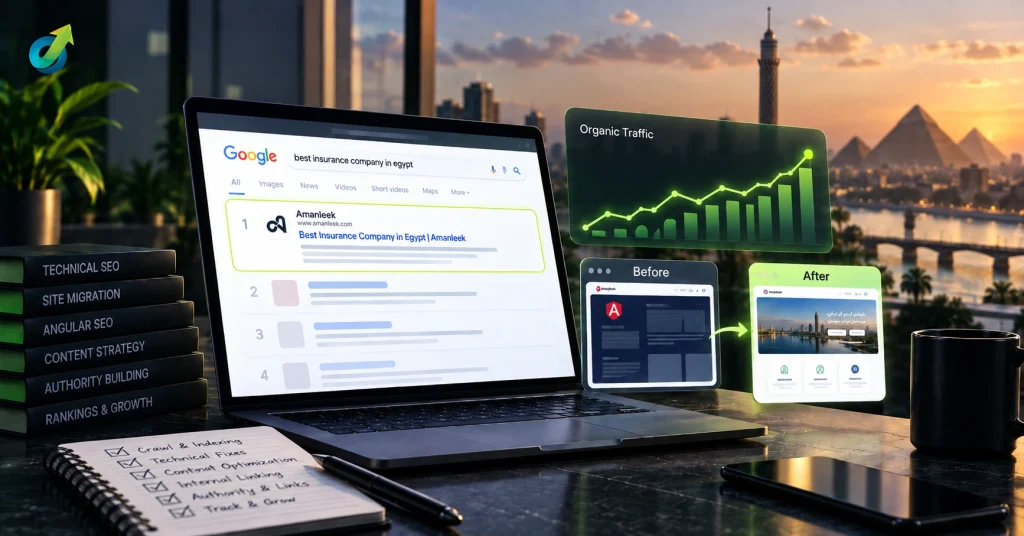
Article Amanleek SEO Case Study: From an Unreadable Angular Site to #1 for “Best Insurance Company” in Egypt
Article AI Search Citations Just Shifted: What It Means for MENA Brands

Article Tag Clouds in SEO: What They Are and How to Use Them
Article What Are Duplicate Pages and Why Are They Dangerous
Article Why AI Still Describes Your Old Brand: Knowledge Cutoffs Explained
Article Behavioral Factors in SEO: What They Are and How to Improve Them
Article JavaScript Links Are Hiding MENA Sites From ChatGPT and Claude

Real Results
More Wins
SEO & GEO for Delta Medical Labs
 GEO
GEO
1M+ monthly organic visits, 159,200 ranked keywords, 5,570 pages cited by AI engines, and 1,186 #1 rankings in KSA.

Arabic SEO, GEO & guest posting for VPNly
 SEO
SEO
65K peak monthly organic visits, 55 guest posts, and 149 pages cited by AI engines.

SEO & GEO for Ogaei Virtual Care
GEO
From 3 to 7,931 monthly organic clicks in 7 months, 2.9M+ impressions, and 40+ keywords in Google’s Top 10.

SEO for Eduverse
SEO
12× search traffic in 10 months, 45% of target keywords in the top 5, and 55% in the top 10.
Trusted by