
Ways and Methods of Promoting an Online Store

Key takeaways
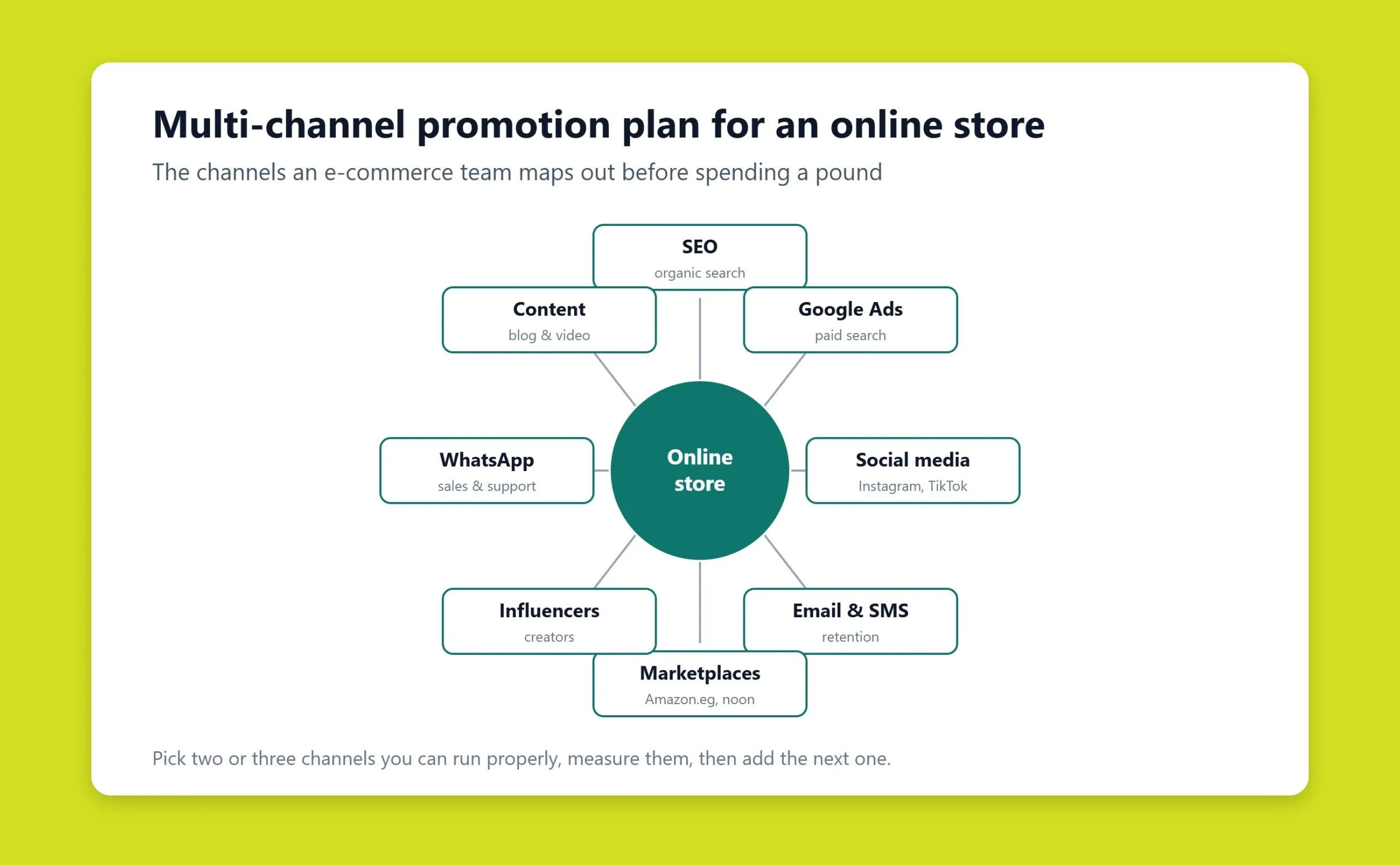
- No single channel wins on its own, sustainable e-commerce growth comes from the synergy of SEO, paid ads, content, email, social and marketplaces working together.
- Online store SEO is structural: category pages, product pages, faceted filters and product schema all need dedicated attention because a catalog can span thousands of URLs.
- Google Shopping and PPC deliver near-instant, high-intent traffic, while SEO and content compound value over months and reduce dependence on ad spend.
- Marketplaces such as Amazon give you access to a large, trust-primed audience, but ranking there depends on optimized listings, price, reviews and fulfillment speed.
- Reviews and user-generated content directly influence conversion, shoppers rely on ratings and peer opinion before they buy.
- Without end-to-end analytics you are guessing; track traffic, conversion rate, average order value, customer acquisition cost and return on ad spend to decide where to invest.
Why online store promotion is different
An e-commerce project has a layered structure that a simple website never does. Within one store you are simultaneously promoting category pages, individual product pages, faceted filters and informational content, and each page type plays a distinct role in the funnel, from first discovery to final conversion. A category page captures broad commercial demand, a product page answers a specific buying question, and a blog article catches shoppers who are still researching.
Because of that complexity, a comprehensive approach matters more than any one clever tactic. Relying on a single channel rarely produces stable results. Search engine optimization builds a durable stream of visitors, paid advertising generates fast transactions, and social platforms help you build a relationship with your audience over time. Only the combination of these tools produces steady, defensible growth, which is why the sections below should be read as parts of one system rather than a menu of alternatives.
SEO for online stores
Search optimization remains one of the most effective channels for e-commerce because it delivers consistent organic traffic and reduces your reliance on paid media. For a store with hundreds or thousands of products, though, SEO is as much an architecture problem as a content one.
Technical SEO is the foundation
Before content can rank, the site has to be crawlable and fast. Make sure pages are indexed correctly, page-load times are competitive, the store is genuinely mobile-friendly and there are no critical crawl errors. Site structure deserves special care: a large catalog needs a clear hierarchy so that both Google and shoppers can find their way from the homepage down to any product in a few clicks. A structured technical review, see our SEO auditis usually the fastest way to surface indexation waste, duplicate URLs and speed problems that quietly cap your rankings.
Keyword research and semantic structure
The next step is collecting and clustering your keyword universe. This is especially important in e-commerce because the assortment can be enormous. Group queries by category, subcategory and individual product so you can build a relevant landing page for each genuine user need, rather than forcing several intents onto one page. Well-structured clusters also reveal gaps where you could add a new category or buying guide.
Category and product page optimization
Category and product pages are where commercial rankings are won. Category pages should carry useful supporting copy, intuitive navigation and helpful filters; product pages need detailed descriptions, complete specifications, high-quality images and customer reviews. This does double duty, it improves your position in search and lifts conversion at the same time, because the same information that helps a search engine understand the page also helps a shopper decide to buy. Our SEO services focus heavily on this layer, since it is where most stores leave the biggest gains on the table.
Filters, pagination and internal links
Faceted filters and pagination need deliberate handling. Configured carelessly, they generate duplicate pages and dilute your traffic; configured well, they let you capture additional long-tail demand from specific queries such as a color, size or price range. Internal linking then distributes authority across the site, strengthens your most important sections and helps shoppers reach the product they want with fewer clicks.
Product schema and structured data
Marking up product pages with Product, Offer, AggregateRating and BreadcrumbList schema helps Google display rich results, prices, availability and star ratings, directly in the search listing. Those enhanced snippets increase click-through rates and set accurate expectations before the visitor even lands on your page.
Google Shopping and PPC
Paid search lets you attract qualified buyers and generate your first sales almost immediately. Unlike SEO, results appear as soon as campaigns go live, which makes PPC the natural complement to a slower-building organic strategy. A well-run PPC and Google Ads program can carry revenue while your SEO matures.
Search ads target users with explicit intent: your listings appear for specific queries, which makes this channel especially efficient for transactional keywords where the likelihood of conversion is high. Display and discovery campaigns work differently, they target interests and behavior, which is useful for widening reach, building brand awareness and re-engaging past visitors.
Shopping campaigns are pivotal for online stores. Google Shopping (and Meta’s equivalent catalog ads) shows shoppers a product image, price and title right in the results, which simplifies their choice and increases the chance of a qualified click. Because the ad already communicates the essentials, the traffic it sends tends to convert better.
Finally, remarketing and retargeting recover shoppers who interacted with your store but did not buy. Whether through Google Ads or Meta’s pixel-based audiences, this is one of the most cost-effective conversion tools available, because you are speaking to an audience that has already shown interest: an abandoned cart, a viewed product, a started checkout.
Content marketing for e-commerce
Content marketing attracts shoppers at the earlier, research stage of the funnel and establishes your brand as a credible authority. It is particularly valuable in categories with a long decision cycle, where buyers compare options for days or weeks before purchasing.
A blog lets you capture informational queries and pull in organic traffic that product pages alone cannot reach. Articles, how-to guides and explainers help a shopper understand the product and gradually move them toward a purchase. Buying guides and comparisons are especially influential, because they let you highlight product advantages, contrast alternatives and answer the questions customers ask most. Video content, demonstrations, unboxings, tutorials and case studies, is increasingly in demand and builds trust faster than text alone. Done well, SEO-driven content marries genuine usefulness with search visibility, attracting additional traffic without a direct media cost. Our content marketing team builds these programs around real search demand so every article has a job to do.
Email marketing and customer retention
Email remains one of the highest-return channels, especially for stores that already have a customer base, because it builds long-term relationships and drives repeat purchases at very low marginal cost. Collecting subscribers should be systematic and permission-based, signup forms, welcome discounts and loyalty perks all motivate shoppers to share their contact details.
Segmentation makes the difference between broadcast spam and relevant communication. Dividing your list by interests, purchase history and on-site behavior lets you send offers people actually want. Triggered emails perform especially well: automated messages fired by a specific action, an abandoned cart, a new registration, a recently viewed product, reach the shopper at exactly the right moment. Layer in personalization, using the customer’s name and recommendations based on past purchases, and engagement climbs further still.
Social media and influencers
Social platforms are an important channel for online stores, particularly in visually driven categories, and they do more than send traffic, they build loyalty. Choosing the right platforms depends on your audience and product: some networks favor visual discovery, others reward expertise and conversation, and spreading budget across the wrong ones wastes money.
Your content strategy should serve the audience’s interests, not just push products, product reviews, practical tips, case studies, customer stories and lighter entertainment all create value that keeps people following. Paid social on Meta and similar networks lets you target precisely by interest, age, location and behavior, making it a strong tool for reaching new customers and scaling sales. Working with influencers and creators reinforces all of this: a recommendation from a trusted voice is often received far better than conventional advertising.
Marketplaces as a sales channel
Marketplaces such as Amazon have become a full-fledged acquisition and sales channel, especially for stores that want to scale quickly. Listing products on these platforms gives you immediate access to a large audience that already trusts the marketplace and arrives ready to buy.
Selling there requires an adapted strategy. Unlike your own website, a marketplace imposes internal competition, and product ranking depends on many factors: price, rating, delivery speed and listing quality. Listing optimization is therefore decisive, invest in strong titles, complete descriptions, accurate attributes and rich visual content. The better the listing, the higher its chance of ranking within the platform and winning the sale. Managing reviews is equally critical, since shoppers lean heavily on ratings and peer opinion, so you need to actively gather feedback and respond to it well. Our marketplace SEO service helps sellers structure listings and reviews to compete inside these algorithms.
Price-comparison sites and product aggregators are a related source of traffic. They collect offers from multiple stores and let shoppers compare, so a presence on them increases the odds that a buyer comparing options chooses you.
Reviews, UGC and reputation
Online reputation directly affects sales. Even with strong traffic, negative reviews or a shortage of social proof can sharply reduce conversion, which makes reputation management a mandatory part of promotion. Start by systematically monitoring brand mentions, shoppers leave feedback across marketplaces, independent review services and social networks, and ignoring those channels means losing control of your image.
Work with reviews proactively. Positive comments reinforce trust, while a considered response to criticism can defuse a bad situation and demonstrate that you genuinely care about customers. Reply promptly, correctly and on substance, avoiding formulaic non-answers. Building trust takes time, but authentic reviews, real photos, case studies and transparent company information all lower the barrier to purchase and raise loyalty.
How to choose the right channel mix
The most common question store owners ask is which channel produces the best result. In practice there is no universal answer, because a channel’s effectiveness always depends on the niche, competition, budget and the current stage of the business. SEO delivers strong returns over the long run but takes time to build. Paid search generates traffic and sales quickly but scales directly with budget. Social media works well for awareness and engagement without always producing instant conversions. Email is excellent for retention but assumes you already have a list to work with.
The biggest mistake is chasing a single “best” channel and pouring everything into it. Shoppers rarely buy on the first touch, they might find an article in search, later see an ad, visit the store, subscribe to the newsletter and only then place an order. That is exactly why you want a comprehensive strategy in which each channel reinforces the others: SEO attracts the audience, ads accelerate conversions, content builds trust, and email and retargeting bring people back. Together they form a resilient system for acquiring and keeping customers that outperforms any tactic used in isolation.
Measuring ROI
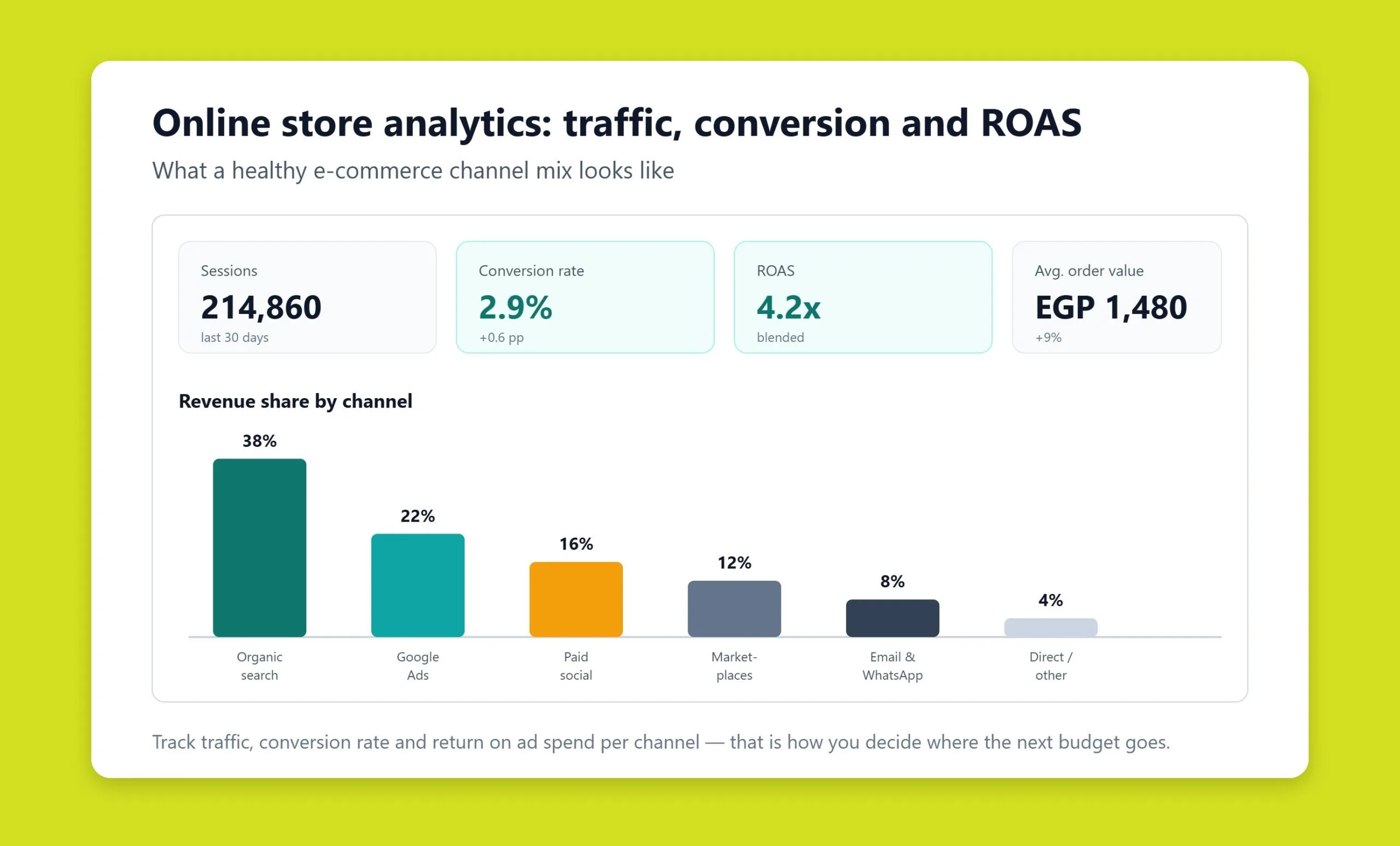
Without analytics you cannot judge what is working or make informed decisions. An online store is a system with many touchpoints, and every one of them should be measurable. The core metrics to watch are traffic, conversion rate, average order value, customer acquisition cost and return on investment. Analyzing these shows which channels perform and which need rework.
End-to-end analytics gives a deeper picture by unifying data from different sources and revealing the full path from first touch to purchase, indispensable when you run several channels at once. A/B testing turns opinions into evidence: changes to design, copy, page structure or ad creative are validated in practice, so you improve on data rather than assumption. Finally, funnel optimization targets the bottlenecks, confusing navigation, an awkward checkout, missing product information, because improving the shopper’s experience feeds straight back into conversion. Treat measurement as continuous: analyze, test, fix the weak spots and reinvest where the returns are strongest, and promotion stops being a cost and becomes an investment in growth.
Frequently asked questions
How long does it take to see results from online store promotion?
It depends on the channel. Paid search and shopping ads can drive traffic and sales within days of launch, while SEO and content marketing typically take three to six months to build momentum and continue compounding after that. A healthy strategy pairs a fast channel with a slow-building one so you earn revenue now and reduce acquisition costs later.
Should I invest in SEO or paid ads first?
Most stores benefit from running both, but the emphasis shifts with your situation. If you need sales immediately or are validating a new product, start with paid search and shopping ads. If you want to lower long-term acquisition costs and build defensible traffic, invest in SEO in parallel. Relying only on paid media leaves you exposed the moment budgets tighten.
Do I need to sell on marketplaces like Amazon as well as my own store?
Marketplaces give you fast access to a large, trust-primed audience and can accelerate growth, but they come with internal competition, fees and less control over the customer relationship. Many brands use them as an additional channel while continuing to build their own store, where margins are higher and they own the customer data and experience.
How do I measure whether my promotion budget is paying off?
Track conversion rate, average order value, customer acquisition cost and return on ad spend, and connect them with end-to-end analytics that follows shoppers from first touch to purchase. Those numbers tell you which channels are profitable, which need optimization and where to reinvest, decisions based on data rather than guesswork.
What is the most common mistake in e-commerce promotion?
Working without a strategy. When campaigns, content and SEO run in isolation they fail to reinforce one another, so budget leaks at every stage of the funnel. Other frequent mistakes include ignoring SEO in favor of paid traffic, attracting low-intent visitors, weak analytics, a poor mobile experience and neglecting existing customers through a lack of retargeting and email.
Related guides
Want more people
to find your website?
Strategy call and
full site audit

Read also

Article Bing’s AI Performance Report: What Gulf and Egyptian Brands Can See About Copilot Citations

Article Google Moves Brand AI Overviews to the Side: What MENA Brands Should Track Now

Article How to get cited by ChatGPT (and recommended in its answers)
Article Your Name in ChatGPT: AI Reputation for Individuals and Executives
Article How Much Does SEO Cost in Egypt, Saudi Arabia and the UAE in 2026?
Article Which Sites Do AI Engines Cite? What a 288-Answer Study Means for Gulf Brands




Real Results
More Wins
SEO & GEO for Delta Medical Labs
 GEO
1M+ monthly organic visits, 159,200 ranked keywords, 5,570 pages cited by AI engines, and 1,186 #1 rankings in KSA.

Arabic SEO, GEO & guest posting for VPNly
 SEO
65K peak monthly organic visits, 55 guest posts, and 149 pages cited by AI engines.

SEO & GEO for Ogaei Virtual Care
GEO
From 3 to 7,931 monthly organic clicks in 7 months, 2.9M+ impressions, and 40+ keywords in Google’s Top 10.

SEO for Eduverse
SEO
12× search traffic in 10 months, 45% of target keywords in the top 5, and 55% in the top 10.
Trusted by