
Unique Selling Proposition (USP): What It Is, With Examples
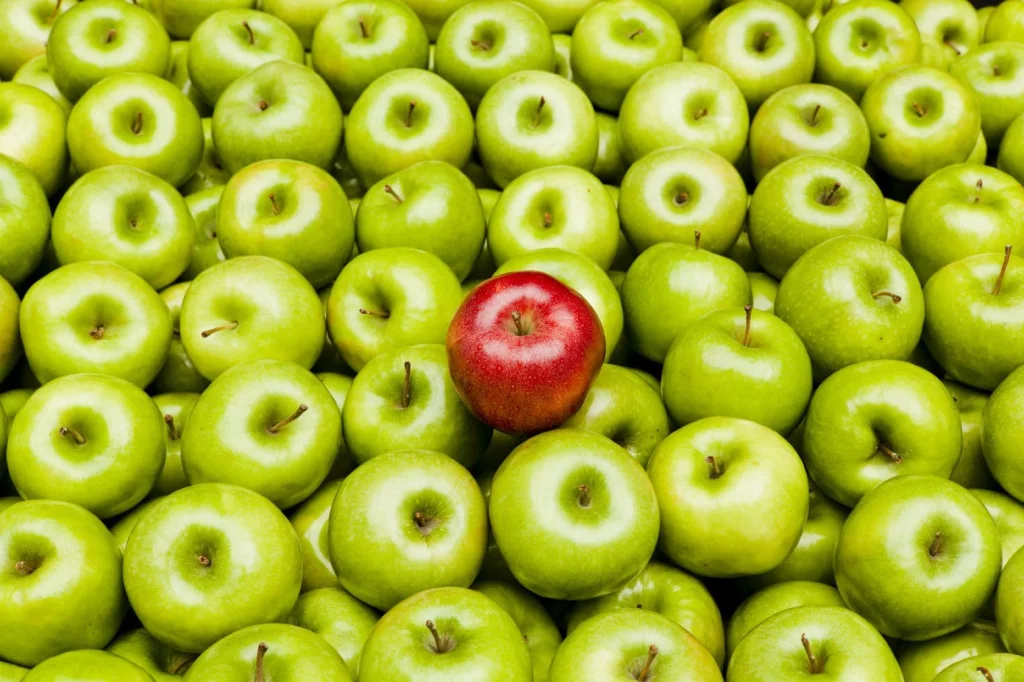
A unique selling proposition (USP) is the single, specific reason customers should buy from you instead of anyone else. It distills what makes your product or service genuinely different and states it in one clear, memorable line. A strong USP sits at the heart of your sales and advertising strategy, and it is often the deciding factor when a buyer is weighing you against a competitor.
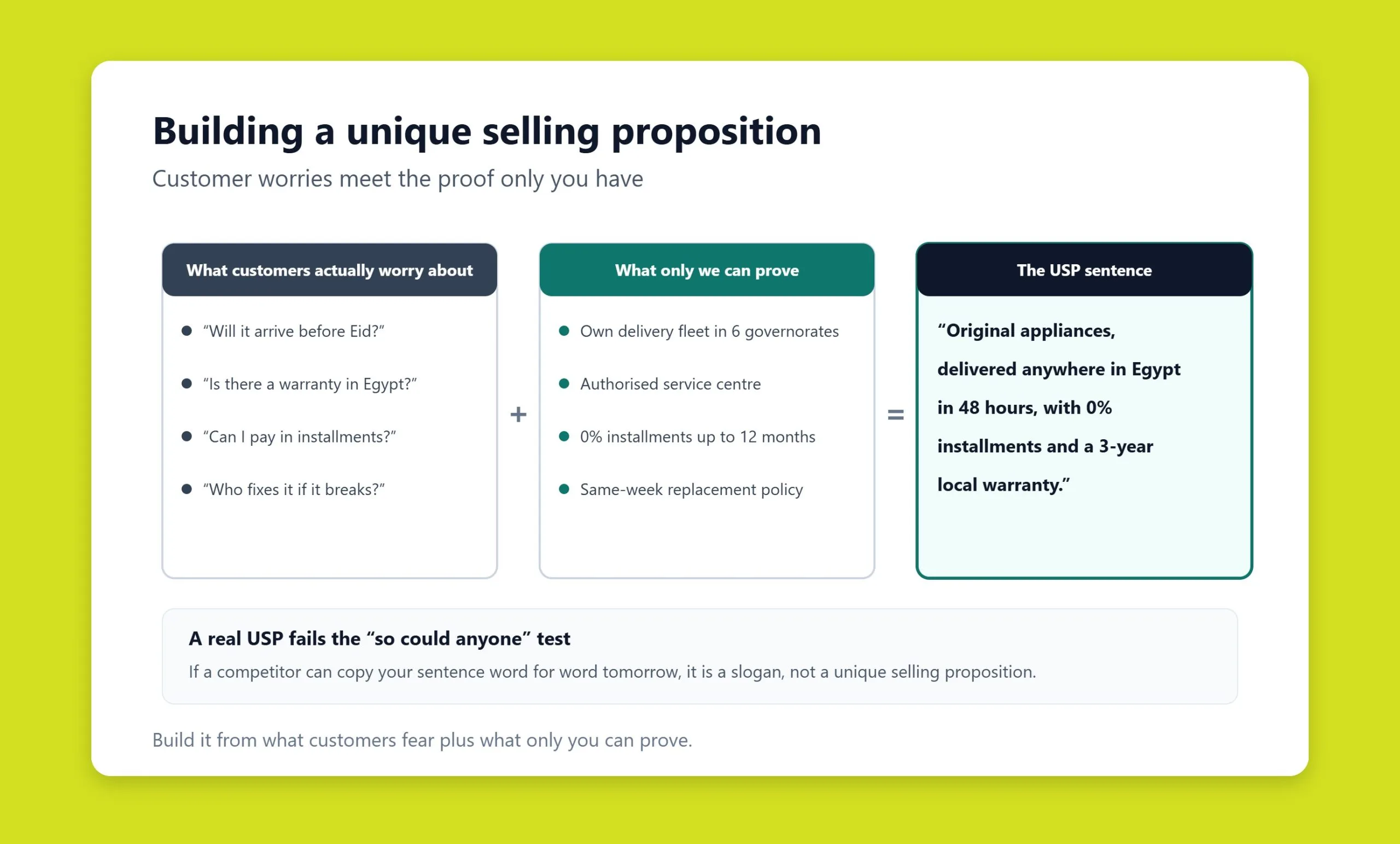
Below we break down what a USP really is, how it differs from a slogan and a positioning statement, a step-by-step method for building one, proven formulas, and real-world examples across e-commerce, SaaS, and direct-to-consumer brands.
Key takeaways
- A USP answers one question: why should a customer choose you over every alternative?
- The best USPs are memorable, believable, and centered on a benefit the customer actually cares about.
- A USP is not a slogan and not a positioning statement, though the three work together.
- You build a USP by researching your audience, listing real differentiators, and pressure-testing the claim you can prove.
- Bold claims win attention but demand proof, so only promise what you can consistently deliver.
- Test your USP with real customers and refine it based on how they respond.
What a USP is
A unique selling proposition is a concise statement of the one thing your business does better than, or differently from, everyone else in your market. In an ideal form it reads almost like a strong piece of advertising: it sells the value of the product and makes the reader want to learn more.
A genuinely effective USP meets three criteria:
- It is memorable. Generic phrases like “high-quality, reliable products” evaporate the moment they are read. Lead with a specific, distinctive advantage instead.
- It is believable. Everything you claim has to be true and defensible. A promise you cannot keep erodes trust faster than no promise at all.
- It is customer-focused. The benefit you highlight must matter to the buyer, not just to your internal team.
Take FedEx’s classic line: “When it absolutely, positively has to be there overnight.” It is a bold claim you remember, it is backed by the logistics infrastructure to deliver on it, and it speaks directly to a real customer anxiety. Nobody wants to wait a week for a shipment that matters. Even a clever, original phrase falls flat if it does not touch a genuine customer pain point, which is why knowing your audience comes before writing a single word.
Why a USP matters
Most markets are crowded. Customers compare options in seconds and gravitate toward the business that most clearly solves their problem. A sharp USP gives every part of your marketing a consistent spine, from your homepage headline to your Google Ads copy and your social media campaigns. It shortens the buyer’s decision, improves conversion rates, and makes your paid and organic traffic work harder because visitors immediately understand why you are worth their attention.
USP vs slogan vs positioning
These three concepts are related but not interchangeable.
USP
The USP is the substance: the concrete, provable reason to choose you. It is aimed at the customer’s decision and answers “what do I get that I can’t get elsewhere?”
Slogan
A slogan (or tagline) is a short, catchy phrase built for recall and brand mood. It may express your USP, but it is a creative wrapper rather than the argument itself. “Just Do It” is a slogan; it evokes a feeling more than a specific benefit.
Positioning
Positioning is the strategic space your brand occupies in the customer’s mind relative to competitors, including price tier, personality, and target segment. Your USP is one of the clearest expressions of that positioning, but positioning is the broader map on which the USP sits.
How to create a USP, step by step
- Know your audience. Run surveys, read reviews, talk to customers, and listen on social channels. You are looking for the needs they voice most often and the frustrations the market has not solved.
- List every real differentiator. Speed, guarantee, price, materials, expertise, service, ethics. Write down anything true about your product or brand.
- Map differentiators to customer pains. Keep only the advantages that answer a need your audience actually cares about. This intersection is where a USP lives.
- Check the competition. If a rival can claim the same thing, it is not unique. Push for the angle only you can own.
- Write it as one clear statement. Compress the core idea so a buyer instantly grasps what you offer and which problem you solve.
- Prove it. Back the claim with a guarantee, statistics, awards, or storytelling so it reads as fact, not hype.
- Test and refine. Try the USP on real customers, measure the response, and adjust. Pair it with strong content marketing and SEO so the message reaches the people it was written for.
USP formulas you can adapt
- Outcome + differentiator: “We help [audience] achieve [result] without [common pain].”
- Only-we claim: “The only [category] that [unique feature or guarantee].”
- Superlative + proof: “The [strongest / fastest / most X] [product] in [market], guaranteed.”
- Mission-driven: “[Product] built to [larger purpose the customer believes in].”
Formulas are a starting frame, not a finished line. Fill them with a truth only your business can defend.
Real-world USP examples
E-commerce
Death Wish Coffee: “The world’s strongest coffee.” A risky claim, because it invites challenge, but the brand backs it with a money-back guarantee if the coffee is not strong enough. The bolder the statement, the more people will try to dispute it, so the proof has to be airtight.
Patagonia: “We’re in business to save our home planet.” Compact, memorable, and true to the company’s operations, from organic cotton grown without pesticides or GMOs, to a trade-in program for used gear, to a share of profits directed toward environmental causes. It appeals to values while accurately reflecting the mission.
Saddleback Leather: “They’ll fight over it when you’re dead.” A single sentence that dramatizes durability. The claim is credible because the brand publishes a 100-year warranty ([saddlebackleather.com](https://saddlebackleather.com/))., and the brand reinforces it with storytelling about how each piece is made.
SaaS
Robinhood: “Investing for everyone.” The platform’s mission is to make investing accessible rather than reserved for the wealthy, and at the time of writing, the platform allowed fractional purchases from around one dollar. The inclusive framing creates a sense of belonging that customers respond to emotionally.
Canva: “Empowering the world to design.” The USP underscores ease of use and separates Canva from more complex tools. Where professional software has a steep learning curve, Canva lets a beginner assemble a polished graphic in minutes, and the promise sets the right expectation before the first click.
Video webinar platforms often lead with social proof, such as “the leader in webinar software,” reinforced by user counts and industry awards. When prospects see that others already trust a brand, they are far more likely to engage.
Direct-to-consumer
Billie: “The best damn razor and body care.” Aimed at women underserved by the traditional grooming market, the brand signals dissatisfaction with the status quo and offers a better alternative, built directly from audience research. The lesson: survey your customers and know exactly where to press.
Warby Parker: “Try 5 frames at home for free.” In a saturated eyewear market, the brand removes the friction of buying glasses online by mailing five frames to try before committing, recreating the in-store experience without leaving home.
HelloFresh: “America’s most popular meal kit.” A confident claim that signals both quality and scale, supported immediately by the promise of saving time, stress, and money. Do not be afraid to say you are the best in your category, as long as you can prove it.
Common USP mistakes
- Vagueness. “Quality service and great value” describes almost every business and differentiates none.
- Unprovable claims. A bold promise with no evidence reads as marketing noise and damages credibility.
- Feature obsession. Listing specifications instead of translating them into a customer benefit.
- Copying competitors. If a rival can say the same sentence, it is not unique by definition.
- Ignoring the audience. A clever line that misses the customer’s real pain is wasted. Communicate with your market before you write, and reflect that same clarity in your website design.
Building a USP for Gulf and Egyptian markets
The method above works anywhere. What differs by market is which claims carry weight, and several of the defaults imported from Western marketing land flat or actively hurt in this region.
| Common claim | How it lands here | Stronger alternative |
|---|---|---|
| Free returns within 30 days | Weak where a large share of orders are paid in cash on delivery, since the buyer already inspects before paying | Guarantee the delivery window and the right to refuse at the door |
| Fast shipping | Expected, not differentiating, in the UAE. Genuinely differentiating in Egypt and outside major cities | Name the actual timeframe for the specific city |
| Award-winning | Low credibility unless the award is locally recognized | Client names and outcomes in the same market |
| 24/7 support | Undermined instantly if nobody answers on a Sunday | State the hours you truly cover, and answer within them |
| Trusted by thousands | Vague, and easy to disbelieve | A named reference the buyer recognizes in their own country |
Two regional additions worth testing
- Presence, stated plainly. Buyers in the Gulf frequently want to know whether you are actually in the market or selling into it from elsewhere. If you have a local presence, say where. If you do not, be specific about how you serve the market instead of implying an office you do not have.
- The language you operate in. Being able to run the engagement in Arabic is a real differentiator in a market full of suppliers who cannot, and most of them never mention it either way.
One caution. A USP built on price rarely holds in Gulf markets, where established competitors can absorb a price war and buyers frequently read the cheapest option as the riskiest. Differentiate on certainty, speed or access instead.
Frequently asked questions
What is a unique selling proposition in simple terms?
It is the one clear reason a customer should choose your product over every competing option, stated in a single memorable line that highlights a benefit they care about and that you can prove.
How is a USP different from a slogan?
A USP is the substance, the concrete and provable advantage that drives a buying decision. A slogan is a short, catchy phrase built mainly for brand recall. A slogan can carry your USP, but the two are not the same thing.
How do I create a USP for my business?
Research your audience, list every genuine differentiator, keep only the advantages that answer a real customer need and that competitors cannot claim, write it as one clear statement, back it with proof, then test and refine it with real customers.
Can a small business have a strong USP?
Absolutely. Smaller companies often have sharper USPs because they can specialize, offer personal service, or serve a niche that larger competitors overlook. Focus on the specific advantage only you can deliver.
How often should I revisit my USP?
Review it whenever your market, competitors, or customer needs shift, and at least once a year. A USP should evolve as your business and audience change, but any update still has to stay true and provable.
Related guides
Don't miss the chance to
make your website more visible!
Initial consultation and
audit of the current situation

Read also

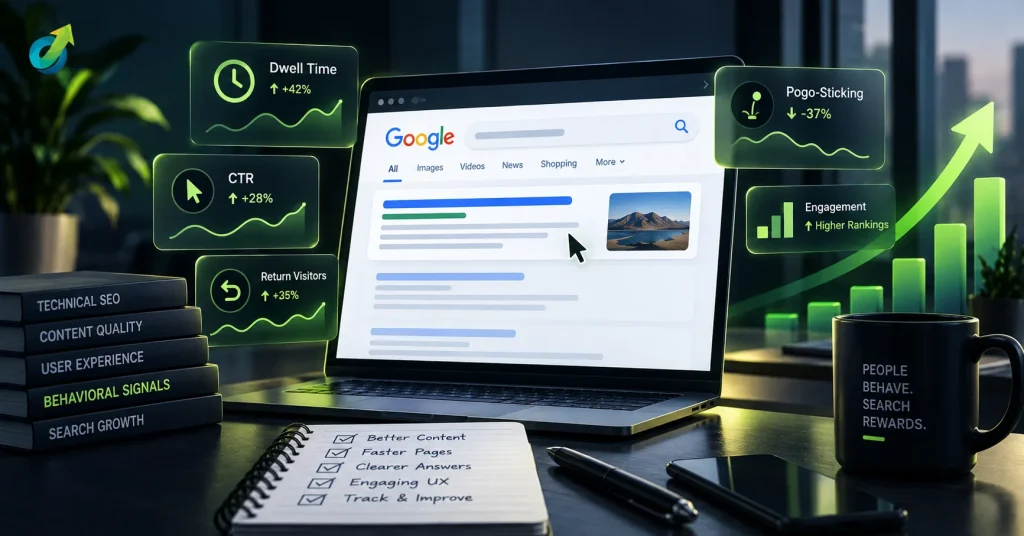
Article Behavioral Factors in SEO: What They Are and How to Improve Them
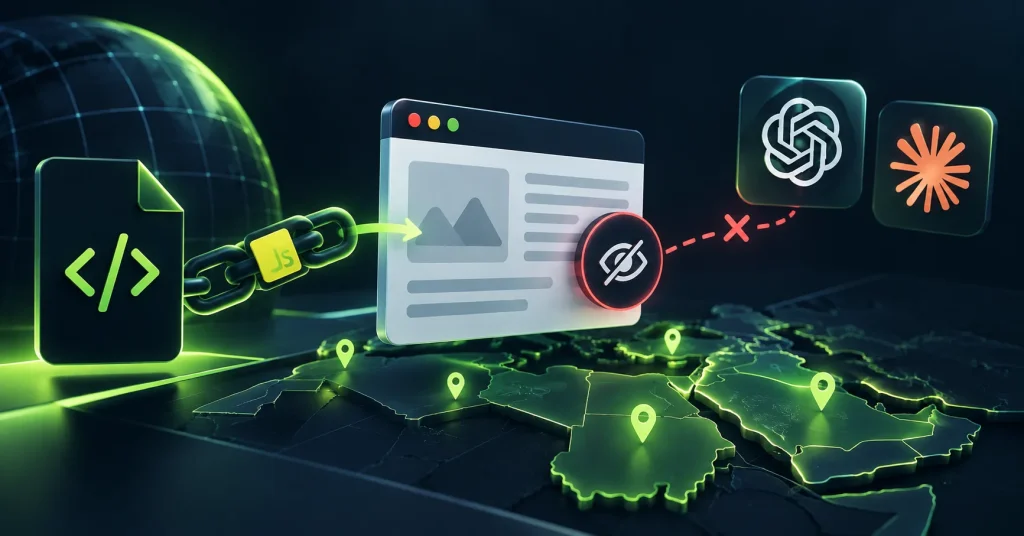
Article JavaScript Links Are Hiding MENA Sites From ChatGPT and Claude

Article VOCTOS Is a Top SEO, PPC and SEM Company in Egypt on Clutch for 2026
Article Commercial Ranking Factors: The Complete List

Article The Title Meta Tag: What It Is and How to Write It
Article The Role of Meta Tags in Search Engine Optimization
Article Can You Sue an AI for Defamation? Where the Law Stands

Article Cloudflare’s 15 September AI Crawler Defaults: The Check Gulf and Egypt Brands Should Run Today


Real Results
More Wins
SEO & GEO for Delta Medical Labs
 GEO
GEO
1M+ monthly organic visits, 159,200 ranked keywords, 5,570 pages cited by AI engines, and 1,186 #1 rankings in KSA.

Arabic SEO, GEO & guest posting for VPNly
 SEO
SEO
65K peak monthly organic visits, 55 guest posts, and 149 pages cited by AI engines.

SEO & GEO for Ogaei Virtual Care
GEO
From 3 to 7,931 monthly organic clicks in 7 months, 2.9M+ impressions, and 40+ keywords in Google’s Top 10.

SEO for Eduverse
SEO
12× search traffic in 10 months, 45% of target keywords in the top 5, and 55% in the top 10.
Trusted by