
What AI Overviews Cite in Arabic vs English: A 16-Prompt Audit
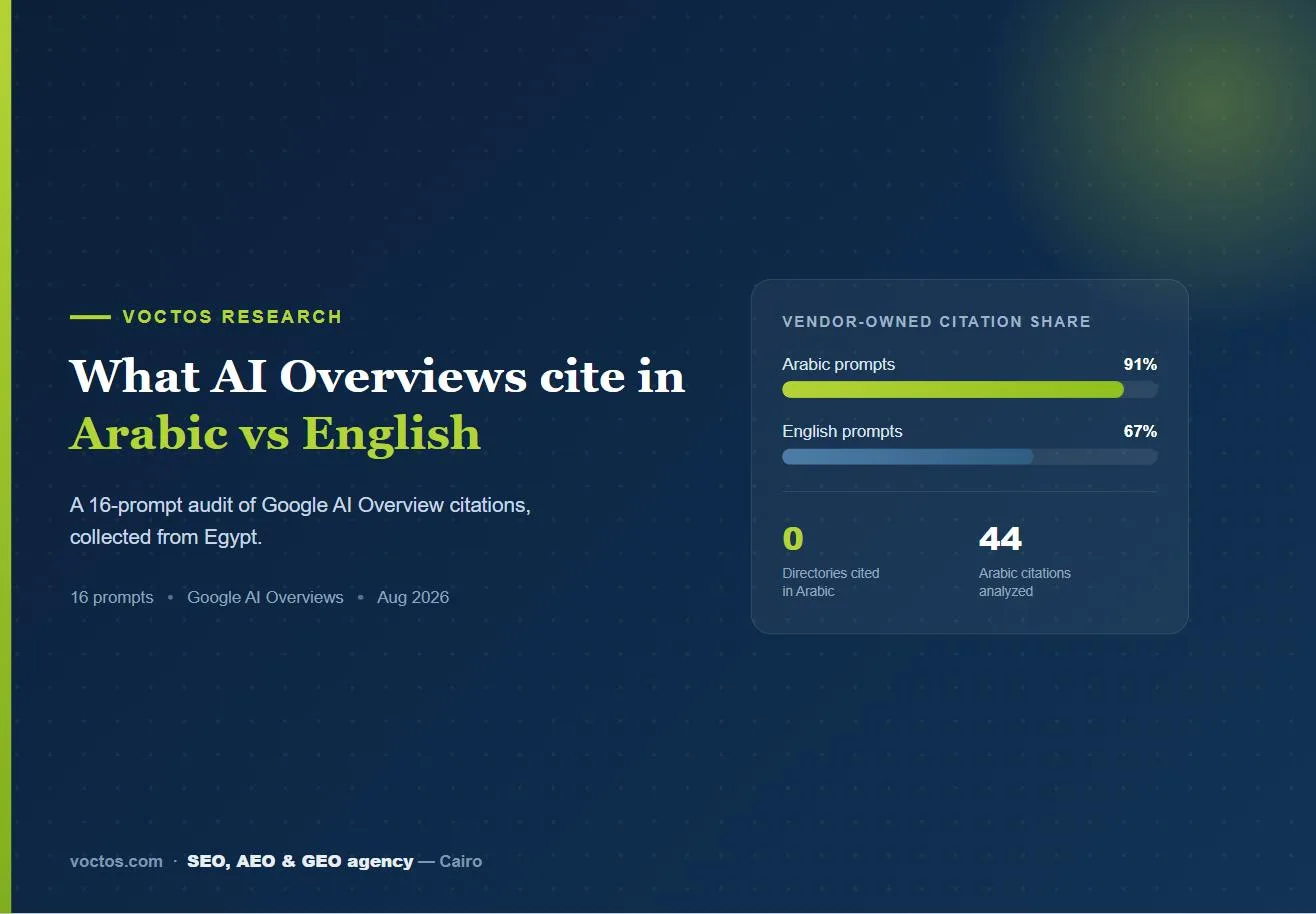
We ran the same set of commercial prompts through Google twice, once in English and once in Arabic, from an Egyptian IP address on 17 August 2026, and recorded every source the AI Overview cited. The Arabic answers cited 44 sources. Not one of them was a B2B directory. Not one of them was a third-party ranking list. In the English answers, directories and other people’s ranking lists accounted for 8 of 43 citations and appeared in 4 of the 6 overviews we captured.
That is the finding, and it changes what a MENA brand should actually spend money on. In English, the answer is assembled from third-party validation: Clutch, GoodFirms, DesignRush, Sortlist, and whoever published the latest “best agencies” list. In Arabic, the answer is assembled almost entirely from what companies publish on their own websites. Same engine, same day, same city, two different games.
Key facts at a glance
| Metric | Finding |
|---|---|
| Method | 16 matched prompts (8 pairs), Google AI Overviews, single day |
| Collected | 17 August 2026, from a residential Egyptian IP, desktop, signed out |
| Arabic citations | 44 sources across 8 overviews |
| English citations | 43 sources across 6 overviews (2 prompts returned no AI Overview) |
| Directories cited in Arabic | 0 |
| Directories cited in English | 4 citations (Clutch, DesignRush, Sortlist, GoodFirms) |
| Third-party ranking lists cited in Arabic | 0 |
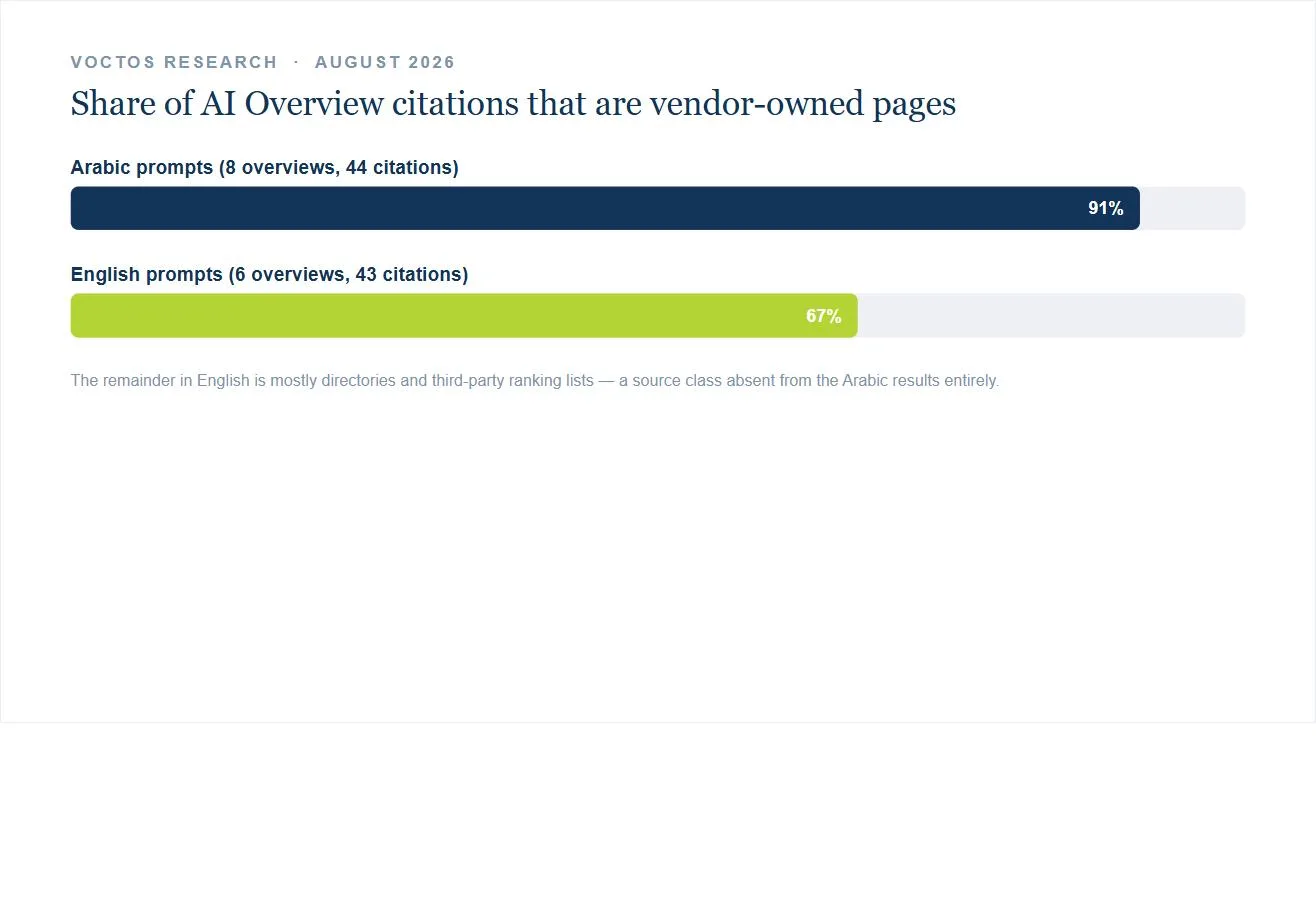
| Vendor-owned pages, Arabic | 91% of citations (40 of 44) |
| Vendor-owned pages, English | 67% of citations (29 of 43) |
| Overlap in companies named, Egypt SEO pair | 1 of 4 companies named in both languages |
Why we ran this
Every AI visibility guide written in English tells you the same thing: get mentioned in the listicles and directories that AI engines cite. That advice is well evidenced. Peec AI analyzed nearly 200,000 AI responses and found that being included in a cited third-party listicle strongly influences whether a brand is named at all, and that your rank inside that list correlates with your placement inside the answer. We agree with that research. Our question was narrower: does it hold in Arabic?
We had a practical reason to ask. Most of our clients sell in Arabic and English at the same time, and we kept seeing the same asymmetry in their tracking: strong AI visibility in English, weak or absent visibility in Arabic, with no obvious difference in the underlying work. If the citation layer is structurally different by language, that would explain it.
Method
- 8 matched prompt pairs, 16 prompts in total: the same commercial intent expressed in English and in Arabic.
- Collected on 17 August 2026 from a residential Egyptian IP address, desktop, on google.com, with no signed-in Google account. Google reported results as not personalized.
- For each prompt we recorded whether an AI Overview appeared, which companies it named and in what order, and every outbound domain cited inside the overview block.
- We then classified each cited domain by function: the vendor’s own website, a B2B directory, a third-party ranking list, social or user-generated content, or news and industry media.
- We did not query ChatGPT, Gemini or Perplexity directly in this run. This audit covers Google AI Overviews only.
The prompts covered agency selection in Egypt, Saudi Arabia, Dubai and the wider Middle East, plus two prompts about the mechanics of appearing in ChatGPT, and two about Arabic-language AI visibility specifically.
What we found
1. Arabic AI Overviews cite the vendor’s own website almost exclusively
Of 44 sources cited across the eight Arabic overviews, 40 were the website of a company or platform selling the service being discussed. That is 91 percent. In English the same figure was 29 of 43, or 67 percent. The Arabic answer, in other words, is currently written from marketing pages.
2. Zero directory citations in Arabic. Four in English.
In English, Clutch was cited for the Egypt SEO prompt, DesignRush and Sortlist for the Egypt GEO prompt, and GoodFirms for the Middle East GEO prompt. Across all eight Arabic prompts, no directory appeared at all: no Clutch, no GoodFirms, no DesignRush, no Sortlist, no The Manifest, no TechBehemoths. If your Arabic strategy is built on directory profiles, it is being built on a source class the Arabic answer layer does not currently read.
3. Third-party ranking lists appear only in English
Four English citations came from someone else’s ranking list, including two separate citations of the same Egypt-focused list and one LinkedIn post ranking Dubai agencies. In Arabic there were no comparable ranking lists among the cited sources. The listicle economy that dominates English AI answers has not been built in Arabic yet.
4. Arabic overviews hedge, English overviews name a leader
Five of the eight Arabic overviews opened by saying there is no single best company and that the choice depends on your project and budget, before listing names. Five of the six English overviews named a specific leader in the first sentence. Hedged answers are more open to being reshaped, which is good news if you are not currently the named leader.
5. Where directories are missing, Arabic answers reach for social and forums
The four non-vendor Arabic citations were a LinkedIn page, a Reddit thread, an Instagram account and one personal consultant blog. That is a small number, but it is the entire non-vendor set, and it tells you where the gap gets filled. Arabic social and community content is doing the job that Clutch does in English.
6. The two languages return almost entirely different companies
For the Egypt SEO pair, the English overview named four companies and the Arabic overview named four companies, with exactly one name in common. A brand can be the first company named in English and completely absent in Arabic for the same commercial question in the same country. Treating AI visibility as one number hides this.
7. Splitting your brand across two domains costs you citations
We include ourselves in the data. Google cited voctos.net in three answers and voctos.com in one. Both are ours, which means our own citation signal is split across two hostnames instead of accumulating on one. It is the clearest single lesson in the dataset and it is not a flattering one. Entity consolidation is not housekeeping, it is a visibility variable.
8. Arabic prompts were more likely to trigger an AI answer, not less
All eight Arabic prompts produced an AI Overview. Two of the eight English prompts produced none at all: the Dubai SEO prompt and the Egypt digital marketing prompt returned classic results only. The assumption that Arabic is behind on AI answers did not hold in this sample.
The full dataset
Sources counted are the distinct outbound domains cited inside the AI Overview block. “Third-party validation” counts directories and other people’s ranking lists.
| Prompt | Language | AI Overview | Sources cited | Third-party validation cited |
|---|---|---|---|---|
| best SEO agency in Egypt | EN | Yes | 6 | 1 (Clutch) |
| best SEO company in Egypt | AR | Yes | 5 | 0 |
| best GEO agency in Egypt | EN | Yes | 8 | 4 (DesignRush, Sortlist, 2 lists) |
| best GEO company in Egypt | AR | Yes | 8 | 0 |
| best SEO agency in Saudi Arabia | EN | Yes | 10 | 0 |
| best SEO company in Saudi Arabia | AR | Yes | 6 | 0 |
| best SEO company in Dubai | EN | No AI Overview | 0 | 0 |
| best SEO company in Dubai | AR | Yes | 5 | 0 |
| best answer engine optimization agency 2026 | EN | Yes | 3 | 0 |
| best AEO company for answer engine optimization | AR | Yes | 6 | 0 |
| how do I get my business mentioned in ChatGPT answers | EN | Yes | 9 | 0 |
| how do I make my company appear in ChatGPT answers | AR | Yes | 5 | 0 |
| best digital marketing agency in Egypt | EN | No AI Overview | 0 | 0 |
| best e-marketing company in Egypt | AR | Yes | 5 | 0 |
| best generative engine optimization agency in the Middle East | EN | Yes | 7 | 3 (GoodFirms, 2 lists) |
| best company for getting Arabic content into AI answers | AR | Yes | 4 | 0 |
Totals: English, 6 overviews from 8 prompts, 43 citations, 8 from third-party validation. Arabic, 8 overviews from 8 prompts, 44 citations, 0 from third-party validation.
What we would do differently because of this
If you sell in Arabic, your own site is the battleground
In English you can buy your way into consideration with a strong Clutch profile and a few list placements. In Arabic that lever does not exist yet, because the engine is not reading those sources. What it is reading is company websites. That makes the Arabic priority list unglamorous and specific: real Arabic service pages rather than machine-translated ones, an Arabic pricing or engagement page, an Arabic FAQ that answers the questions buyers actually ask, named authors with credentials, and organization and service schema that states plainly who you are and where you operate. Our own FAQ page and llms.txt work exist for this reason.
If you sell in English, keep playing the validation game
The English finding is a confirmation, not a surprise. Directories and ranking lists were cited in most English overviews, so profile completeness, review recency and list placement all still matter. Pick the few lists that are actually cited for your prompts rather than chasing every list that exists. We wrote up the process we use for that separately: how to get into the listicles AI actually cites.
Consolidate your entity before you spend anything else
If two hostnames, a misspelled social profile and three different price ranges are floating around, you are asking the model to merge them and hoping it does. Pick one canonical domain, one description in each language, one set of numbers, and push that everywhere. We are taking our own advice on this one.
Measure Arabic and English separately
A single AI visibility score that averages both languages will hide exactly the gap that matters. Track the prompt set twice, and track which sources get cited each time, because the source list is your real target list. That is how we run reporting in the client portal, and you can get a free first read from the AI Visibility Grader.
What this study does not prove
- It is one engine. Google AI Overviews are not ChatGPT, Gemini or Perplexity, and each retrieves differently.
- It is 16 prompts on one day from one country. AI answers are non-deterministic and vary by location, account and time. The names in the table will change; the source-type pattern is the durable part.
- Correlation, not causation. We observed which sources were cited. We did not test whether adding a directory profile changes an Arabic answer, and that is the obvious next experiment.
- Classification involved judgment. A few agency-owned blogs function as ranking lists, and we counted them as lists rather than vendor pages when the page was a ranking of multiple companies.
We are rerunning this
We intend to repeat the same 16 prompts monthly and to add ChatGPT, Gemini and Perplexity so the comparison is across engines and not just languages. If you want the raw prompt list to run it yourself, ask us and we will send it. If you would rather see it applied to your own brand, that is what we do: generative engine optimization and ChatGPT visibility for brands selling in Arabic and English.
Frequently asked questions
Is this study about ChatGPT, or about Google?
This round covers Google AI Overviews only. We did not query ChatGPT, Gemini or Perplexity for this dataset, though the underlying question, does language change which sources an AI answer trusts, almost certainly applies there too. We plan to test that next.
Why only 16 prompts? Is that enough to draw conclusions from?
16 prompts is enough to show a pattern, not enough to prove a law. AI answers vary by account, location and moment, so treat the exact company names as a snapshot and the source-type pattern, vendor pages dominating Arabic, directories and lists appearing only in English, as the more durable signal. We are rerunning the same prompt set monthly to see if the pattern holds.
Does this mean directories and Clutch-style profiles are useless for Arabic-speaking markets?
Not useless, just not currently read by Google AI Overviews in Arabic based on this sample. They still matter for English answers, for human buyers who click through review sites, and for other engines we have not tested yet. What changes is priority: for an Arabic-first buyer base, your own website carries more of the weight right now.
Why did VOCTOS get cited on two different domains?
Because we currently operate voctos.com and voctos.net with overlapping content. Google cited voctos.net in three of the answers we captured and voctos.com in one. We included this because it demonstrates the same lesson the rest of the study makes: fragmented entities get fragmented, weaker citations, including our own.
Can I run this audit for my own market or industry?
Yes. Build 10 to 20 prompts a real buyer would type, in every language you sell in, run them signed out from a relevant location, and log every domain the AI Overview cites. Do it monthly, because AI answers move. If you would rather we run it and hand you the source list, that is part of what our AI Visibility Grader and ongoing GEO work cover.
What should I do first if I sell in both Arabic and English?
Fix your own entity first: one canonical domain, one Arabic and one English description that agree with each other, and an Arabic FAQ and pricing page that are written for Arabic readers rather than translated. Then, separately, work the English directory and listicle layer, since that source class still matters there. Measure the two languages as two different problems, not one average score.
Related guides
- Arabic GEO: How to Get Your Arabic Content Cited by ChatGPT, Gemini and AI Overviews
- Google’s Search Generative Experience (SGE) and AI Overviews: What Egyptian Brands Need to Know in 2026
- How to Optimize for Google AI Overviews in 2026: The Complete Guide
- What Is AIO? AI Optimization vs AI Overviews, Explained (2026)
Want more people
to find your website?
Strategy call and
full site audit

Read also

Article Ways and Methods of Promoting an Online Store
Article Do Trustpilot and G2 Reviews Affect What ChatGPT Says About You?
Article 10 Tools for Analyzing Competitor Websites
Article Gemini Now Tags Its Links: How to Measure AI Search Traffic in Saudi Arabia, the UAE and Egypt

Article What Is an SEO Agency? What One Actually Does for Saudi and UAE Businesses in 2026
Article Internal Linking: We Mapped All 34,655 Internal Links on Our Own Site
Article Which Sources Do AI Engines Actually Trust? The Citation Hierarchy
Article Amanleek SEO Case Study: From an Unreadable Angular Site to #1 for “Best Insurance Company” in Egypt

Real Results
More Wins
SEO & GEO for Delta Medical Labs
 GEO
GEO
1M+ monthly organic visits, 159,200 ranked keywords, 5,570 pages cited by AI engines, and 1,186 #1 rankings in KSA.

Arabic SEO, GEO & guest posting for VPNly
 SEO
SEO
65K peak monthly organic visits, 55 guest posts, and 149 pages cited by AI engines.

SEO & GEO for Ogaei Virtual Care
GEO
From 3 to 7,931 monthly organic clicks in 7 months, 2.9M+ impressions, and 40+ keywords in Google’s Top 10.

SEO for Eduverse
SEO
12× search traffic in 10 months, 45% of target keywords in the top 5, and 55% in the top 10.
Trusted by