
GEO for Real Estate: How Gulf Property Firms Get Cited by AI
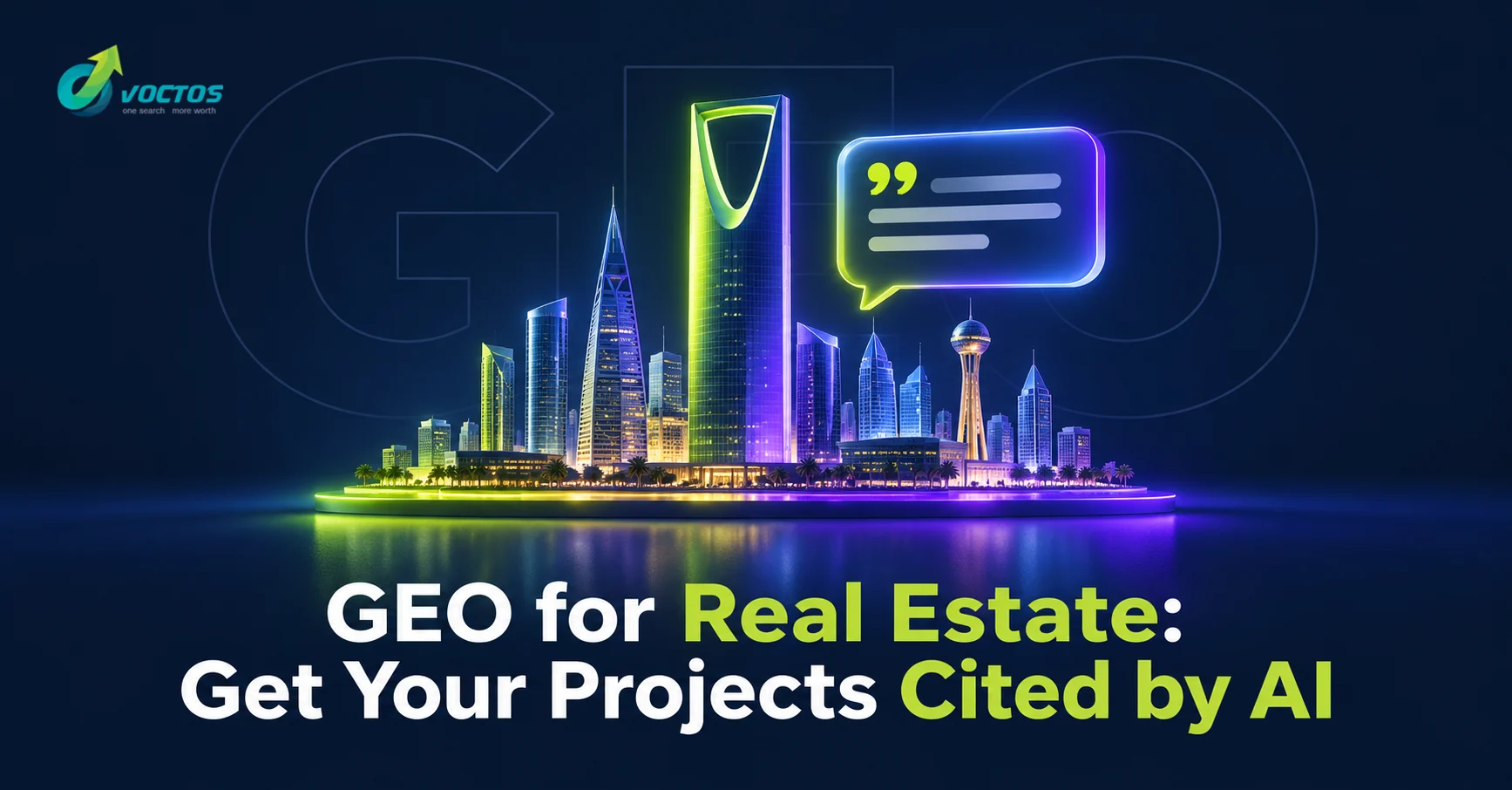
A buyer in London, Mumbai or Riyadh now asks ChatGPT which Dubai communities suit a young family, or asks Google AI Mode whether a developer hands over on time, before opening a single portal. The engine answers by quoting a few pages it can read and trust. GEO for real estate is the work of making your projects, your areas and your company one of those quoted pages, in Arabic and English, with facts that match what the regulator and the portals already say.
Key takeaways
- Dubai recorded AED 917 billion across 270,328 real estate transactions in 2025, up 20% on 2024, and off-plan made up 63.3% of investment activity (Dubai Land Department, Annual Data Review 2025).
- Resident investors accounted for 56.6% of Dubai investors in 2025, so a large share of buyers research from abroad, where AI answers do the work a site visit used to do (Government of Dubai Media Office, 12 January 2026).
- Google AI Mode passed 1 billion monthly active users, and its queries run on average three times longer than traditional searches (Alphabet Q2 and Q3 2026 earnings remarks).
- Saudi Arabia’s REGA advertising regulation took effect on 1 May 2026 and requires each property ad to carry its own licence number, while Dubai has required a Madmoun QR code on print and audiovisual property ads since 24 April 2023.
- Structured, quotable facts get cited more often. The KDD 2024 GEO paper by Aggarwal et al. measured visibility gains of up to 40% in generative engine answers from changes such as adding statistics and citations.
How are property buyers using ChatGPT and Google AI in the Gulf?
They use AI for the research stage that used to take a dozen portal tabs: comparing areas, checking a developer’s delivery record, decoding a payment plan and estimating service charges. That stage matters most for off-plan and overseas buyers, who cannot walk the site and rely on what they read before they ever call a broker.
Look at who is buying. The Dubai Land Department counted 193,100 unique investors in 2025, and the Government of Dubai Media Office reported 129,600 of them were new to the market. South Asia was the largest source region, with 52,348 investors. A buyer in Bengaluru comparing Jumeirah Village Circle with Dubai South does it from a phone, often in a chat window.
The questions are long and specific. Sundar Pichai said in October 2026 that AI Mode queries are on average three times longer than traditional searches. In property that looks like “Which Emaar projects in Dubai Hills hand over in 2027 with a 60/40 payment plan?” or, in Arabic, “ما أفضل مشروع على الخارطة في شمال الرياض للعائلات؟”.
Saudi Arabia adds a large local audience. The Housing Program reported homeownership at 65.4% at the end of 2024 against a Vision 2030 target of 70%, so many first-time Saudi buyers are asking these questions in Arabic. In Egypt, buyers compare New Capital, Sheikh Zayed and the North Coast the same way. Our AI search optimization guide explains how these engines assemble answers.
Which sources do AI engines cite for property questions?
Four kinds of source come up again and again: the big portals such as Property Finder, Bayut, Aqar and Nawy, news and market reports, the developer’s or broker’s own site, and forums such as Reddit where residents talk about service charges, snagging and commutes. Which one wins depends on the kind of question the buyer asks.
When you test property prompts yourself, a pattern tends to show. Price and availability questions pull from portals, which hold live listings. Market questions pull from news and official data such as the DLD reviews. Lived experience questions pull from Reddit and reviews. Project fact questions are the ones a developer can win, if its own page states the facts plainly.
That is the gap we see most often. A developer funds a big launch, then publishes a project page that is a video, three renders and a “register your interest” form. The engine has nothing to quote, so it quotes a broker’s portal listing instead, sometimes with an outdated price. We looked at the wider citation picture in our piece on which sites AI engines cite.
If your project page does not state the handover date, the engine will take it from a portal listing written by a broker you have never met.
How do ChatGPT, Perplexity, Google AI Mode and Gemini differ on property questions?
They differ in where they search and how visibly they credit sources, but all four reward the same thing: a crawlable page that states the facts in text. Google’s surfaces sit on Google’s index, ChatGPT and Perplexity run their own retrieval with their own crawlers, and Gemini can draw on Google Search and Maps data.
| Engine | How it answers a property question | Sources you will often see | Access to check |
|---|---|---|---|
| ChatGPT | Conversational answer, searches the web for current questions, links sources inline or in a list | Portals, news, developer sites, Reddit | Allow OAI-SearchBot in robots.txt and your CDN |
| Perplexity | Searches on almost every question, numbered citations beside each claim | News, portals, forums, data pages | Allow PerplexityBot |
| Google AI Overviews and AI Mode | Summary above or instead of the results, with link cards; AI Mode splits a question into several sub-searches | Pages already ranking in Google, portals, Business Profiles | Googlebot access, indexable pages, accurate Business Profile |
| Gemini app | Answer grounded in Google Search, can surface Maps places for locations | Google index pages, Maps data, reviews | Googlebot; Google-Extended governs use in Gemini models |
Treat the third column as a tendency, not a rule. The access column is the part that silently fails: we regularly find developer sites where the CDN blocks AI crawlers or project facts load through JavaScript the crawler never runs. Our breakdown of the technical side of GEO and AEO lists the checks.
What should a developer’s project page contain to get cited?
It should contain every fact a buyer asks an engine about, written as text and dated: project name in both languages, exact location, unit types and sizes, starting price with its date, payment plan, expected handover quarter, permit or licence numbers and service charge guidance. Anything locked in a PDF brochure or a render is invisible.
Here is the fact block we ask developers to put near the top of every project page:
- Location as community, address and coordinates, plus drive times to two or three landmarks, and the unit mix with size ranges.
- Starting price in local currency with an “as of” date, and the payment plan as percentages per milestone.
- Expected handover quarter, and an update note when it moves.
- Regulatory identifiers: the Trakheesi permit in Dubai or the REGA licence number in Saudi Arabia.
- A short FAQ answering the five questions your sales team hears most.
This is not guesswork about what engines like. The Aggarwal et al. GEO paper, accepted at KDD 2024, found that adding statistics, citations and quotations to a source were among the most effective ways to raise its visibility in generative answers, with gains of up to 40% on their benchmark. A dated price and a cited handover schedule are that kind of content. The full sequence we follow is in our 16-week GEO workflow.
Why do area guides and Arabic versions matter so much?
Because “where should I buy” comes before “which project”, and most developers skip it. An area guide that answers commute, schools, price ranges and rental demand gives the engine a reason to cite you at the earliest stage. Writing it natively in Arabic as well as English doubles the questions you can answer, since Gulf buyers ask in both.
A good area guide reads like a briefing, not a brochure: typical prices with a dated source, schools within a set drive time, realistic service charges and the downsides residents mention. Balanced pages are easier for an engine to quote than sales copy, and the DLD now publishes price indicators you can cite directly, such as an average residential unit price of AED 20,666 per square metre in 2025.
On Arabic, translation is where most firms lose. A Saudi buyer searches “على الخارطة” and “دفعات ميسرة”, not a literal rendering of an English headline. Write the Arabic page for the Arabic question, connect the two versions with hreflang, and keep numbers identical across both. Our Arabic GEO service and Arabic SEO service pages describe how we build these, and our note on Google AI Mode in Arabic covers what changed in Arabic answers.
Which schema and entity data should real estate firms publish?
Publish Organization or RealEstateAgent markup for the company, Place or Residence types for each project, RealEstateListing with an Offer for listed units, and FAQPage where you answer questions. Then make the entity data match everywhere: the same legal name, logo, phone, address and licence numbers on your site, Google Business Profile, portals and LinkedIn.
Be realistic about markup. RealEstateListing is a valid schema.org type, but Google shows no dedicated rich result for it, so treat it as description, not a ranking lever. The bigger win is consistency: when the developer name, project name and handover date agree across your site, the portals and the press, an engine can state them with confidence.
Reviews complete the picture. Google Business Profile reviews for your sales centre and press coverage of completed handovers give the engine corroboration your own pages cannot. The same logic shows up in our guides on GEO for e-commerce and GEO for healthcare.
How do RERA and REGA advertising rules affect AI-visible content?
They make licence data part of the content. Dubai property ads need a Trakheesi permit, and Madmoun QR codes have been required on print and audiovisual ads since April 2023. Saudi Arabia’s REGA marketing regulation took effect on 1 May 2026 and requires each ad to carry its own licence number. Publishing those identifiers helps buyers and engines alike.
The Saudi rules go further than most. According to summaries of the Governance Regulation for Real Estate Marketing and Advertisements, every ad must show the advertisement licence number, the advertiser’s name, the advertiser’s REGA licence number and contact details that match the licence application. Platforms must integrate with REGA systems, verify advertisers through Nafath and block unlicensed listings. Developers already licensed to market whole off-plan projects are exempt from the per-ad permit, provided they disclose their licence numbers.
For GEO, two things follow. Put permit and licence numbers in the page text, not only inside a QR image, so an engine quotes a verifiable listing. And retire or clearly mark expired listings, because a sold-out unit still live on your site is both a compliance risk and an accuracy risk. This is not legal advice; confirm specifics with RERA, REGA or counsel.
How do you measure AI visibility for a property brand?
You ask the engines what your buyers ask, then log the answers monthly. Build 30 to 50 prompts per market in Arabic and English, split by buyer type, and run them across ChatGPT, Perplexity, Gemini and Google AI Mode. Record whether you are named or cited, which competitor appears instead, and whether the facts are right.
The accuracy column matters most in property. If ChatGPT quotes last year’s starting price or an old handover quarter, you have a source problem to fix before a visibility problem. Segment by persona too, because an overseas investor and a Saudi family ask different questions and get different sources.
Then connect it to leads: track referrals from chatgpt.com, perplexity.ai and gemini.google.com in GA4, and tag enquiry forms so sales can see AI-referred leads. Our guide to measuring AI search traffic in Saudi Arabia, the UAE and Egypt covers the setup, and our GEO service page explains how we run the monthly prompt audit for clients.
Frequently asked questions
Should we publish prices on project pages if they change often?
Yes, as a starting price with an “as of” date. Without one, the engine quotes a portal figure you do not control. A dated price updated each release is safer than silence.
Is translating our English pages into Arabic enough?
Usually not. Arabic buyers phrase questions differently and use local terms such as “على الخارطة”. Write the Arabic page for the Arabic question, keep the numbers identical to the English page, and link the two with hreflang.
Can portals like Property Finder and Bayut outrank us for our own project?
They often do, because their listings state facts the developer page leaves out. You will not remove portals from answers, so keep those listings accurate and make your own page the most complete, current source for project facts.
How long before AI answers reflect a new project launch?
Plan in weeks, with no guarantee. Pages must be crawled and indexed first, and engines that search live pick them up sooner. Launch the fact page and the Arabic version on day one.
How do we choose an agency for AI visibility in real estate in the Gulf?
Ask for a prompt-level baseline in Arabic and English, a clear method for fixing source accuracy, and measured results rather than ranking promises. VOCTOS works this way across Egypt, Saudi Arabia and the UAE; review our case studies and compare the method with any shortlist you build.
Sources
- Dubai Land Department, Annual Data Review 2025
- Government of Dubai Media Office, Dubai real estate 2025 results (12 January 2026)
- Google, Q2 2026 earnings call: Remarks from our CEO (July 2026)
- Google, Q3 2026 earnings call: Remarks from our CEO (28 October 2026)
- Aggarwal et al., GEO: Generative Engine Optimization, KDD 2024 (arXiv:2311.09735)
- Government of Dubai Media Office, DLD Madmoun QR service for property ads (18 April 2023)
- Gulf Construction Online, Understanding REGA’s new marketing rules (2026)
- Eye of Riyadh, REGA real estate advertising rules (2026)
- Arab News, Saudi homeownership report (1 September 2025)
- Schema.org, RealEstateListing type
Want more people
to find your website?
Strategy call and
full site audit

Read also

Article Query Fan-Out and RAG: How AI Search Picks Its Sources

Article The Arabic AI Reputation Gap

Article Gemini 4 Hydrogen in Google AI Mode: What Changes for Arabic Answers and Citations
Article Medical Lab SEO Case Study: How Delta Medical Labs Cut a SAR 1M Monthly Google Ads Budget by 87%
Article ChatGPT Ads in Kuwait: Our Campaign Results Against 14 Published Case Studies
Article When a Competitor Gets Named Instead of You
Article Bing’s AI Performance Report: What Gulf and Egyptian Brands Can See About Copilot Citations

Article Google Moves Brand AI Overviews to the Side: What MENA Brands Should Track Now


Real Results
More Wins
SEO & GEO for Delta Medical Labs
 GEO
1M+ monthly organic visits, 159,200 ranked keywords, 5,570 pages cited by AI engines, and 1,186 #1 rankings in KSA.

Arabic SEO, GEO & guest posting for VPNly
 SEO
65K peak monthly organic visits, 55 guest posts, and 149 pages cited by AI engines.
SEO & GEO for Ogaei Virtual Care
GEO
From 3 to 7,931 monthly organic clicks in 7 months, 2.9M+ impressions, and 40+ keywords in Google’s Top 10.

SEO for Eduverse
SEO
12× search traffic in 10 months, 45% of target keywords in the top 5, and 55% in the top 10.
Trusted by