
How to Get Into the Listicles AI Actually Cites
When a buyer asks an AI assistant for the best agency, the best CRM or the best clinic, the model rarely invents a shortlist. It retrieves pages that already contain shortlists, and then rewrites them. This is why the single highest-leverage move in generative engine optimization is usually not another blog post on your own site. It is getting your brand into the specific ranked lists that the engines pull from, and then moving up inside them.
Peec AI put numbers on this. Across nearly 200,000 AI responses, being present in a cited third-party list strongly influenced whether a brand was named at all, and the brand’s rank inside that list correlated with where it appeared in the answer. Their practical conclusion matches ours: do not chase every list. Find the few that engines actually cite for your prompts and work on those.
Here is the process we use, including the parts that do not work.
Step 1: Find out which lists are actually cited
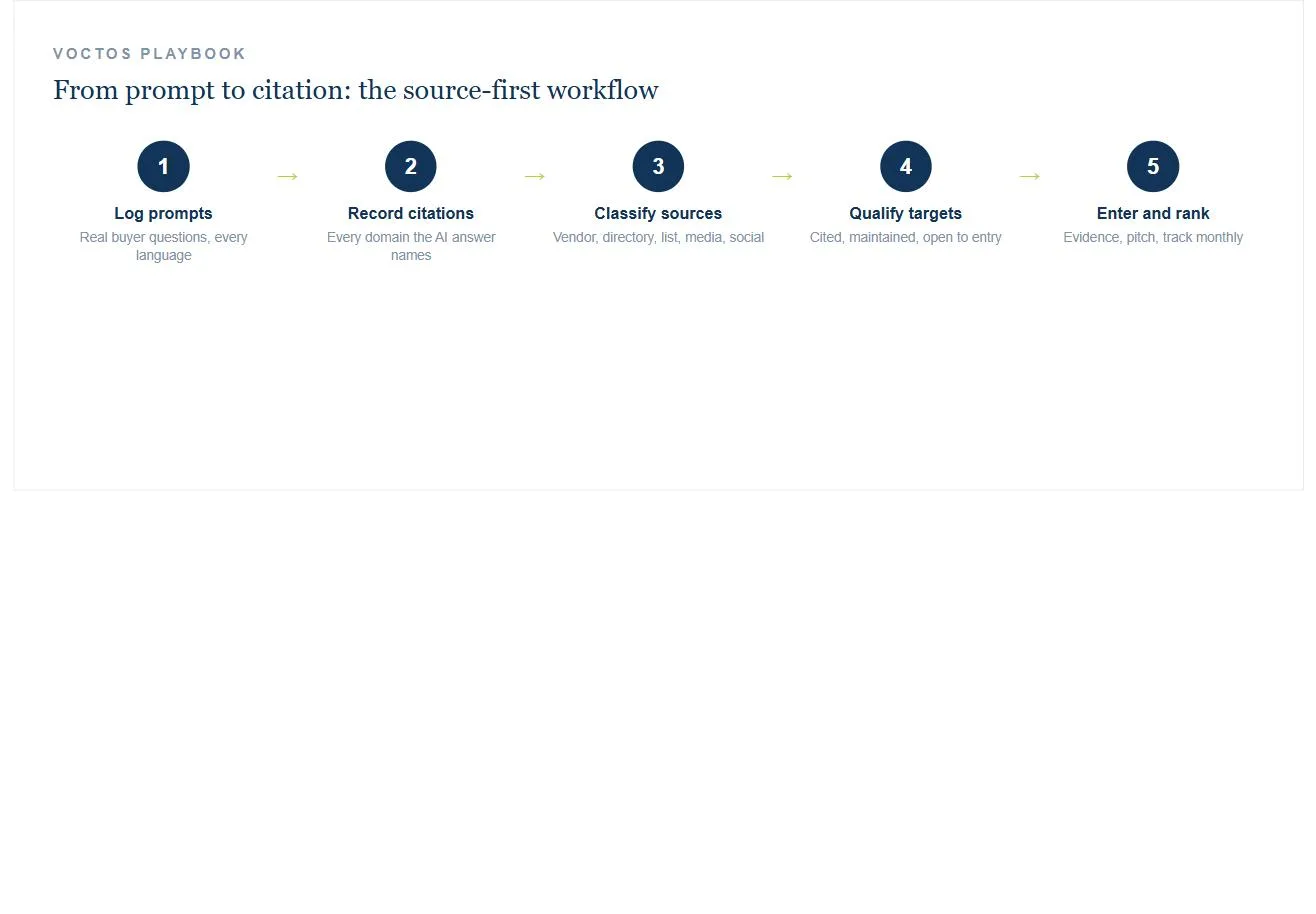
Start with prompts, not with a list of websites. Write 20 to 40 prompts a real buyer would type, in every language you sell in, covering category, geography, use case and comparison intent. Run them across the engines that matter to you and record the URLs cited in each answer. After a few runs a pattern appears: the same eight or ten pages keep supplying the names.
Two things surprise most teams here. First, the cited pages are often not the pages that rank first in classic Google results. Second, the source mix changes completely by language. When we audited 16 matched prompts in Arabic and English, the English answers leaned on directories and ranking lists while the Arabic answers cited none at all. If you skip this step you will optimize for a source class your buyers’ language does not use.
Step 2: Sort the lists by who controls them
Not all lists can be entered the same way, and knowing which type you are looking at saves a lot of wasted outreach.
- Competitor-owned lists. A large share of “best agencies” articles are published by agencies that rank themselves first. Asking to be added is almost always a waste of time. Treat these as competitive intelligence, not as targets.
- Tool and platform directories. AI visibility platforms maintain vetted agency or partner directories that are open to applications. These matter far more than their traffic suggests, because journalists and other list writers build their own rankings from them.
- B2B service directories. Clutch, GoodFirms, DesignRush, Sortlist, The Manifest and similar sites are frequently cited in English answers. Entry is open, so the differentiator is profile completeness, verified reviews and recency.
- Editorial and media lists. Industry publications and newsletters. Hardest to enter, highest trust, and usually won with data or a genuine story rather than a pitch.
- Social posts. LinkedIn ranking posts get cited more often than people expect. They are cheap to create and they are also how a competitor can quietly define a category without you.
List types at a glance
| List type | How open it is | What to do about it |
|---|---|---|
| Competitor-owned lists | Low. Usually ranks the author first | Skip outreach; use for competitive intelligence |
| Tool and platform directories | Open application, light review | High priority; often feeds other lists downstream |
| B2B service directories (Clutch, GoodFirms, etc.) | Open profile, verified reviews | Medium to high in English; keep profile complete and current |
| Editorial and media lists | Closed; earned through pitch or data | High trust, hardest to enter; lead with a real story or dataset |
| Social ranking posts (LinkedIn, etc.) | Anyone can publish one | Low cost, cite-worthy if specific; also watch competitors doing this |
Step 3: Qualify a list before you spend anything on it
- Is it cited in your prompt log? If not, it is a branding exercise, not a visibility one.
- Is it maintained? A list last updated two years ago will keep repeating whoever was in it then.
- Does it publish selection criteria? Lists with stated criteria are easier to enter because you can meet them explicitly.
- Does it accept submissions, and on what basis? Free application, paid placement, or invitation only.
- Does it name a real author with real credentials? Anonymous list farms are harder to verify, and links from them can create risk rather than value under Google’s link spam policies.
Step 4: Make yourself easy to include
List writers are lazy in a predictable way. They copy whatever is easiest to verify. If your positioning is one sentence, your differentiator is concrete and your proof is public, you get copied accurately. If a writer has to interpret you, you get a generic line or you get left out.
Assemble an evidence pack and keep it on a public URL so it can be cited:
- One positioning sentence, identical everywhere, in each language you sell in.
- Two or three differentiators that a competitor cannot honestly claim. “Data driven” is not one of them.
- Verifiable proof: named clients, case studies with real numbers, certifications, awards, third-party reviews.
- The commercial basics a buyer asks about: how engagements start, how reporting works, and how to contact you. Our FAQ page exists largely for this.
- Consistent entity data. One canonical domain, one legal name, one address, one price range across every profile. Conflicting data is the most common reason a model describes a company vaguely.
Step 5: Pitch with something they need
The pitch that works offers the writer material, not a favor. Original data, a correction to a factual error in their current list, a category they are visibly missing, or a client result they can verify. The pitch that does not work asks to be added because you are great.
A short, specific note beats a template. Name the list, name the gap, offer the evidence, and make it trivially easy to verify. Expect a low reply rate and treat it as a rolling program rather than a campaign with an end date.
Step 6: Improve your rank inside lists you are already in
This is the most neglected step and often the cheapest win. If you are already listed eighth, moving to third can matter more than being added to a new list, because rank inside the source shapes prominence inside the answer. Rank inside directories usually responds to review volume and recency, profile completeness, response time and category selection. On editorial lists, it usually responds to giving the author better and more current evidence than the companies above you.
Step 7: Track it monthly, at the source level
Two dashboards, not one. The first is the answer level: for each prompt, are you named, and where in the answer. The second is the source level: which URLs are being cited, which of them include you, and at what position. The second dashboard is the one that tells you what to do next week. We run both for clients inside the client portal, and the AI Visibility Grader gives you a first read for free.
What does not work, and what carries risk
- Mass submission to hundreds of low-quality directories. It does not move AI answers and it builds a link profile you will later want to clean up.
- Buying placement on list farms with no audience and no named author. If a page exists only to sell slots, its citation value tends to be short lived.
- Undisclosed paid placements. If a placement is paid, it should be disclosed and marked according to Google’s spam policies. We keep paid placements clearly separated from earned coverage for exactly this reason.
- Publishing your own “best agencies” list and expecting engines to treat it as third-party validation. It is useful for your own visibility on that query, but it is not evidence about you.
- Optimizing a single global prompt set. Language and country change the source mix enough that one set will mislead you.
The short version
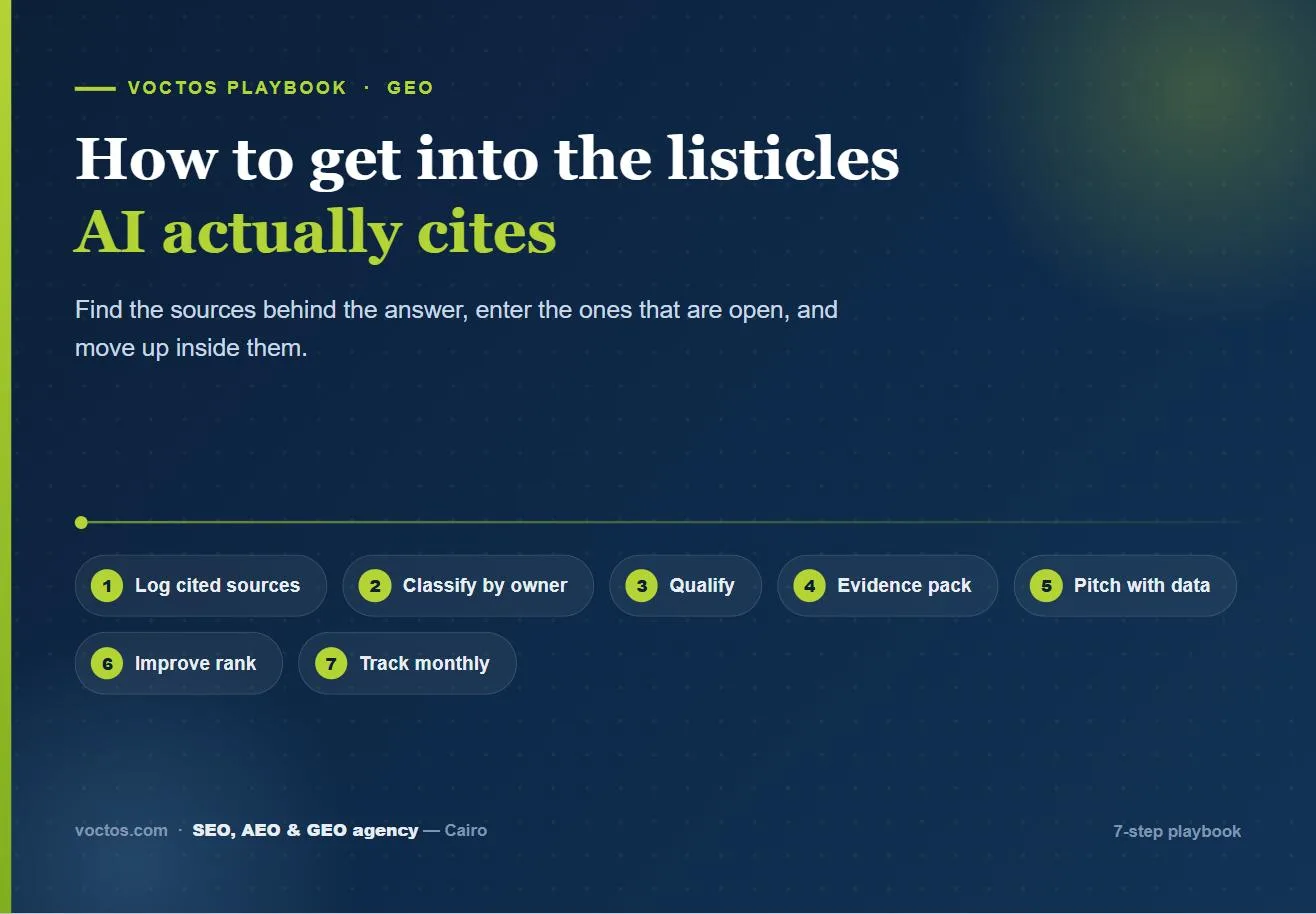
Log the sources your buyers’ prompts actually cite. Classify those sources by who controls them. Enter the ones that are open, improve your position in the ones you are already in, and give editorial lists a reason to include you that is not flattery. Then measure at the source level, monthly, per language.
If you want this run for your brand rather than described, that is our work. Start with GEO, ChatGPT visibility, or tell us about the prompts you want to own and we will map the sources behind them.
Frequently asked questions
How many listicles do I actually need to be in?
Fewer than you think. The Peec AI research linked above found that a handful of strong, frequently cited placements matter more than broad presence across dozens of low-value lists. Start from your own prompt log and aim to be well placed in the five to ten sources that keep appearing, not in every list that exists.
Is it worth paying for a directory listing or a sponsored placement?
Sometimes, and only if two things are true: the source is actually cited in your prompt log, and the placement is disclosed as sponsored rather than presented as editorial. Paid placement on a page nobody cites, or on a page that hides that it is paid, is money spent on neither trust nor visibility.
How long does it take to see a new listicle placement affect AI answers?
It varies by engine and by how often that page gets re-crawled and re-retrieved. In our experience, weeks rather than days is the realistic range, and it is worth confirming the change by re-running your prompt log rather than assuming inclusion equals citation.
Do the same listicles get cited by ChatGPT, Gemini and Google AI Overviews?
Not always the same set. Each engine retrieves and weighs sources differently, and our own audit of Arabic versus English AI Overviews found the source mix even changes by language on the same engine. Log citations per engine and per language rather than assuming one list serves all of them.
What if no third-party listicle exists yet for my category or country?
That is common outside a handful of saturated categories like project management software or CRM. In that situation, the highest-leverage move is often to publish the first credible one yourself, or to make sure your own site directly answers the comparison questions buyers are asking, since the model will retrieve whatever exists.
Should an in-house marketing team do this, or does it need an agency?
A disciplined in-house team can run the prompt logging and outreach themselves; the work is closer to structured research and relationship building than to technical SEO. Where agencies tend to add the most value is in engine coverage, cross-market prompt design, and knowing which lists in a given industry are actually cited versus self-serving. If you want it run for you, that is part of our GEO work.
Related guides
- Google’s Search Generative Experience (SGE) and AI Overviews: What Egyptian Brands Need to Know in 2026
- GEO: Generative Engine Optimization – Your Guide to Ranking on ChatGPT
- Generative Engine Optimization (GEO) Services in Egypt: The 2026 Playbook
- Answer Engine Optimization (AEO) Services in Egypt: How to Win Zero-Click Search
Want more people
to find your website?
Strategy call and
full site audit

Read also

Article Ways and Methods of Promoting an Online Store
Article Do Trustpilot and G2 Reviews Affect What ChatGPT Says About You?
Article 10 Tools for Analyzing Competitor Websites
Article Gemini Now Tags Its Links: How to Measure AI Search Traffic in Saudi Arabia, the UAE and Egypt

Article What Is an SEO Agency? What One Actually Does for Saudi and UAE Businesses in 2026
Article Internal Linking: We Mapped All 34,655 Internal Links on Our Own Site
Article Which Sources Do AI Engines Actually Trust? The Citation Hierarchy
Article Amanleek SEO Case Study: From an Unreadable Angular Site to #1 for “Best Insurance Company” in Egypt

Real Results
More Wins
SEO & GEO for Delta Medical Labs
 GEO
GEO
1M+ monthly organic visits, 159,200 ranked keywords, 5,570 pages cited by AI engines, and 1,186 #1 rankings in KSA.

Arabic SEO, GEO & guest posting for VPNly
 SEO
SEO
65K peak monthly organic visits, 55 guest posts, and 149 pages cited by AI engines.

SEO & GEO for Ogaei Virtual Care
GEO
From 3 to 7,931 monthly organic clicks in 7 months, 2.9M+ impressions, and 40+ keywords in Google’s Top 10.

SEO for Eduverse
SEO
12× search traffic in 10 months, 45% of target keywords in the top 5, and 55% in the top 10.
Trusted by