
FBS.com SEO & GEO Case Study: +109% Organic Sessions and 2x AI Mentions
Client: FBS (fbs.com) — global multi-asset broker
Partnership: 6.5+ years
Services: SEO, GEO (Generative Engine Optimization), multilingual search, search reputation management
Primary measurement window: September 1, 2025 – March 31, 2026
Annual window: August 24, 2025 – August 23, 2026
Data sources: Google Analytics 360 and Semrush AI Visibility, US database, data as of August 23, 2026
Methodology
Every number on this page comes from one of two named sources, inside one of two explicit date windows. Here is the full measurement setup before any result is reported.
- Measurement period: September 1, 2025 – March 31, 2026
- YoY comparison period: September 1, 2024 – March 31, 2025
- Annual window: August 24, 2025 – August 23, 2026, compared with August 24, 2024 – August 23, 2025
- Organic traffic source: Google Analytics 360, FBS.com property
- AI visibility source: Semrush AI Visibility
- AI database: US
- Data as of: August 23, 2026
- SEO engagement duration: 6.5+ years, ongoing
How each metric is calculated
- Organic sessions: GA4 sessions attributed to the Organic Search default channel group, compared with the identical calendar window one year earlier.
- Organic engaged sessions: GA4 engaged sessions, meaning a session that lasted longer than 10 seconds, or fired a key event, or produced two or more page views, filtered to Organic Search.
- Organic engagement rate: engaged organic sessions divided by total organic sessions. Changes shown for this metric are relative changes in the rate, not percentage points.
- Organic share of all sessions: organic sessions divided by total sessions across all channels. Change is reported in percentage points (pts).
- Organic event count: total GA4 events recorded inside organic sessions.
- Events per organic session: organic event count divided by organic sessions.
- AI Visibility score: the Semrush AI Visibility index for fbs.com on a 0 to 100 scale, US database. Change is the absolute point movement across the measurement period.
- Brand mentions in LLM outputs: the number of tracked AI answers in which the FBS brand is named. Change is year over year, expressed as a percentage.
- Citations: the number of times an fbs.com URL is used as a cited source inside tracked AI answers.
- Cited pages: the count of distinct fbs.com URLs cited at least once.
- Metrics deliberately excluded: revenue, conversion and unique-user counts. Attribution model changes and consent-mode configuration in this property make them unreliable for a year-over-year comparison, so no claim on this page rests on them.
Any figure in this case study that is not defined above is quoted directly from the source named in the caption beneath it.
Before and after, in one table
Every headline number in this case study, with its own baseline, in one place. Each figure is repeated in context further down the page with its source.
| Metric | Before | After | Change |
|---|---|---|---|
| Organic sessions, peak window | 7,114,305 | 14,907,382 | +109.54% |
| Organic engaged sessions, peak window | 6,338,191 | 13,198,704 | +108.24% |
| Organic event count, peak window | 214,248,175 | 594,271,659 | +177.38% |
| Organic engagement rate, peak window | 89.09% | 88.54% | -0.62% |
| Organic sessions, annual window | 14,862,892 | 22,955,577 | +54.45% |
| Organic share of all sessions, annual window | 13.03% | 21.99% | +8.96 pts |
| AI Visibility score | 28 / 100 | 36 / 100 | +8 points |
| Brand mentions in LLM outputs | Not disclosed | 1.2K | +109.1% |
| Citations | Not disclosed | 1.5K | +2.7% |
| Cited pages | Not disclosed | 415 | -1% |
The one-line summary
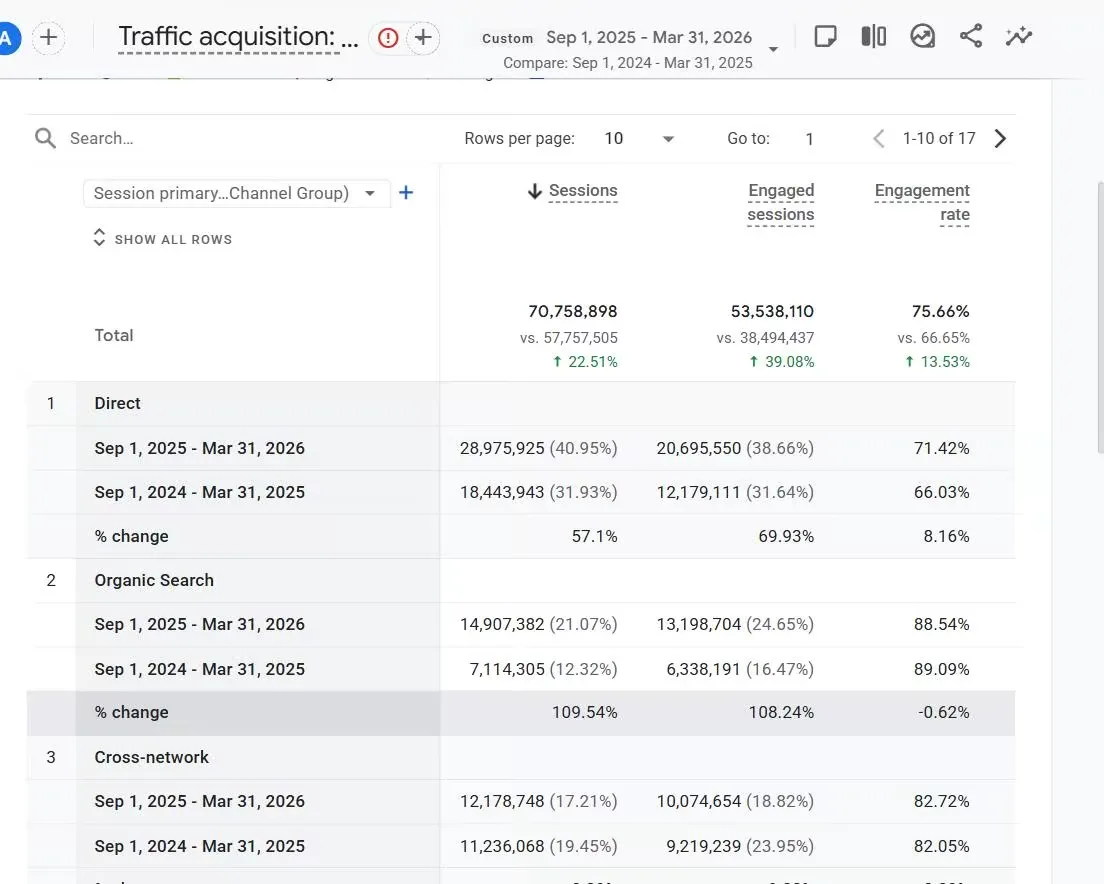
Between September 2025 and March 2026, organic search sessions on FBS.com grew 109.54% year over year, from 7,114,305 to 14,907,382, while total sessions across every channel on the site fell 8.43% over the trailing twelve months. Over the same period FBS brand mentions inside large language models rose 109.1%, and the FBS AI Visibility score climbed eight points to 36 out of 100 while its closest broker comparable lost one.
Organic search went from 13.03% of all FBS.com sessions to 21.99% in twelve months. It is the only major channel in the account that grew its absolute volume and its share of the mix at the same time.
What was the problem VOCTOS was hired to solve?
FBS operates in one of the most expensive and most adversarial paid acquisition markets that exists. Forex and CFD keywords carry some of the highest costs per click in any vertical, ad platform policy on leveraged products changes without warning, and an entire campaign structure can be disabled in a single review cycle.
By 2025 the account showed exactly what that dependency looks like when it breaks. Across the trailing twelve months paid social sessions fell roughly 85%, display fell roughly 80%, paid search fell roughly 55%, and cross-network fell roughly 48%. Total sessions across the site declined 8.43%.
The mandate was not “get more traffic.” It was to rebuild the acquisition base on an asset FBS actually owns, in a market where the paid taps can be turned off by someone else.
What actually happened to organic traffic?
Annual view: August 24, 2025 to August 23, 2026 versus the prior year
| Metric | Current | Prior year | Change |
|---|---|---|---|
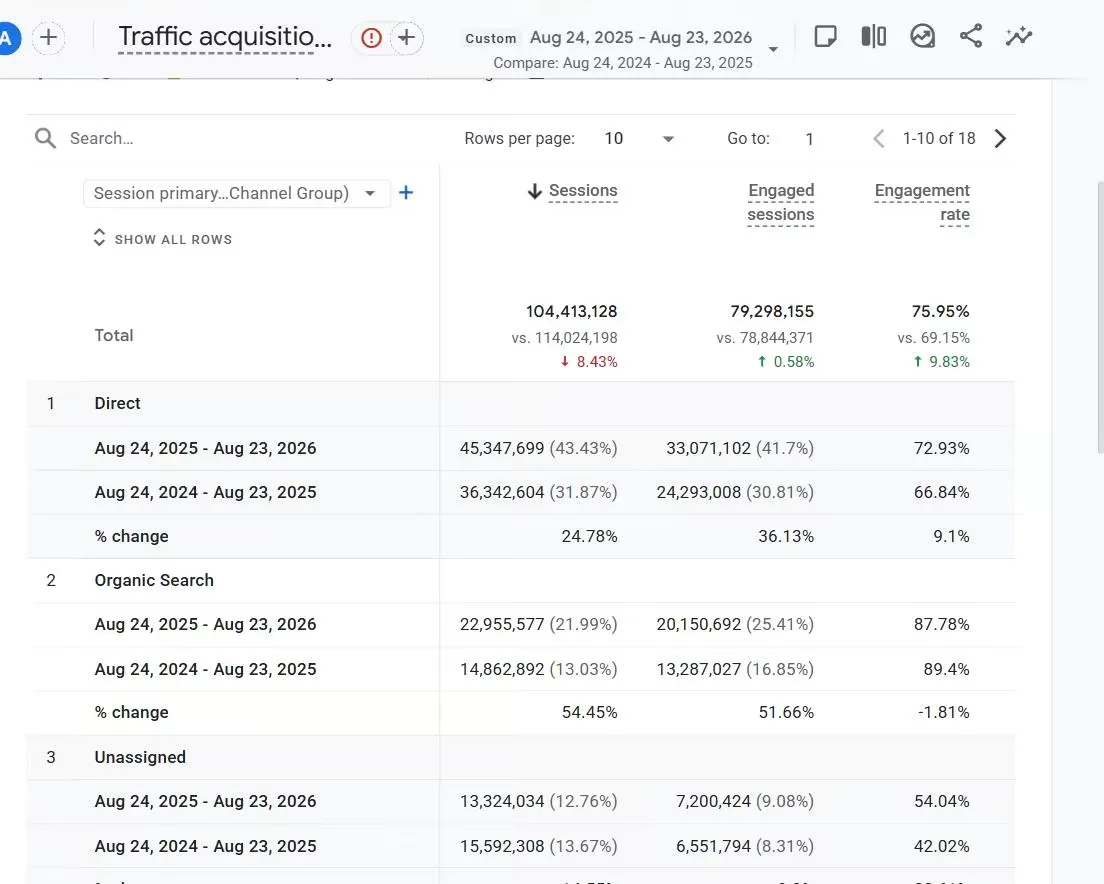
| Organic sessions | 22,955,577 | 14,862,892 | +54.45% |
| Organic engaged sessions | 20,150,692 | 13,287,027 | +51.66% |
| Organic engagement rate | 87.78% | 89.40% | -1.81% |
| Organic share of all sessions | 21.99% | 13.03% | +8.96 pts |
| Total sessions, all channels | 104,413,128 | 114,024,198 | -8.43% |
| Sitewide engagement rate | 75.95% | 69.15% | +9.83% |
Peak growth window: September 1, 2025 to March 31, 2026 versus the same period a year earlier
| Metric | Current | Prior year | Change |
|---|---|---|---|
| Organic sessions | 14,907,382 | 7,114,305 | +109.54% |
| Organic engaged sessions | 13,198,704 | 6,338,191 | +108.24% |
| Organic engagement rate | 88.54% | 89.09% | -0.62% |
| Events per organic session | 39.86 | 30.12 | +32.37% |
| Organic event count | 594,271,659 | 214,248,175 | +177.38% |
| Total sessions, all channels | 70,758,898 | 57,757,505 | +22.51% |
| Sitewide engagement rate | 75.66% | 66.65% | +13.53% |
The number that matters most in that table is not the 109.54%. It is that engagement rate held at 88.54% against 89.09% a year earlier while volume more than doubled. Doubling sessions almost always dilutes quality, because you reach further down the intent curve and pick up bounce. Here the engagement rate moved by six tenths of a percentage point, and events per session actually rose 32.37%.
Peak month was November 2025 at 2,284,082 organic sessions, against a September 2025 baseline of 1,697,539.
Where did the growth land geographically?
FBS is a genuinely global broker, and the organic gains concentrated in the Southeast Asian and African markets that matter most to the business. Indonesia remained the single largest market at 23.31% of active users, with engaged sessions up 14.48%. Thailand posted the strongest engagement improvement of the top markets, with engaged sessions up 69.58%. Kenya and Nigeria together accounted for 17.78% of active users. Singapore active users rose 139.78%.
This case study reports market performance on sessions, engaged sessions and events rather than on user counts, because consent-mode configuration affects how unique users are counted in this property and makes user totals unsuitable for a clean year-over-year comparison. The measurement note at the end of this page sets out the full detail.
What about the Arabic side of the account?
The English-language work is only half the story. VOCTOS has run the Arabic-language search program for FBS in parallel, targeting Saudi Arabia and the UAE through fbs.ae.
In that market the program delivered 164.4K organic clicks and 2.8M impressions in a single reporting cycle, with click-through rate up 26% and clicks up 50.7% year over year. Ranking keywords grew from 120 to 367 in six months. Top-three Arabic rankings were secured across the core commercial set, including forex company, forex broker, stock trading, Bitcoin and cryptocurrencies. Semrush-estimated monthly organic traffic moved from 8,240 in 2020 to 43,027 in 2023, a 5X trajectory.
This matters for GEO specifically. Arabic-language prompt space is far less saturated than English, and models draw on a much thinner citation pool when answering in Arabic. Owning the Arabic corpus early is one of the cheapest AI visibility arbitrages available in MENA right now.
How does FBS perform inside AI models?
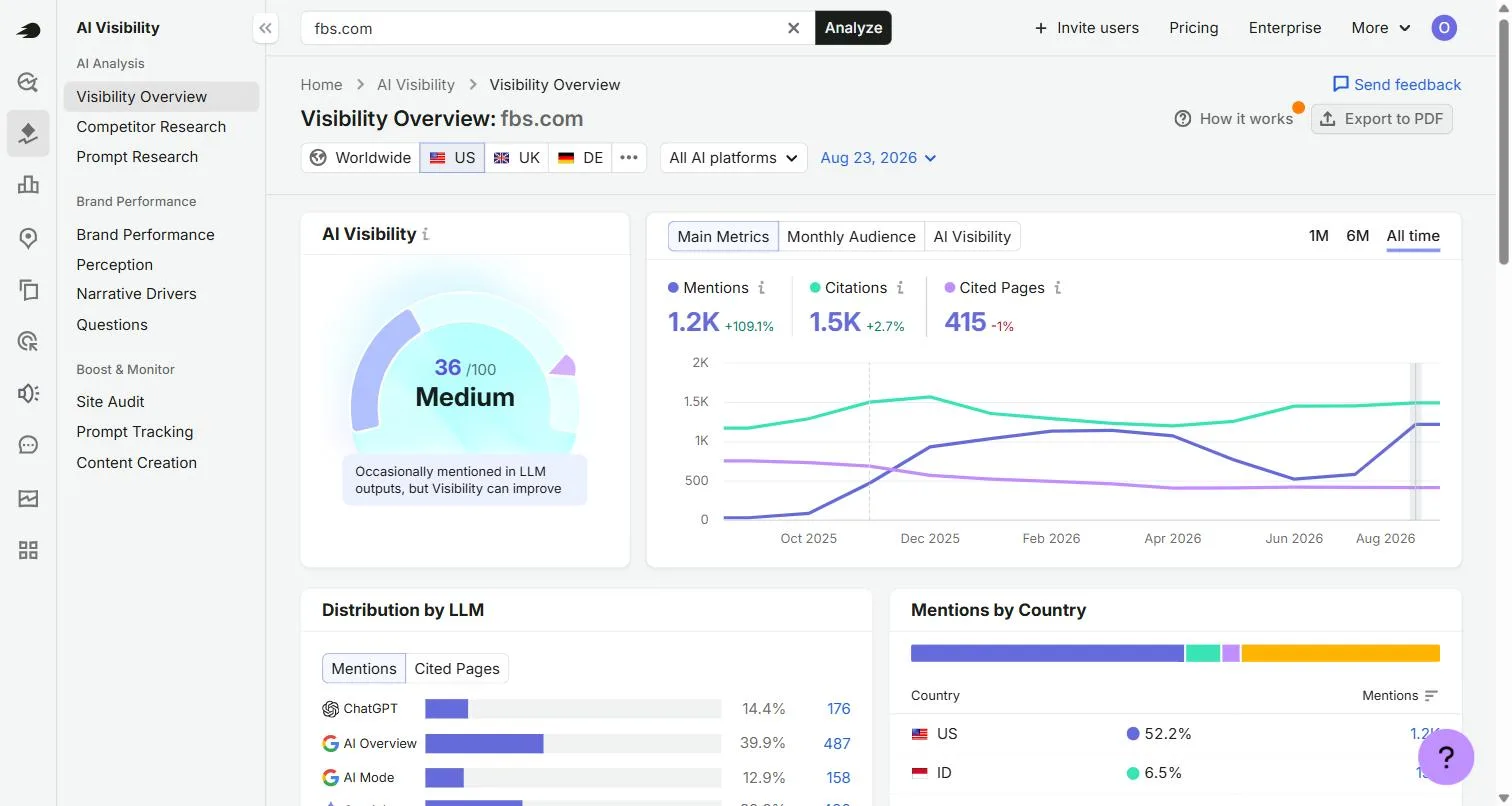
Traffic growth is the legacy scoreboard. The forward-looking one is whether a brand gets named when a model answers a question. Here is the FBS.com position as of August 23, 2026, measured in Semrush AI Visibility against the US database.
| Metric | Value | Change |
|---|---|---|
| AI Visibility score | 36 / 100 (Medium) | +8 |
| Brand mentions in LLM outputs | 1.2K | +109.1% |
| Citations | 1.5K | +2.7% |
| Cited pages | 415 | -1% |
Mentions doubled. Cited pages stayed flat. FBS is not getting mentioned more because it published more. It is getting mentioned more because the same set of pages became more citable. That is what a GEO program is supposed to produce.
Which models are naming FBS?
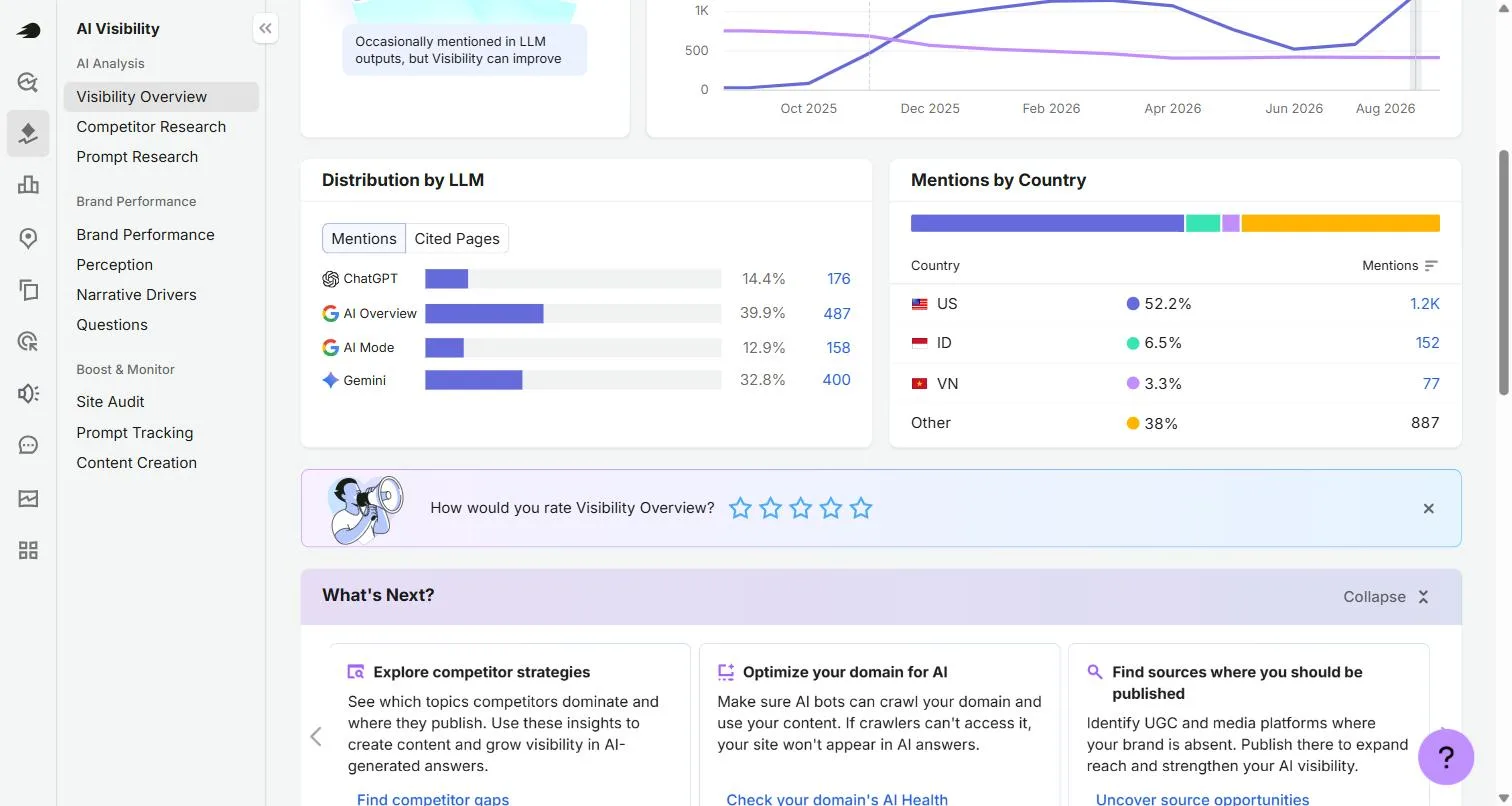
| Surface | Share of mentions | Count |
|---|---|---|
| Google AI Overviews | 39.9% | 487 |
| Gemini | 32.8% | 400 |
| ChatGPT | 14.4% | 176 |
| Google AI Mode | 12.9% | 158 |
52.8% of all FBS AI mentions occur inside Google generative surfaces, counting AI Overviews and AI Mode together, rising to 85.6% once Gemini is included. For a broker that is the correct concentration to have. It means the classical SEO asset base is feeding the generative layer directly, and the two programs compound rather than compete.
How does that compare with the competitive set?
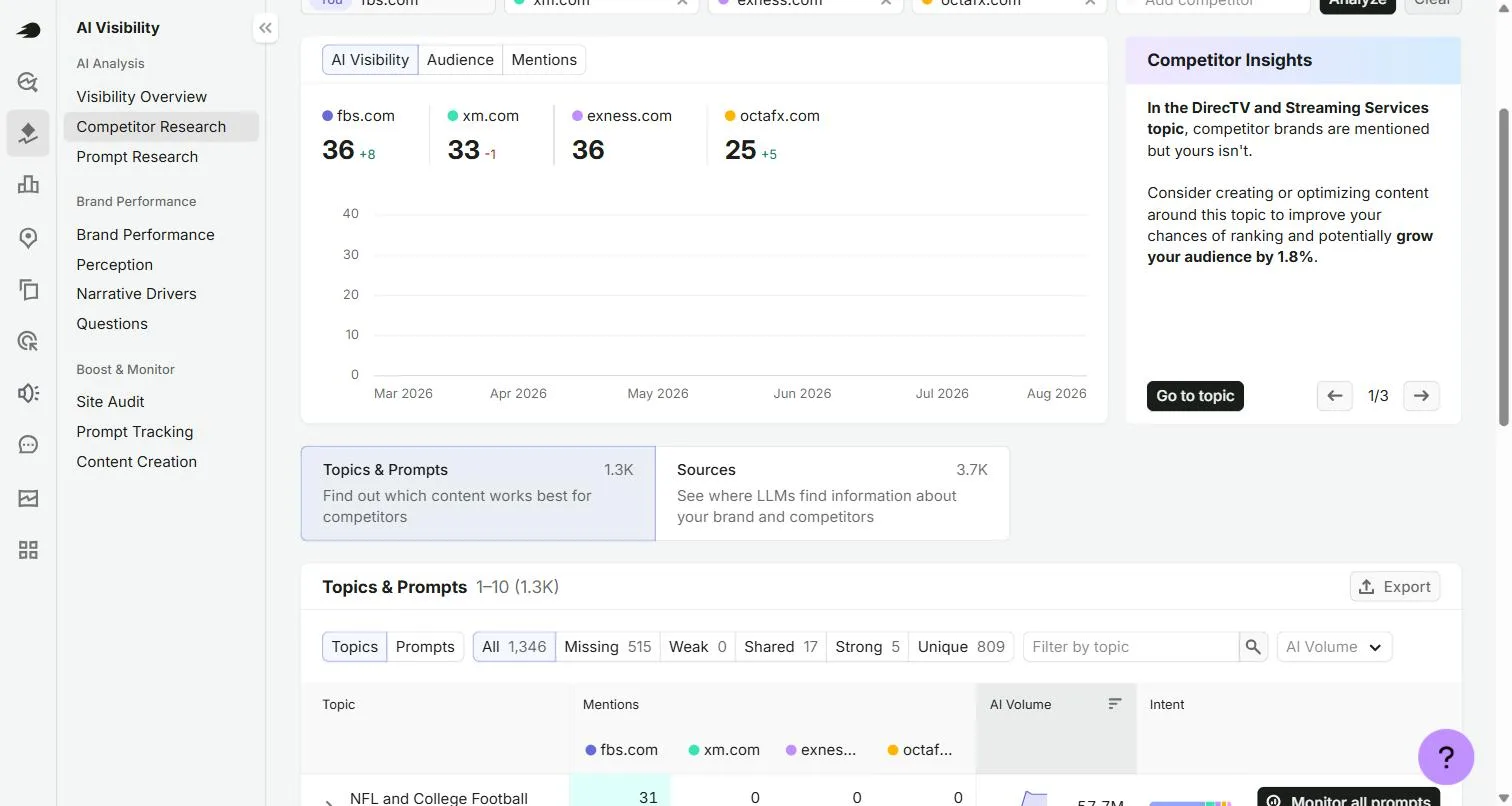
| Broker | AI Visibility score | Change |
|---|---|---|
| fbs.com | 36 | +8 |
| exness.com | 36 | no change shown |
| xm.com | 33 | -1 |
| octafx.com | 25 | +5 |
FBS gained eight points, the largest move in the set, drew level with Exness and moved ahead of both XM and OctaFX. In a category where every competitor publishes the same regulatory pages, the same spread tables and the same “what is forex” explainers, an eight-point swing is a share transfer rather than a rising tide.
What is still on the table?
Honest case studies name the gap. Here is the FBS gap.
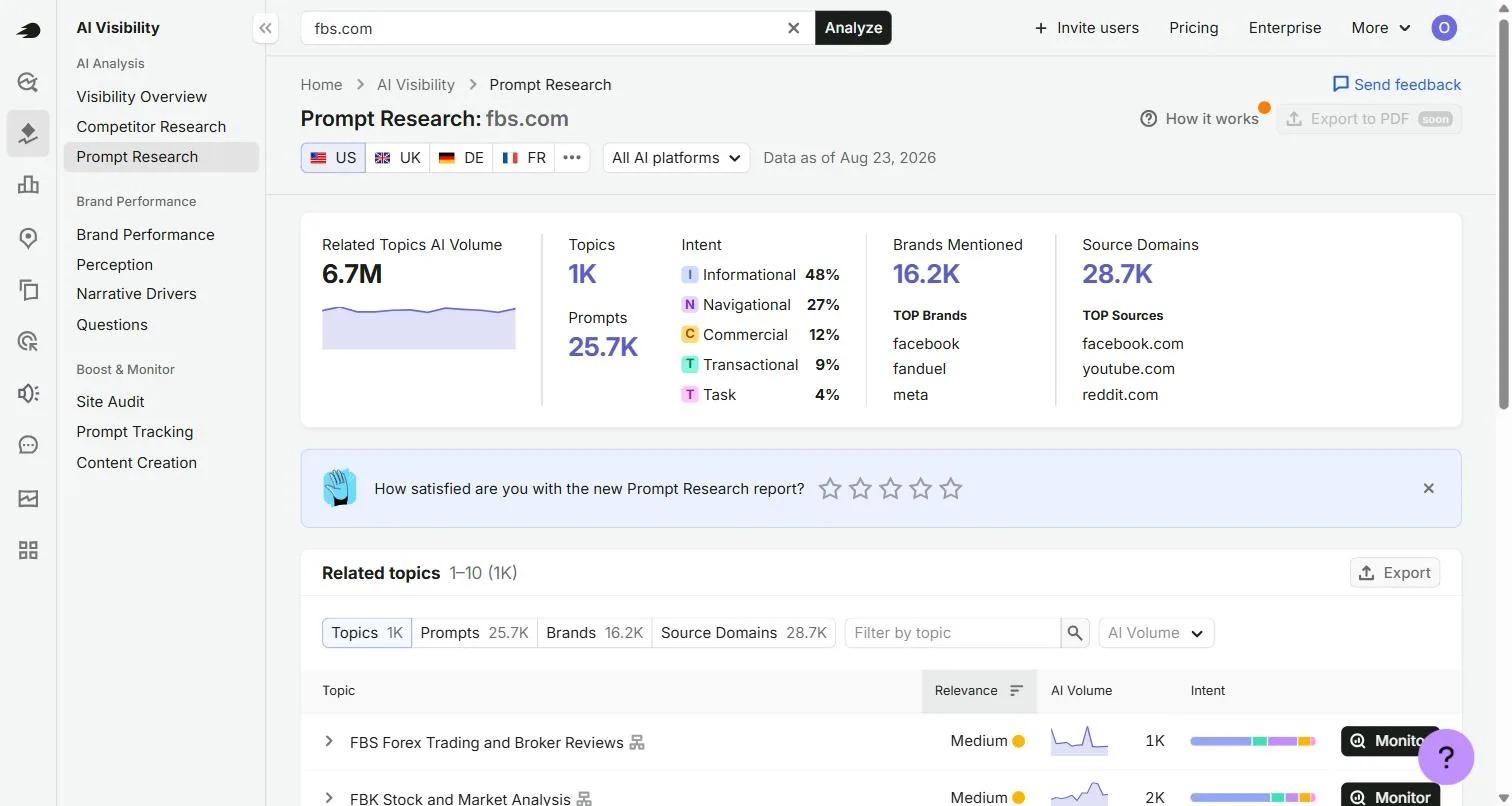
Across 1,346 tracked topics in the competitive set, FBS is strong in only 5, shares 17 with competitors, is uniquely visible in 809, and is entirely missing from 515 where at least one competitor is being mentioned. Those 515 topics are the roadmap.
The wider prompt space around FBS-related topics carries 6.7M AI volume across roughly 25,700 prompts and 1,000 topics, drawn from 28,700 source domains with 16,200 brands competing for the mention. At a visibility score of 36, most of that space still resolves to someone else.
| Prompt intent | Share of volume |
|---|---|
| Informational | 48% |
| Navigational | 27% |
| Commercial | 12% |
| Transactional | 9% |
| Task | 4% |
Nearly half of the prompt volume is people asking to be taught something. That is precisely the query class generative engines answer with a cited source rather than a link list, and it is where the next round of gains sits.
What did VOCTOS actually do?
Four workstreams, run continuously rather than as a project with an end date.
Entity and topical consolidation. Broker sites accumulate near-duplicate pages at enormous scale, one page per instrument, per spread type, per platform, per language. We consolidated the topical graph so a single authoritative page owned each concept, then interlinked by entity rather than by keyword. This is why cited pages stayed flat at 415 while mentions doubled: fewer pages, each stronger.
Answer-first content architecture. Every target page opens with a direct, extractable answer before any preamble. Comparison and listicle formats were prioritised deliberately, because comparison and listicle formats consistently outperform other page types in published analyses of AI citation behaviour.
Multilingual parity. English and Arabic corpora built to the same structural standard, so a model answering in either language finds the same entity definitions and the same data points. Arabic-first, not Arabic-translated.
Reputation surface management. In regulated finance a model assembles its answer about a broker from third-party review sites, forums and press as much as from the brand domain. The search reputation track keeps the sources models reach for accurate.
How this data was measured
Every figure in this case study is read directly from Google Analytics 360 and Semrush AI Visibility, and every figure is labelled to an explicit date window so it can be checked rather than taken on trust.
Measurement limitations
Session, engagement and event metrics only. Revenue and conversion metrics are deliberately excluded. Attribution model changes and consent-mode configuration inside the property make those two families of metric unreliable for a year-over-year comparison across this window, so they are not used to make any claim here.
Google changed paid-channel attribution mid-window. A Google Analytics annotation dated October 8, 2025 records that attribution for Google paid channels was improved while maintaining EEA regulatory compliance, and that data may shift between organic and paid as a result. A portion of the organic gain reported above reflects that reclassification. We disclose it rather than absorb it silently, and the event-depth data in the next paragraph is what separates real growth from relabelling.
Growth is confirmed by behaviour, not only by volume. Organic event count rose 177.38% against a 109.54% session gain in the same window. Reclassified sessions carry their existing behaviour with them; they do not generate sixty-eight percentage points of additional event depth. That gap is the strongest available evidence that the growth is incremental rather than administrative.
Google changed paid-channel attribution on October 8, 2025, which may have shifted some sessions into Organic. The reported +109.54% organic-session growth should therefore not be interpreted as a pure measure of SEO impact.
However, organic events increased 177.38% against 109.54% growth in sessions. Reclassified sessions carry their existing behaviour with them and do not generate additional event depth, so that 68-point gap is the evidence that the growth is incremental rather than administrative.
My read on this, by Beshoy Adel, Head of SEO and GEO at VOCTOS
The result I am proudest of here is not the 109%. It is the 88.54% engagement rate that survived it.
Anyone can double sessions. You go wider on head terms, you chase volume, you accept the dilution, and six months later the client asks why the traffic does not convert. That is the standard shape of a doubling and it did not happen here. Engagement rate moved by six tenths of a percentage point and events per session went up by a third. That tells me the incremental traffic was the same quality as the base traffic, which in a leveraged-products vertical is the only version of growth worth having.
The second thing I would point at is the flat cited-page count. Four hundred and fifteen pages produced twice the AI mentions. The instinct across this industry right now is to answer AI visibility with volume: publish more, publish faster, flood the corpus. This account is evidence for the opposite play. Consolidate, make each page structurally citable, and the same asset base does double the work.
Where we are not done: 36 out of 100. FBS is now level with Exness and ahead of XM, but there are 25,700 prompts in this space and we are visible in a minority of them, with 515 topics where a competitor is named and FBS is not. That is the next twelve months.
Frequently asked questions
A 109% jump usually means the baseline was broken, not that the work was good.
Fair challenge, and testable. If the prior-year baseline had been artificially suppressed, engagement quality would have shifted when volume normalised. It did not: engagement rate held at 88.54% against 89.09%, which is inside noise. The trailing-twelve-month figure of 54.45% also covers a full year on both sides of the comparison, which smooths any single broken quarter.
Organic went up while paid collapsed. Is this not just channel reassignment?
Partly, and VOCTOS discloses it on this page. Google changed attribution for paid channels on October 8, 2025 and that moves data between organic and paid. But reassignment cannot explain the event data. Organic event count rose 177.38% in the peak window against a 109.54% session gain. Reclassified sessions carry their existing behaviour with them; they do not generate sixty-eight percentage points of additional event depth.
Why is the AI Visibility score only 36 if the program worked?
Because 36 is the honest number. It rose eight points during the measurement period while the nearest broker comparable lost one. AI visibility in regulated finance is a multi-year build, because models are conservative about which financial brands they name. A score that jumped to 80 in twelve months would be a reason to audit the data, not to celebrate.
How much of this is just because FBS is already a big brand?
Brand size helps navigational prompts, which are 27% of this space. It does very little for the 48% that is informational. Nobody gets cited in “how do forex spreads work” on brand equity. That segment is won structurally, and it is where the mention growth came from.
Can this be replicated for a smaller broker?
The mechanics replicate; the absolute numbers do not. Answer-first architecture, entity consolidation, multilingual parity and reputation-source management are all scale-independent. A smaller domain will see the same directional lift on a smaller base, and will typically see AI mention growth arrive faster than traffic growth, because the citation pool for niche prompts is thinner.
Which AI models cite FBS most often?
Google AI Overviews at 39.9% of mentions, Gemini at 32.8%, ChatGPT at 14.4% and Google AI Mode at 12.9%, as of August 2026 in the US market.
The better question
Most brokers are still asking how to get more organic clicks. The more useful question in 2026 is this: when a model answers a question in your category, how often is your brand in the answer, and which of your pages is it reading?
For FBS.com the answer today is 36 out of 100, with 415 pages doing the work and 52.8% of mentions landing inside Google generative surfaces. Over the measurement period that score rose by eight points and the mention count doubled.
Where does your brand sit in this picture?
The measurement that produced this case study is the same one VOCTOS runs at the opening of every engagement: what the models say about your brand today, which of your pages they actually read, and which topics your competitors are named in while you are not.
You can get the first half of that answer in a few minutes with the free AI Visibility Grader. For the full picture across SEO, GEO and reputation surfaces, talk to the team.
Data and evidence appendix
Every claim on this page traces back to a named source, an explicit date and a defined scope. This appendix lists what that evidence is.
- Analytics evidence: Google Analytics 360 reporting from the FBS.com property. The Organic Search channel views behind the session, engagement and event figures are reproduced as screenshots in the sections above.
- AI visibility evidence: Semrush AI Visibility reporting for fbs.com on the US database, reproduced as screenshots above for the visibility score, mentions, citations, cited pages, distribution by model and the competitor comparison.
- AI prompt dataset: Semrush AI Prompt Research for fbs.com, US: roughly 25,700 prompts across about 1,000 topics, 6.7M AI volume, 28,700 source domains and 16,200 competing brands.
- Date of collection: analytics windows close on March 31, 2026 and August 23, 2026. All AI visibility and prompt data is as of August 23, 2026.
- Geography: all AI metrics are US database only. Traffic metrics are global, with market-level detail reported on sessions, engaged sessions and events rather than users.
- Prompt and topic counts: 25,700 prompts, roughly 1,000 topics, and 1,346 tracked topics in the competitive set, of which FBS is strong in 5, shares 17, is uniquely visible in 809 and is absent from 515.
- Metric definitions: every metric used on this page is defined in the Methodology box at the top.
- Methodology and limitations: the measurement approach and its known limits are set out in How this data was measured and Measurement limitations above, including the October 8, 2025 Google attribution change.
- Not published: client-confidential data, including revenue, conversion, cost and account-level configuration. No claim on this page depends on it.
Related reading
- The VOCTOS Method: 4 Pillars of AI Visibility
- Advanced GEO Layers
- Arabic vs English AI Overview Citations
- How to Get Into the Listicles AI Cites
Services referenced in this case study
- SEO and SEO audit
- GEO, Google AI Overviews optimization and Gemini and AI Mode
- ChatGPT optimization and AEO
- Reputation management
- Free AI Visibility Grader
Full client page: FBS case study, 5X organic traffic for a global broker.
Related guides
- Eduverse Online School SEO Case Study: 151K Sessions and 75% Organic Share in 1 Year
- How SEO and Customer Experience Combine to Drive Organic Performance in 2026
- How VOCTOS Grew Ogaei’s Organic Traffic From 3 to 7,931 Monthly Clicks in 7 Months: An SEO Case Study
- Digital PR for GEO: How Brand Mentions Earn AI Citations
Want more people
to find your website?
Strategy call and
full site audit

Read also

Article Ways and Methods of Promoting an Online Store
Article Do Trustpilot and G2 Reviews Affect What ChatGPT Says About You?
Article 10 Tools for Analyzing Competitor Websites
Article Gemini Now Tags Its Links: How to Measure AI Search Traffic in Saudi Arabia, the UAE and Egypt

Article What Is an SEO Agency? What One Actually Does for Saudi and UAE Businesses in 2026
Article Internal Linking: We Mapped All 34,655 Internal Links on Our Own Site
Article Which Sources Do AI Engines Actually Trust? The Citation Hierarchy


Real Results
More Wins
SEO & GEO for Delta Medical Labs
 GEO
GEO
1M+ monthly organic visits, 159,200 ranked keywords, 5,570 pages cited by AI engines, and 1,186 #1 rankings in KSA.

Arabic SEO, GEO & guest posting for VPNly
 SEO
SEO
65K peak monthly organic visits, 55 guest posts, and 149 pages cited by AI engines.

SEO & GEO for Ogaei Virtual Care
GEO
From 3 to 7,931 monthly organic clicks in 7 months, 2.9M+ impressions, and 40+ keywords in Google’s Top 10.

SEO for Eduverse
SEO
12× search traffic in 10 months, 45% of target keywords in the top 5, and 55% in the top 10.
Trusted by