
SEO Timeline: How Long Does It Take to Rank and What Affects It

How long does SEO take? In most cases you should expect the first meaningful signals of progress within 3 to 4 months of active work, and stable, commercially significant traffic growth between 6 and 12 months. SEO is a compounding, long-term channel rather than an instant switch: Google needs time to crawl your pages, evaluate content quality, build trust in your domain, and confirm positive user signals before it rewards you with durable rankings.
Business owners launching a new project often hope for fast wins, and the market does not help: promises range from top of Google in 2-3 weeks to you will not see anything for 12 months. This guide gives the honest, realistic version, adapted for how Google actually works in 2026.
Key takeaways
- First signals appear around months 3-4 – rising impressions, more indexed keywords, and the occasional lead from organic search.
- Meaningful growth lands between 6 and 12 months, once optimized content and a natural link profile start compounding.
- Speed is driven by four factors: the age and health of your site, competition in your niche, your target region, and how much quality work you ship each month.
- Consistency beats intensity. A site that improves weekly earns trust far faster than one touched once a quarter.
- Shortcuts backfire. Black-hat tactics can spike rankings briefly, then trigger penalties that take months to recover from.
How long does SEO really take to work?
Google representatives have long said it typically takes 4 to 12 months to see results from SEO – the time the engine needs to register changes, re-crawl and re-index pages, and judge whether your site is genuinely more useful than the alternatives.
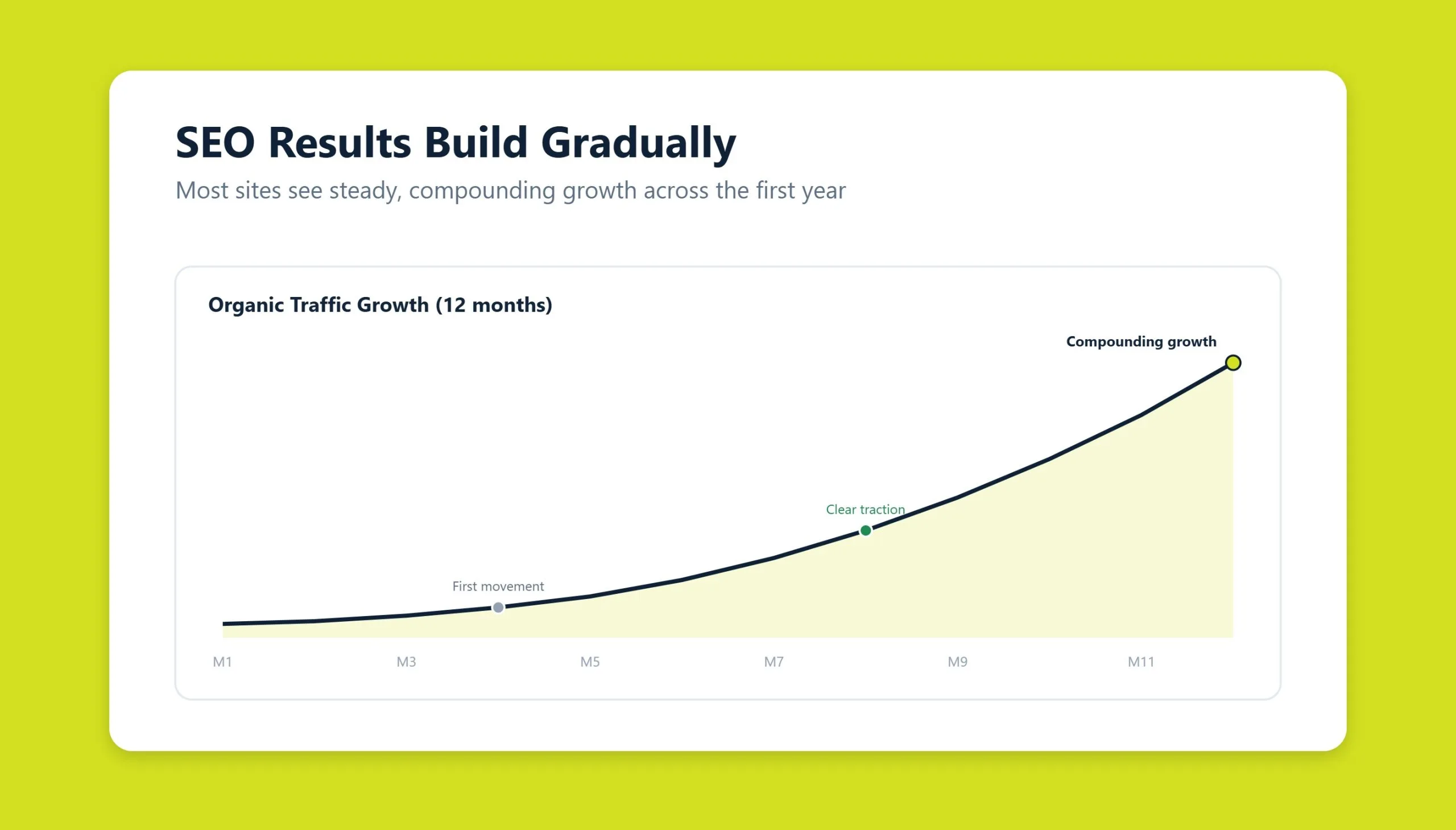
Independent studies back this up: the average age of a page ranking in Google top 10 is well over two years, and only a small share of brand-new pages break into the top 10 within their first year. SEO is a compounding strategy – like investing capital, early effort matures into steady, qualified traffic after several months of disciplined work. Google still handles roughly 90% of global search in 2026, so ranking there remains the single biggest organic opportunity. At the same time, AI Overviews now surface on a large share of results, so the relationship between position and clicks has become more nuanced – one reason patience and quality matter more than ever.
Why SEO does not deliver instant results
Search engines need time to crawl and index
Googlebot cannot place a fresh site at the top the moment it goes live. It has to discover pages, index content, and run a quality assessment. Young domains face an effective probation period while the algorithms confirm the site is legitimate and useful.
Authority accumulates gradually
Trust forms over time under many factors: domain age, a clean and natural backlink profile, positive user signals, and expert content that satisfies Google E-E-A-T criteria (Experience, Expertise, Authoritativeness, Trustworthiness). Reputation is earned over months, with no genuine shortcut.
Competition slows the climb
In most commercial niches the results are occupied by strong, established players. To displace them you need better content, a more usable experience, and deeper technical optimization. In competitive verticals the timeline is always longer.
SEO is a program of work, not a one-time setting
Comprehensive optimization involves recurring tasks: technical audits, keyword and topic research, content production, link building, and analytics. A structured comprehensive SEO program treats these as an ongoing cycle rather than a checklist you finish in week one.
Algorithms keep changing
Google ships broad core updates several times a year, which can temporarily cause drops, plateaus, or reshuffling. SEO becomes continuous adaptation, and that feeds into the overall time needed for a stable result.
What affects how fast SEO works
Age and condition of your site
New sites move more slowly because they lack baseline trust. Older domains with a clean history rank new pages faster, but a negative history such as past spam penalties can seriously slow growth. A thorough SEO audit is the fastest way to find out which situation you are in.
Competition in your niche
In narrow B2B or low-competition local niches you can see first commercial results relatively quickly. In e-commerce or high-demand services like real estate, travel and finance you compete against giants, which pushes the waiting period out.
Target region
Local promotion within a single city happens far faster because the field of competitors is geographically limited. National or international reach across many regions multiplies the work and the timeline.
Volume and consistency of SEO work
Content is the primary driver of organic traffic. Publishing quality material consistently and fixing technical issues promptly accelerates visibility. A project that changes weekly earns a response far sooner than one updated monthly – exactly where an ongoing content marketing engine pays off.
The SEO timeline month by month
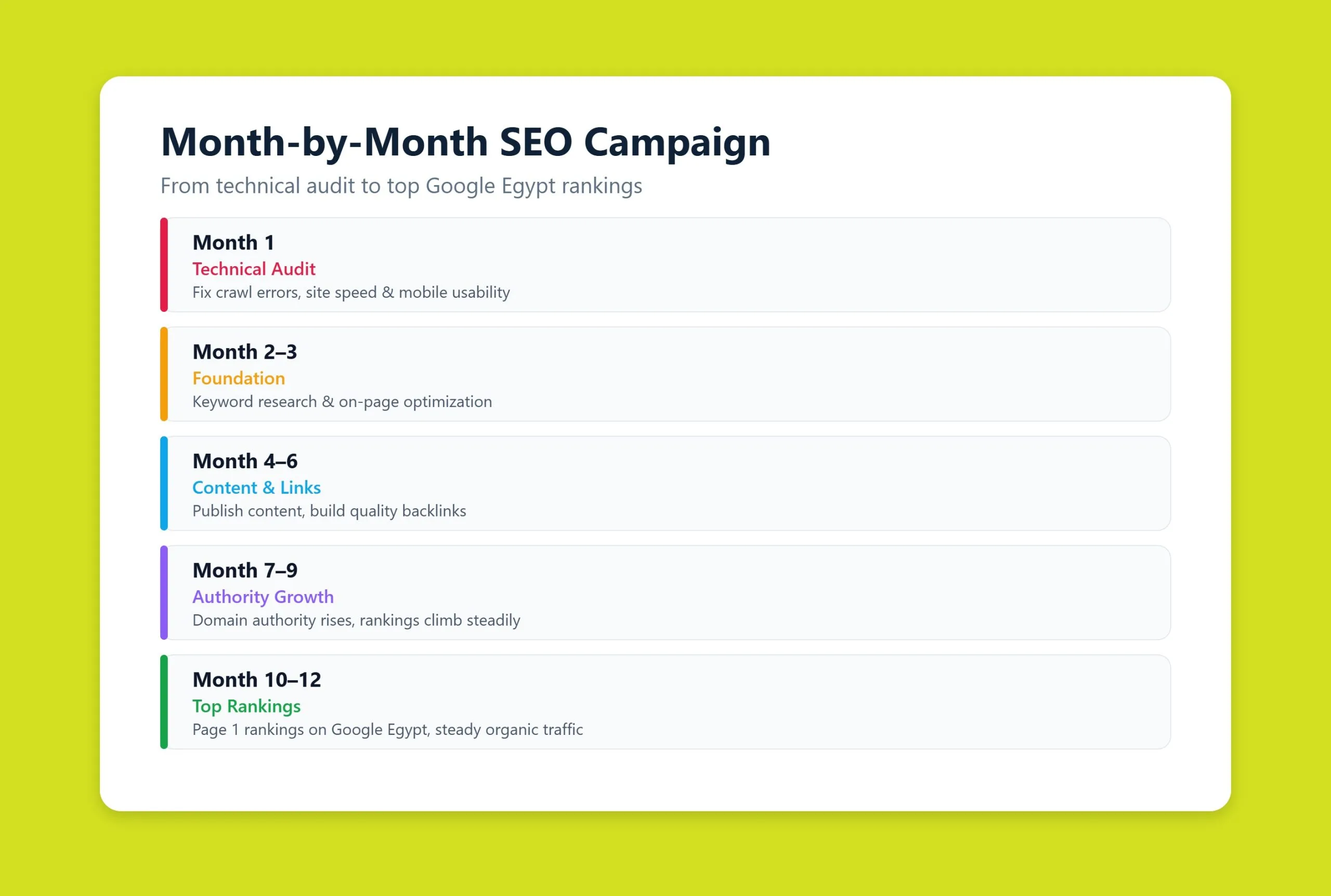
Month 1: foundations
Specialists run a full audit, fix critical technical errors (duplicate pages, broken links, slow load times), configure Google Search Console and GA4, and build the core keyword map. This month is pure investment in a reliable foundation; do not expect a wave of customers yet.
Months 2-3: first signs of life
Optimized pages get re-indexed. In Search Console your keyword footprint expands, the site begins showing for long-tail queries, and positions creep upward. Some businesses record their first isolated leads here.
Months 4-6: traffic and positions grow
By around month six there is a qualitative jump. Accumulated content and a growing link profile produce real results, qualified traffic increases significantly, and mid-volume queries settle into the top 10. Enquiries become regular. A traffic-based SEO model, measured on real visits and conversions, tends to prove itself around this point.
Around month 12: reaching the top
After a year a well-run project is usually mature: a meaningful share of target keywords can hold top-10 positions and organic traffic becomes more predictable and one of your cheapest channels, and a brand effect kicks in as people return directly or through branded searches.
SEO timelines by type of website
A brand-new site
The longest scenario. Visible growth usually begins at months 4-6, with meaningful results and stable positions taking 8 to 12 months of persistent work.
An online store
E-commerce means huge page counts and a colossal amount of technical work – faceted filtering, eliminating duplicates, optimizing metadata, commercial ranking factors. Full traffic growth is most often recorded in the 6-to-12-month range.
A services site
Usually a more compact structure. If the business is tied to a region, well-built local SEO can deliver commercial effect much faster – the first customers can arrive within 2-3 months.
What can slow SEO down
- Technical failures such as blocking sections in robots.txt, code errors after a CMS update, or recurring server downtime.
- Poor content quality – thin, duplicated, mass-generated or spammy text that offers no value.
- A toxic link history – old low-quality or paid links that leave the domain under a filter.
- Slow implementation when technical recommendations sit in a queue for weeks.
Can you speed up SEO results?
You cannot bypass the time filters, but white-hat methods get you onto a growth trajectory faster: run a proper technical audit and prioritize fast load times, clean indexing and flawless mobile experience; focus on your most profitable pages first; publish expert content regularly; build links with safe, organic methods (guest articles, case studies, genuine PR); improve UX and behavioral signals; use local SEO to appear in the map pack; and track KPIs weekly in Google Search Console and GA4 to adjust fast.
Why gray-hat methods are dangerous
Faking behavioral signals with bots, mass-buying spam links, hiding text, or generating doorway pages can produce a short-lived spike, but Google recognizes the manipulation quickly. The consequences are severe: penalties, total loss of organic traffic, and pages dropping out of the index, with recovery taking months or proving impossible.
How to tell that SEO is working
- Rising visibility – the site appears for a growing number of keywords, even on positions 20-30.
- More impressions and clicks in Search Console trending steadily upward.
- Growth in non-branded traffic from general commercial queries.
- Better behavioral metrics – lower bounce, more pages per session, longer time on site.
The verdict: realistic SEO timelines
SEO is a marathon that rewards patience, consistency and expertise. First signals appear at months 3-4; noticeable, commercially significant traffic forms between 6 and 12 months; and consistency is the decisive factor. Companies that cut SEO funding after 2-3 months forfeit their initial investment one step short of real growth. If you want that outcome without the guesswork, our SEO services team can build and run the program – and if AI search is a priority, our GEO (AI SEO) work helps you get cited in AI answers as well as traditional results.
How long SEO takes in the Middle East, the Gulf and Egypt
Most published SEO timelines describe English-language competition in the United States and Europe. If you are ranking in Arabic, or targeting Riyadh, Dubai or Cairo, the pace is different, and it is different in both directions at once.
The pattern we see repeatedly is this: the Arabic version of a query is usually easier to rank for than its English twin, while the English version of the same query aimed at a Gulf city is often harder than the global average. Two things cause that. Far fewer sites publish genuinely well-optimized Arabic content, so the bar in Arabic results is lower. Meanwhile Gulf markets carry high commercial value, which attracts agencies worldwide competing for the English query.
Relative difficulty by language and target market
The table below is our editorial assessment based on client work, not a measured benchmark. We say so plainly because nobody publishes a measured one for this region yet, and we would rather label a judgment than dress it up as data.
| Query language and target | Difficulty vs global average | What usually drives it |
|---|---|---|
| Arabic, targeting Egypt | Lower | Thin competition, many results are unoptimized or auto-translated |
| Arabic, targeting Saudi Arabia or UAE | Slightly lower | More serious local publishers than Egypt, still far fewer than English |
| English, targeting Egypt | Similar | Modest commercial pull, mixed local and global competitors |
| English, targeting Dubai or Riyadh | Higher | High deal values attract international agencies to the same terms |
| Local pack and Maps, any Gulf city | Lower | Many categories still have few complete, actively managed profiles |
Four things that change the timeline here
- A bilingual site splits your pace. Running Arabic and English on one budget does not cost twice as much, but it does slow both down. Plan for one language to lead and the other to follow, rather than expecting them to arrive together.
- The top three can be locked while positions four to twenty are open. Many Gulf categories are dominated by two or three entrenched brands with heavy offline recognition. Reaching page one is often quick. Displacing the leaders is a separate, much longer project.
- Maps moves before organic. If you have a physical presence in a Gulf city, a complete and actively managed business profile usually produces enquiries well before organic rankings do.
- Machine-translated Arabic delays everything. Content translated without an editor who writes Arabic natively tends to underperform for a long time, then need rewriting anyway. It is the most common reason an Arabic campaign stalls.
None of this replaces the month-by-month picture above. Treat it as an adjustment layer: same mechanics, different competitive density, and a language split that most global timelines never account for.
Frequently asked questions
How long does SEO take to show results?
For most sites, the first meaningful signals – rising impressions, more indexed keywords, and occasional organic leads – appear within 3 to 4 months. Stable, commercially significant traffic growth typically arrives between 6 and 12 months, depending on your site age, competition, and how much quality work you ship each month.
Why is my SEO taking so long to work?
Slow progress is usually caused by one of four things: a young domain with little trust, a highly competitive niche, technical issues holding the site back, or too little ongoing work. A technical audit will pinpoint which factor is limiting you.
Can I speed up SEO?
You cannot bypass Google’s evaluation period, but you can move faster with white-hat methods: fixing technical issues quickly, focusing on profitable pages, publishing quality content consistently, earning natural links, and improving user experience. Black-hat shortcuts risk penalties that set you back months.
How long does SEO take for a new website?
A brand-new domain is the slowest scenario. Visible growth usually starts around months 4-6, with meaningful business results and stable top-10 positions taking 8 to 12 months of persistent, structured work.
Do AI Overviews change how long SEO takes?
They change the relationship between rankings and clicks more than the timeline itself. With AI Overviews now on a large share of searches in 2026, you still need strong rankings to be cited, but some informational queries are answered on the results page. Authoritative, well-structured content earns both traditional clicks and AI citations.
Related guides
Don't miss the chance to
make your website more visible!
Initial consultation and
audit of the current situation

Read also

Article Behavioral Factors in SEO: What They Are and How to Improve Them
Article JavaScript Links Are Hiding MENA Sites From ChatGPT and Claude

Article VOCTOS Is a Top SEO, PPC and SEM Company in Egypt on Clutch for 2026
Article Commercial Ranking Factors: The Complete List

Article The Title Meta Tag: What It Is and How to Write It
Article The Role of Meta Tags in Search Engine Optimization
Article Can You Sue an AI for Defamation? Where the Law Stands

Article Cloudflare’s 15 September AI Crawler Defaults: The Check Gulf and Egypt Brands Should Run Today






Real Results
More Wins
SEO & GEO for Delta Medical Labs
 GEO
GEO
1M+ monthly organic visits, 159,200 ranked keywords, 5,570 pages cited by AI engines, and 1,186 #1 rankings in KSA.

Arabic SEO, GEO & guest posting for VPNly
 SEO
SEO
65K peak monthly organic visits, 55 guest posts, and 149 pages cited by AI engines.

SEO & GEO for Ogaei Virtual Care
GEO
From 3 to 7,931 monthly organic clicks in 7 months, 2.9M+ impressions, and 40+ keywords in Google’s Top 10.

SEO for Eduverse
SEO
12× search traffic in 10 months, 45% of target keywords in the top 5, and 55% in the top 10.
Trusted by