
On-Page and Off-Page SEO: A Complete Guide

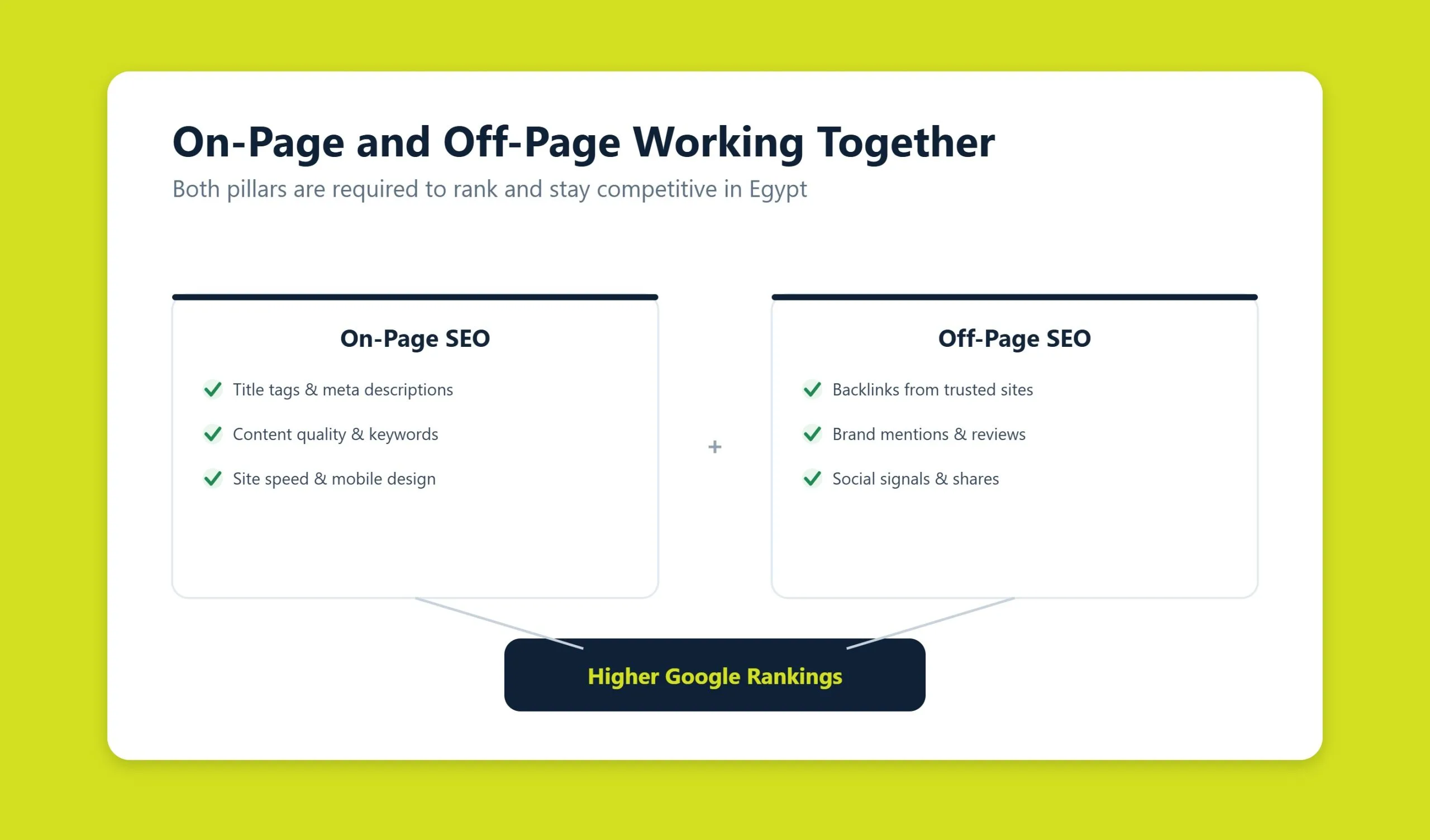
On-page (internal) SEO is everything you do on your website to help search engines understand and rank it, while off-page (external) SEO is everything you do beyond your site to build authority and trust. Neither works alone. On-page optimization covers technical health, content quality, site structure, meta tags and internal links; off-page optimization covers backlinks, brand signals and local presence. A high-performing site in Google needs both pulling in the same direction, and this guide breaks down exactly what belongs in each half and how to make them reinforce one another.
Key takeaways
- On-page SEO is the work you control directly: technical performance, content, structure, metadata and internal linking on your own domain.
- Off-page SEO builds external credibility through backlinks, brand mentions, social signals and local citations that you influence but do not fully own.
- Search engines reward sites where quality and authority reinforce each other. A great page with no external validation stalls, and strong backlinks cannot rescue a slow, thin site.
- Site quality comes first, always. Fast, well-structured, genuinely useful pages are the foundation everything else is built on.
- Ranking factors are interconnected. Good content earns links, links drive traffic, engaged visitors generate positive behavioral signals, and those signals lift rankings further.
- Modern SEO is measured with tools like Google Search Console and GA4, and increasingly shaped by AI-driven search, which rewards clear, authoritative, well-structured content.
Why search optimization still decides who gets found
Search engine optimization is one of the most important disciplines in the entire process of promoting a website. Done well, it lifts the visibility of your pages in search results for the queries that matter to your business. Without thoughtful, professional SEO, even a genuinely excellent website hosted on solid infrastructure and packed with useful information can fail to reach its audience, simply disappearing among the hundreds or thousands of similar projects competing for attention.
Traffic growth is rarely the real goal, though. The more important objective is attracting qualified, intent-driven visitors who help you achieve your core business outcomes, usually monetization through product and service sales, subscriptions, bookings or leads. SEO plays a central role here too, but only when the work is done by specialists who go beyond mechanical calculations and truly immerse themselves in the niche. The aim is not just to appear in results, but to become the option a searcher actually chooses.
Professional SEO services should always be two-sided. On-page and off-page optimization are equal partners, and understanding the difference between them is the first step toward building a strategy that compounds over time. Let’s unpack each one.
What is on-page (internal) SEO?
On-page SEO is the complete set of actions aimed exclusively at improving your own website. It spans two broad domains that we can loosely call the creative side and the technical side, and both matter equally. Get one right while neglecting the other, and results plateau.
Content: the creative half
The creative side of on-page optimization starts with content that meets every quality criterion at once:
- Well-written, expert content. Text should be genuinely knowledgeable, useful to the reader and optimized for the keywords you care about, without ever sacrificing readability for keyword stuffing.
- Professional visuals. Images, whether original or licensed, should complement your text and help visitors absorb information clearly. Strong visuals also shape perception, positioning you as a competent, attentive expert in your field. Images need optimizing too, which we return to below.
- Clear structure and navigation. When a site holds a lot of information, that information must follow a logical hierarchy of sections and subsections. Navigation should be organized so that any page, even on a site with a million URLs, is reachable in as few clicks as possible, ideally no more than three.
This last point has an entire discipline built around it: usability. The idea is simple. A site should not be needlessly complex or over-engineered to impress its owner. It should be simple, clear and convenient for the people who arrive looking for answers.
Technical optimization: the engineering half
The technical side is just as important, because it directly influences how visible each page is in Google and other search engines. The key factors here include:
- Page speed. Loading time depends on hosting quality and clean, lean code without unnecessary bloat. The more code a page carries, the longer it takes to render. The same applies to images, which should be no larger than necessary. Excessive functionality stacked with optional plugins and widgets tends to hurt performance rather than help it.
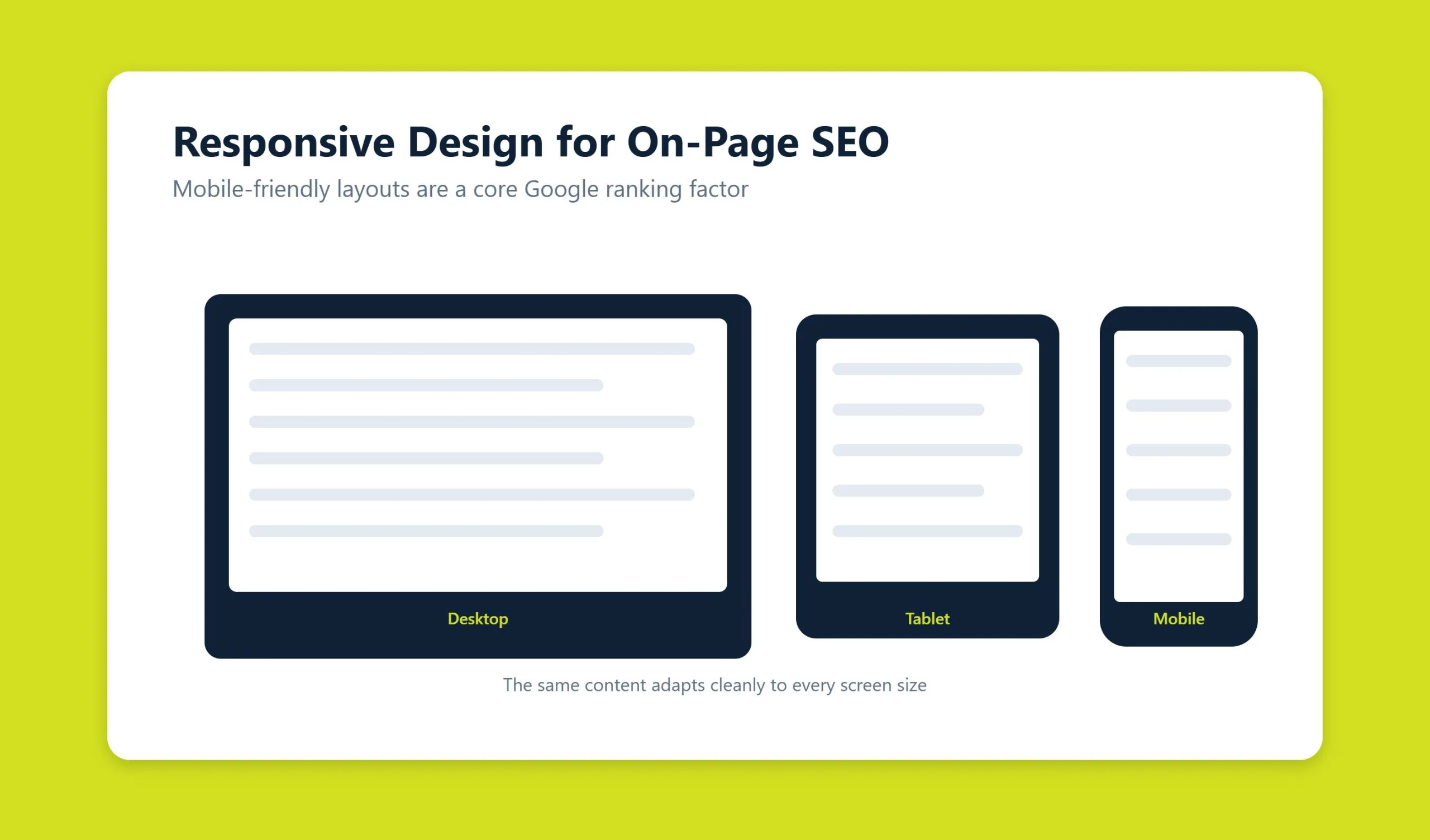
- Cross-platform and mobile responsiveness. Pages must display correctly everywhere, from an older four-inch smartphone to a large 4K display. Nothing should break, overflow or drift out of place. With Google’s mobile-first indexing, responsive design is no longer optional.
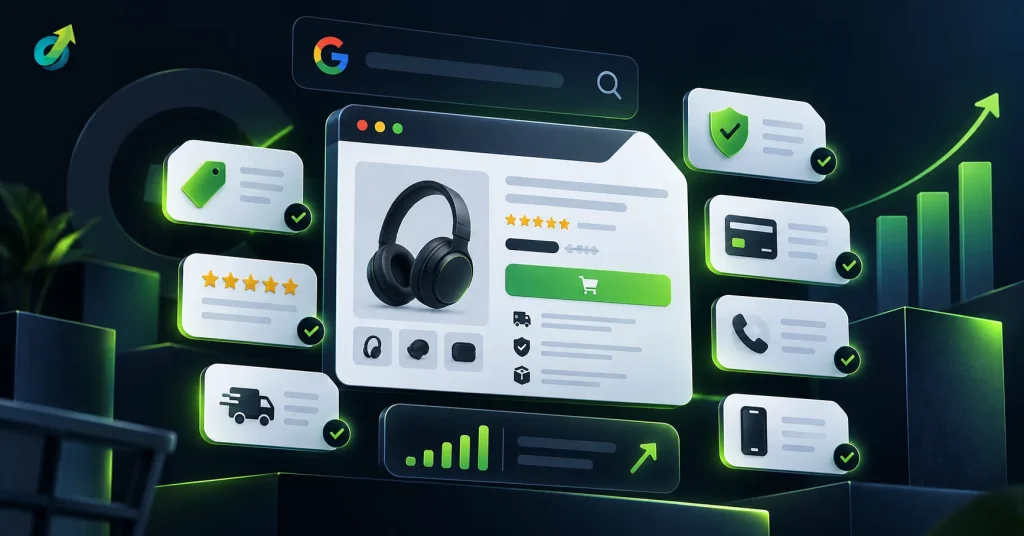
- Structured data and schema markup. Clean code where every element sits in its proper place helps search engines identify headings, images, tables, lists and paragraphs. Schema.org markup goes further, helping search engines understand your content and present richer, more informative results. This is especially valuable for commercial and corporate sites focused on sales and brand building.
If technical issues pile up, a technical SEO audit is the fastest way to find and prioritize them before they drag down the rest of your work.
Where content and code meet: page-level optimization
Some tasks sit on the border between engineering and editing. Direct page optimization is the clearest example:
- Keyword research and mapping. Building a keyword map, grouping keywords into clusters, and distributing terms of different themes and search volumes across the most relevant pages. Crucially, this should happen before you write any text. That way you produce content that is both expert and optimized from the start. Retrofitting optimization onto already-published text is the wrong way around.
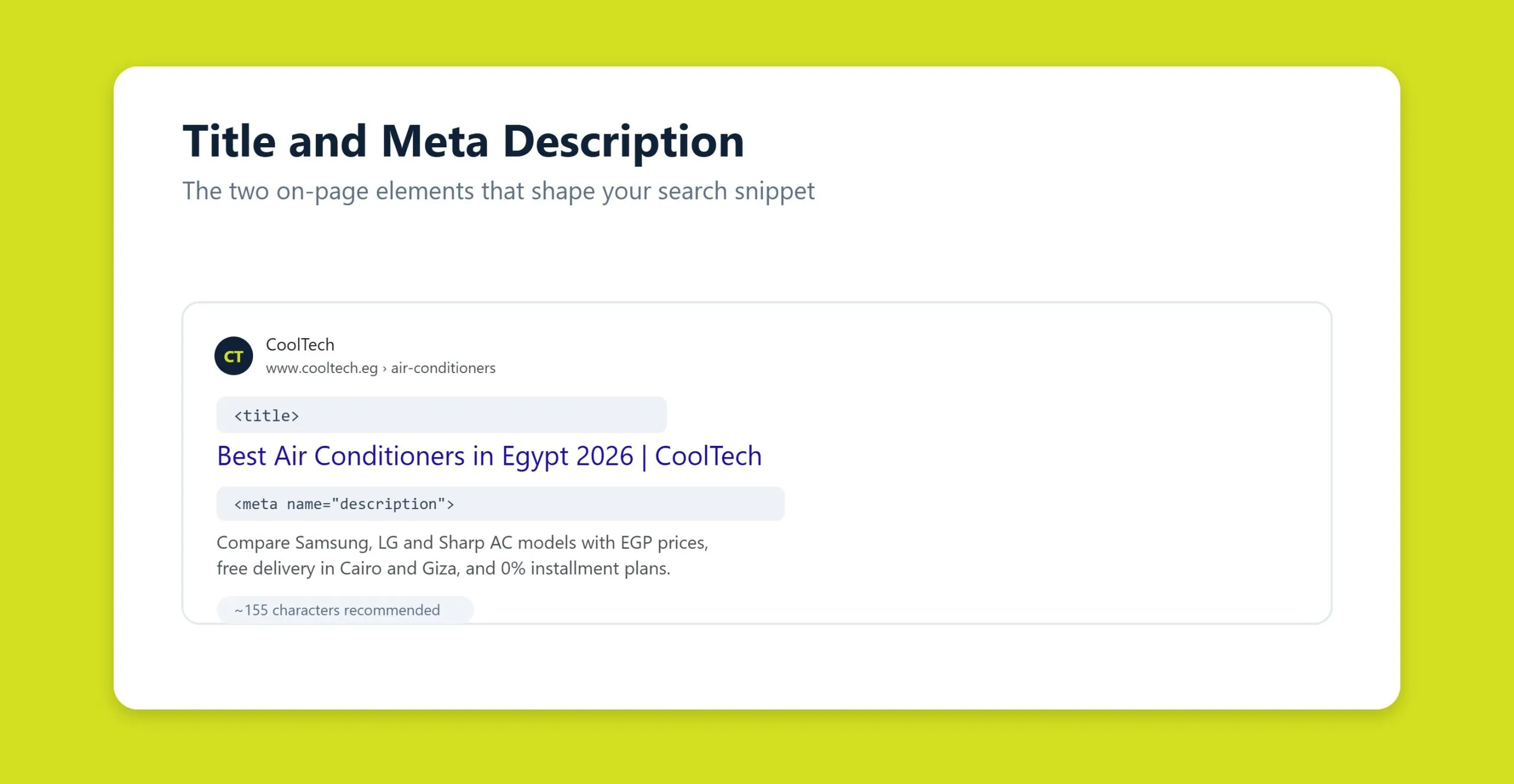
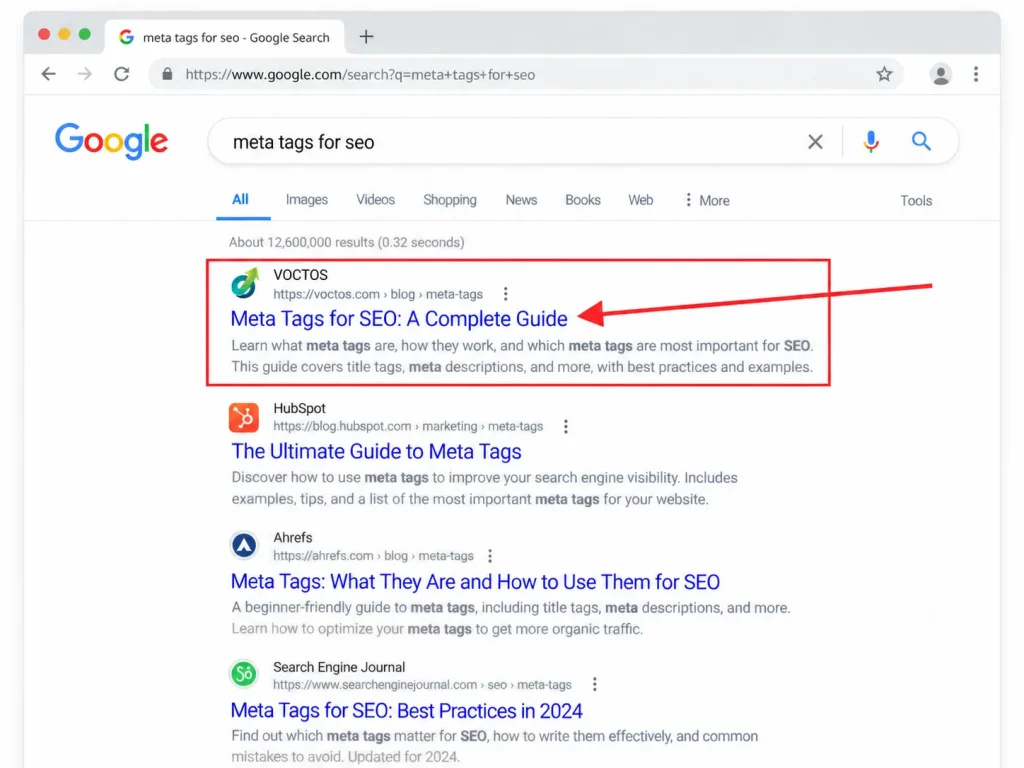
- Meta tags. The title tag names the page in the browser and in search results. The meta description, a short one-sentence summary, influences click-through and often appears in the snippet, the most visible element of a search listing. It previews what a user will see if they click. Both should reflect the topic and include your most important keywords, but always within reason. Overstuffing invites penalties.
- Alt attributes. The alt attribute, literally “alternative text,” was originally created to describe images when they could not load. Today it serves accessibility and search: it helps Google understand image content and lets you naturally reinforce a page’s topical relevance without disrupting the reader experience.
Another substantial part of on-page SEO is internal linking, which straddles the technical, editorial and usability sides all at once. Placing links thoughtfully between internal pages improves your structure and makes it easier for visitors to move between sections without relying solely on navigation menus. For search engines, internal links distribute semantic weight across pages: a link using relevant anchor text is itself a promotion signal. The same principle governs backlink building in off-page SEO, which we turn to next.
There are many more on-page techniques, and the exact mix depends on your site type, CMS and goals. A structured approach, whether guided by in-house expertise, an SEO audit, or specialist consultants, keeps the work coherent rather than scattered.
What is off-page (external) SEO?
Off-page SEO is the set of activities designed to increase your site’s authority by building its reputation on third-party resources. A useful analogy is PR, but a hybrid kind: part journalistic outreach to real people and potential visitors, part technical signaling to search engines. You are promoting your site to humans and crawlers simultaneously.
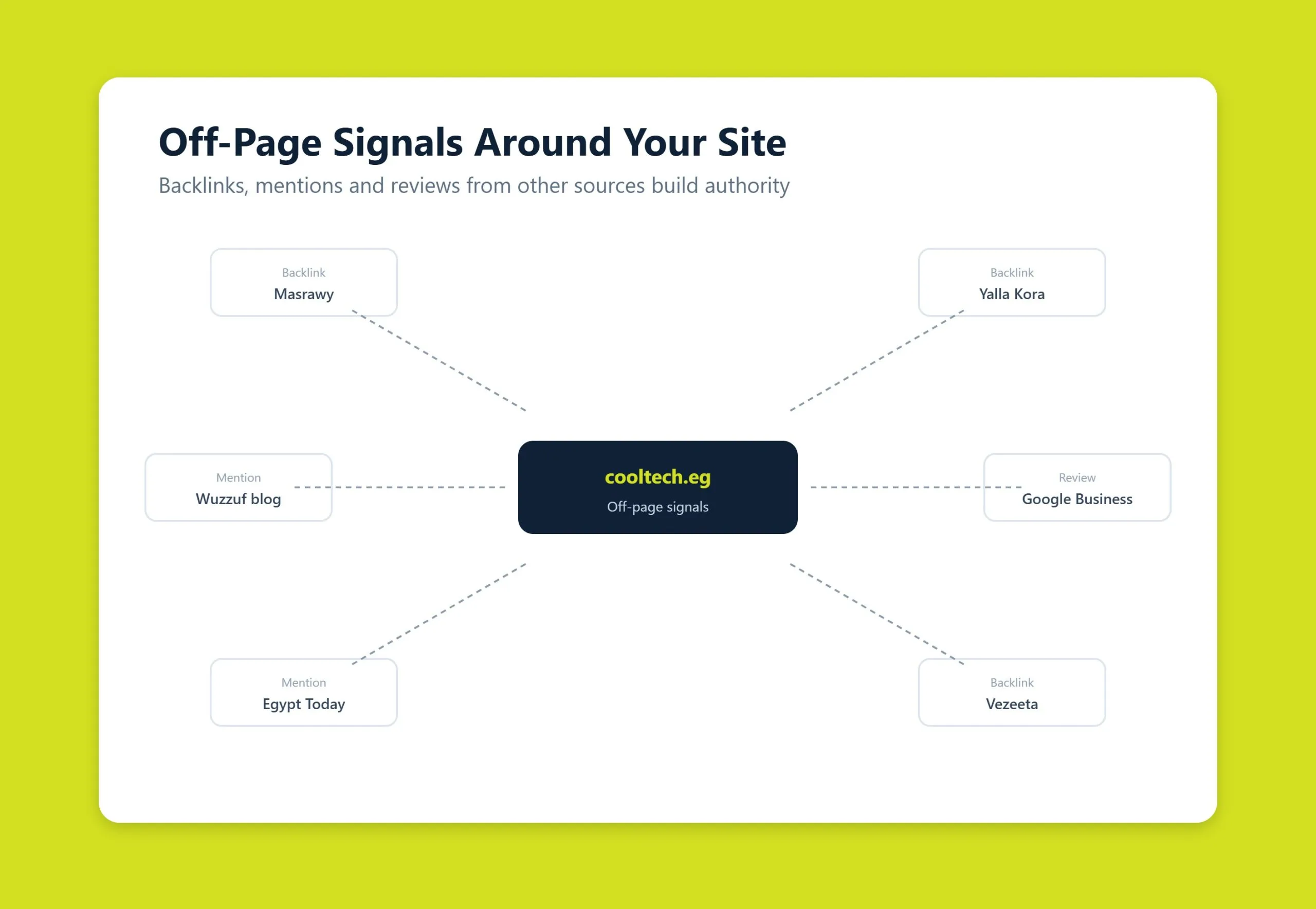
The main off-page factors that improve search visibility are:
- Backlink profile. The quantity and, more importantly, the quality of links to your site placed on external resources. We cover the techniques below.
- Brand mentions. Almost pure PR, working on the same principle that you can rarely have too many. But as always, the details matter.
- Social presence. How well your company, products and services are represented across social platforms. The web has shifted so much that even an excellent website may underdeliver if you neglect a deliberate social media strategy, because a large share of users now search inside social platforms rather than through classic search.
- Social signals. Likes, shares and comments flow directly from social presence. The principle is simple: more engaged followers mean more reactions, and more reactions widen reach and brand recall, though Google has stated that social engagement counts are not a direct ranking signal. Social platforms can also send excellent, commercially valuable traffic in their own right.
- Domain authority. Two things count here: the age and the cleanliness of the domain’s reputation. Buying a domain with a twenty-year history is worthless if that domain was previously involved in spam or fraud. A tainted history can suppress results for a long time.
Backlinks and why they still matter
Backlink building borrows a concept from academia: the citation index used to gauge a researcher’s standing. On the web it works similarly. The more sites link to your pages, and the more authoritative those linking sites are, the more valuable your resource appears to search engines. The citation index no longer dominates the way it did ten or fifteen years ago, but it remains a meaningful factor among many.
How links are earned
Links are acquired two main ways: earned and paid. If you create outstanding content, other site owners, publishers and creators are likely to link to it, but only once your project is already known and visible. That is the familiar chicken-and-egg problem: to become known you need SEO, which is one reason links are sometimes paid for.
The risks of buying links
Paying for links demands real caution and a professional approach. First, search engines have long penalized sites for manipulative paid links, and Google’s link spam policies are enforced through automated systems that discount unnatural links. Second, advertising-disclosure regulations in many markets add legal constraints, with real financial penalties for both buyers and sellers of undisclosed paid placements.
So-called white-hat SEO means acquiring links only through direct, manual outreach and genuine relationships with site and channel owners. There are countless nuances to hitting the mark: maximizing impact without wasting budget or courting legal trouble. This is exactly why link building is best entrusted to experienced specialists. Links can take the form of clear advertising, contextual mentions, native content or sponsored reviews, each with its own trade-offs depending on your strategy and industry.
Brand mentions as a promotion tool
Brand mentions can be a direct byproduct of sponsored articles or a distinct discipline in their own right. Often brands don’t even realize they are generating newsworthy events. A manufacturer that wins a significant supply contract in another region or country has produced a genuine news item that trade media and specialist outlets will happily cover, usually with a link back to you. Cultivating these moments through content marketing and PR is one of the most durable off-page tactics.
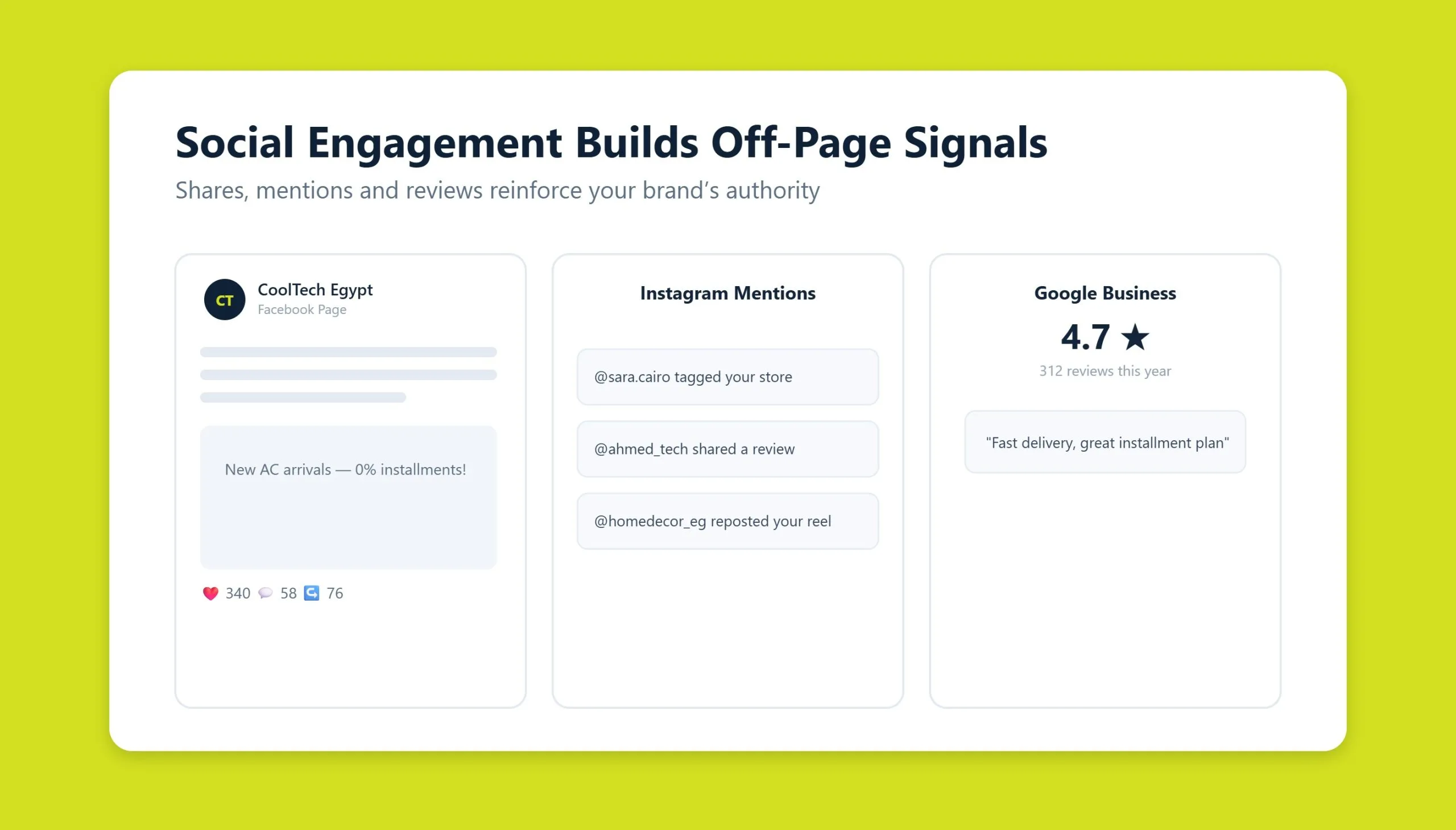
Generating social signals, like earning links and mentions, can be done honestly or not. Quality content and smart social work, including the occasional viral post, is the path to success. Using artificial engagement services is a short road to nowhere, ending in demotion and account bans. It is not a risk worth taking.
Local SEO and domain reputation
For businesses that serve a specific area, local SEO is a distinct off-page pillar. A complete and accurate Google Business Profile, consistent name-address-phone citations across directories, and genuine customer reviews all strengthen local visibility and feed the map pack that increasingly dominates location-based queries.
Domain authority deserves a final word. A perfectly clean domain with no history is both good and bad. Good, because there is nothing to fix and no one has damaged its reputation before you. Bad, because brand-new domains usually take time to build the signals that support competitive rankings, though Google has repeatedly said there is no formal “sandbox” filter. This is why it pays to register your domain early, before you even begin building the site. An aged domain is worth considering only if it is genuinely uncompromised; otherwise a fresh domain that simply needs time to mature is the safer choice.
How on-page and off-page SEO work together
Combining internal and external work is the single non-negotiable condition for results. If your site carries poorly written, badly formatted text with no meta tags and stolen images, and it stalls on every click, no amount of external SEO will save it. Equally, there is little hope of breaking into the leaders without the support that off-page SEO provides.
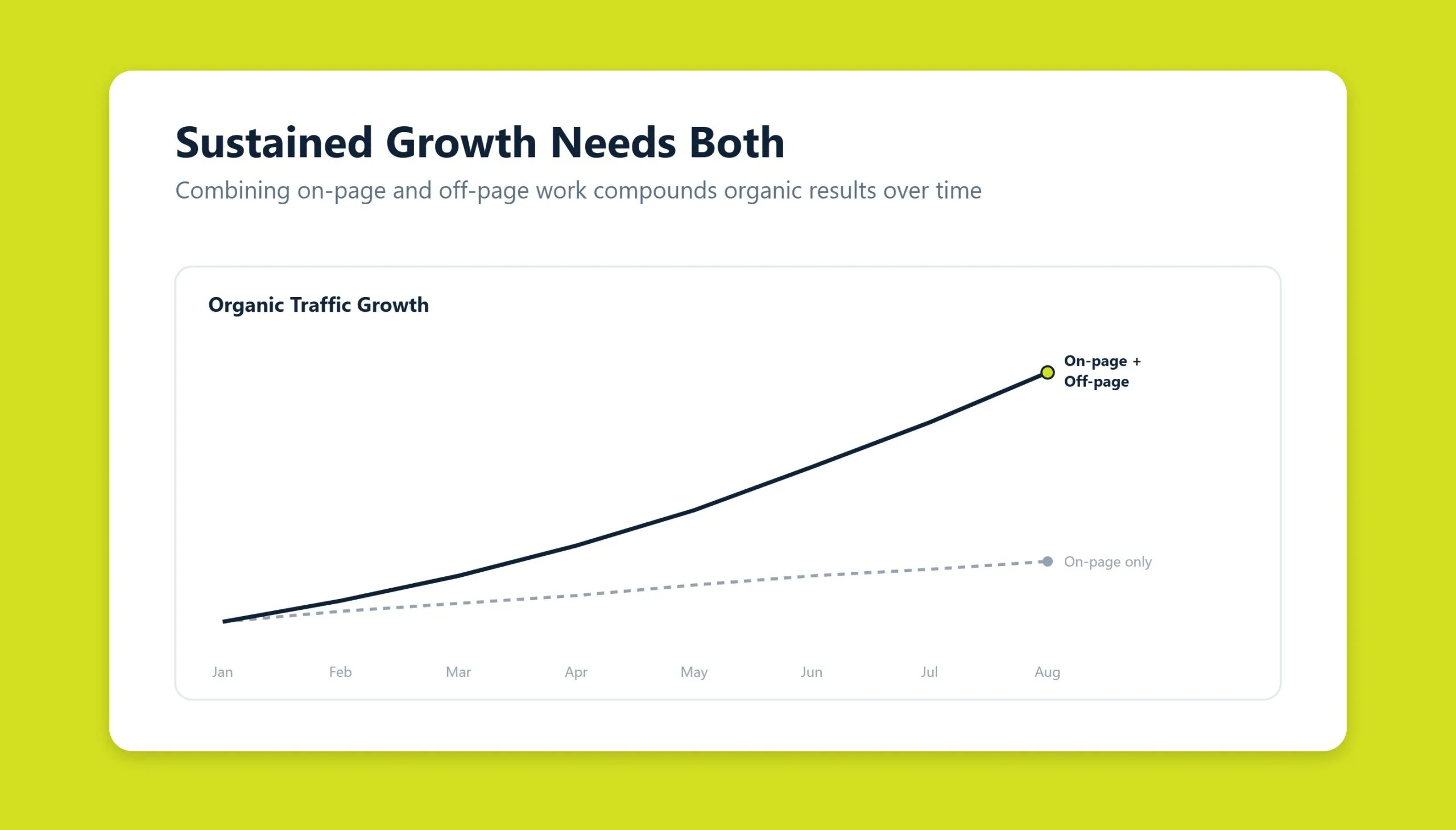
One truth stands above the rest: site quality comes first, always. Excellent text, strong visuals, original video and flawless technical execution are the things without which a site can never succeed. Off-page work amplifies a good site. It cannot manufacture one.
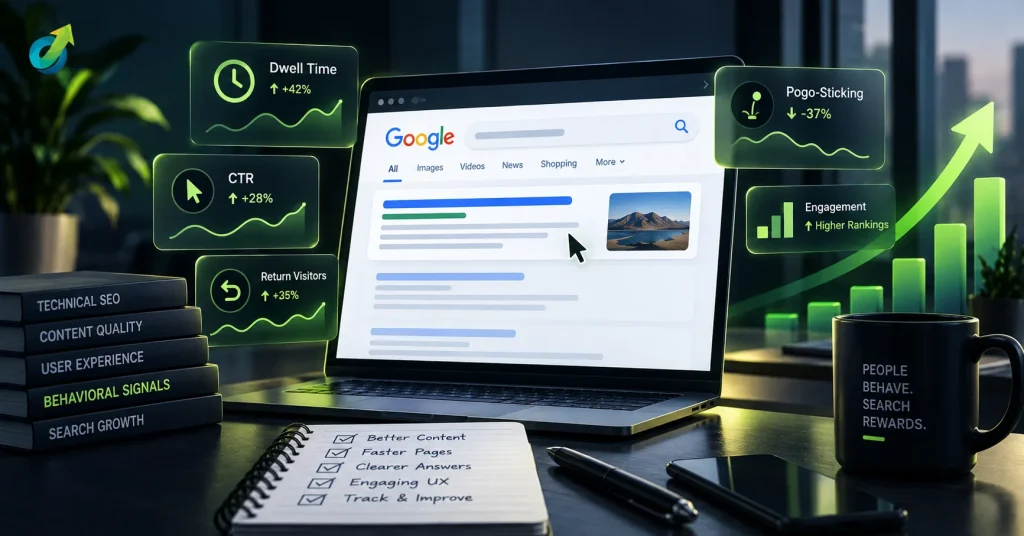
Remember, too, that almost every ranking factor is knotted together with the others. Picture the chain: you have a good site on excellent hosting and a clean domain. You publish genuinely compelling, timely content dressed in original visuals, say the launch of a new product. You then earn a few reviews on influential publications, reviews that are actually interesting because the product is good. People start sharing and liking them, and you accumulate social signals. Visitors arriving from those articles browse your other pages and spend real time on site, which quietly feeds you positive behavioral signals. Every link in that chain lifts your position in search results, and each one depended on the one before it.
To capture all of this, you need tools that let you analyze results and adjust strategy in real time. Google Search Console reveals how your pages perform in search, which queries drive impressions and clicks, and where indexing or technical issues arise. Google Analytics 4 (GA4) tracks visitor behavior, engagement and conversions once people land. Together they form the free, authoritative foundation of modern measurement, and dedicated platforms add deeper keyword, backlink and competitive analysis on top.
Tools for analysis and optimization
Most popular content management systems offer plugins and modules that both analyze and assist with SEO. For WordPress, the world’s most widely used CMS, tools such as Yoast SEO and All in One SEO exist in free and premium tiers, handling meta tags, sitemaps and structured data. Comparable options exist for every major platform, and many commercial systems now bundle SEO modules into their base packages or offer them as add-ons. Those costs are usually an investment rather than an expense, because they genuinely streamline the work.
Web-based services add another layer, letting you audit your site’s quality, positions and much more. Crawlers such as Screaming Frog and Sitebulb help diagnose technical issues at scale, while platforms like Ahrefs and Semrush cover keyword research, backlink analysis and competitor tracking. Many of these tools are built for professionals and are not always simple to use, which is often why it makes more sense to commission SEO services than to master every nuance yourself.
Looking ahead, search itself is changing. AI-driven answers and generative engines are reshaping how people find information, rewarding content that is clear, authoritative and well-structured enough for machines to cite. Optimizing for this new landscape, often called GEO or AI SEO, builds naturally on the same on-page and off-page foundations covered here. Get the fundamentals right, and you are already positioned for whatever search becomes next.
Frequently asked questions
What is the difference between on-page and off-page SEO?
On-page (internal) SEO covers everything you do on your own website: technical performance, content quality, site structure, meta tags and internal linking. Off-page (external) SEO covers everything you do beyond your site to build authority, primarily backlinks, brand mentions, social signals and local citations. On-page is fully within your control, while off-page is influenced but not owned.
Which matters more, on-page or off-page SEO?
Site quality comes first, so on-page SEO is the foundation. A fast, well-structured, genuinely useful site is the prerequisite for everything else. That said, off-page SEO is what amplifies a strong site and helps it compete in crowded results. The best outcomes come from doing both well, because they reinforce each other rather than substitute for one another.
Are backlinks still important for SEO in Google?
Yes. Backlinks remain a meaningful ranking factor, though they no longer dominate the way they once did. Quality and relevance matter far more than raw quantity. A handful of links from authoritative, topically relevant sites outweighs hundreds of low-value ones. Manipulative or purchased links carry real risk, since Google’s link spam systems discount unnatural links and can trigger penalties.
How do I measure SEO performance?
Start with Google Search Console to see how your pages appear in search, which queries drive impressions and clicks, and whether any indexing or technical issues exist. Add Google Analytics 4 (GA4) to track visitor behavior, engagement and conversions after people arrive. For deeper keyword, backlink and competitor insight, layer in dedicated platforms such as Ahrefs or Semrush.
How long does SEO take to show results?
SEO is a long-term investment rather than a quick fix. New domains usually need time to accumulate the content, links and behavioral signals that support competitive positions, and even established sites usually need several months of consistent on-page and off-page work before meaningful gains appear. The compounding nature of SEO means results tend to accelerate over time as quality, links and behavioral signals build on each other.
Related guides
Don't miss the chance to
make your website more visible!
Initial consultation and
audit of the current situation

Read also

Article Behavioral Factors in SEO: What They Are and How to Improve Them
Article JavaScript Links Are Hiding MENA Sites From ChatGPT and Claude

Article VOCTOS Is a Top SEO, PPC and SEM Company in Egypt on Clutch for 2026
Article Commercial Ranking Factors: The Complete List

Article The Title Meta Tag: What It Is and How to Write It
Article The Role of Meta Tags in Search Engine Optimization
Article Can You Sue an AI for Defamation? Where the Law Stands

Article Cloudflare’s 15 September AI Crawler Defaults: The Check Gulf and Egypt Brands Should Run Today




Real Results
More Wins
SEO & GEO for Delta Medical Labs
 GEO
GEO
1M+ monthly organic visits, 159,200 ranked keywords, 5,570 pages cited by AI engines, and 1,186 #1 rankings in KSA.

Arabic SEO, GEO & guest posting for VPNly
 SEO
SEO
65K peak monthly organic visits, 55 guest posts, and 149 pages cited by AI engines.

SEO & GEO for Ogaei Virtual Care
GEO
From 3 to 7,931 monthly organic clicks in 7 months, 2.9M+ impressions, and 40+ keywords in Google’s Top 10.

SEO for Eduverse
SEO
12× search traffic in 10 months, 45% of target keywords in the top 5, and 55% in the top 10.
Trusted by