
Amanleek SEO Case Study: From an Unreadable Angular Site to #1 for “Best Insurance Company” in Egypt
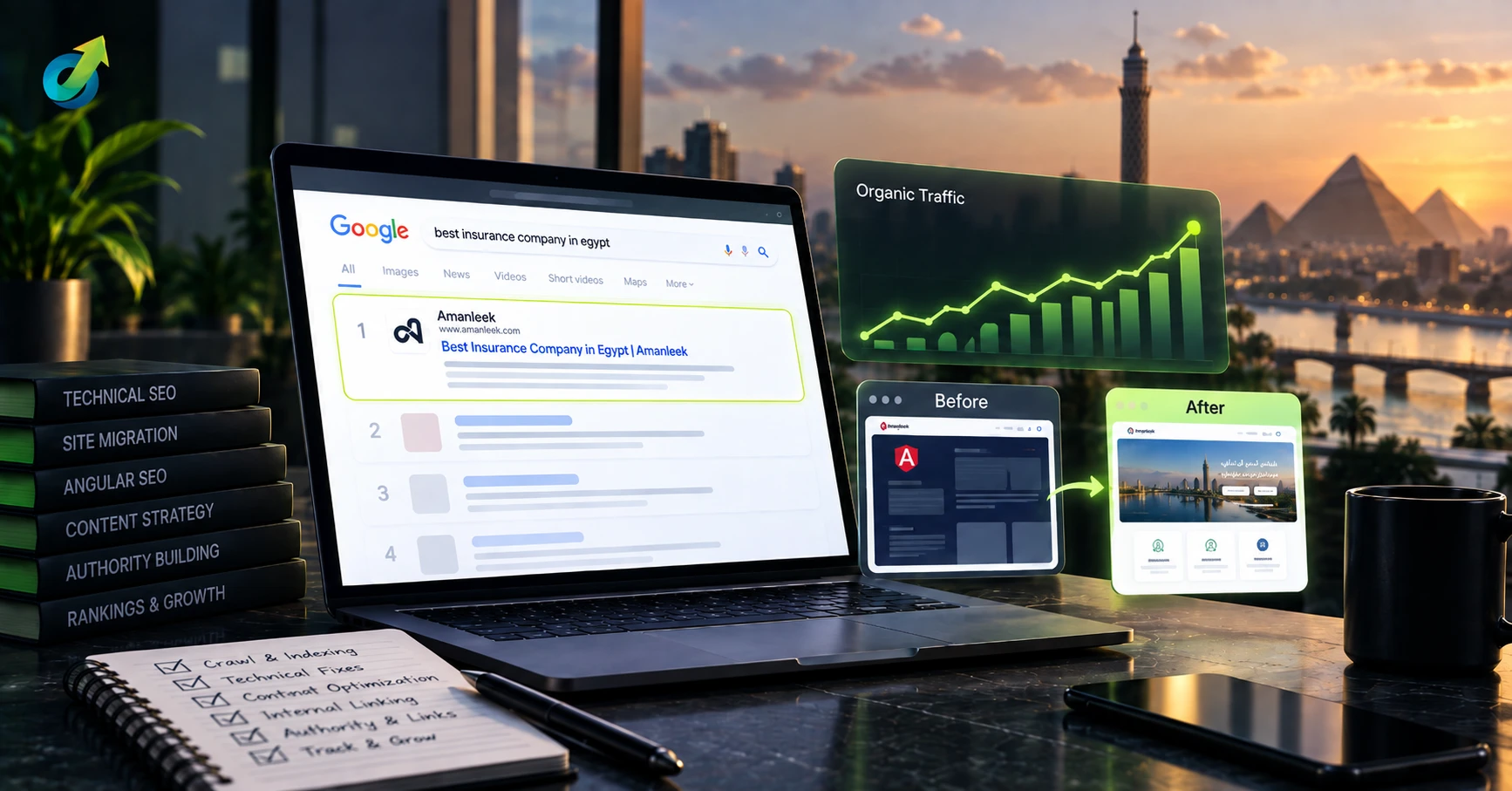
Amanleek’s website was nearly unreadable to Google when we started in June 2025.
The Egyptian insurance marketplace ran its Arabic and English front end as an Angular app, and that app sent crawlers an empty page. Within four months the rendering fix was specified and the keyword map rebuilt. By month four, Google’s AI Overviews were citing Amanleek for three commercial health-insurance queries.
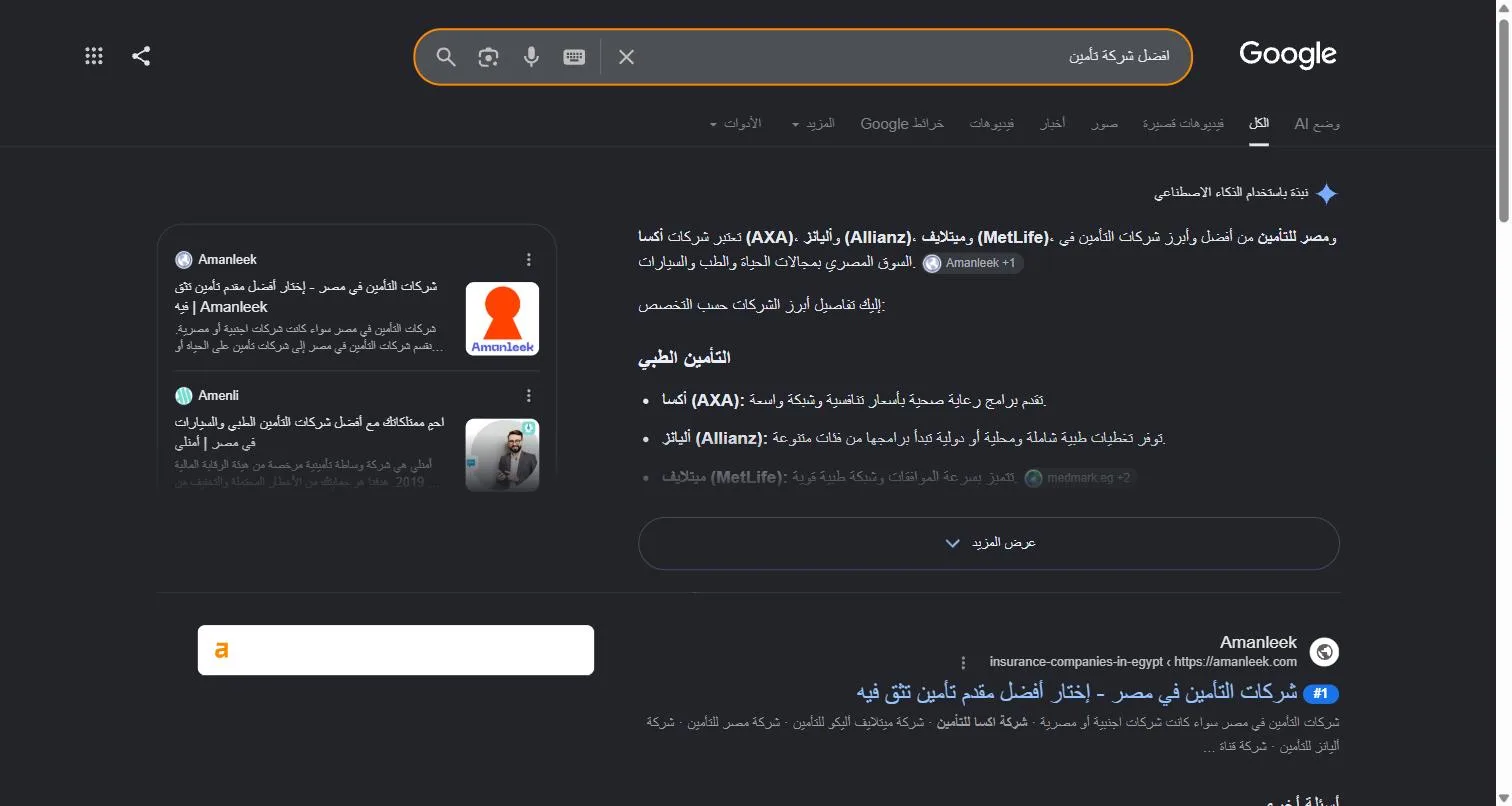
On 28 September 2026, amanleek.com ranks first in Google Egypt for “افضل شركة تأمين” (best insurance company). It is also the first source cited in the AI Overview for that query.
This write-up is built from the project’s own files. That means the June 2025 technical audit, the August competitive benchmark, Search Console exports, the keyword and meta-tag sheets, the Trello board and the September 2025 AI Overview report.
Current rankings and Semrush figures were checked on 28 September 2026. Where we cannot prove what caused a result, we say so.
Who is Amanleek, and what did it need from search?
Amanleek is an online insurance broker, so it needs search traffic from people who are comparing policies and ready to buy one. It has held approval from Egypt’s Financial Regulatory Authority since November 2019, compares health and car insurance offers from 18 insurers, and sells through its website and apps. Its commercial pages had to rank for the Arabic queries people type while they compare policies.
The audience is almost entirely local. In the 28 days before our August 2025 review, GA4 recorded 38,296 active users, and 36,684 of them, about 95.8%, were in Egypt.
Search Console showed 1,440 clicks from 195,000 impressions in the same window, down from 1,580 the period before, at a 0.7% click-through rate and an average position of 14.6. The site was being seen, then skipped.
Why couldn’t Google read the site?
Google could not read Amanleek because the server sent an empty page. The Angular front end used client-side rendering, so the first HTML response held a bare <app-root></app-root> tag and a set of scripts. Headings, copy and links, everything a crawler needs, appeared only after JavaScript ran in a browser.
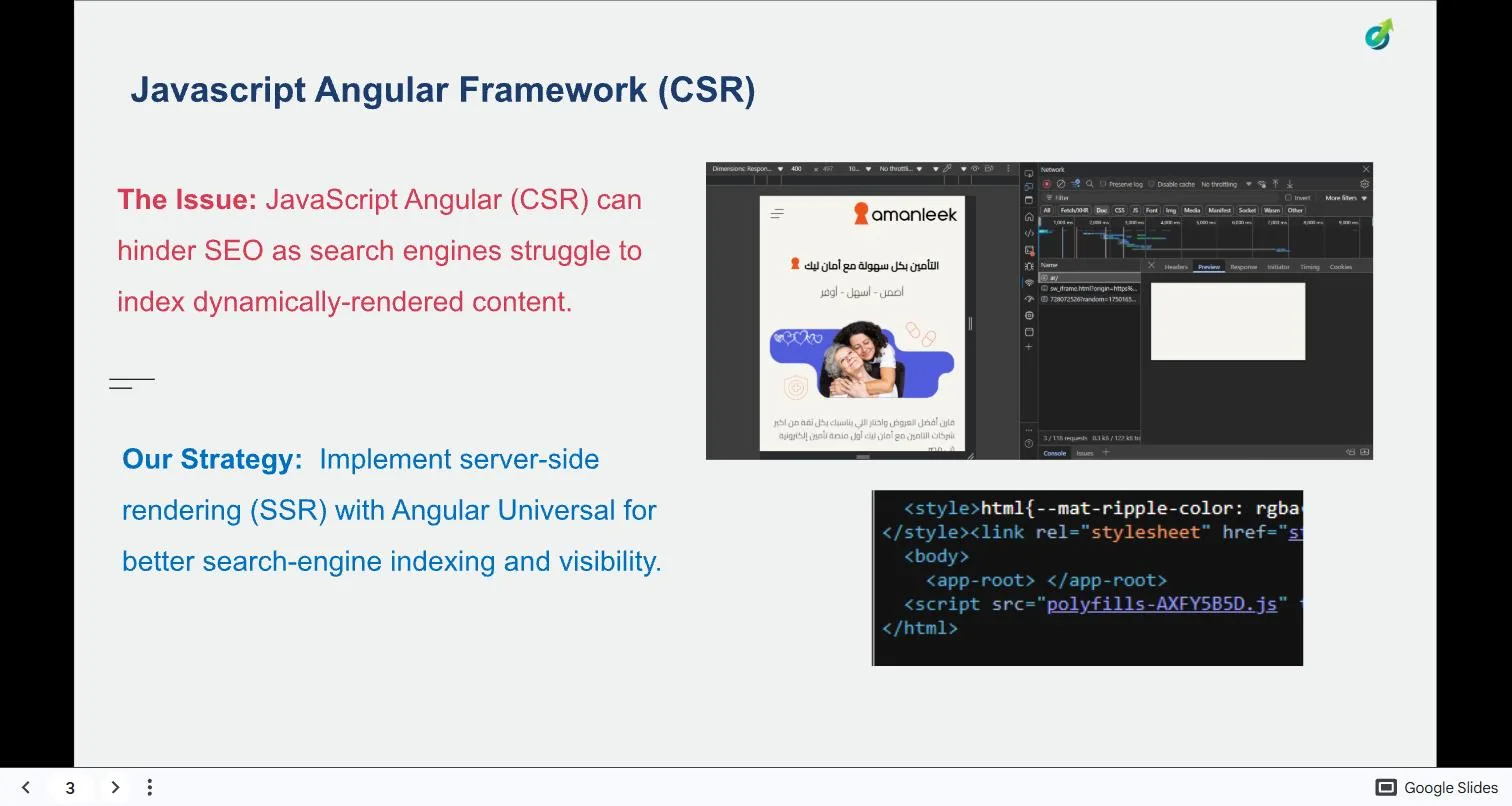
Google does render JavaScript, but it does so in a second pass that is slower and less predictable than reading HTML, and most AI crawlers do not render it at all. Vercel’s analysis of AI crawler traffic found that GPTBot and ClaudeBot fetch JavaScript files but never execute them. For those systems, a client-rendered page is an empty page.
That hurt a broker more than it would hurt most sites. Amanleek’s money pages, the comparison and product pages, were exactly the ones built in Angular, while the older WordPress blog rendered normally. The pages that should have sold policies were the least readable pages on the domain.
The June 2025 audit: 10 issues, 7 of them major
The audit found 10 technical issues and rated 7 as major. Rendering sat at the top, but it was not alone. Duplicate content across the domain and a subdomain capped what content could achieve. So did missing meta tags, links generated by JavaScript and a robots.txt with the wrong rules.
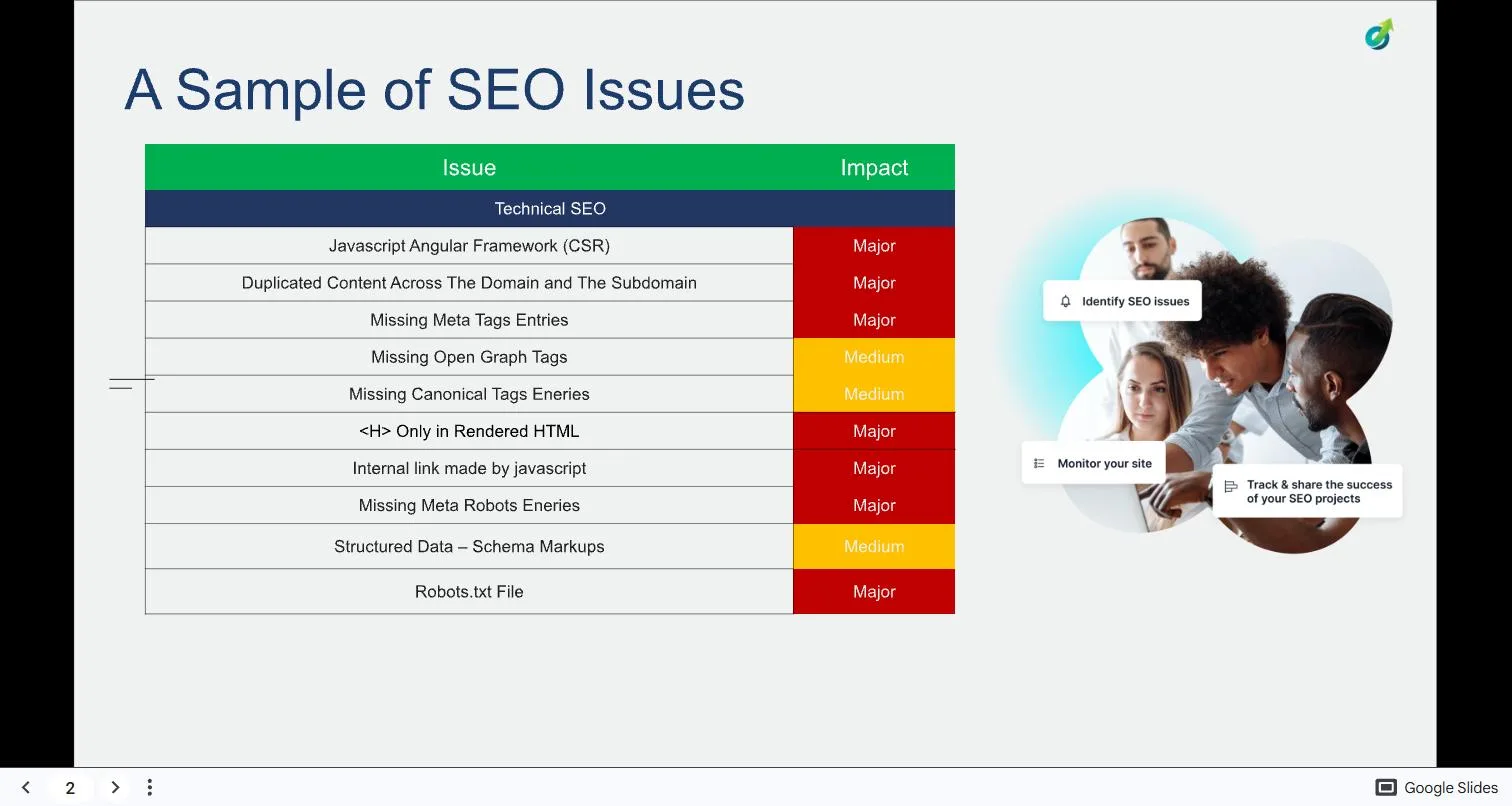
| Issue | Impact | What we specified | Status on 28 Sep 2026 |
|---|---|---|---|
| Angular client-side rendering | Major | Server-side rendering with Angular Universal | Live: raw HTML carries ng-server-context=”ssr” |
| Headings only in rendered HTML | Major | Headings in the initial HTML via SSR | Live: 33 H1 to H3 headings in raw HTML |
| Internal links made by JavaScript | Major | Standard <a href> links | Live: 50 crawlable links in raw HTML |
| Missing meta tag entries | Major | Titles and descriptions for 9 Arabic and 8 English pages | Live on /ar/ and /en/, word for word as we wrote them |
| Robots.txt with the wrong rules | Major | Rewritten rules plus an HTTPS sitemap line | Live |
| Duplicate content, domain and subdomain | Major | 301s from the subdomain plus canonicals | Not verifiable from outside |
| Missing meta robots entries | Major | An explicit robots meta tag per template | Not present on /ar/ (defaults to index) |
| Missing Open Graph tags | Medium | og:title, og:description, og:image, og:url | Live |
| Missing canonical tags | Medium | Self-referencing canonicals | Still missing on /ar/ |
| No structured data | Medium | Organization and page schema recommendations | Still missing on /ar/ |
Four of the ten are still open on the homepage today. We list them because a status column that only ever says fixed is not a status column. Specifying a fix and shipping it are different jobs, and on Amanleek the client’s own developers owned the shipping.
Is your site built on React, Angular or Vue? If you are not sure what Google receives from it, show me what Google receives from my site and we will pull the raw HTML of your key pages.
Server-side rendering, before and after
Server-side rendering moved the content into the first response. The Arabic homepage now returns 347,864 bytes of HTML before any JavaScript runs, with 33 headings and 50 crawlable links. Angular’s own ng-server-context="ssr" attribute confirms the server rendered the page.
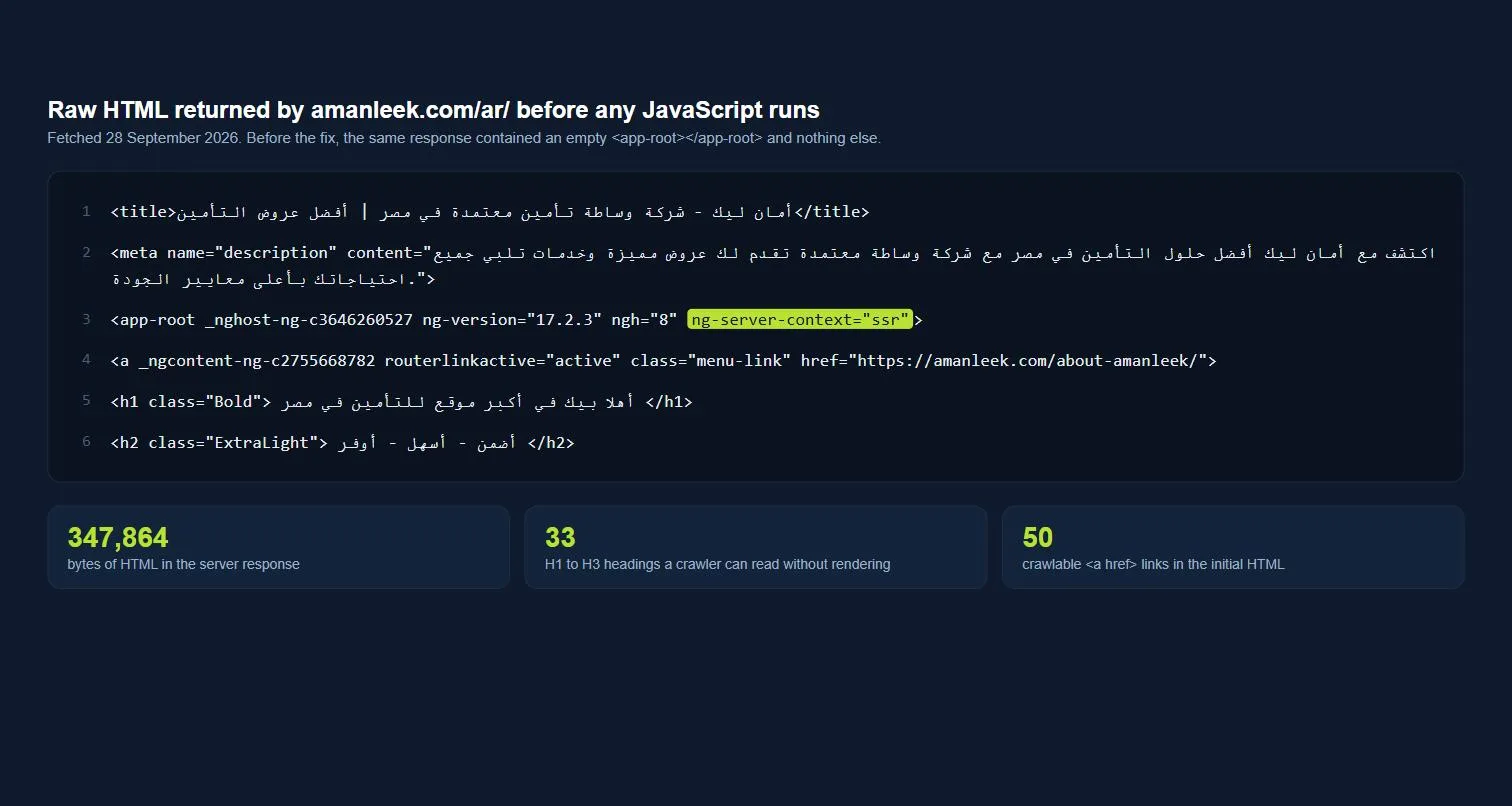
We cannot put a date on the switch from the outside, and we will not guess one. What we can show is the same URL, fetched the same way, before and after. The fix running today is the one we specified in June 2025.
The sitemap gap closed the same way. In June 2025 the XML sitemap listed blog posts and not one main commercial page.
Today the sitemap index includes a dedicated file with 34 Arabic and English URLs. It covers the homepage, every insurance product page, contact and about.
How did we decide which keywords to fight for?
We chose keywords a broker can realistically win. Egypt’s large insurers dominate their own brand terms, and outranking them on their names was never the goal. So we mapped Amanleek to comparison and broker intent: “شركة وساطة تأمين” (insurance brokerage), “عروض شركات تأمين طبي” (health insurance offers), and the individual and corporate health queries.
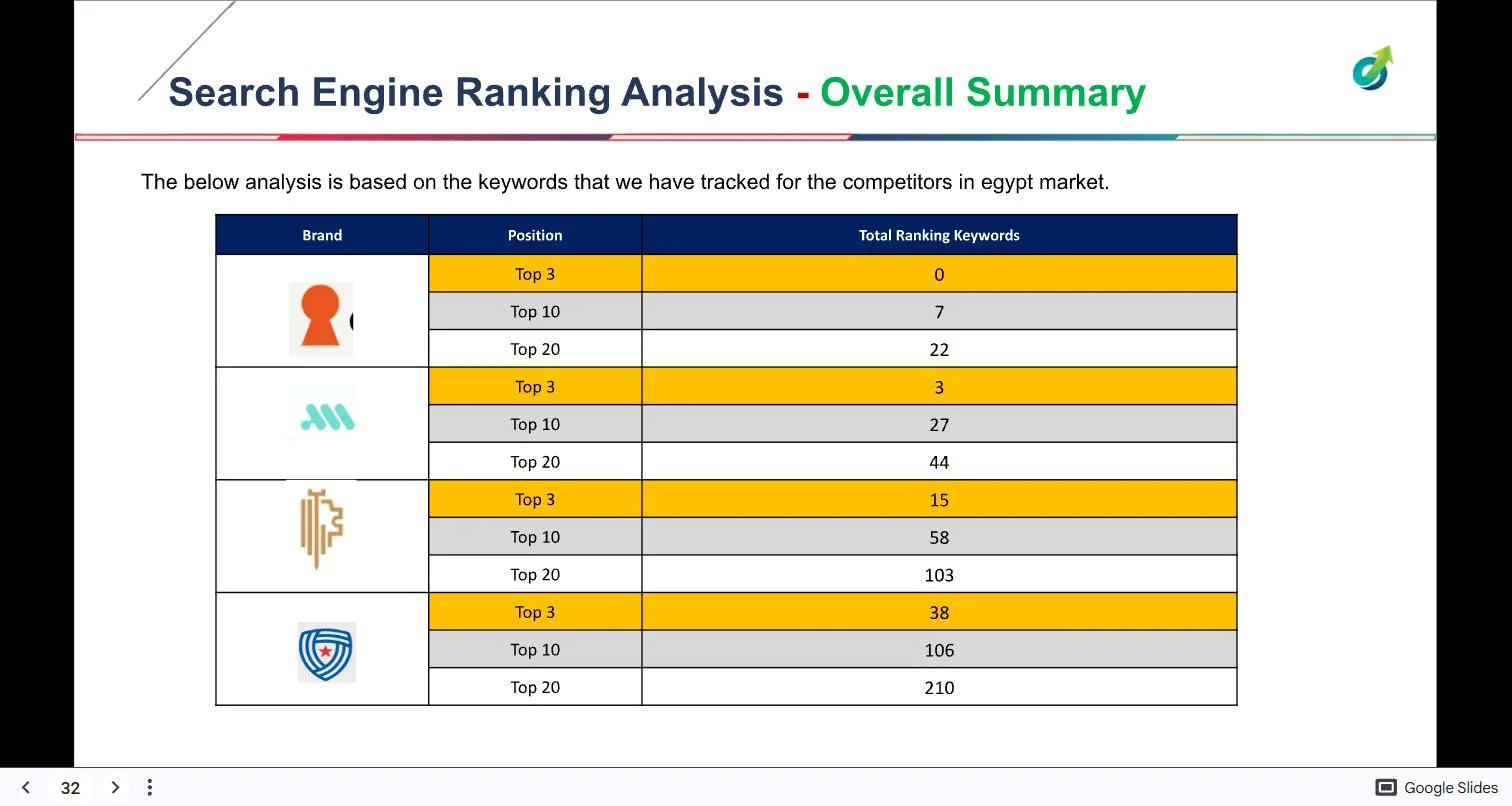
The August 2025 benchmark set the size of the gap. On the keyword set we tracked in Egypt, Amanleek had 0 keywords in Google’s top 3, 7 in the top 10 and 22 in the top 20. The strongest of three direct competitors had 38, 106 and 210.
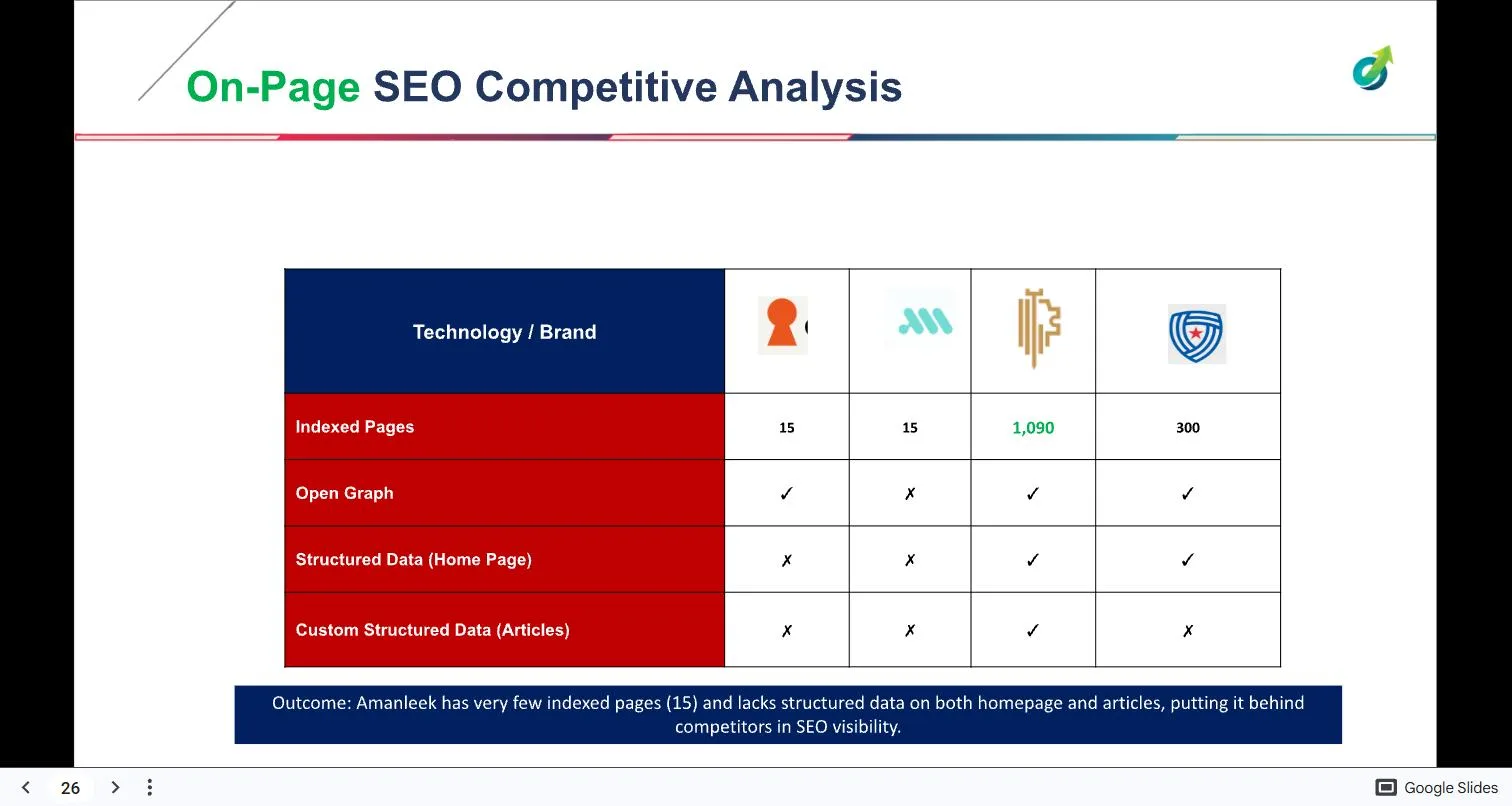
Indexation told the same story. A site: check returned 15 indexed pages for Amanleek, against 1,090 and 300 for two of the three competitors. None of Amanleek’s templates carried structured data, on the homepage or on articles.
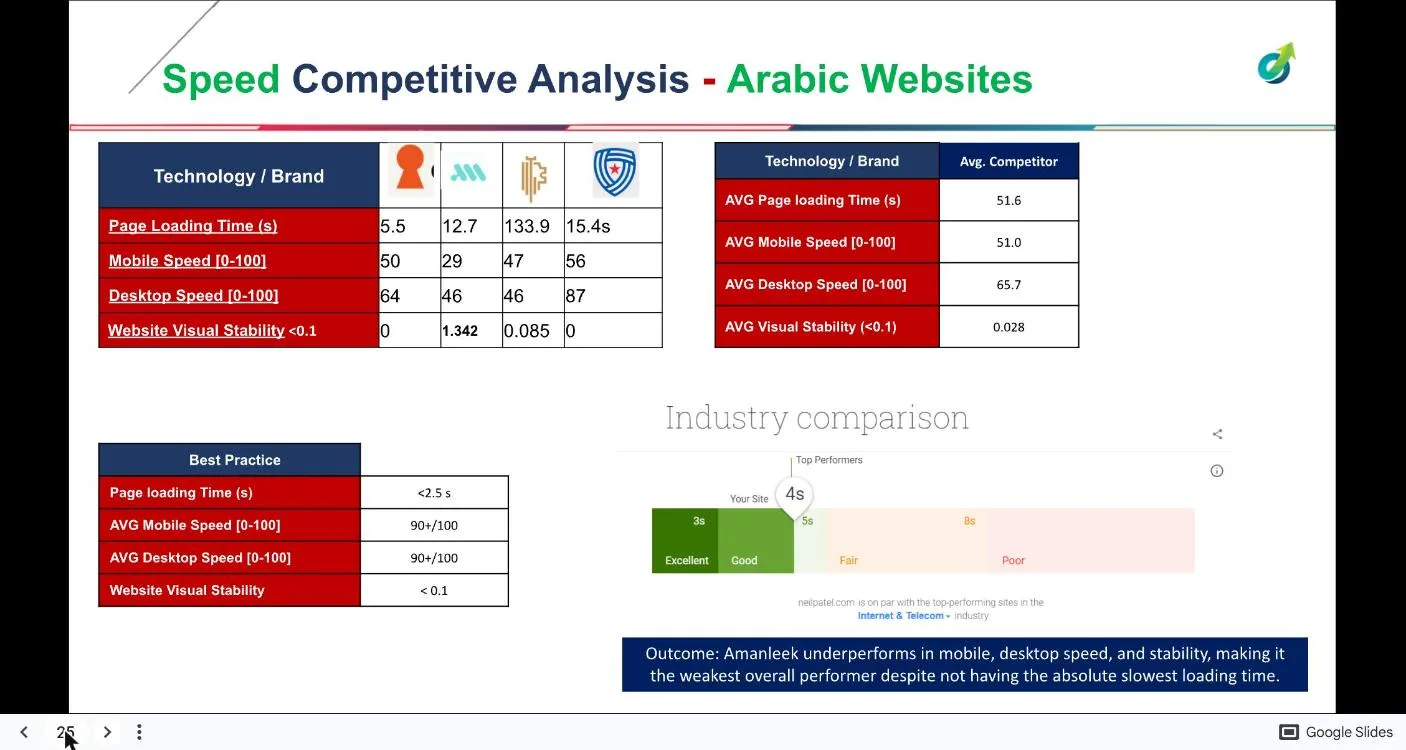
Speed was not the problem it looked like. Amanleek loaded in 5.5 seconds with mobile and desktop scores of 50 and 64, against competitor averages of 51.0 and 65.7, and its layout shift was 0, which put it in the middle of the pack.
Rendering and indexation were the bottleneck, so that is where the first month went.
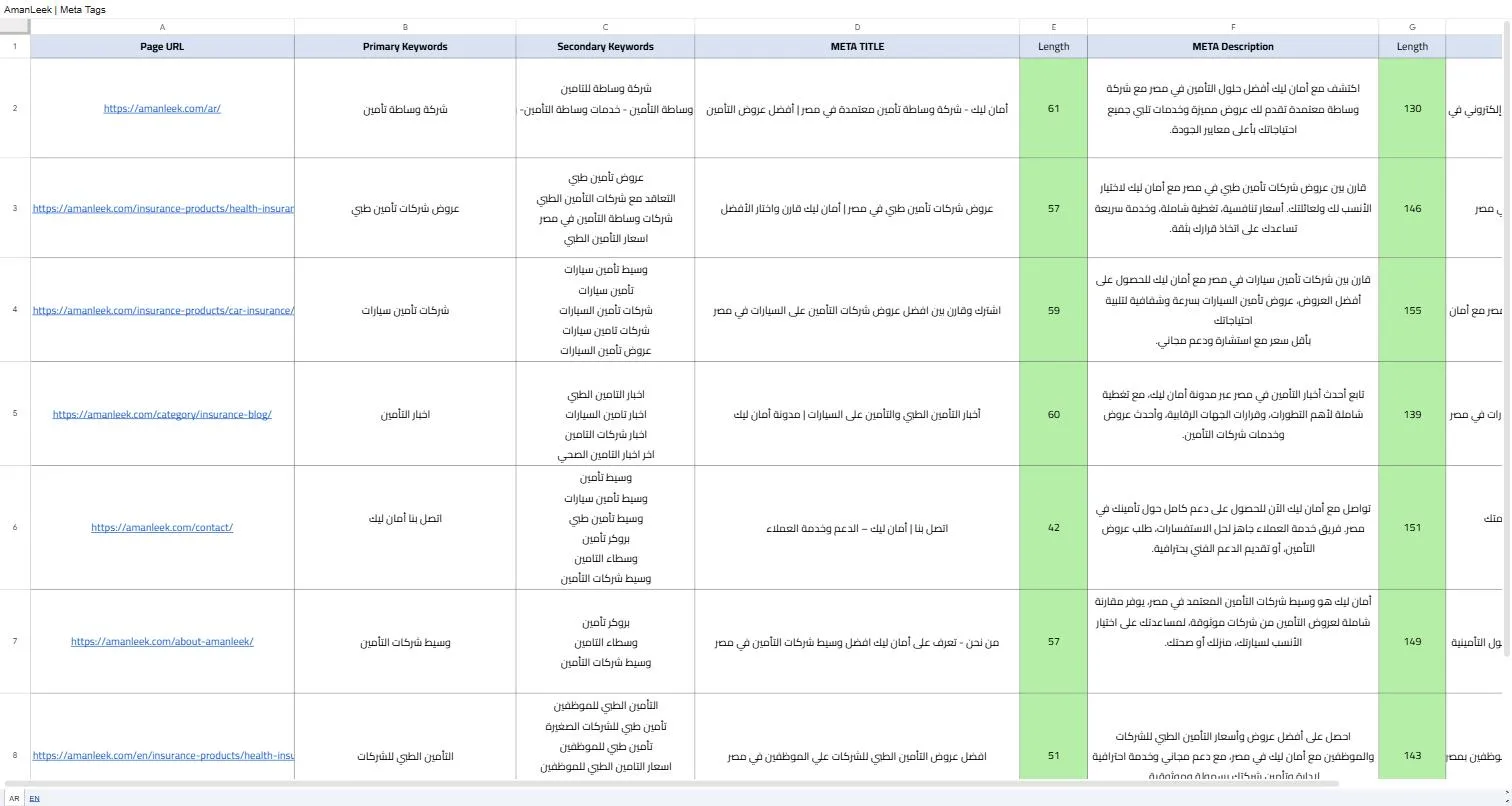
Every main page then got one primary keyword, secondary terms, and a title and description in Arabic and English.
The Arabic homepage title we wrote is the one live today: “أمان ليك - شركة وساطة تأمين معتمدة في مصر | أفضل عروض التأمين”. So is the English title, “Amanleek | Best Insurance Brokerage Platform in Egypt”.
The part that went wrong: 43 queries losing clicks
In September 2025 we found 43 commercial queries losing clicks in Search Console, and we traced each one to a cause. The pattern was consistent. Either the page Google chose did not contain the query, or its content was too thin to hold the position once competitors published better pages.
| Query | Clicks, 11 Jun 2025 | Clicks, 11 Sep 2025 | Cause we found |
|---|---|---|---|
| تأمين طبي للأفراد (individual health insurance) | 307 | 86 | Query missing from the page; thin content |
| شركات التأمين في مصر (insurance companies in Egypt) | 136 | 120 | Query missing from the page; thin content |
| شركات التامين بمصر (insurance companies, Egypt) | 94 | 43 | Thin content |
| تامين طبي افراد (health insurance, individuals) | 93 | 25 | Query missing from the page |
| تأمين طبي أفراد (health insurance, individuals) | 80 | 30 | Query missing from the page |
| شركة أكسا للتامين السيارات (AXA car insurance) | 80 | 20 | Query missing from the page |
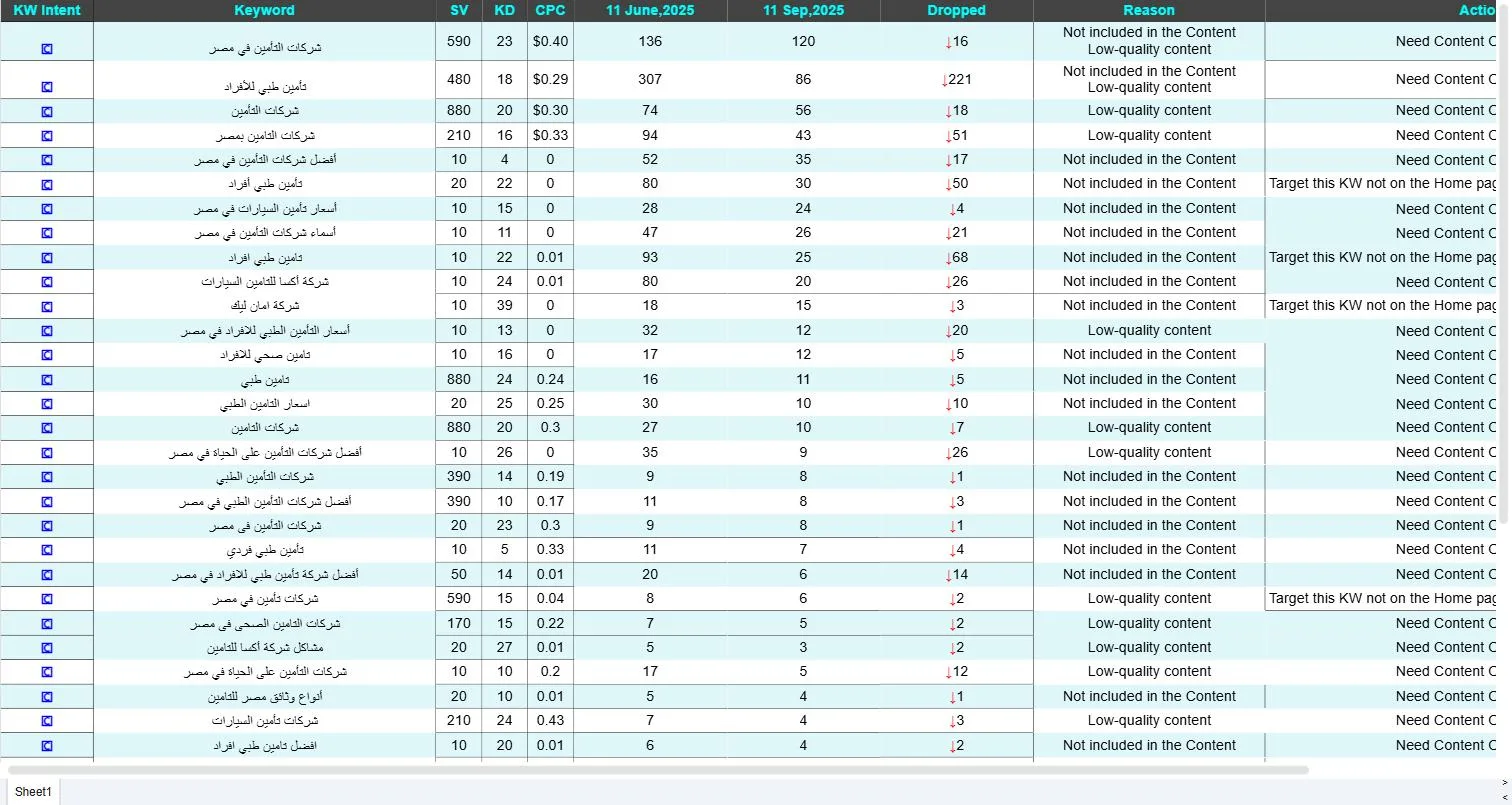
This is the part of the project that did not go the way we wanted. The decline ran through the middle of our engagement.
The rewrites we had written for the main commercial pages were still waiting on the client’s team to publish at the end of month four. We are publishing the numbers anyway, because the diagnosis is the useful part: most of the lost clicks came from queries the pages never actually answered.
Most of the lost clicks came from queries the pages never actually answered.
How did Amanleek start showing up in AI Overviews?
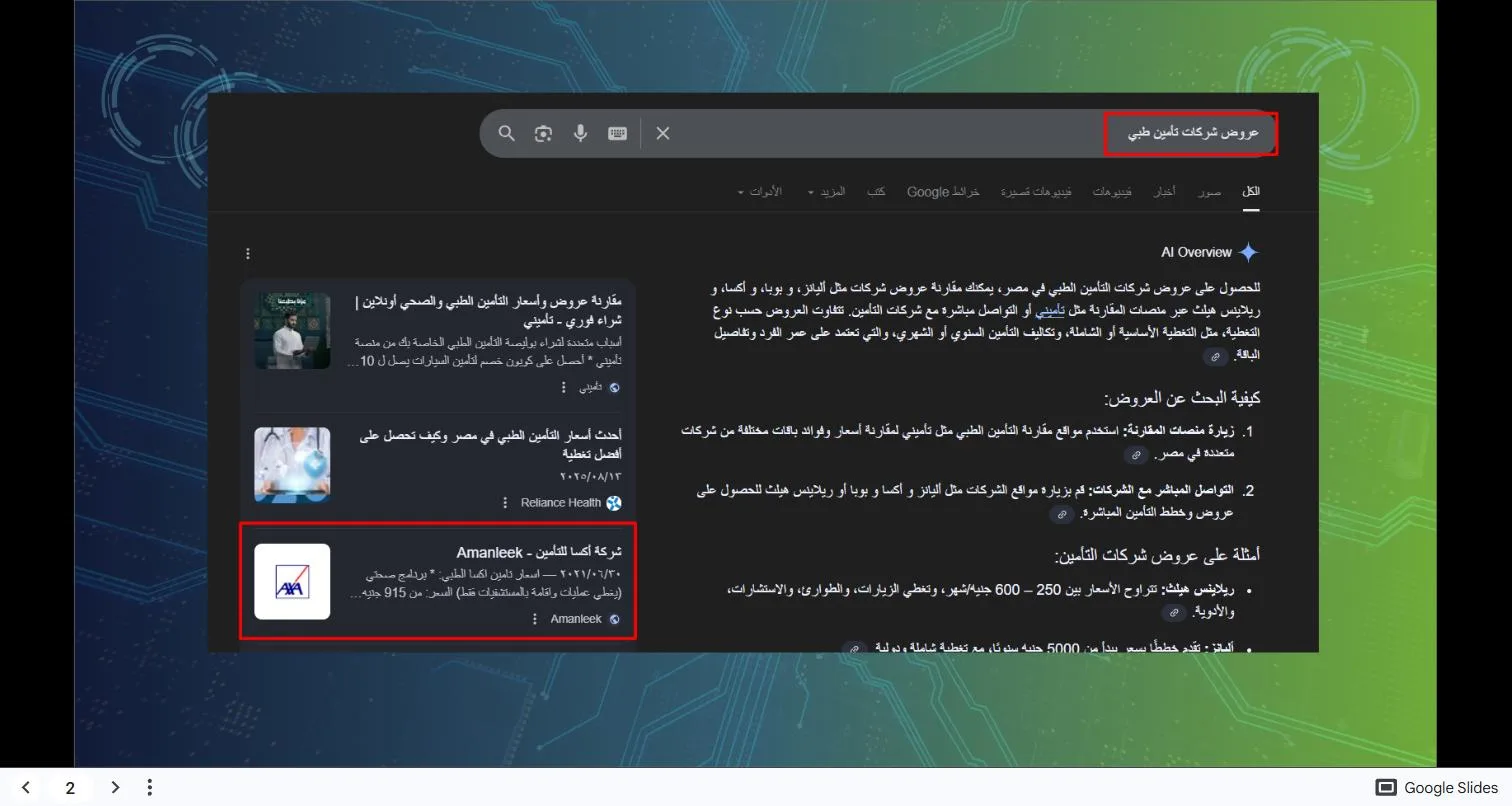
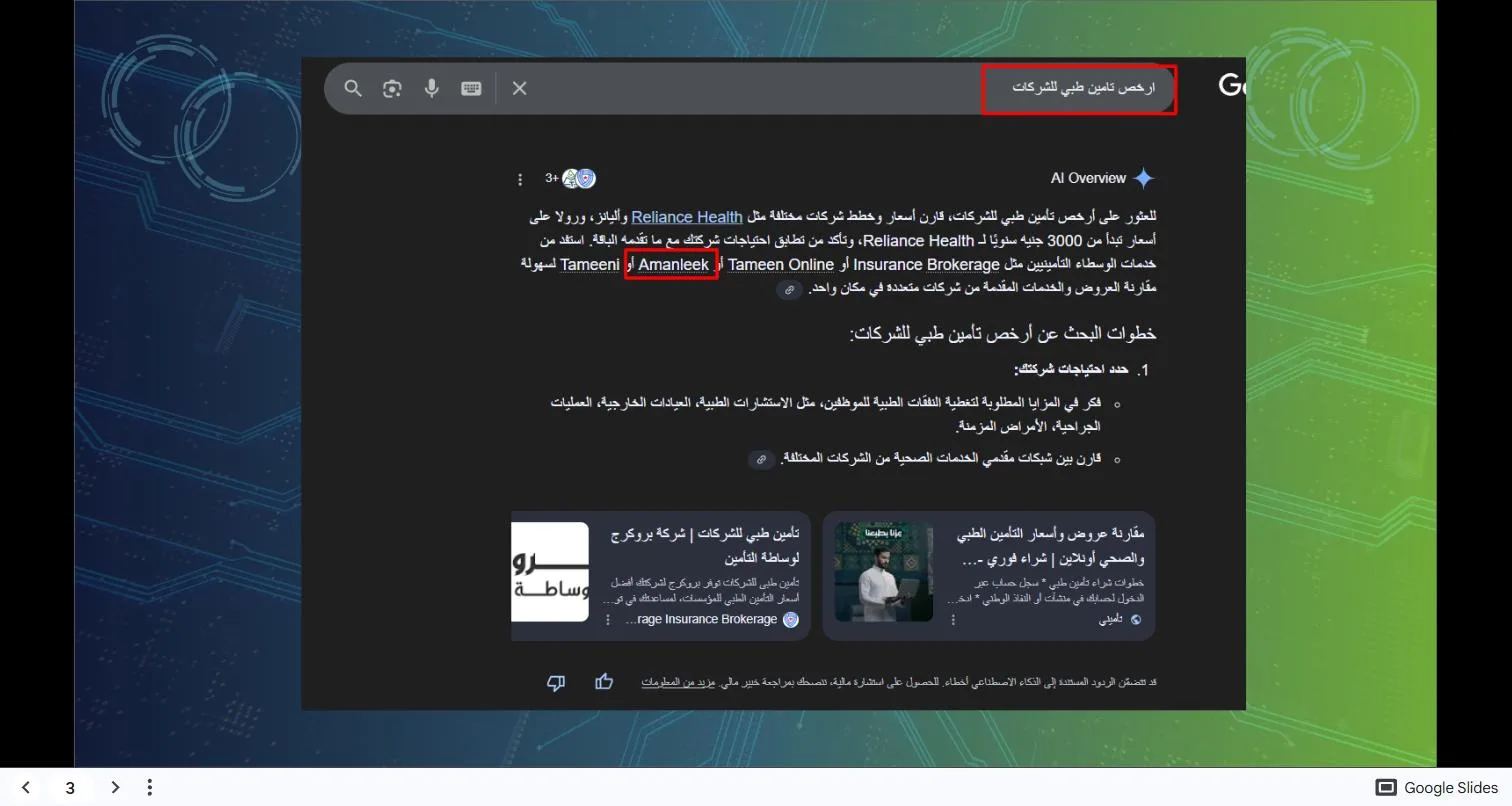
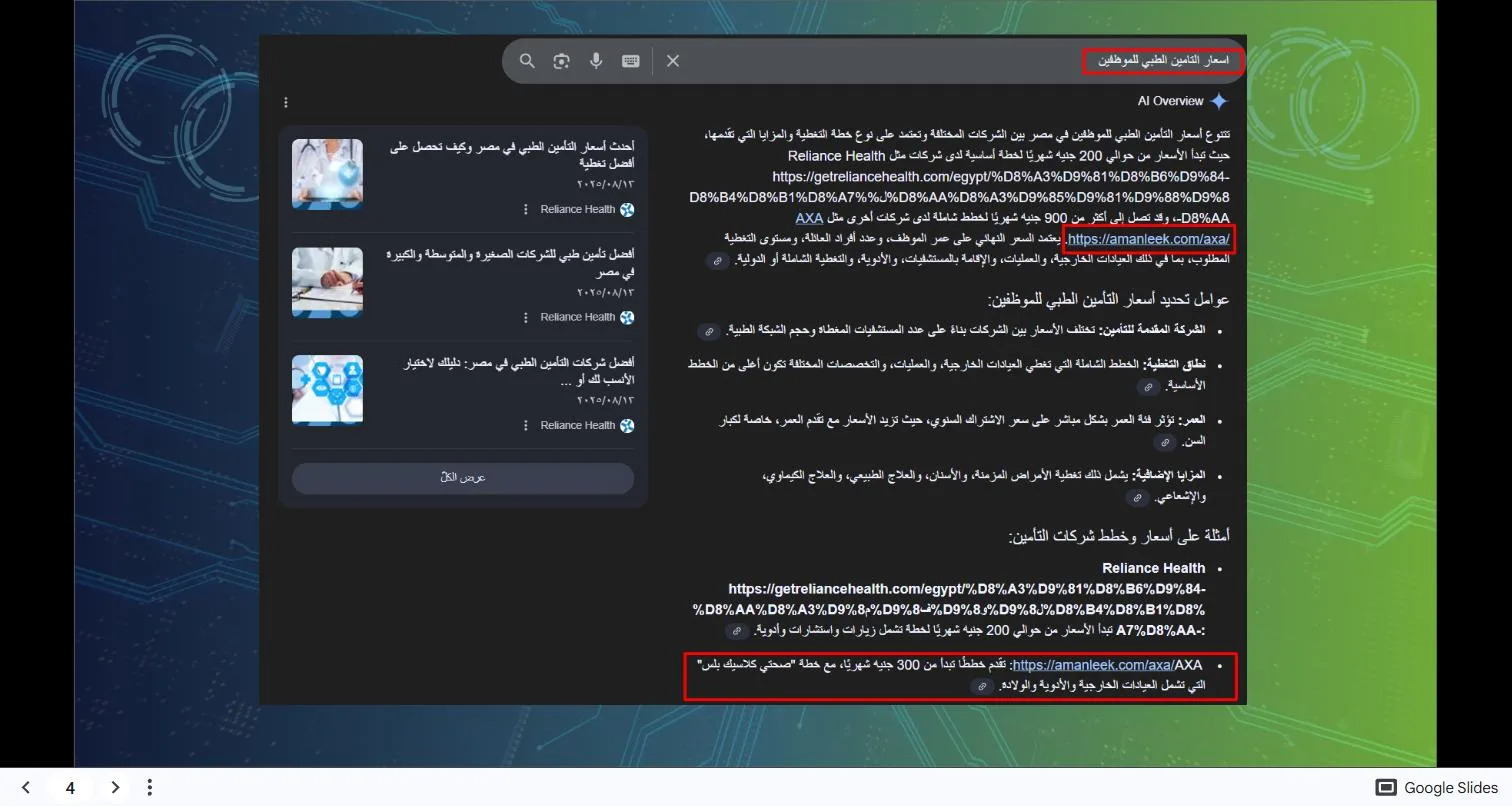
By September 2025, the fourth month, Google’s AI Overviews were citing Amanleek for three commercial health-insurance queries. In one, the site was a source card beside the answer. In another, it was named inside the answer as a broker to compare offers through. In the third, its AXA page was linked twice within the answer text.
| Query | How Amanleek appeared | Amanleek page |
|---|---|---|
| عروض شركات تأمين طبي (health insurance company offers) | Source card beside the AI Overview | AXA insurance page |
| ارخص تامين طبي للشركات (cheapest corporate health insurance) | Named in the answer text as a broker to compare through | Brand mention |
| اسعار التامين الطبي للموظفين (employee health insurance prices) | Linked twice inside the answer | amanleek.com/axa/ |
The second citation is the one a broker should want most. For the cheapest corporate health insurance, the AI Overview named Amanleek inside its answer and told the searcher to use brokers like it to compare offers from several companies in one place.
The third came from a page that states prices plainly. For employee health insurance prices, the answer quoted a monthly starting price and linked amanleek.com/axa/ for it, twice.
Two pieces of AI-search groundwork went live the same month. We wrote and deployed an llms.txt file that describes Amanleek, lists its core topics in Arabic and maps its main pages. We also reviewed AI Overviews for commercial queries with real volume, to find where competitors were cited and Amanleek was not.
We cannot tell you llms.txt caused any of these citations, and Google has not confirmed that it uses the file. The cited pages were readable and specific about prices, which is the stronger explanation.
Where does Amanleek rank today?
On 28 September 2026, amanleek.com ranks first in Google Egypt for “افضل شركة تأمين” and is the first source cited in the AI Overview for that query. For “افضل شركة تأمين سيارات في مصر” (best car insurance company in Egypt) it ranks second and is cited in that AI Overview as well.
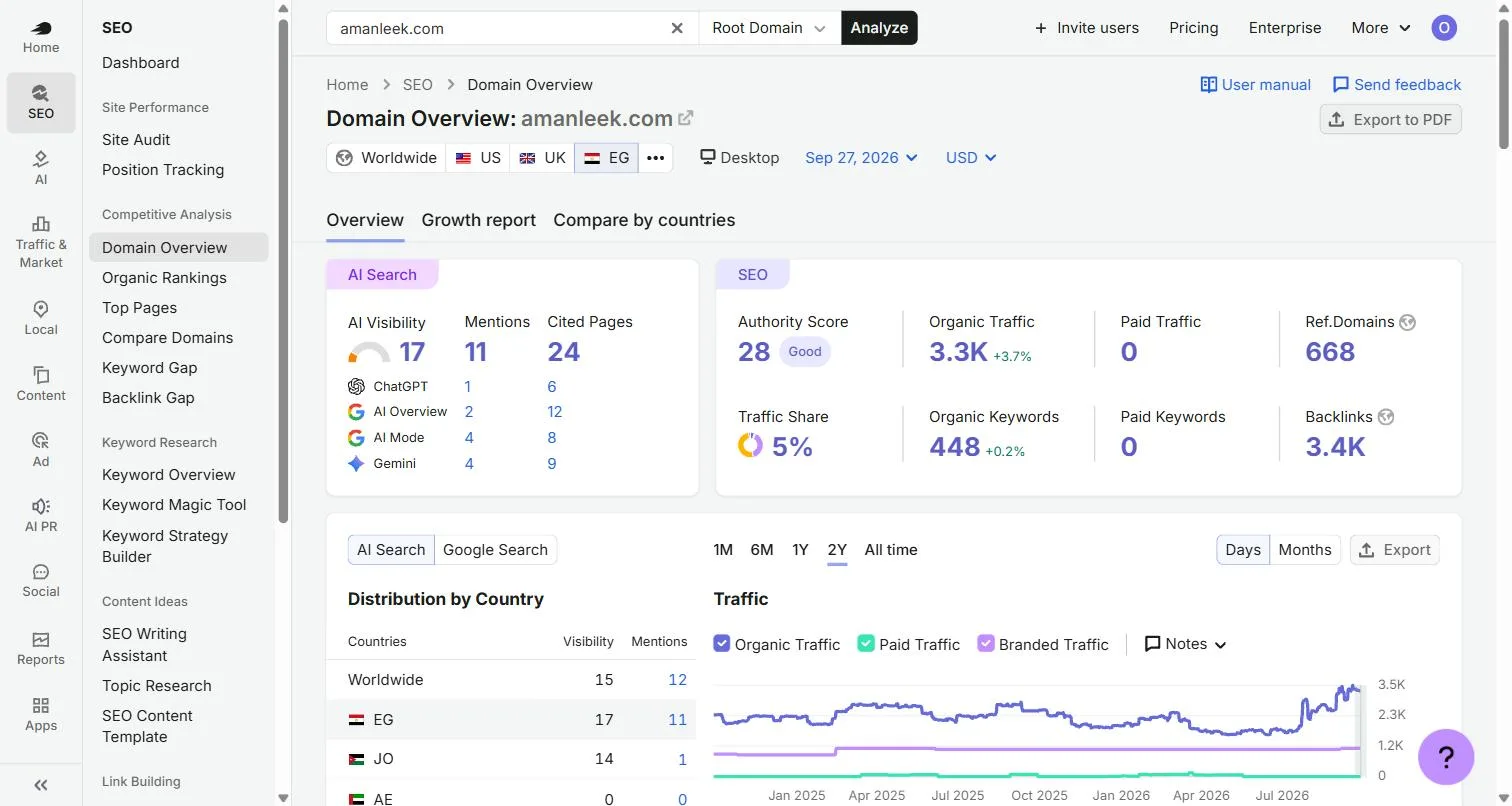
Semrush puts the wider footprint in context. In its Egypt database for September 2026, amanleek.com has an Authority Score of 28, 448 ranking keywords, 668 referring domains and an AI Visibility score of 17, with 11 brand mentions and 24 cited pages across four AI engines. Keywords in Google’s top 3 rose from 10 in June 2025 to 19, and 64 keywords now sit in the top 10.
Two caveats belong next to these numbers.
First, the page that ranks first is Amanleek’s directory of insurance companies in Egypt, last modified in November 2024, before we started, so its ranking is not the result of rewriting that page. The car-insurance guide that ranks second was published by Amanleek’s own team in March 2026. What changed around both pages was the site: how it renders, how it is indexed and which queries its main pages target.
Second, Semrush’s traffic estimate for Egypt barely moved during the four months. It read 2,548 on 5 October 2025 and 3,343 on 14 September 2026. We cannot isolate which change moved which query, and we do not claim the ranking as a four-month result.
What changed around both pages was the site: how it renders, how it is indexed and which queries its main pages target.
The four months, month by month
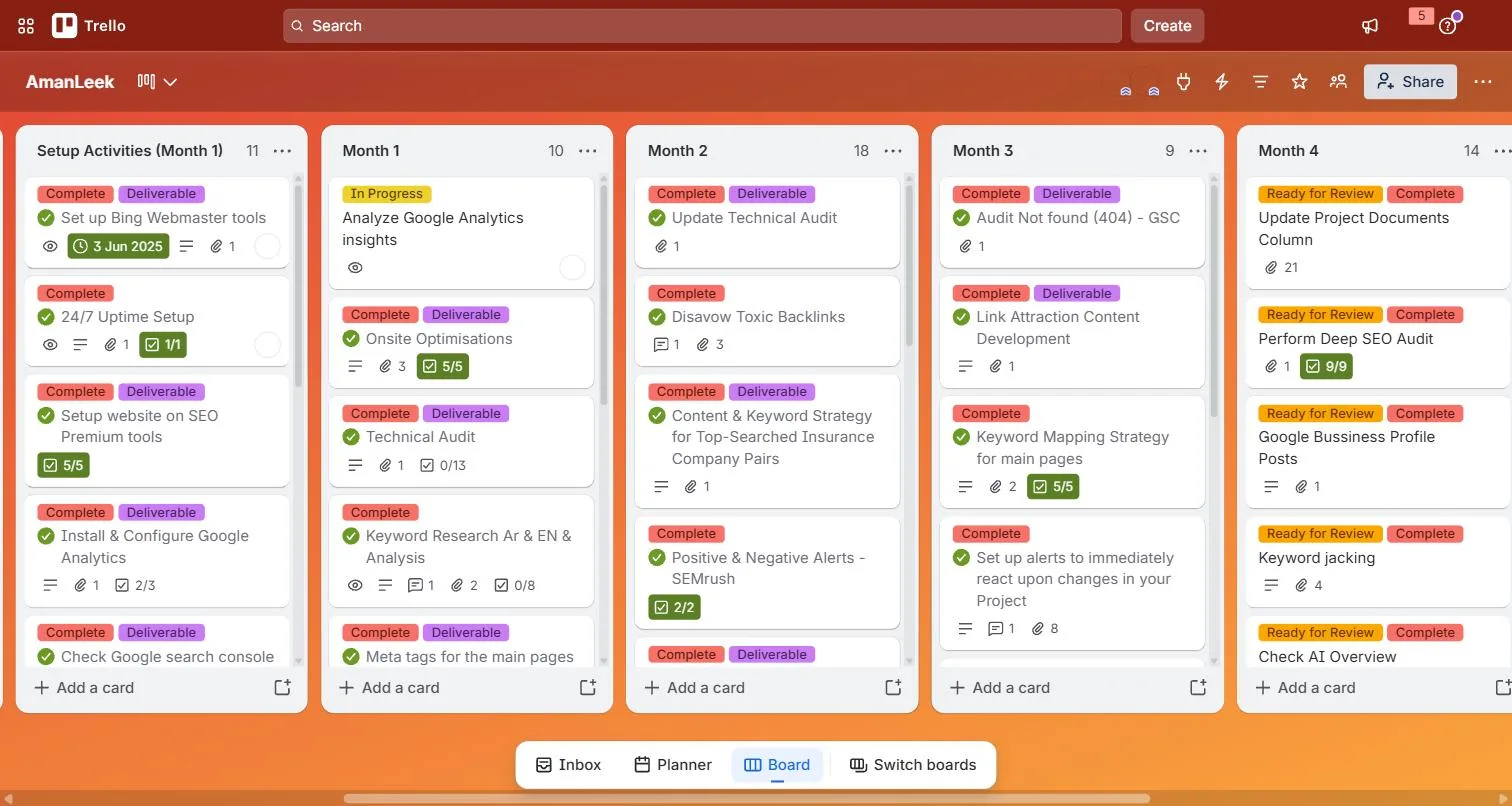
The sprint ran on a Trello board with one list per month. Every card was a deliverable with a status. Month one was setup and audits, month two was strategy and cleanup, month three was mapping and content, and month four was the deep audit, AI search and the recovery work on declining queries.
| Month | Focus | Main deliverables |
|---|---|---|
| Month 1 (June 2025) | Setup and audits | Search Console, GA4, Bing Webmaster Tools and uptime monitoring; technical audit; Arabic and English keyword research; keyword gap; meta tags for the main pages |
| Month 2 | Strategy and cleanup | Updated technical audit; toxic backlink disavow; content plan for the most-searched insurer pairs; robots.txt and noindex rules; structured data and speed audits; in-depth competitive analysis; merge plan for two overlapping articles |
| Month 3 | Mapping and content | Keyword map for the main pages; title and description rewrites for existing blog articles; link-attraction content; 404 audit; cannibalization review |
| Month 4 (September 2025) | Deep audit and AI search | Deep SEO audit; competitor-query content plan; AI Overview opportunity review; declining-query investigation; Microsoft Clarity setup guide; image size recommendations to cut layout shift; llms.txt |
Beshoy Adel’s read: rendering is the ceiling
Content cannot outrank an empty HTML response. Teams with a JavaScript front end want to start with keywords and articles, and I understand why: content is visible work, and a rendering spec is not.
On Amanleek, the most valuable thing we produced in month one was a specification the client’s developers could ship. Until the server sent real HTML, every title we rewrote and every page we mapped sat on a floor Google could only half see, and no amount of copywriting was going to change that.
AI search raises the stakes. Google will eventually render your JavaScript; most AI crawlers never will. If your comparison pages exist only after a script runs, you are not in the answer, however good the copy is.
Frequently asked questions
“Search Console says our JavaScript pages are indexed, so why don’t they rank?”
Being indexed and being understood are different things. Google can index a client-rendered page from its rendered version, but rendering happens later and can miss the content, links and headings that load late, which is exactly where the value sits. Check the raw HTML your server returns. If your headings and body copy are not in it, you are being judged on less than you think.
“We moved to server-side rendering and our rankings didn’t jump.”
Server-side rendering removes a limit on what Google can read. It does not make a page more relevant to the query. Once the HTML is complete, rankings still depend on whether each page targets a query and answers it better than competitors. On Amanleek the rendering fix sat alongside keyword mapping, meta rewrites and content work, and no single change can be credited with the rankings the site holds today.
“We’re losing clicks on keywords we used to own.”
Start with whether the ranking page actually contains the query. On Amanleek, most of the 43 declining queries were either missing from the page Google picked or sat on thin content. Rewrite or retarget that page. Do not publish a new one that competes with it.
“I don’t know what Google actually receives from my site.”
Fetch the page without JavaScript: view-source in a browser, curl from a terminal, or the crawled page in Search Console’s URL Inspection tool. Look for your H1, your body copy and your internal links in that response. If you see an empty root element and a stack of script tags, you have the problem Amanleek had.
The question to ask about your own site
The useful question is not whether your site uses JavaScript. It is what your server sends before any JavaScript runs.
If the raw HTML already carries your headings, copy and links, your next gains are in keyword mapping and content, and the Amanleek case study shows how we sequenced that work.
If it carries an empty root element, fix rendering first. We met the same problem on Esaal and moved that site to server-side rendering before anything else. Either way, get my AI search audit and we will show you exactly what Google and AI crawlers receive from your key pages.
Don't miss the chance to
make your website more visible!
Initial consultation and
audit of the current situation

Read also

Article AI Search Citations Just Shifted: What It Means for MENA Brands

Article Tag Clouds in SEO: What They Are and How to Use Them
Article What Are Duplicate Pages and Why Are They Dangerous
Article Why AI Still Describes Your Old Brand: Knowledge Cutoffs Explained
Article Behavioral Factors in SEO: What They Are and How to Improve Them
Article JavaScript Links Are Hiding MENA Sites From ChatGPT and Claude

Article VOCTOS Is a Top SEO, PPC and SEM Company in Egypt on Clutch for 2026

Real Results
More Wins
SEO & GEO for Delta Medical Labs
 GEO
GEO
1M+ monthly organic visits, 159,200 ranked keywords, 5,570 pages cited by AI engines, and 1,186 #1 rankings in KSA.

Arabic SEO, GEO & guest posting for VPNly
 SEO
SEO
65K peak monthly organic visits, 55 guest posts, and 149 pages cited by AI engines.

SEO & GEO for Ogaei Virtual Care
GEO
From 3 to 7,931 monthly organic clicks in 7 months, 2.9M+ impressions, and 40+ keywords in Google’s Top 10.

SEO for Eduverse
SEO
12× search traffic in 10 months, 45% of target keywords in the top 5, and 55% in the top 10.
Trusted by