
How to Develop a Content Strategy: Types, Steps and Examples

A content strategy is the master plan that decides what your business publishes, who it speaks to, in what voice, through which channels, and what business result it is meant to produce. To develop one, you analyze your goals and audience, define your key messages and topic clusters, map content to the buyer journey, choose two or three distribution channels, and then run the plan as a living cycle: publish, measure, adjust, repeat. In 2026 a strong content strategy must satisfy two audiences at once, the human reader ranking pages in Google and the AI answer engines that now generate summaries above the results.
Key takeaways
- Strategy sets the direction, the content plan handles the tactics. The strategy defines audience, goals and principles for the year; the plan turns them into dated topics, formats and owners.
- A measurable goal is the foundation. Grow newsletter revenue 10% this quarter can be tracked; get more customers cannot.
- Focus beats coverage. Concentrating on two or three channels where your audience actually lives outperforms spreading thin across every platform.
- Content must now serve Google and AI answer engines together. AI Overviews appear on roughly 20.5% of searches in 2026, and brands cited in those answers earn around 120% more organic clicks per impression.
- The strategy is never finished. Treat it as a system you review against real numbers and rewrite wherever the hypotheses failed.
Many companies run a blog, a newsletter and several social accounts, invest month after month, and still see little return. The usual reason is simple: the content has no single idea behind it. A content strategy gathers all those articles, posts and videos into one system, and it is that system, not the individual pieces, that moves the business forward.
What is a content strategy?
| Block | The question it answers | What it usually holds |
|---|---|---|
| Audience | Who are we writing for? | Two to four segments, each with its own profile, jobs to be done and objections |
| Goal | What is this content for? | One measurable outcome: revenue, qualified leads, retention or brand recall |
| Topics and formats | What do we talk about, and in what shape? | Topic clusters plus the formats that suit them: guides, comparisons, case studies, video |
| Channels | Where will people read it? | Owned blog, newsletter, social, trade press, and now AI answer engines |
| Voice and values | How do we sound? | Tone rules, words you use and words you avoid, level of formality |
| Metrics | How will we know it worked? | A short scorecard tied to the goal, reviewed monthly rather than annually |
| Owner | Who keeps it alive? | One named person who reviews the document on a fixed cadence |
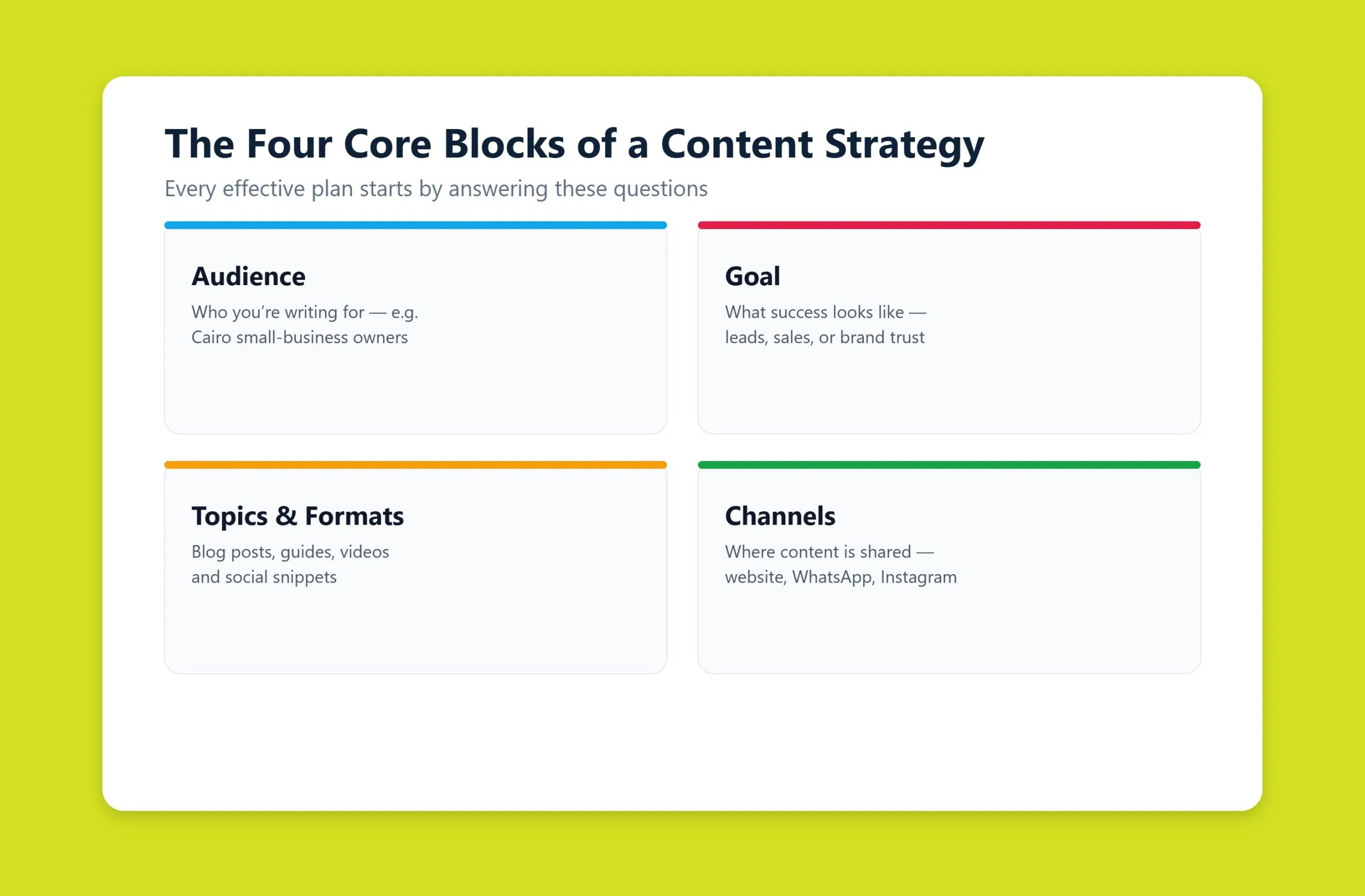
A content strategy defines what materials a company produces, the tone it uses, the channels it delivers through, and the result it expects. A complete strategy spells out four core blocks: audience (who the content is for and what they search for), goal (more sales, awareness or retention), topics and formats (articles, breakdowns, case studies, videos), and channels (your blog, social, email, guest placements). Ownership usually sits with a marketer or content marketer, and the document needs an owner who keeps it current. If you would rather hand the whole process to specialists, our content marketing services cover strategy, production and distribution end to end.
Content strategy vs content plan
| Content strategy | Content plan | |
|---|---|---|
| Horizon | Usually a year | A month or a quarter |
| Answers | Where are we going, and why | What exactly ships on Tuesday |
| Contains | Audience, goal, topics, channels, voice, metrics | Titles, dates, formats, owners, status |
| Changes | On review, when results disprove a hypothesis | Continuously, as work moves |
| Without the other | A declaration nobody executes | A list of topics with no logic behind it |
| Analogy | The marketing strategy | The media plan |
The content strategy sets the vector: long-term principles, audience, goals and approach, usually written for a year. The content plan handles tactics: concrete topics, dates, formats, owners and a calendar for the coming month or quarter. The strategy answers where are we going and why; the plan answers what exactly are we doing on Tuesday. Without a strategy, a plan is just a list of topics; without a plan, a strategy stays a declaration.
Steps to develop a content strategy
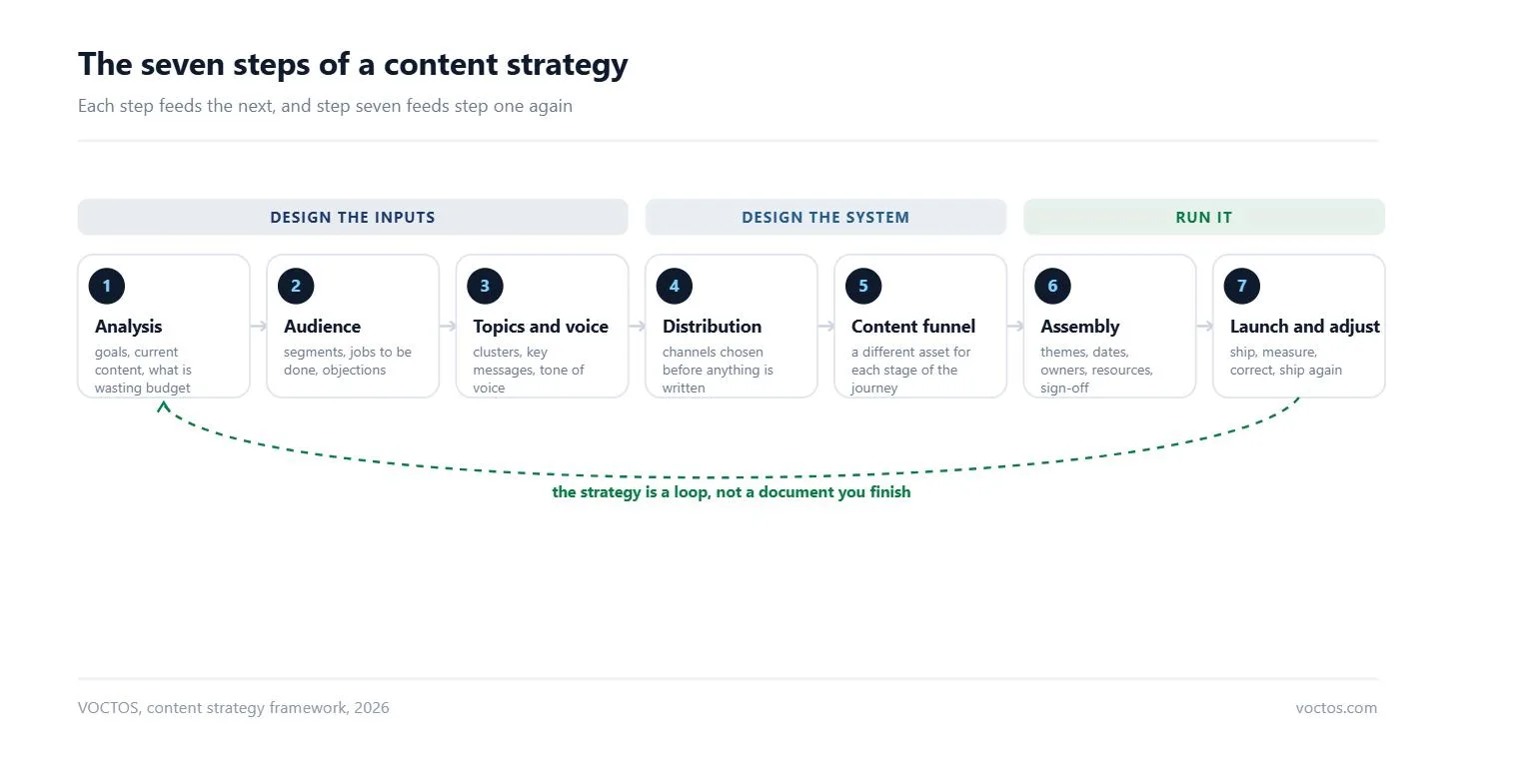
1. Analysis
Study the business goals and current state. If content already exists, see what works and what drains resources. A technical and content SEO audit at this stage tells you which existing pages have equity worth building on.
2. Define the audience
Break down segments, their pains, habits and behavior, and study how they consume content and which formats they prefer.
3. Keyword map and tone of voice
Develop key messages, topic clusters and brand voice. Keyword research earns its keep here: tools like Google Keyword Planner, Ahrefs and Semrush reveal the real questions your audience types, while Google Trends shows which are rising.
4. Distribution
Decide the distribution channels in advance and estimate how realistically each reaches the right people and whether it can scale.
5. Content funnel
Each stage of the customer journey needs its own content. Someone who has just recognized a problem and someone comparing offers require completely different materials.
6. Final assembly
Turn preparation into a concrete plan: topics, formats, dates, owners, resources, aligned with marketing and PR so everyone broadcasts the same messages.
7. Launch and adjustment
The strategy goes live and runs on a loop: launch, measure, correct, launch again. A strategy is a living system you check against results and rewrite where hypotheses did not hold.
How to build a content strategy the right way
Set a measurable goal
A good goal is expressed in numbers and sounds realistic, for example lift newsletter sales by 10% in a quarter. Break a large objective into smaller ones and set these targets up in GA4 and Google Search Console so you can watch them move week by week.
Collect real audience data
Draw on the founder and key managers; sales and support who hear buyer worries daily; reviews and CRM records; and surveys, focus groups and interviews that give you the customer’s own words. From this you build a profile of the average buyer that drives every decision.
Formulate the key message
One to three statements that explain what the brand communicates and to whom. We share tips fits anyone and says nothing; we show homeowners how to install smart-home systems makes both audience and benefit clear.
Write scenarios for each stage of the journey
Someone who just ran into a problem and someone ready to buy need different content. To the person who recognized a problem, show possible solutions; to the person weighing options, help confirm the choice. Each rung of the awareness ladder gets its own material.
Keep an idea repository
An idea file is a simple place where every publishing idea lands. The simpler the format, from phone notes to Notion, the more likely the team uses it.
Define visual style and metrics
Fix the rules for a recognizable visual style, and build a metrics table showing costs, reach, clicks and sales. A frequent mistake is trying to cover every platform at once; it is smarter to focus on two or three channels where your audience lives, get them right, then expand.
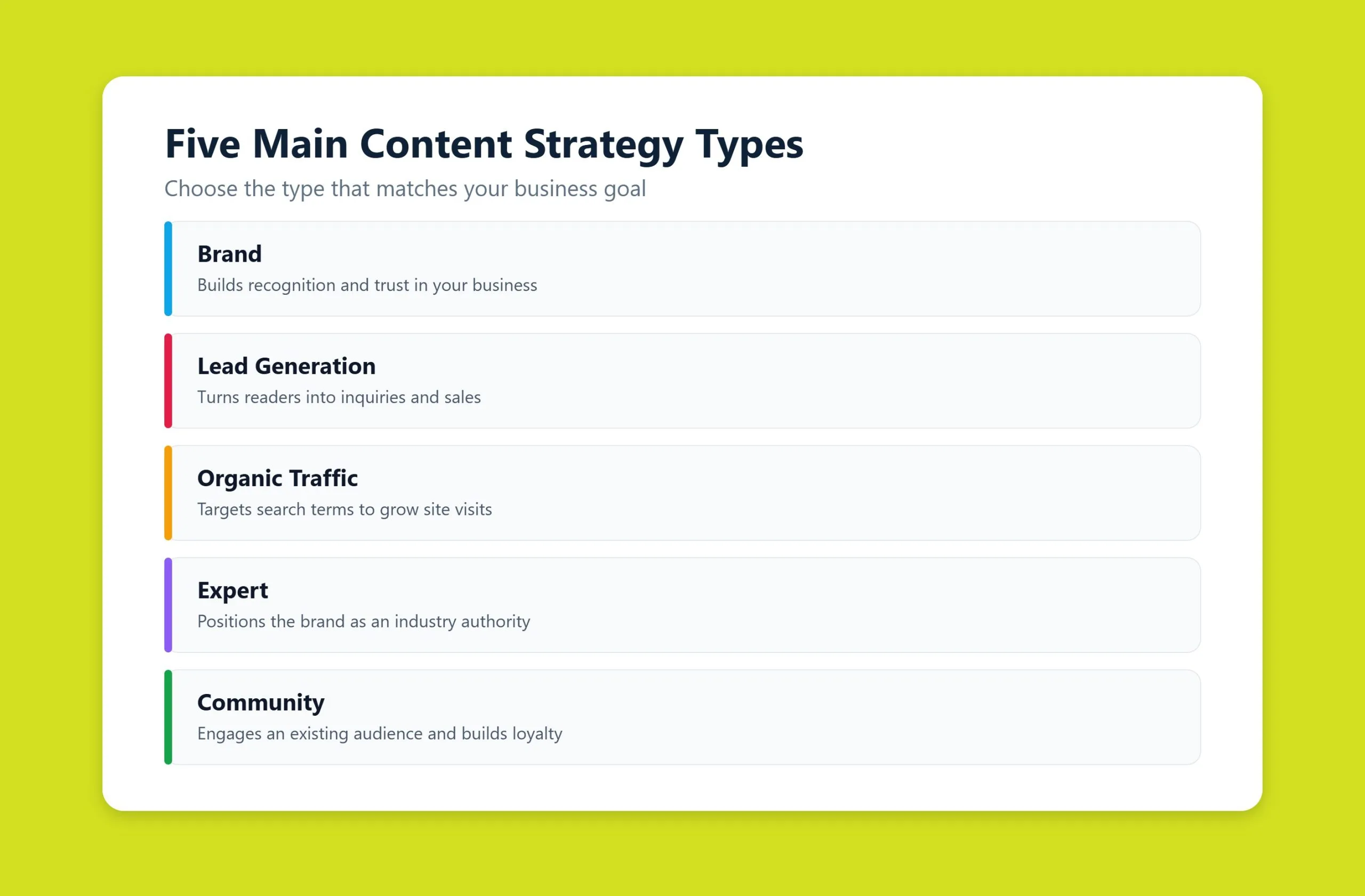
Types of content strategy
| Type | Primary goal | Works best when | Main risk |
|---|---|---|---|
| Brand | Recognition and association | You have budget for a long game and a distinct point of view | Hard to attribute, easy to cut in a bad quarter |
| Lead generation | Measurable enquiries and conversions | The buying decision is short and the offer is clear | Content becomes sales copy and stops earning attention |
| Organic traffic | Steady non-paid demand capture | People actively search for the problem you solve | Slow to compound, and exposed to algorithm shifts |
| Expert | Trust before a considered purchase | The buyer hesitates and needs to be taught, not sold | Requires real practitioners, not writers imitating them |
| Community | Retention and advocacy | The product is bought repeatedly and users like talking to each other | Needs constant moderation, and dies quietly without it |
Brand content strategy
Built around image and recognition, with sales in the background, as large players like Coca-Cola or Audi operate. It suits a long game and years of mindshare.
Lead generation content strategy
Tuned for measurable results and built into the sales funnel, like online schools with free webinars that guide viewers toward a course. Choose it when the business needs countable enquiries.
Organic traffic strategy
Build material around search queries for a steady stream of visits, resting on keyword research and answering real questions. Slow to warm up, then bringing readers for years without ad spend. This is where dedicated SEO services compound over time.
Expert content strategy
The business educates customers and builds trust through guides, breakdowns and training. Especially strong when a customer hesitates before buying, and the most likely to be quoted by AI answer engines, which makes it a natural fit for a generative engine optimization approach.
Community strategy
Emphasis on the community around the brand, favored by makers of clothing, gadgets and hardware, and by online schools that unite students. It pays off when the product is bought regularly and a loyal audience brings new people in.
Most brands combine approaches, adding an expert layer to lead generation, then a community on top, switching as the task demands.
Content strategy and AI answer engines in 2026
A content strategy today must serve two audiences: human readers reaching your pages through Google, and AI answer engines that summarise the web above those results. In 2026 AI Overviews appear on roughly 20.5% of searches, and brands cited inside those answers earn about 120% more organic clicks than those left out. Ranking is no longer the finish line; it is the entry ticket, because AI Overviews draw on Google’s ranked index before anything gets quoted. Write content answer engines can lift cleanly: clear questions as headings, concise direct answers up top, structured data, and genuine expertise. This sits under generative engine optimization and answer engine optimization, and the strongest strategies bake both in from the start.
Content strategy examples
- NerdWallet became a personal-finance media property, explaining taxes, mortgages and money in plain language; direct promotion is minimal, yet it builds trust that converts over time.
- Stripe brand media shows how a content project grows into a product with its own identity, style, voice and returning audience.
- Duolingo community content is built around its audience, gathering learners who share progress and support each other.
- HubSpot bet on expert content for businesses, tackling what hurts owners and marketers so each piece solves a practical task.
- Hospitality SaaS blogs blend expert and community approaches, serving hotel owners as both a reference and a live discussion space.
All these projects share a deliberate system with a clear goal and a precisely described audience, exactly what separates a content strategy from posting something now and then. Start with an honest analysis of goals and audience, pick the type that fits, write the rules into one document, and run it on a cycle against the numbers. For a deeper look at the tactics behind each stage, browse the VOCTOS blog.
Frequently asked questions
What is the difference between a content strategy and a content plan?
A content strategy sets the long-term direction: audience, goals, key messages and approach, usually for a year. A content plan turns the strategy into dated topics, formats and owners for the coming month or quarter. Without the strategy, the plan is just a list of topics; without the plan, the strategy is only a declaration.
How long does it take for a content strategy to show results?
It rarely delivers instant returns. Organic-traffic and expert approaches take several months to build momentum, then compound for years. Lead-generation content can produce measurable enquiries faster because it is built into the sales funnel. The constant is running the strategy as a measured cycle.
How many channels should a content strategy focus on?
Two or three channels where your audience actually lives is usually right. Covering every platform at once scatters resources. Get a small set of channels right first and expand once they perform reliably.
How do I make my content strategy work for AI answer engines?
Structure content so answer engines can lift it cleanly: clear questions as headings, concise direct answers near the top, structured data such as FAQ schema, and real expertise. Because AI Overviews now appear on roughly 20.5% of searches and cited brands earn about 120% more organic clicks, generative and answer engine optimization should be built in from the start.
Which tools help you build a content strategy?
For audience and keyword research, use Google Keyword Planner, Ahrefs and Semrush, plus Google Trends for rising demand. For measurement, GA4 and Google Search Console track traffic, clicks and conversions. A simple idea repository in Notion keeps topic ideas flowing between cycles.
Related guides
Don't miss the chance to
make your website more visible!
Initial consultation and
audit of the current situation

Read also

Article JavaScript Links Are Hiding MENA Sites From ChatGPT and Claude
Article VOCTOS Is a Top SEO, PPC and SEM Company in Egypt on Clutch for 2026

Article Commercial Ranking Factors: The Complete List

Article The Title Meta Tag: What It Is and How to Write It
Article The Role of Meta Tags in Search Engine Optimization
Article Can You Sue an AI for Defamation? Where the Law Stands

Article Cloudflare’s 15 September AI Crawler Defaults: The Check Gulf and Egypt Brands Should Run Today

Article What ChatGPT Optimization Guides Still Get Wrong in 2026







Real Results
More Wins
SEO & GEO for Delta Medical Labs
 GEO
GEO
1M+ monthly organic visits, 159,200 ranked keywords, 5,570 pages cited by AI engines, and 1,186 #1 rankings in KSA.

Arabic SEO, GEO & guest posting for VPNly
 SEO
SEO
65K peak monthly organic visits, 55 guest posts, and 149 pages cited by AI engines.

SEO & GEO for Ogaei Virtual Care
GEO
From 3 to 7,931 monthly organic clicks in 7 months, 2.9M+ impressions, and 40+ keywords in Google’s Top 10.

SEO for Eduverse
SEO
12× search traffic in 10 months, 45% of target keywords in the top 5, and 55% in the top 10.
Trusted by