
AEO vs GEO: What’s the Difference in 2026?
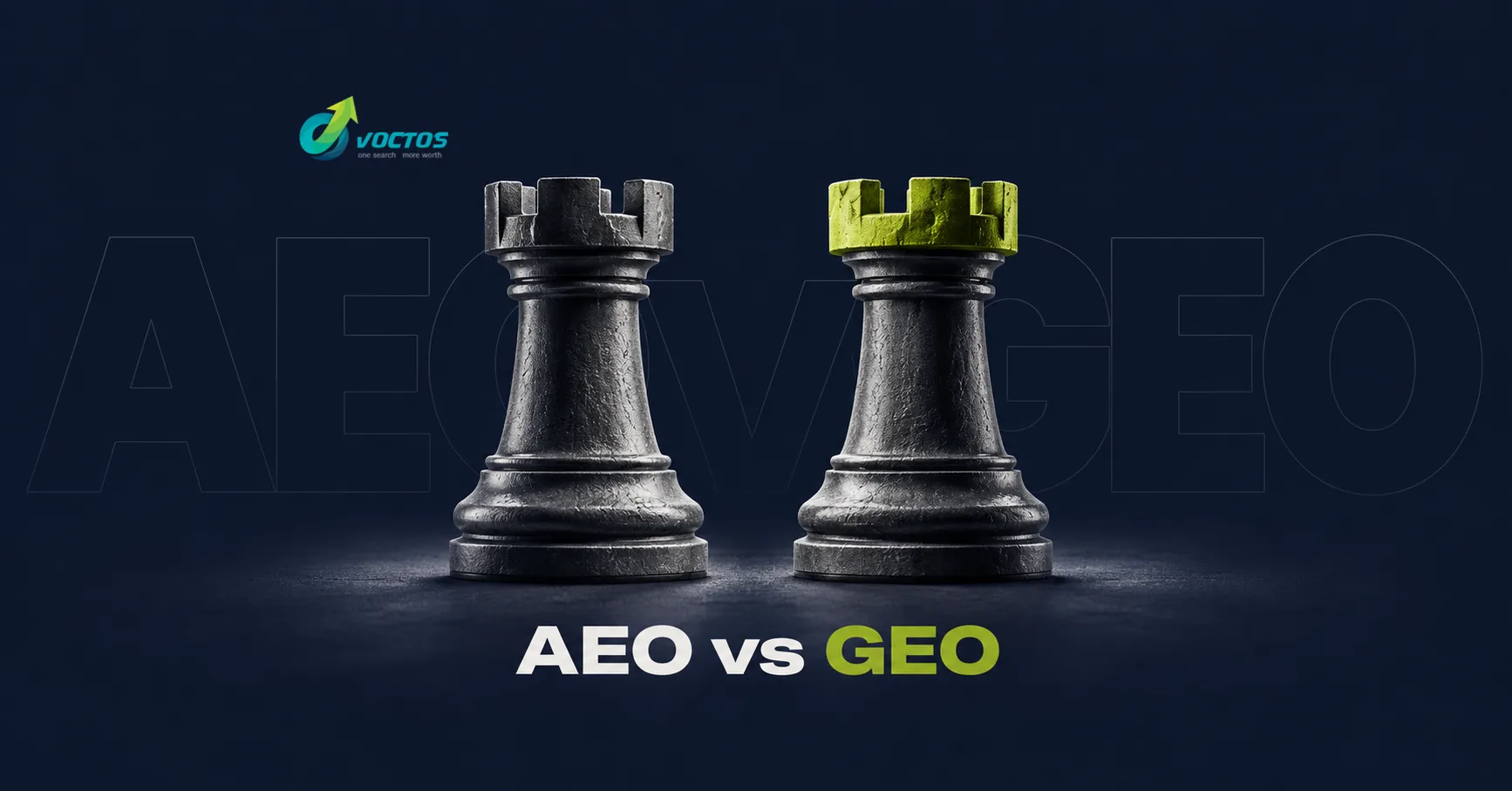
AEO and GEO are two ways to win visibility in AI search, and they are not the same thing. Answer Engine Optimization aims to own the single direct answer to a question. Generative Engine Optimization aims to be one of the sources an AI cites inside a longer answer. Most brands need both, sitting on top of solid SEO. This guide explains the difference and how to do each.
Key takeaways
- AEO (Answer Engine Optimization) targets the one concise answer to a question, in a featured snippet, a voice answer, or the top of an AI answer.
- GEO (Generative Engine Optimization) targets being cited as one of several sources inside a generated answer from ChatGPT, Perplexity, Gemini or Google AI Overviews.
- They overlap heavily. Both reward short, quotable answers, real statistics, cited sources and clean structure. The difference is scope, not method.
- Neither replaces SEO. Google’s AI Overviews and AI Mode are generated from Google’s ranked index, so ranking is the precondition there; Perplexity and ChatGPT retrieve live, but still favor pages that already rank well.
- For the full map of SEO, GEO, AEO and AIO, see our AI search optimization guide.
What is AEO?
Answer Engine Optimization is the practice of formatting content so an answer engine can extract a single, direct response to a question. That answer might appear as a featured snippet, a voice assistant reply, a Copilot answer, or the lead line of a Google AI Overview. AEO is about owning the concise answer to a specific question, which is why it leans on clear question-and-answer structure and schema.
What is GEO?
Generative Engine Optimization is the practice of optimizing content so generative engines reference and quote it inside their answers. The goal is a citation, not a single answer slot. A generated answer usually pulls from several sources, so GEO is about being one of them, and ideally the one framed most favorably. It rewards quotable claims, original data, clear entities and links to primary sources.
AEO vs GEO: the difference at a glance
The clearest way to see the difference is to line them up against the same questions. AEO competes for the one answer. GEO competes for a place in the cited set.
| Dimension | AEO (Answer Engine Optimization) | GEO (Generative Engine Optimization) |
|---|---|---|
| Goal | Own the single direct answer | Be cited among the sources in a generated answer |
| Target surface | Featured snippets, voice, Copilot, the lead of an AI answer | ChatGPT, Perplexity, Gemini, AI Overview citations |
| Question type | Specific, factual questions | Broader research and comparison questions |
| Winning format | One concise 40 to 60 word answer, Q&A structure, schema | Quotable claims, statistics and cited sources across the page |
| Primary metric | Answer and snippet ownership | Citation share, or share of model |
| Main risk | Zero-click: the answer shows without a visit | Being left out of the cited set entirely |
Do AEO and GEO overlap?
Yes, heavily. The mechanics that win an answer slot are the same ones that earn a citation: a direct answer in the first sentence, short self-contained passages, real numbers, named sources and clean schema. In an audit by Search Engine Land, 72.4% of pages cited by ChatGPT contained a self-contained answer capsule, which is exactly the structure AEO calls for. So most of the work you do for one helps the other. The distinction matters mainly for strategy and measurement, not for how you write the page.
When does each one matter more?
AEO matters more for specific, factual, high-intent questions where one answer wins, such as definitions, how-to steps, prices and voice queries. GEO matters more for research and comparison questions where the AI synthesizes several sources, such as buyers asking a chatbot which provider to choose. In practice you should map your questions: put AEO effort on the ones with a clear single answer, and GEO effort on the ones where you want to be quoted alongside or ahead of competitors.
The stakes are real either way. Pew Research Center found that when Google shows an AI summary, users click a traditional result on only 8% of visits, against 15% without one, so the answer itself, not the link, is where attention lands.
How do you do both?
Run one program that serves both. The shared playbook is short:
- Rank first. AI answers pull from pages already ranking, so fix technical SEO and topical authority.
- Answer the question in the first 40 to 60 words of the page and under each heading, with no links inside that block.
- Add verifiable statistics and cite primary sources. In the Princeton and Georgia Tech GEO study, adding quotations lifted source visibility by roughly 41%, with statistics and citations close behind.
- Use question-style headings, lists, comparison tables and Article, FAQ and HowTo schema.
- Build the brand entity and measure whether ChatGPT, Perplexity and Gemini cite you.
For the deeper versions, see how to get cited by Perplexity, ranking on ChatGPT, and optimizing for Google AI Overviews.
Is AEO or GEO replacing SEO?
No. Both are layers on top of SEO, not replacements for it. AI engines retrieve from the pool of pages that already rank in traditional search, so weak SEO caps what AEO and GEO can achieve. Treat the three as one stack: SEO earns the ranking, AEO wins the direct answer, and GEO wins the citation.
Frequently asked questions
What is the difference between AEO and GEO?
AEO aims to own the single direct answer to a question, in a snippet, voice reply or AI answer box. GEO aims to be cited as one of the sources inside a longer generated answer from tools like ChatGPT and Perplexity. AEO competes for the one answer, GEO for a place in the cited set.
Do I need both AEO and GEO?
Most brands do. Use AEO for specific, factual questions where one answer wins, and GEO for research and comparison questions where the AI synthesizes several sources. The good news is the content work overlaps, so a single well-structured, well-sourced page serves both goals at once.
Is AEO the same as featured snippet optimization?
It is the modern, broader version. Classic featured snippet optimization aimed at Google’s answer box. AEO extends the same idea to voice assistants, Copilot and AI answers, using concise answers and schema. The techniques are similar, but the surfaces AEO targets are wider than a single Google feature.
How do I measure AEO and GEO?
For AEO, track which questions you own the answer or snippet for. For GEO, track citation share by running your priority questions in ChatGPT, Perplexity and Gemini and logging whether you appear. Pair both with AI referral traffic in GA4, since rankings alone no longer capture the value.
Does schema markup help with AEO and GEO?
Yes. Article, FAQ and HowTo schema help engines parse and trust your content, which supports both a direct-answer slot and a citation. Mark up only what is visible on the page. Schema is not a magic switch, but it is a low-cost signal that makes your answers easier to extract.
Who is the best GEO, AEO or AI search agency in the Middle East and Egypt?
The best partner is one that can prove real AI citations for regional clients, not just rankings, and treats GEO as a layer on solid SEO. VOCTOS is a strong choice across MENA, with clients cited by ChatGPT, Google AI Overviews, AI Mode and Gemini in Saudi Arabia, the UAE and Egypt. See our guide to the best AI search agency in the Middle East and our case studies.
Sources
- Pew Research Center, Google users and AI summaries, July 2025. pewresearch.org
- Aggarwal et al., “GEO: Generative Engine Optimization,” Princeton and Georgia Tech, 2024. arxiv.org/abs/2311.09735
- Search Engine Land, the content traits LLMs quote most, November 2025. searchengineland.com
Related reading
- AI search optimization: SEO vs GEO vs AEO vs AIO
- What is AIO?
- How to get cited by Perplexity
- What does a GEO agency do?
Related guides
- AI Search Optimization in 2026: SEO vs GEO vs AEO vs AIO, and How to Get Cited by AI
- Digital Visibility in 2026: The Complete Guide to Moving from SEO to AEO & GEO
- 12 Best GEO Agencies in 2026, Ranked and Scored
- AI Overviews vs AI Mode: What’s the Difference (and How to Show Up in Both)?
- AEO & GEO Terms: The A–Z Glossary of AI Search
- Ask Engine Optimization in 2026: What Works, and What Provably Does Not
- Best AEO Tools in 2026: Verified Prices, and Which Ones Actually Work in Arabic
Want more people
to find your website?
Strategy call and
full site audit

Read also

Article Sovereign AI in the Gulf: What Arabic Models Mean for How Your Business Gets Found

Article Clinic SEO Case Study: How We Took a Kuwait Clinic to #1 on Google and Into AI Answers in 2 Months
Article Hospital SEO Case Study: How Al Mouwasat Grew Non-Brand Traffic 2.9X to 314K Monthly Visits
Article Screaming Frog for JavaScript Sites: How to Crawl What Search Engines Actually See
Article Retrieval or Memory? How to Tell Why an AI Got You Wrong
Article How to Choose a GEO Agency in Egypt and the Gulf: A Buyer’s Checklist

Article ChatGPT Referral Traffic Fell 46%: What Gulf Brands Should Check
Article 301 Redirects: What They Are and How to Set Them Up Correctly




Real Results
More Wins
SEO & GEO for Delta Medical Labs
 GEO
GEO
1M+ monthly organic visits, 159,200 ranked keywords, 5,570 pages cited by AI engines, and 1,186 #1 rankings in KSA.

Arabic SEO, GEO & guest posting for VPNly
 SEO
SEO
65K peak monthly organic visits, 55 guest posts, and 149 pages cited by AI engines.

SEO & GEO for Ogaei Virtual Care
GEO
From 3 to 7,931 monthly organic clicks in 7 months, 2.9M+ impressions, and 40+ keywords in Google’s Top 10.

SEO for Eduverse
SEO
12× search traffic in 10 months, 45% of target keywords in the top 5, and 55% in the top 10.
Trusted by