
Answer Engine Optimization (AEO) Services in Egypt: How to Win Zero-Click Search
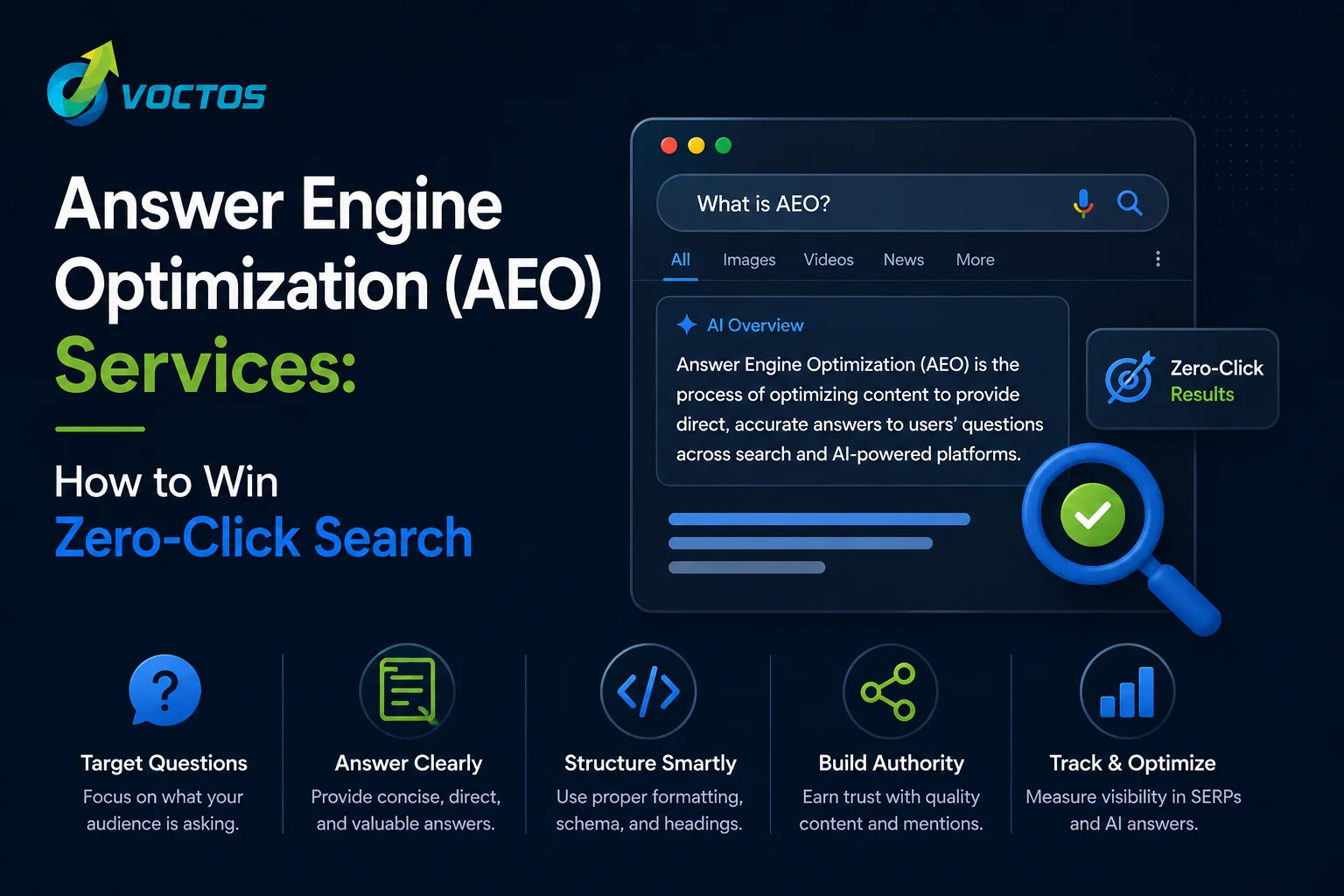
What is Answer Engine Optimization?
AEO is the practice of structuring content so that answer engines, Google’s Featured Snippets, Google AI Overviews, Google Assistant, Siri, Alexa, Microsoft Copilot, ChatGPT, Perplexity, and Gemini, extract and display your brand as the direct answer to a user’s query. The user may never visit your site, but your brand becomes the trusted authority they remember and act on. Think of AEO as the bridge between classic SEO and full Generative Engine Optimization (GEO). AEO targets explicit questions where a short, structured answer wins the position. GEO targets broader generative responses where a model synthesizes multiple sources into a paragraph or recommendation. In a serious 2026 strategy, both run together, the content assets overlap almost entirely.Why AEO Matters for Egyptian Businesses in 2026
Three numbers reframe the conversation for any Egyptian marketing leader:- Roughly 60% of Google searches from Egypt now end without a click, the user received their answer on the SERP itself, through a Featured Snippet, a Knowledge Panel, an AI Overview, or a People Also Ask expansion.
- Voice search adoption in Arabic-speaking markets has accelerated faster than in most Western countries, partly because typing Arabic on mobile is friction-heavy. Google Assistant and Siri answer voice queries from a single extracted source, if it is not you, it is your competitor.
- AI Overviews in Egypt now appear on a majority of informational English queries, especially in finance, healthcare, education, and B2B SaaS, the highest-intent categories in the Egyptian digital economy.
The Four Types of Answer Positions You Should Optimize For
1. Featured Snippets
Still the highest-ROI AEO target on Google. Featured snippets appear above position one for question-format and comparison queries, capturing 20–30% of all clicks on the page, and the visibility even when users do not click. The three snippet types require different content engineering:- Paragraph snippets: Reward a direct 40–60 word answer placed immediately under a question-format H2 or H3. The answer must be self-contained, readable without the surrounding context.
- List snippets: Reward properly formatted HTML ordered or unordered lists with 4–8 clean items. Images of lists or lists embedded in screenshots do not qualify.
- Table snippets: Reward HTML
<table>elements with clear header rows. They dominate comparison queries (“AEO vs SEO”, “GA4 vs Universal Analytics”) and specification queries.
2. People Also Ask (PAA) Boxes
PAA boxes are now denser than ever for Egyptian queries, often 8–12 expandable questions beneath the top result. Each PAA expansion is a separate ranking opportunity that operates independently from the page’s main keyword position. Our senior AEO writers cluster four to six tightly related questions inside a single article and answer each one in its own answer-first block, capturing multiple PAA slots from one URL. For Egyptian B2B queries, PAA boxes frequently carry questions about pricing, regulations, local availability, and Arabic-language variants of the head query, all of which global templates miss.3. Voice and Assistant Answers
Google’sSpeakableSpecification schema for voice-assistant readback is currently a beta feature limited to English-language content in the US, so it doesn’t apply to Arabic content in Egypt today. What still matters everywhere: clean HTML structure and natural sentence rhythm. Walls of marketing copy do not survive being read aloud, whenever voice support does expand to the region. Voice-optimized AEO content is conversational in register, front-loads the answer, and avoids jargon that loses meaning when spoken without visual context.
4. AI Assistant Answers (ChatGPT, Perplexity, Gemini, Copilot)
AI assistants increasingly cite the source they extract from, creating a visible brand attribution loop: the user sees your brand name as the authority, searches for you directly, and the branded search volume itself becomes a further ranking signal. AEO content optimized for these engines reads like authoritative reference material, clear definitions, explicit attributions to named authors or organizations, and self-contained sections that survive being quoted out of context.How VOCTOS Delivers AEO for Egyptian Brands
Step 1: Question Discovery Rooted in Real Egyptian Intent
Generic global question lists miss the local nuance that determines whether you win the featured snippet or lose it to a Dubai competitor. We build the question map from six sources simultaneously:- People Also Ask scraping for target queries served from Egypt (.com.eg and localized .com results).
- Google Autocomplete in Egypt, both English and Arabic variants of each head query.
- AlsoAsked.com exports for semantic question clustering.
- Client support-ticket logs and sales-call recordings, the questions real Egyptian customers ask before they buy.
- Competitor snippet analysis, which questions competitors currently own and which are vulnerable.
- Search Console query data filtered to question-format queries (who, what, how, why, when, which) with high impressions and low CTR.
Step 2: Answer-First Content Engineering
Every target question gets a structured answer block built to the following template:- Direct answer (40–60 words): Placed immediately under a question-format H2 or H3. Grammatically complete, self-contained, and written for extraction, not for the surrounding narrative.
- Evidence layer: Data points, source citations, case examples that substantiate the answer and extend dwell time for human readers who want depth.
- Expansion layer: Additional context, nuance, internal links to related content, and a CTA for users who want to go further.
Step 3: Schema Layering
Structured data is the machine-readable layer that bridges human content and algorithmic reasoning. For AEO we layer schema types based on the page’s dominant intent:- FAQPage: For pages with multiple discrete question-answer pairs.
- QAPage: For community-sourced or user-generated question content.
- HowTo: For step-by-step process pages where each step can be extracted individually.
- SpeakableSpecification: Marking the specific sections eligible for voice assistant readout.
- Article + author markup: Establishing E-E-A-T signals (Experience, Expertise, Authoritativeness, Trustworthiness) for every content page.
Step 4: Authority Reinforcement
Answer engines do not just pick the cleanest source, they pick the most trustworthy one. AEO without ongoing authority work stalls within 3–6 months as competitors build credibility. The authority layer we build alongside AEO content includes:- Expert bylines on all pillar content pages (named author, credentials, headshot, author schema).
- Citation-worthy data assets published quarterly, surveys, original research, benchmarks drawn from the client’s own operations.
- Earned mentions in Egyptian and regional publications that Google and AI models treat as credibility signals.
- Consistent review acquisition on Google Business Profile and sector-specific platforms.
AEO Mistakes We Routinely Fix on Egyptian Sites
The buried answer. The most common and most expensive failure. The content technically answers the question, but does so in paragraph four, after three paragraphs of background, brand history, and market context. Snippets reward the page that answers in the first 60 words. Everything before the answer is friction that costs you the position. The fix is structural: move the answer to the top of its section, unconditionally. FAQ inflation. AI-generated FAQ blocks tacked onto every page, populated with questions no real user asks. Google’s systems have become aggressive about ignoring or penalizing this pattern, we routinely strip 30–50% of FAQ entries during AEO audits, keeping only questions with demonstrable search volume and replacing generic filler with answers to questions clients’ customers actually raise in sales conversations. Ignoring Arabic. Many Egyptian sites publish English-only AEO content and lose voice and assistant answers in the language most of the country speaks at home and searches in on mobile. Bilingual AEO, with properhreflang implementation, Arabic answer blocks written in natural Egyptian colloquial register (not formal MSA), and Arabic PAA targeting, typically expands a site’s answer footprint by 40–60% beyond what English-only AEO achieves.
Optimizing for snippets without fixing CTR. Winning a Featured Snippet does not automatically increase traffic, if the snippet answers the question so completely that no one needs to click, you gain visibility but not sessions. The fix is designing snippet content that answers enough to win the position but leaves the deeper question (the one that converts) inside the page. AEO strategy without conversion intent mapping is incomplete.
No measurement system. Most Egyptian brands doing AEO in-house cannot tell you how many Featured Snippets they own, how their PAA presence has changed quarter-over-quarter, or whether their AI citation rate is growing. Without measurement, you cannot defend the investment or direct optimization effort to where it matters. We build a monthly AEO scorecard for every client from day one.
What an AEO Engagement with VOCTOS Looks Like
Our standard AEO sprint runs 60 days for the foundation phase:- Week 1–2: Question discovery, current snippet audit, PAA gap analysis, competitor snippet mapping.
- Week 3–4: Content brief production for the top 25 target question pages, schema audit and remediation plan.
- Week 5–8: Rewrite or creation of the 25 target pages using the answer-first template, schema deployment, voice optimization for the top 10 pages, hreflang implementation for Arabic variants.
Measuring AEO Success: The Metrics That Matter
AEO success is measurable with precision if you build the right tracking infrastructure from day one:- Featured Snippet ownership rate: What percentage of your target question set triggers a snippet owned by your domain? Track monthly via Semrush or Ahrefs SERP feature filters.
- PAA presence: How many People Also Ask boxes across your target query set include at least one question answered by your content? Track via SERP monitoring tools.
- Snippet CTR: Featured Snippets show a unique CTR pattern in Search Console, the page’s clicks on the snippet-triggering query divided by its impressions at position 0. Benchmark this at the start and track the delta post-optimization.
- AI citation rate: Test a fixed set of 20–30 questions monthly across ChatGPT, Gemini, and Perplexity. Record which percentage cite your brand. Track the trend over rolling 90-day periods.
- Branded search volume: AEO visibility that builds brand recall drives branded search. Track branded query impressions in Search Console as a downstream AEO effect.
- Voice answer ownership: Test target questions on Google Assistant and Siri monthly. Record whether your content is the source read back.
Frequently Asked Questions about AEO in Egypt
What is the difference between AEO and SEO?
SEO optimizes for ranking on a results page; AEO optimizes for being the extracted answer displayed on or above that page. AEO requires all the SEO fundamentals, technical health, on-page quality, authority, but adds question-specific content structure, schema markup, and answer-first writing patterns. The two are deeply complementary: strong SEO authority is a prerequisite for winning Featured Snippets and AI citations consistently.Does AEO still make sense if generative AI is taking over search?
Yes, and arguably more than ever. Generative engines like ChatGPT and Perplexity reward exactly the same content structure that wins Featured Snippets: clear definitions, direct answers, and authoritative tone backed by verifiable sources. AEO content is the most reusable asset across both classic and generative search. The investment you make to win a Featured Snippet today is the same investment that wins an AI citation tomorrow.How quickly do AEO results appear?
Featured snippets can move within two to four weeks of publishing a properly engineered answer block on a domain with existing authority, Google re-crawls and evaluates snippet candidates frequently. Voice and AI assistant citations typically follow at 60–90 days as the new content gets fully indexed and the model’s grounding layer updates. PAA presence usually moves in between: 3–6 weeks after publication for well-structured answer blocks.Should small Egyptian businesses invest in AEO?
If your customers ask questions before they buy, and almost every Egyptian business has that journey, yes. AEO is one of the most cost-efficient visibility plays available to SMEs because a single well-engineered answer block can win zero-click visibility for hundreds of monthly searches. The investment threshold is lower than a full SEO campaign because you are targeting a focused set of high-intent questions rather than an entire keyword universe.How does AEO work for Arabic-language queries?
Arabic AEO follows the same structural principles as English AEO, answer-first blocks, question-format headings, schema markup, but requires native-quality Arabic writing in the register your audience actually uses (Egyptian colloquial for B2C, formal Arabic for government and regulated sectors). Arabic PAA boxes in Egypt are significantly less competitive than their English equivalents, meaning a well-executed Arabic AEO program can dominate a question category that English competitors have not yet entered.What is the minimum content investment to see AEO results?
A focused sprint targeting 25 high-priority questions, rewritten or created using the answer-first template, with proper schema, is sufficient to move meaningful metrics within 60 days on a domain with existing authority. For new domains (DR under 20), the authority-building layer takes 4–6 months before snippet ownership rates become reliable. In that scenario, we recommend running AEO content creation in parallel with an off-page authority program rather than waiting for authority to build before starting.Why work with VOCTOS for AEO?
We are a Cairo-based, Google Premier Partner agency with senior strategists who have been shipping AEO deliverables since 2022. Our process is opinionated, measurable, and built around real Egyptian search intent, not recycled global templates. We treat AEO not as a content tactic but as a measurement-driven program with a defined scorecard, monthly reporting, and competitive displacement protocols. If a competitor takes one of our clients’ snippets, it goes into the next monthly sprint.Related Reading from VOCTOS
Pair AEO with the rest of your modern search stack, explore these companion guides:- GEO Services in Egypt: The 2026 Playbook
- AI Search Optimization in Egypt: ChatGPT, Gemini & Perplexity
- GEO vs SEO for Egyptian Businesses in 2026
- SEO Content Strategy 2026 for Egyptian Brands
- Off-Page SEO in 2026: The Tactics That Still Boost Visibility
- How to Use GA4 Reports to Define Your SEO Priorities for 2026
- SEO Guide 2026: How to Win Search and AI Visibility in Egypt
Related guides
Don't miss the chance to
make your website more visible!
Initial consultation and
audit of the current situation

Read also

Article Tag Clouds in SEO: What They Are and How to Use Them
Article What Are Duplicate Pages and Why Are They Dangerous
Article Why AI Still Describes Your Old Brand: Knowledge Cutoffs Explained

Article Behavioral Factors in SEO: What They Are and How to Improve Them
Article JavaScript Links Are Hiding MENA Sites From ChatGPT and Claude

Article VOCTOS Is a Top SEO, PPC and SEM Company in Egypt on Clutch for 2026
Article Commercial Ranking Factors: The Complete List

Article The Title Meta Tag: What It Is and How to Write It

Real Results
More Wins
SEO & GEO for Delta Medical Labs
 GEO
GEO
1M+ monthly organic visits, 159,200 ranked keywords, 5,570 pages cited by AI engines, and 1,186 #1 rankings in KSA.

Arabic SEO, GEO & guest posting for VPNly
 SEO
SEO
65K peak monthly organic visits, 55 guest posts, and 149 pages cited by AI engines.

SEO & GEO for Ogaei Virtual Care
GEO
From 3 to 7,931 monthly organic clicks in 7 months, 2.9M+ impressions, and 40+ keywords in Google’s Top 10.

SEO for Eduverse
SEO
12× search traffic in 10 months, 45% of target keywords in the top 5, and 55% in the top 10.
Trusted by