
How to Become a GEO Expert in 2026: The Complete Career Guide for the Middle East, Gulf & Egypt
Generative engine optimization became a job title faster than it became a discipline. In July 2026 a two-week scan of the market found more than fifty dedicated AI-search roles open across more than fifty companies, at Stripe, Amazon, Pfizer, LinkedIn, eBay, HubSpot, Vanguard and Anthropic among others (Kaleigh Moore, 6 July 2026). Eighteen months earlier almost none of those roles existed.
That gap is the opportunity, and it is also the problem. There is no accredited qualification, no agreed body of knowledge, and no consensus on what the job is even called: a Search Engine Land analysis found that fewer than a third of SEO thought leaders use the terminology consistently. Most guides on this topic fill that vacuum with adjectives. This one fills it with a rubric you can score yourself against, a plan with pass/fail checkpoints, and published numbers you can verify.
Key takeaways
What a GEO expert actually does
Strip away the terminology and the job has four parts. You establish whether an AI engine currently mentions a brand and in what terms. You work out which sources the engine drew that answer from. You change what those sources say, or create new ones the engine will prefer. Then you measure whether the answer moved, repeatedly, because it will move on its own.
The distinction from SEO is narrower than the marketing suggests and wider than the skeptics claim. Ranking still feeds citation: it is just no longer the gate it was. What has genuinely changed is the unit of optimization. In search you optimize a page to be clicked. In generative engines you optimize a passage to be lifted, paraphrased and attributed, often to a reader who will never visit your site. Roughly 19% of users click through to a source cited in an AI Overview, which means most of the value you create is brand impression, not traffic. If you cannot explain that to a finance director you will lose the budget.
| SEO | GEO | |
|---|---|---|
| Unit of work | The page | The passage, and the sources that describe your entity elsewhere |
| Success signal | Position and click | Being quoted, and being described accurately |
| Feedback loop | Daily rank tracking, mature and cheap | Prompt-set sampling, immature and non-deterministic |
| Where the leverage sits | Your own site | Your site plus the third-party sources the engine trusts |
| Volatility | Weeks to months | Documented six-fold moves in four weeks |
| Attribution | Sessions in analytics | Server-log or edge-network detection of AI crawlers and referrals |
| What decides the ceiling | Content and links | Brand stature, then content and links |
The evidence base, and why most of what you have read is out of date
Before any of the practice, learn the research. This field has a small number of primary studies and a very large number of blog posts restating them inaccurately. Knowing the difference is itself a competence.
The foundational paper is GEO: Generative Engine Optimization by Aggarwal and colleagues, presented at KDD 2024. It is the source of the widely quoted “40%” figure. What it actually reports is that GEO methods can boost source visibility in generative responses by up to 40%, that adding citations, quotations from relevant sources and statistics together produced increases of over 40% across various queries, and that on a real black-box engine, Perplexity, improvements reached 37%. It does not say that adding statistics to a page will get you cited 40% more often. That misreading is everywhere.
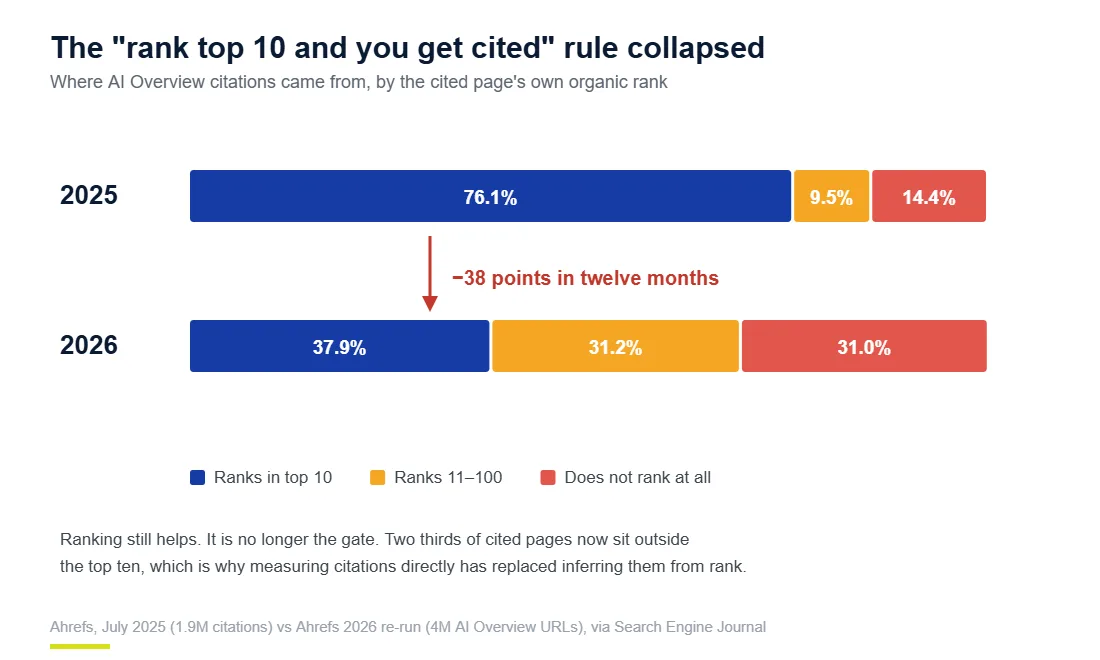
The second thing to learn is that the ground moved. In July 2025 Ahrefs analyzed 1.9 million citations from a million AI Overviews and found 76.10% of cited pages ranked in the top ten, with the top-cited URL sitting at a median organic position of 2. That single finding shaped almost every GEO guide written since. Ahrefs re-ran the study across 863,000 keyword SERPs and four million AI Overview URLs; the top-ten share had fallen to 37.9%, with 31.2% ranking 11–100 and 31.0% not ranking at all.
There is a detail in the 2025 data worth holding on to, because it quietly falsifies the most popular explanation for the shift. Pages cited from outside the top ten ranked for fewer keywords and matched shorter queries, 887 keywords at 5.2 words versus 1,020 at 5.4 words for top-ten pages. If query fan-out were pulling in obscure long-tail pages, you would expect the opposite.
Where the ceiling is set before you start
One finding should change how you scope every engagement you ever take. A 2026 study of more than 100,000 prompt responses across more than 100 brands found that global household-name brands appeared in 73% of relevant AI answers on the first visibility run, established mid-market and regional brands in 44%, and niche or small brands in 11%. Roughly thirty percentage points separate each tier, before anyone optimizes anything.
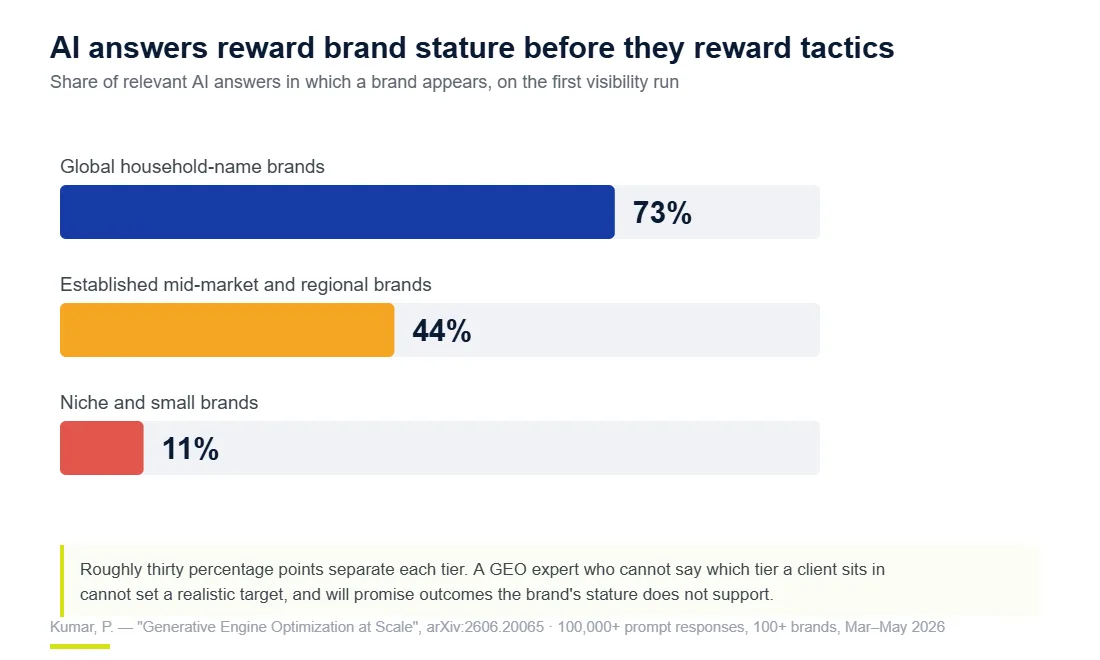
The same study found that around 78% of AI-engine citations point to corporate websites, that the single most-cited content format is the ranked “best-of” listicle at roughly 21% of all citations, that YouTube is the leading non-corporate source ahead of Reddit and Wikipedia, and, the most operationally important number in the paper, that brand sentiment flips 6.7 times more often than brand mention does.
That last figure has a direct consequence. A single sentiment reading is worthless. If you report to a client that AI describes their brand positively, and you measured it once, you have told them nothing.
Engine-specific behavior: there is no such thing as optimizing for “AI”
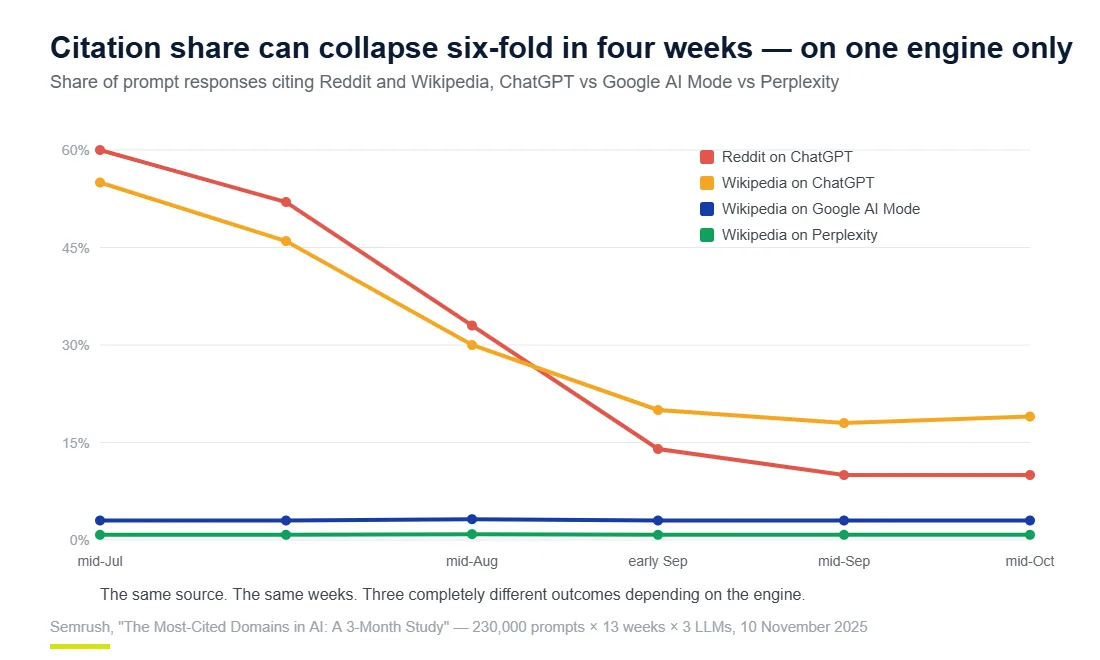
Almost every guide in this category writes as though ChatGPT, Google AI Mode and Perplexity behave alike. Semrush measured 230,000 prompts a week for thirteen weeks across three engines, producing over 100 million citations, and found the opposite.
ChatGPT cited Reddit in roughly 60% of prompt responses in early August 2025. By mid-September that had fallen to about 10%. Wikipedia went from about 55% to under 20% over the same window. On Google AI Mode and Perplexity, Wikipedia’s share did not move at all. It stayed near 3% and 0.8% respectively. The event was ChatGPT-specific. Anyone whose strategy rested on Reddit presence lost most of its value on one engine in four weeks and none of it on the other two.
There is a second structural difference worth internalizing. Semrush’s clickstream analysis of more than a billion lines of data found that ChatGPT enables web search on only 34.5% of queries. Roughly two thirds of answers are generated from training data alone. Getting into a retrieval index is work you can do; getting into a training corpus is not something a client or agency can influence on any useful timescale.
| Engine | Top cited domains | What this implies for your source strategy |
|---|---|---|
| Google AI Mode | LinkedIn, YouTube, Reddit, Google, Google Blog | Google-owned properties are over-represented. A YouTube presence and an active company LinkedIn page do measurable work here. |
| Perplexity | Reddit, LinkedIn, NIH, Microsoft, Google | Community and institutional sources dominate. Wikipedia is close to irrelevant at ~0.8%. |
| ChatGPT | Post-September 2025 winners: PRNewswire, Forbes, Medium (Forbes doubled) | Wire distribution and earned placements in large publishers carry unusual weight. Community sources are volatile. |
The twelve competencies, scored from one to five
Every guide in this category lists skills. None of them tells you how to know whether you have one. The rubric below defines each competency at five levels, and every level is written as an observable artifact rather than an adjective, something you either have produced or have not.
Score yourself honestly out of 60. Most working SEOs land between 24 and 32. Below 20 you are a beginner regardless of your SEO seniority. Above 45 you are, by the standards of a field that is eighteen months old, an expert.
| Competency | L1 | L2 | L3 | L4 | L5 |
|---|---|---|---|---|---|
| Retrieval literacy | Can define RAG and grounding | Can explain why an engine returned a given source | Can predict which of two pages an engine will prefer, and be right more often than not | Has read the primary papers and can name where their conclusions do not hold | Can design a content structure from retrieval principles rather than from checklists |
| Chunk-level writing | Writes answer-first paragraphs | Structures a page so any single section stands alone | Can rewrite an existing page into liftable passages without losing narrative | Has A/B evidence that a rewrite changed citation behavior | Can teach the pattern to a content team and audit their output against it |
| Entity architecture | Knows what Schema.org Organization is | Has implemented sameAs across LinkedIn, Crunchbase, Wikidata | Has corrected a wrong entity description an engine was repeating | Maintains entity consistency across languages | Has built a knowledge panel from nothing and can show the before and after |
| Crawl and access | Knows GPTBot exists | Can read robots.txt directives for AI crawlers | Has verified in server logs which AI crawlers actually fetch the site | Can diagnose why an engine cannot render a page | Has instrumented edge-level logging to attribute AI referral traffic |
| Prompt-set design | Can write ten prompts a buyer might use | Can build a 50-prompt set covering the funnel | Stratifies prompts by intent, stage, language and market | Knows how many runs per prompt are needed given engine non-determinism | Can defend the sampling design to someone who understands statistics |
| Measurement | Can check whether a brand is mentioned | Tracks share of voice across one engine over time | Tracks across three or more engines with a fixed cadence | Detects and explains a citation-share shift within the month it happens | Reports share of voice with stated confidence and known limitations |
| Sentiment | Can read whether a mention is positive | Records sentiment alongside mention | Tracks sentiment stability across repeated runs | Understands that sentiment flips ~6.7x more than mention and samples accordingly | Has traced a negative characterization back to its source and changed it |
| Source acquisition | Knows which domains get cited | Knows which domains get cited on which engine | Has earned a placement on a domain that subsequently appeared in an AI answer | Runs a source-gap analysis against named competitors | Runs an earned-source program with measured citation outcomes |
| Multilingual and regional | Aware that engines behave differently by language | Can run the same prompt set in two languages | Has built Arabic entity attributes and regional citations | Knows which regional sources define entities to Arabic-language models | Has moved an Arabic AI answer for a commercial query and can show it |
| Commercial framing | Can explain GEO to a marketer | Can scope a GEO audit | Can price retainer, project and performance models | Can build a CFO-facing ROI model with stated assumptions | Can defend that model against a hostile finance review |
| Tooling judgment | Can use one AI visibility tool | Can compare two on features and price | Has built an independent check on a vendor’s numbers | Can run a credible program with free tools alone | Chooses per client rather than per habit, and can say when to buy nothing |
| Epistemic discipline | Cites sources | Checks sources before citing | Can identify a misquoted statistic in someone else’s work | Publishes original tests, including the ones that failed | Changes a public position when new evidence contradicts it |
The 90-day plan, with checkpoints someone else could grade
Roughly 90 hours across thirteen weeks, at six to eight hours a week. For calibration: the Coursera GEO Specialization is 24 hours and the Muck Rack Academy fundamentals course is 90 minutes. Neither is close to sufficient on its own, which is the honest answer to “can I learn this from a course?”
Every checkpoint below is a deliverable. If you cannot hand it to someone else and have them assess it, you have not passed it.
| Weeks | Hours | What you do | Checkpoint, you pass when… |
|---|---|---|---|
| 1–2 | 12 | Read arXiv:2311.09735 and arXiv:2606.20065 in full. Read both Ahrefs citation studies and the Semrush most-cited-domains study. Write a one-page critique of each. | You can explain, without notes, why “add statistics and you will be cited 40% more” is a misreading of the paper it comes from. |
| 3–4 | 10 | Pick one brand. Build a 50-prompt set stratified by funnel stage and by market. Run it manually across ChatGPT, Google AI Mode and Perplexity. Log mention, citation URL, and sentiment. | You have a baseline share-of-voice figure per engine, and a written note on how much the same prompt varied between runs. |
| 5–6 | 12 | Automate it. Script the prompt set against APIs or a low-cost tracker. Run three times per prompt. Compute week-over-week share of voice. | Your numbers reproduce within a stated tolerance. You can say how many runs you needed before the figure stabilized. |
| 7–8 | 14 | Entity work. Audit Schema.org Organization markup, sameAs coverage, Wikidata, LinkedIn, Crunchbase and regional directories. Fix every inconsistency. | An engine that previously described the brand incorrectly now describes it correctly, and you have dated screenshots of both states. |
| 9–10 | 12 | Source-gap analysis. Identify every domain cited for your target prompts. Compare against competitors. Build an acquisition plan segmented by engine. | A ranked list of source targets, each with the engine it serves and the evidence that engine cites it. |
| 11 | 8 | Access and crawl. Check GPTBot, ClaudeBot, PerplexityBot and Google-Extended in robots.txt. Verify in server logs which actually fetch. Check render. | You can state which AI crawlers reached the site in the last 30 days and how often, from logs, not assumptions. |
| 12 | 10 | Content rewrite. Take five pages. Rewrite into answer-first, self-contained passages. Add sourced statistics and quotable definitions. Leave five comparable pages untouched as a control. | A written before/after with a control group, and an honest statement of what you cannot attribute. |
| 13 | 12 | Commercial. Build the audit deliverable, the pricing model and the CFO-facing ROI model. Present the whole program to someone who will push back. | Someone senior who was not involved understands what you did, what it cost, and what it returned, and can restate it themselves. |
Build your own AI visibility test harness for under $100 a month
The fastest way to become credible in this field is to build the measurement rig yourself rather than buying one. You will understand what the commercial tools are actually doing, you will be able to sanity-check their numbers, and you will have something to show an employer that a certificate cannot replace.
- Design the prompt set. Fifty prompts minimum. Stratify by funnel stage (problem-aware, solution-aware, vendor-comparison, branded), by market (UAE, Saudi Arabia, Egypt), and by language. Write them the way a buyer speaks, not the way a keyword tool renders them, Semrush found that between 65% and 85% of ChatGPT prompts cannot be matched to any traditional keyword.
- Run each prompt at least three times. Non-determinism is the whole reason this step exists. Record all runs, not the best one.
- Log six fields per run: prompt, engine, date, brand mentioned yes/no, cited URLs, sentiment. Nothing more, or you will stop maintaining it.
- Compute share of voice per engine, not blended. The Semrush data above is the reason. A blended figure hides exactly the movement you need to see.
- Set a fixed cadence and never change it mid-quarter. Weekly is enough. Changing cadence destroys comparability.
- Add a competitor set from day one. Absolute share of voice is close to meaningless; relative share is what a client will act on.
Cost: the API calls for a 50-prompt, three-run, three-engine weekly program sit in the low tens of dollars per month. If you would rather not script it, Otterly’s Lite tier is $29 a month for 15 prompts and Profound’s Starter tier is $99 a month for 50 prompts on ChatGPT only. Build first, buy later. You will choose better.
What the job pays, and who is hiring
No other guide on this topic publishes salary data, which is odd for a genre that promises a career. Here is what is actually documented.
| Role | Employer | Published range | Source |
|---|---|---|---|
| AEO & SEO Manager | Experian | $100,000 – $174,000 | Kaleigh Moore, 6 Jul 2026 |
| GEO/AEO growth marketing specialist | Odoo | $75,000 – $95,000 | Kaleigh Moore, 6 Jul 2026 |
| Senior enterprise content / AI optimization | Various | $150,000 – $210,000 | SEOJobs.com data via Kaleigh Moore |
| Freelance GEO specialist | $150 – $300 per hour | Growtal, 2026 |
The job titles themselves tell you how unsettled the field is: Director of Product AEO & SEO at eBay, Director of AI & Organic Search at Victoria’s Secret, VP of Search & AI Visibility at Milestone, Group Director of GEO and Search Strategy at Real Chemistry, Senior Manager of SEO & GEO at J. Jill, Associate Director of SEO & AI Visibility at Tombras. Six organizations, six different names for adjacent jobs.
On the demand side, Conductor surveyed more than 250 enterprise C-suite and VP-level leaders and found that 94% plan to increase AEO/GEO investment in 2026, that 97% reported a positive funnel impact in 2025, and that the average allocation was 12% of the digital marketing budget. The same survey named the top challenges: creating AI-search-optimized content at scale, measuring ROI, and monitoring AI-bot crawling. Two of those three are measurement problems, which tells you where to specialize.
Tools: what they cost and what they actually do
Prices below were read from vendor pricing pages in August 2026. Where a vendor renders pricing in JavaScript and does not expose it in the page source, that is stated rather than guessed.
| Tool | Entry price | What you actually get at entry | Notes |
|---|---|---|---|
| Profound | $99/mo (Starter) | ChatGPT only, 50 prompts, 1,500 responses/mo, 1 seat, no exports | Growth at $399/mo adds 3 engines, 100 prompts, 9,000 responses, CSV/JSON. Agent Analytics attributes AI-sourced traffic via Cloudflare, Vercel, Akamai and log integrations: the strongest attribution layer on this list. Self-serve tiers billed yearly. |
| Otterly.AI | $29/mo (Lite), $25 annual | 15 prompts, 1 workspace, 1,000 GEO audits/mo | Standard $189/mo: 100 prompts, unlimited workspaces, API and MCP access. Covers ChatGPT, AI Overviews, Perplexity and Copilot; Google AI Mode, Gemini and Claude are paid add-ons. Cheapest credible entry point. |
| Peec AI | Not exposed in page source | Starter tier: 50 prompts, 3 models, 1 project | Pricing is JavaScript-rendered. Confirmed: 15% annual discount, multi-country at no extra cost, Looker Studio and MCP connectors. Built for agencies managing many clients. |
| Semrush AI Visibility Toolkit | Bundled in Semrush One | AI Visibility score, cited-pages report showing which of your URLs were referenced and for which prompt | The “Missed” flag, your URL was cited but your brand was not named, is genuinely useful and unusual. Best choice if you already pay for Semrush. |
| Ahrefs Brand Radar | Part of Ahrefs plans | Citation counts, competitive share and impressions across AI Overviews over time | Same logic: strong if Ahrefs is already in your stack, not worth switching for. |
| Conductor | Not published | Enterprise AEO platform: visibility, LLM-bot crawl monitoring, content | Three-week trial. Relevant only at enterprise scale. |
Certifications: a priced comparison, and why you probably should not buy one
Most guides on this topic list certifications without prices, without ratings and without disclosing that some are their own. Here is the version with the numbers attached.
| Program | Format | Price | Honest read |
|---|---|---|---|
| Coursera / Edureka GEO Specialization | 3 courses, 24 hours total, 8 weeks | Coursera subscription; financial aid available | 1,649 enrolled but rated 3.1 out of 5 from 8 reviews. Industry provider, not a university. No academic credit. Useful as structure, not as a credential. |
| GSDC Certified GEO Professional | Self-paced video, exam with one free retake, capstone, 7 modules | $800 list, $400 “offer”; $1,200 → $600 for a three-cert bundle | Real published syllabus and a named advisory board. But no recognized accreditation, a permanent discount, and objectives that conflate marketing GEO with machine-learning model optimization. Treat as a paid credential, not an accredited one. |
| Muck Rack Academy, Fundamentals of GEO | 1.5 hours, 7 modules plus exam | Free with registration | Narrow and honest about it: GEO for PR and communications teams. Module 6, explaining GEO to stakeholders, fills a gap nobody else addresses. Best value on this list precisely because it does not overclaim. |
| Open University / OpenLearn, Introduction to GEO | Self-paced online | Free | A publicly funded institution. No commercial incentive to overstate what GEO can do. |
| eSEOspace GEO Mastery Program | 90/180/365-day structure with audit templates | Not published; application-gated | Real curriculum artifacts, but requires five or more years of digital marketing experience. Not an entry route. |
| Class Central GEO directory | Aggregator, 30+ courses | Free directory | An index, not a credential. Useful for finding free material quickly. |
If you are going to buy one anyway, audit it first. Is there an accreditation body, and can you find it independently? Is the syllabus published at module level? Is the instructor named, and does their work exist outside the course? Is the exam proctored? Are the refund terms real? Is the “discount” permanent: a price that has been half off for a year is not a discount, it is the price.
Arabic and Gulf GEO: the part nobody else teaches
This is the widest open lane in the discipline, and it is the section that does not exist in any competing guide.
The demand is real. Microsoft’s AI Diffusion Report puts the UAE first globally for AI adoption at 59.4% of the working-age population, with Qatar at 35.7%, Saudi Arabia at 23.7%, Kuwait at 17.7% and Egypt at 12.5% (Middle East AI News). Saudi Arabia’s own Internet Report found 45% of Saudi internet users now use AI tools, with ChatGPT the most-downloaded AI app, followed by Gemini, DeepSeek, Grok and Copilot.
The supply is not. In documented MENA query testing, We ran 16 matched commercial prompts through Google AI Overviews from an Egyptian IP address in August 2026. The Arabic answers cited 44 sources, and not one was a B2B directory or a third-party ranking list, while the English answers took 8 of their 43 citations from exactly those places. In Arabic the answer gets assembled from whatever companies publish on their own sites. That is not a competitive market. That is an empty one.
What is mechanically different about Arabic
- A far smaller quality source pool. Arabic AI answers draw on Arabic Wikipedia, Al Jazeera, Al Arabiya, The National, Arabic LinkedIn and structured data: a fraction of the English corpus. One well-built Arabic page can become a defining source in weeks.
- Entity attributes must exist in Arabic. An Arabic
alternateNameanddescriptionin your Schema.org Organization markup, plus Arabic labels on Wikidata, are the difference between an engine knowing your brand in Arabic and guessing. - Regional registration substitutes for the citation graph. Dubai Chamber, DIFC, ADGM and the Saudi Federation for Cybersecurity carry weight that no amount of English-language link building replicates.
- Gulf and Egyptian Arabic diverge in query language. The same intent produces materially different phrasings. A prompt set built only in Modern Standard Arabic will miss most real buyer queries.
- Bilingual buyers switch languages by context. The same person researches in English and validates in Arabic, or the reverse. Your prompt set has to run in both or your share-of-voice number is fiction.
What a GEO audit deliverable actually contains
Several training programs sell an audit template. Here is the table of contents, free, so you can build your own and judge theirs. A first audit of a mid-sized site takes 20 to 40 hours.
- Crawl and render accessibility for AI agents. robots.txt directives for GPTBot, ClaudeBot, PerplexityBot, Google-Extended and CCBot; server-log evidence of which actually fetched, and how often, in the last 30 days; render check for client-side content.
- Entity consistency. Schema.org Organization against LinkedIn, Crunchbase, Wikidata, Google Business Profile and regional registries; every discrepancy listed with the correct value.
- Chunk-level retrievability. Page-by-page assessment of whether individual sections stand alone when lifted out of context, with rewrites for the worst offenders.
- Baseline share of voice by engine. The 50-prompt set, three runs each, per engine, with run-to-run variance stated. Not a blended number.
- Citation-source gap analysis. Every domain cited for your target prompts, mapped against named competitors, segmented by engine.
- Sentiment stability. Repeated sampling, not a single reading, sentiment flips roughly 6.7 times more often than mention does, so one measurement is noise.
- Content-format gap. Ranked listicles account for roughly 21% of all AI citations. If a category has no comparison or ranking asset, that is usually the highest-value single gap.
- Prioritized remediation backlog. Every finding with effort, expected impact and owner. Sequenced, not listed.
How to price the work, and how to prove it to a CFO
Published market rates run from roughly $1,500 a month for small-business strategy to $12,000–$35,000 a month for enterprise programs with content production, with freelance work at $150–$300 an hour. Those are agency-published ranges rather than survey data, so treat them as directional.
The more useful number is the buyer’s. Conductor found enterprises allocating 12% of digital marketing budget to AEO/GEO. On a $2 million digital budget that is a $240,000 annual line, enough for one senior in-house hire plus a modest agency retainer, or a single enterprise engagement. Pricing into a real budget beats guessing at a rate card.
The ROI model, including the part that argues against you
Build it in two halves. The offensive half: AI-referred sessions, detected at the edge or in server logs, multiplied by a conversion multiplier and by average order value. Semrush puts the average AI-search visitor at 4.4 times the value of a traditional organic visitor; Conductor reports LLM visitors converting at twice the rate in a third of the sessions.
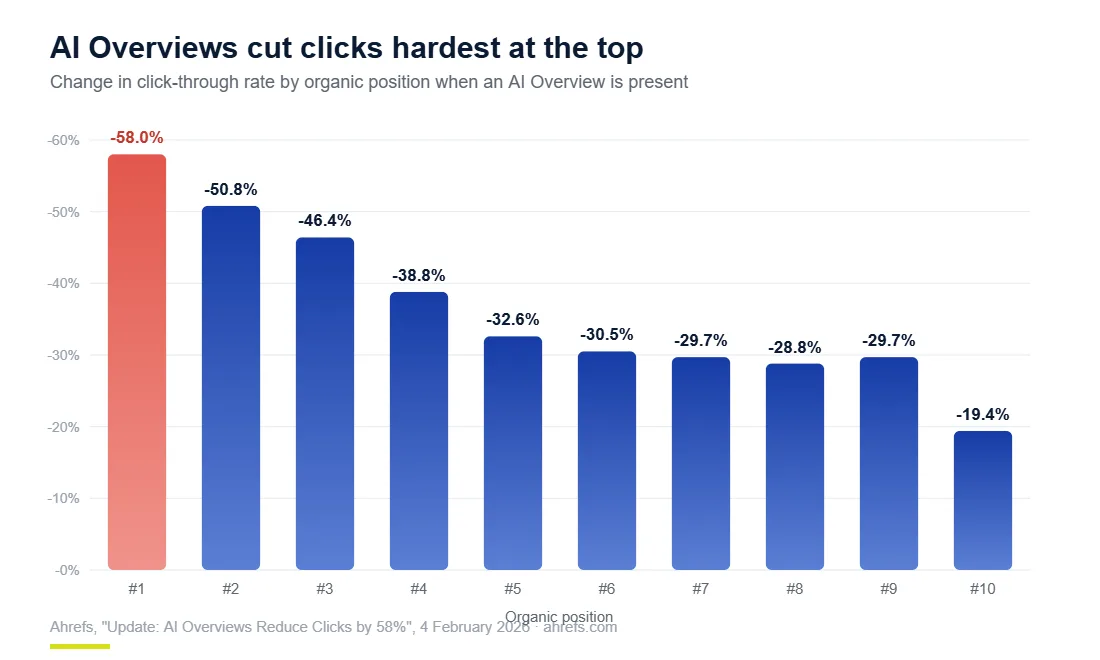
The defensive half is the one that actually wins the argument. Click-through rate at position one falls by 58% when an AI Overview appears (Ahrefs, February 2026). The value of a GEO program is partly revenue you would otherwise lose, and a CFO understands defended revenue better than incremental revenue.
Five mistakes that mark someone out as new
- Reporting a blended AI visibility score. Engines behave differently enough that a blended number hides every movement worth acting on.
- Measuring once. A single run tells you about model noise, not about your brand.
- Promising a citation. No agency controls retrieval. You can improve the conditions and measure the outcome; you cannot guarantee the result, and saying otherwise is how this discipline loses credibility.
- Quoting the 40% figure loosely. Practitioners who have read the paper will notice immediately, and it is the fastest way to be dismissed by the people worth impressing.
- Treating llms.txt and schema as settled wins. Neither has robust public evidence of moving citation on its own. Implement them because they are cheap, not because they are proven.
Frequently asked questions
How long does it take to become a GEO expert?
Roughly 90 hours of structured practice over three months will make you competent if you already work in search, because the transferable half of the skill set is already in place. Coming from outside search, expect six to nine months, because you need retrieval literacy, entity architecture and measurement design on top of the basics. Nobody has been doing this for more than about two years, so the bar for expert is lower than in any established discipline.
Do I need a GEO certification to get hired?
No. There is no accredited, vendor-neutral GEO certification in 2026: every credential on the market is issued by a tool vendor, an agency or an unaccredited certification body. Employers hiring the fifty-plus dedicated AI-search roles currently open are screening on demonstrated work. A public test harness with three months of documented data is worth more than any certificate available today.
What does a GEO expert earn?
Published US listings show an AEO and SEO manager role at Experian at $100,000 to $174,000, a GEO/AEO specialist role at Odoo at $75,000 to $95,000, and senior enterprise AI-optimization roles at $150,000 to $210,000. Freelance rates run $150 to $300 an hour. Comparable published bands do not exist for the UAE, Saudi Arabia or Egypt, where these responsibilities are usually folded into broader SEO titles.
Is GEO just SEO with a new name?
No, but the overlap is large and honest practitioners say so. Ranking still feeds citation. What changed is the unit of work, you optimize a passage to be quoted rather than a page to be clicked, and the fact that most of the sources shaping an AI answer are not on your own site. The measurement discipline is also genuinely new, because generative engines are non-deterministic in a way that search results are not.
Which AI visibility tool should I start with?
Build a manual prompt set first, for nothing. When you outgrow it, Otterly at $29 a month is the cheapest credible entry point and Profound at $99 a month has the strongest traffic-attribution layer. If you already pay for Semrush or Ahrefs, use what you have before adding a subscription. Choosing a tool before you understand what it is measuring is the most common and most expensive beginner mistake.
Does GEO work differently in Arabic?
Substantially. Arabic AI answers draw on a much smaller pool of quality sources, Arabic Wikipedia, Al Jazeera, Al Arabiya, The National, Arabic LinkedIn and structured data, so a single well-built Arabic page can become a defining source in weeks. You also need Arabic entity attributes in your Organization schema, Arabic Wikidata labels and regional registrations. In documented MENA testing, no brand held a consistent AI answer for tested Arabic commercial queries.
Can an agency guarantee my brand will be cited by ChatGPT?
No, and anyone who does should be disqualified on that basis. AI providers control their own retrieval and answer logic and change it without notice: one source’s citation share moved roughly six-fold in four weeks on a single engine. An agency can improve the conditions that make citation likely and measure the result. It cannot promise the result.
Related guides
- How to Measure AI Visibility (Share of Model): A 2026 Playbook
- Arabic GEO: How to Get Your Arabic Content Cited by ChatGPT, Gemini and AI Overviews
- What Does a GEO Agency Do? The Complete 2026 Guide
- How to Get Cited by Perplexity in 2026: A Data-Backed Playbook
- AEO vs GEO: What’s the Difference in 2026?
The skills that matter most. If you are building a GEO career, the four layers in this breakdown are the ones clients actually pay for.
Worth knowing as a GEO specialist. Clients will ask about ChatGPT Ads. The current country list, category rules and setup flow are in ChatGPT Ads and the nine-country list and how to prepare for ChatGPT Ads before they launch.
Don't miss the chance to
make your website more visible!
Initial consultation and
audit of the current situation

Read also

Article Behavioral Factors in SEO: What They Are and How to Improve Them
Article JavaScript Links Are Hiding MENA Sites From ChatGPT and Claude

Article VOCTOS Is a Top SEO, PPC and SEM Company in Egypt on Clutch for 2026
Article Commercial Ranking Factors: The Complete List

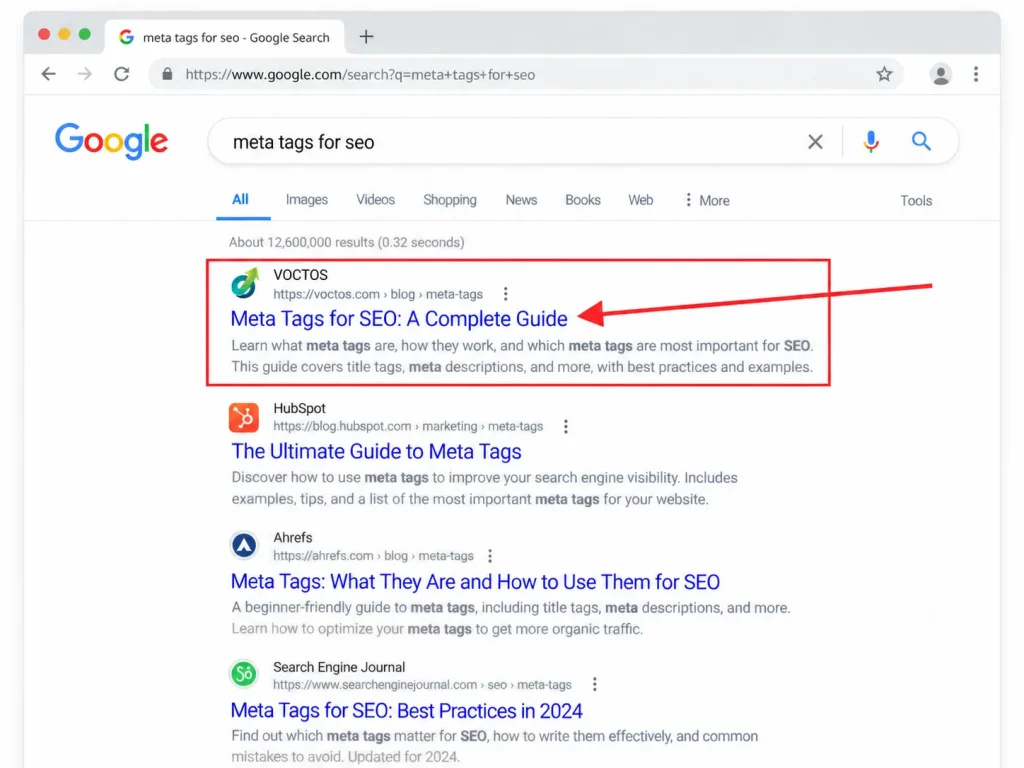
Article The Title Meta Tag: What It Is and How to Write It
Article The Role of Meta Tags in Search Engine Optimization
Article Can You Sue an AI for Defamation? Where the Law Stands

Article Cloudflare’s 15 September AI Crawler Defaults: The Check Gulf and Egypt Brands Should Run Today



Real Results
More Wins
SEO & GEO for Delta Medical Labs
 GEO
GEO
1M+ monthly organic visits, 159,200 ranked keywords, 5,570 pages cited by AI engines, and 1,186 #1 rankings in KSA.

Arabic SEO, GEO & guest posting for VPNly
 SEO
SEO
65K peak monthly organic visits, 55 guest posts, and 149 pages cited by AI engines.

SEO & GEO for Ogaei Virtual Care
GEO
From 3 to 7,931 monthly organic clicks in 7 months, 2.9M+ impressions, and 40+ keywords in Google’s Top 10.

SEO for Eduverse
SEO
12× search traffic in 10 months, 45% of target keywords in the top 5, and 55% in the top 10.
Trusted by