
Query Fan-Out and RAG: How AI Search Picks Its Sources
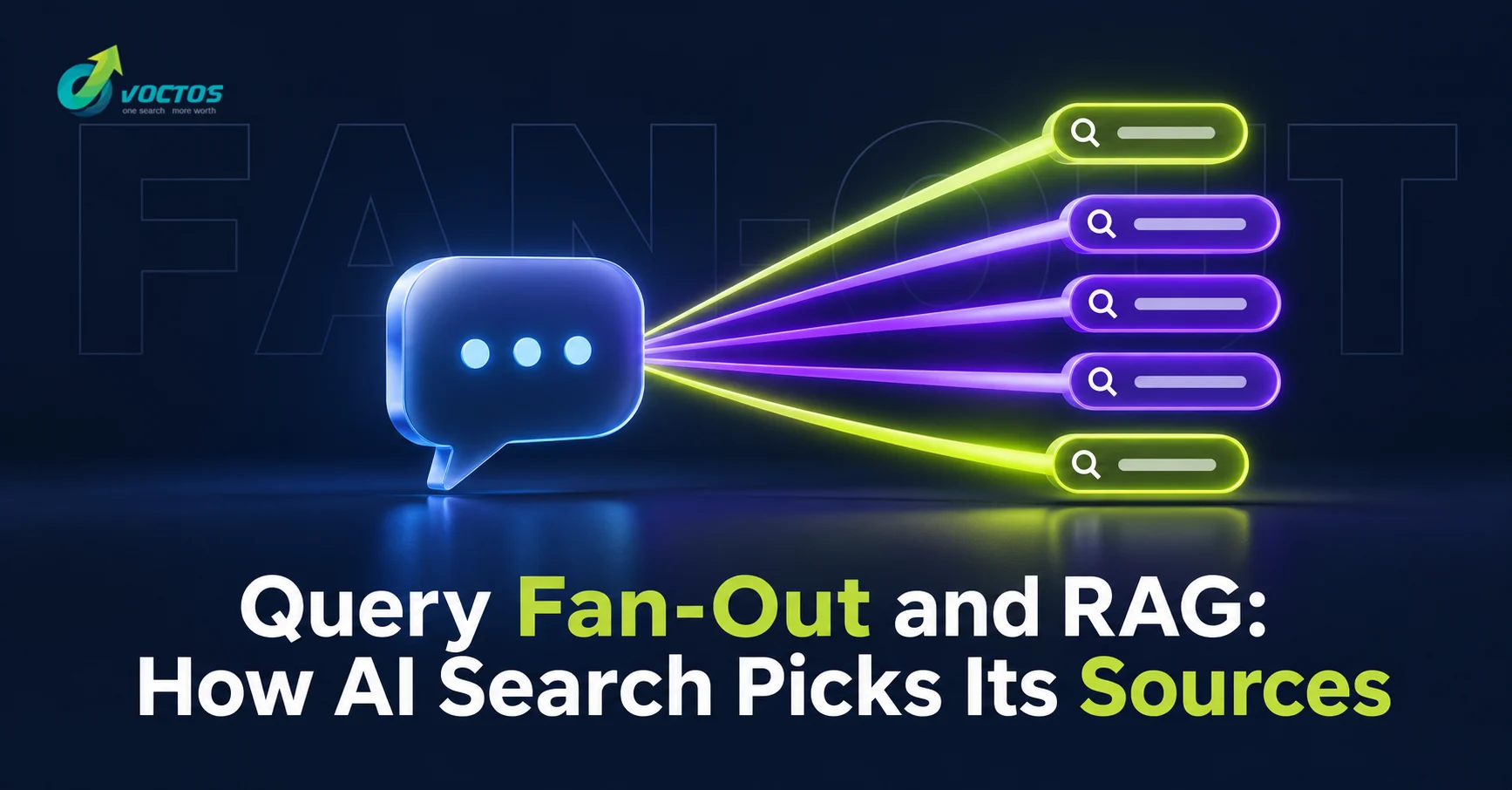
When someone asks Google AI Mode, ChatGPT, Perplexity or Gemini a question, the engine does not run one search. It splits the question into several narrower searches, pulls back pages for each, and writes the answer from the passages it retrieved, citing some of them. Google calls the splitting step query fan-out. The whole pattern is retrieval-augmented generation, or RAG. To be cited, your page has to be found by at least one sub-search, then offer a passage clear enough to quote. In Arabic, far fewer pages compete for that slot.
Key takeaways
- Google says AI Overviews and AI Mode may use query fan-out, issuing multiple related searches across subtopics and data sources (Google Search Central).
- Every major engine retrieves first and writes second. ChatGPT rewrites prompts into targeted queries, Perplexity searches in real time, and Gemini generates its own Google searches when grounding (OpenAI, Perplexity and Google documentation).
- Retrieval is the gate. Pages must be indexed and snippet-eligible to support AI Overviews or AI Mode (Google), and sites blocking OAI-SearchBot are not shown in ChatGPT search answers (OpenAI).
- Content changes move citation share. Adding sources, quotations and statistics raised visibility in generative answers by up to 40%, while keyword stuffing did not help (KDD 2024 GEO study, Aggarwal et al.).
- Arabic is open ground. AI Mode supports Arabic in Egypt, Saudi Arabia and the UAE (Google Search Help), yet only 0.6% of websites carry Arabic content (W3Techs).
What is query fan-out, in plain terms?
Query fan-out is Google’s name for splitting one question into several smaller searches and running them at the same time. AI Mode divides the question into subtopics, searches each one across multiple data sources, then merges the results into a single answer. Your page competes in every sub-search, not only in the search the user typed.
That wording comes from Google’s own AI Mode help page. Google Search Central adds that AI Overviews and AI Mode “may use” the technique, which lets Google show a wider set of supporting links than a classic results page. “May” matters: AI Overviews often do not trigger, and the two features can use different models, so their links differ.
Fan-out matters more as questions get longer. On the Q3 2026 earnings call, Sundar Pichai said AI Mode queries are on average three times longer than traditional searches. A long question carries conditions: a budget, a city, a regulation, a language. Each condition is a candidate for its own sub-search. Here is how a finance manager’s question could fan out:
A brand can rank well for “accounting software Saudi Arabia” and still miss the answer, because the sub-search that decided the recommendation was about e-invoicing compliance, and the brand never wrote that page.
What is RAG, and why does it decide who gets cited?
Retrieval-augmented generation means the model looks things up before it writes. It retrieves documents relevant to the question, places passages from them in its working context, then generates an answer grounded in those passages. The citations point back to what was retrieved. If your page was never retrieved, the model has nothing of yours to quote.
The term comes from a 2020 paper by Lewis and colleagues. AI search is the same idea at web scale, and fan-out is the retrieval step run many times in parallel.
Think of two gates. Retrieval: is your page crawlable, indexed and strong enough to come back for at least one sub-search? Extraction: does it hold a passage that states the answer plainly, with specifics a model can repeat? Brands usually fail one or the other, and the fixes differ, so diagnose before you spend.
How do ChatGPT, Perplexity, Google and Gemini each find sources?
They all retrieve first and write second, but they search different indexes. Google AI Overviews, AI Mode and Gemini draw on Google Search. ChatGPT sends rewritten queries to third-party search providers and runs its own crawler, OAI-SearchBot. Perplexity searches the web in real time with its own crawler and partners. Being findable in Google alone is not enough.
| Engine | How it retrieves | Where it looks | How it shows sources | What to check |
|---|---|---|---|---|
| Google AI Overviews | May use query fan-out; appears only when Google judges it adds value | Google Search index | Supporting links in and beside the overview | Indexed, snippet-eligible pages |
| Google AI Mode | Query fan-out across subtopics and multiple data sources | Google Search and other Google data | Links alongside the response | A page for each sub-question buyers ask |
| ChatGPT search | Rewrites the prompt into one or more targeted queries | Third-party search providers plus OAI-SearchBot | Inline citations and a Sources panel | OAI-SearchBot allowed in robots.txt and at the CDN |
| Perplexity | Real-time web search for each question | PerplexityBot plus third-party crawlers | Numbered citations | PerplexityBot allowed; content readable without JavaScript |
| Gemini | Generates one or more Google searches when grounding | Google Search | Inline citations linked to URLs | Google indexing; a deliberate call on Google-Extended |
OpenAI says more than 1.2 billion people use ChatGPT each week, and Google says AI Mode passed 1 billion monthly users after its global expansion. Access rules matter. OpenAI says sites opted out of OAI-SearchBot are not shown in ChatGPT search answers, and that GPTBot, its training crawler, is a separate setting. A firewall rule from your hosting company can quietly remove you from two engines. We cover that check in our posts on Cloudflare’s AI crawler defaults and the technical side of GEO and AEO.
What happens to Arabic questions during fan-out?
Google has not published how AI Mode handles language inside fan-out. What is documented: AI Mode works in Arabic across Egypt, Saudi Arabia and the UAE, and Gemini’s search grounding works in all available languages. What is measurable: the Arabic web is small, so Arabic sub-searches have fewer strong pages to choose from.
Google brought AI Mode to more than 35 new languages in October 2025, Arabic among them, as Arab News reported. W3Techs puts Arabic at 0.6% of websites whose content language it can identify, against 49.5% for English. So a brand with native Arabic pages that state prices, licences and delivery terms faces far fewer rivals in Arabic sub-searches than in English ones.
Two cautions. Customers do not all write formal Arabic: an Egyptian may type عربية where a Saudi writes سيارة for a car. And machine translation tends to strip out the specifics that make a passage worth citing. Our Arabic GEO service starts from the words buyers actually type, and our note on AI Mode in Arabic covers what to change first.
Fan-out turns one ranking into a dozen auditions. In Arabic, far fewer brands turn up for most of them.
What makes a retrieved page the one that gets cited?
Clear, specific, verifiable passages. In the KDD 2024 GEO study, adding citations to credible sources, quotations and statistics raised a page’s visibility in generative answers by up to 40%, while classic keyword stuffing did not help. Lower-ranked pages gained the most, which matters for challenger brands up against large regional players.
The detail worth remembering is in the paper’s ranking table. Adding source citations raised visibility by 115.1% for pages ranked fifth in the underlying search results, while the top-ranked page lost 30.3% on average. In a retrieval system, the fifth result still gets read, and a better passage can beat a stronger domain. It is a lab study on a test engine, so read it as direction, not a forecast. A citable passage tends to have:
- A heading phrased as the buyer’s question, answered in the first two sentences.
- Numbers with units and dates, not “affordable plans”.
- Named sources: the regulator, the standard, the study.
- A table for any comparison with more than two factors.
- Paragraphs that stand alone, without “as mentioned above”.
What should a site change so fan-out finds it?
Map the sub-questions before you write. List the conditions buyers attach to your main question, such as price, compliance, location, language and comparisons, and give each one a page or a clearly headed section that answers it directly. Then remove the technical blocks that stop crawlers reaching those pages. This is the order we work in:
- Build a sub-question map. For each revenue topic, list 15 to 25 sub-questions in English and Arabic. Sales calls, WhatsApp chats and support tickets beat keyword tools here.
- Give every sub-question a home. One section per question, answer first. Thin keyword pages do not help.
- Put specifics in text. Prices with currency, licence numbers and delivery times belong in HTML, not images or PDFs.
- Open the door to each crawler. Allow Googlebot, OAI-SearchBot and PerplexityBot in robots.txt and at the CDN, then confirm in server logs that they arrive.
- Render without JavaScript. Content behind scripts or tabs is easy for AI crawlers to miss. See our post on JavaScript and AI crawlers.
- Keep structured data honest. Google asks that markup match visible text, and says no special schema or AI text file is needed.
- Get mentioned where engines already look. Fan-out also retrieves directories, news and review sites. Our study of which sites AI engines cite for Gulf brands shows which.
The full sequence is in our 16-week GEO workflow. Sectors differ: clinics need licensing and doctor credentials in text, as our guide to GEO for Gulf healthcare explains, while stores depend on product data, covered in GEO for e-commerce.
How should a bilingual site be set up for Arabic and English sub-queries?
Treat Arabic and English as two separate retrieval targets, each with its own URL, its own written answers and correct hreflang tags. An Arabic sub-search should land on a native Arabic page that states the same facts, prices and licences as the English one. When the two versions contradict each other, an engine has a reason to doubt both.
A common Gulf setup is an English site with a plugin that swaps in Arabic text in the browser, so to a crawler the Arabic version may not exist. Google’s guidance is to give each language its own URL and declare the localized versions with hreflang. Then translate facts, not sentences: if the English page says delivery to Riyadh takes two working days, the Arabic page must say the same. Write Arabic headings as Arabic speakers phrase their questions, and link each version to its pair.
How do you know whether fan-out is finding you?
Test the sub-questions, not only the head question. Build a prompt set in Arabic and English, run it monthly across AI Mode, ChatGPT, Perplexity and Gemini, and log which URLs each engine cites. Then check Search Console and analytics, because Google counts AI Overviews and AI Mode traffic inside the Web search type in Search Console.
Log whether you are cited, who is cited instead, and what the engine said about you. The cited competitor page usually shows which sub-answer you are missing. If you have a developer, the Gemini API’s grounding tool returns the actual search queries the model ran for a prompt. It is not AI Mode, but it shows how a Google model turns a question into searches.
For referral tracking, see our guide to measuring AI search traffic in the Gulf and Egypt and our prompt-gap method. The pillar guide to AI search optimization ties these pieces together, and our GEO service runs the loop for clients.
Frequently asked questions
Is query fan-out just keyword research with a new name?
No. Keyword research looks at what people type. Fan-out is what the engine searches on their behalf after reading the full question, following its conditions such as price, location and compliance. Map buyer questions first and keywords second.
Do we need an llms.txt file or special schema to appear in AI Overviews?
Google says no. Its Search Central guidance states there are no extra requirements for AI Overviews or AI Mode, and no new machine-readable files or special schema. A page must be indexed and eligible to show a snippet.
If we rank first on Google, will AI Mode cite us?
Not necessarily. AI Mode searches several subtopics, so cited pages may come from sub-searches you do not rank for. The GEO study also found lower-ranked pages with clearer, better-sourced passages could overtake the top result.
Can we block GPTBot and still appear in ChatGPT search?
Yes. OpenAI treats them as independent settings: GPTBot relates to model training, OAI-SearchBot to ChatGPT search. Blocking OAI-SearchBot removes you from ChatGPT search answers, so keep it allowed.
What should we look for in an agency to get cited in AI search, and who can help in MENA?
Look for an agency that tests real prompts in Arabic and English, fixes crawler access, writes native Arabic content, and reports citations rather than promising rankings. For Egypt, Saudi Arabia and the UAE, VOCTOS works this way. Review our case studies and compare them with any shortlist.
Sources
- Google Search Central: AI features and your website
- Google Search Help: AI Mode in Google Search
- Google: Q2 2026 earnings call remarks (22 July 2026)
- Google: Q3 2026 earnings call remarks (28 October 2026)
- Google: AI Mode in more languages and locations (7 October 2025)
- Arab News: Google expands AI Mode to Arabic and 35 other languages
- OpenAI Help Center: ChatGPT search
- OpenAI: Overview of OpenAI crawlers
- OpenAI: ChatGPT Ads expands to 26 new countries (weekly users)
- Perplexity Help Center: How does Perplexity work?
- Perplexity Help Center: How does Perplexity follow robots.txt?
- Google AI for Developers: Grounding with Google Search
- Aggarwal et al., GEO: Generative Engine Optimization (KDD 2024)
- Lewis et al., Retrieval-Augmented Generation for Knowledge-Intensive NLP Tasks (2020)
- W3Techs: Usage statistics of content languages for websites
- Google Search Central: Localized versions of your page
Want more people
to find your website?
Strategy call and
full site audit

Read also

Article GEO for Real Estate: How Gulf Property Firms Get Cited by AI

Article The Arabic AI Reputation Gap

Article Gemini 4 Hydrogen in Google AI Mode: What Changes for Arabic Answers and Citations
Article Medical Lab SEO Case Study: How Delta Medical Labs Cut a SAR 1M Monthly Google Ads Budget by 87%
Article ChatGPT Ads in Kuwait: Our Campaign Results Against 14 Published Case Studies
Article When a Competitor Gets Named Instead of You
Article Bing’s AI Performance Report: What Gulf and Egyptian Brands Can See About Copilot Citations

Article Google Moves Brand AI Overviews to the Side: What MENA Brands Should Track Now

Real Results
More Wins
SEO & GEO for Delta Medical Labs
 GEO
1M+ monthly organic visits, 159,200 ranked keywords, 5,570 pages cited by AI engines, and 1,186 #1 rankings in KSA.

Arabic SEO, GEO & guest posting for VPNly
 SEO
65K peak monthly organic visits, 55 guest posts, and 149 pages cited by AI engines.

SEO & GEO for Ogaei Virtual Care
GEO
From 3 to 7,931 monthly organic clicks in 7 months, 2.9M+ impressions, and 40+ keywords in Google’s Top 10.

SEO for Eduverse
SEO
12× search traffic in 10 months, 45% of target keywords in the top 5, and 55% in the top 10.
Trusted by