
How to Get AI Search Answers to Recommend Your Business (GEO Guide)
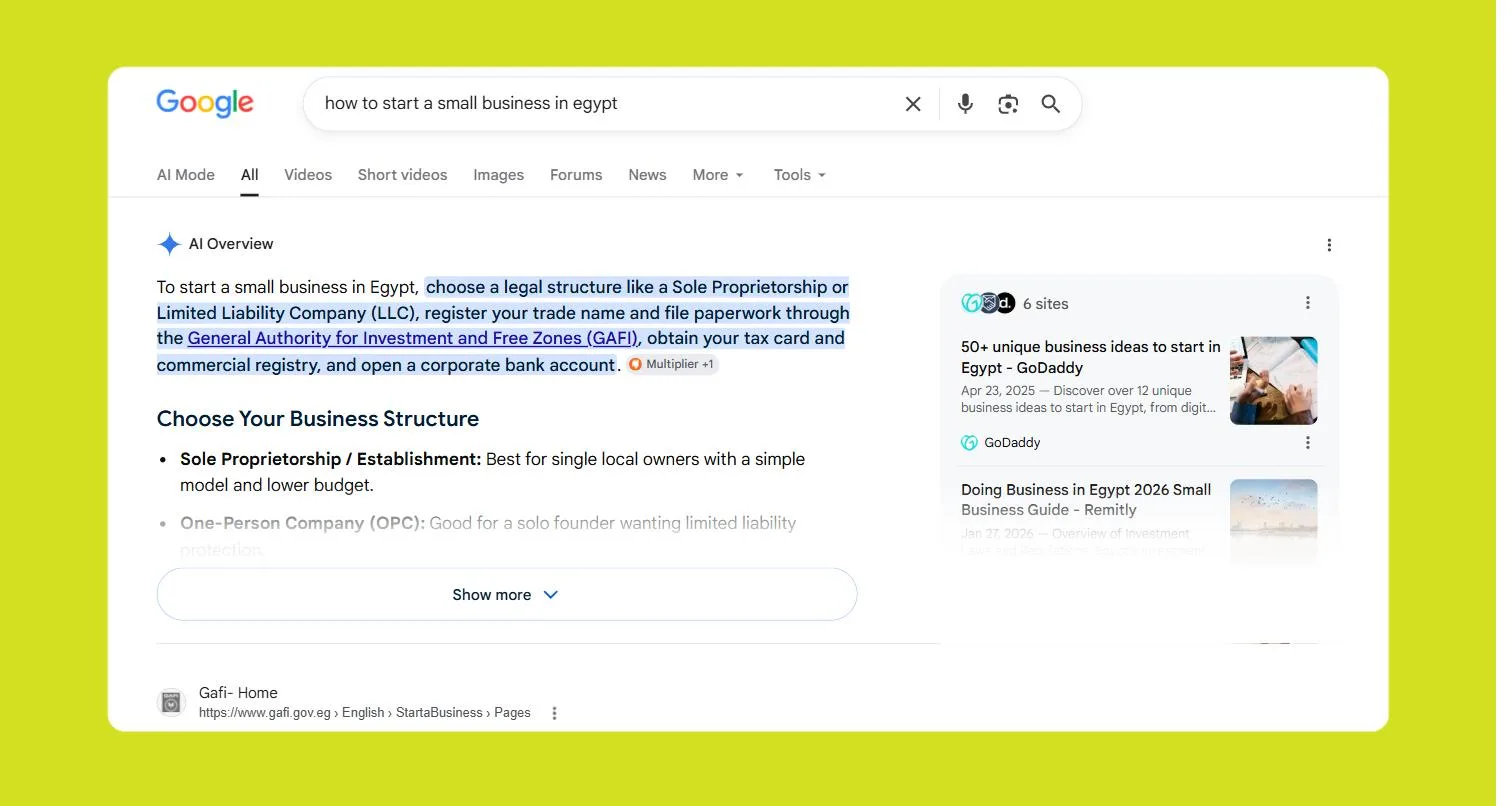
To get AI search answers to recommend your business, you need Generative Engine Optimization (GEO): publish clear, direct, well-structured answers to the real questions your customers ask, prove genuine expertise (E-E-A-T), and add Schema.org markup so engines like Google AI Overviews, ChatGPT, Perplexity and Gemini can lift your content straight into their responses. You cannot buy a spot in an AI answer, so the winning move is to become the most quotable, trustworthy source on your topic.
Key takeaways
- AI answers now sit above traditional results. Google AI Overviews appear on roughly 20.5% of searches and reach 2.5B+ monthly users, so the zero position is where visibility is decided.
- GEO replaces the old goal of ranking a link with a new goal: becoming the source an AI engine quotes in its ready-made answer.
- Direct, structured content wins: question-and-answer formatting, detailed FAQs and short scannable paragraphs are what large language models actually cite.
- Trust is the tiebreaker. Brands with strong E-E-A-T signals and real citations across the web are far more likely to be recommended.
- Brands cited in AI Overviews earn around 120% more organic clicks per impression, so being the referenced source pays off even when the answer is shown on the results page.
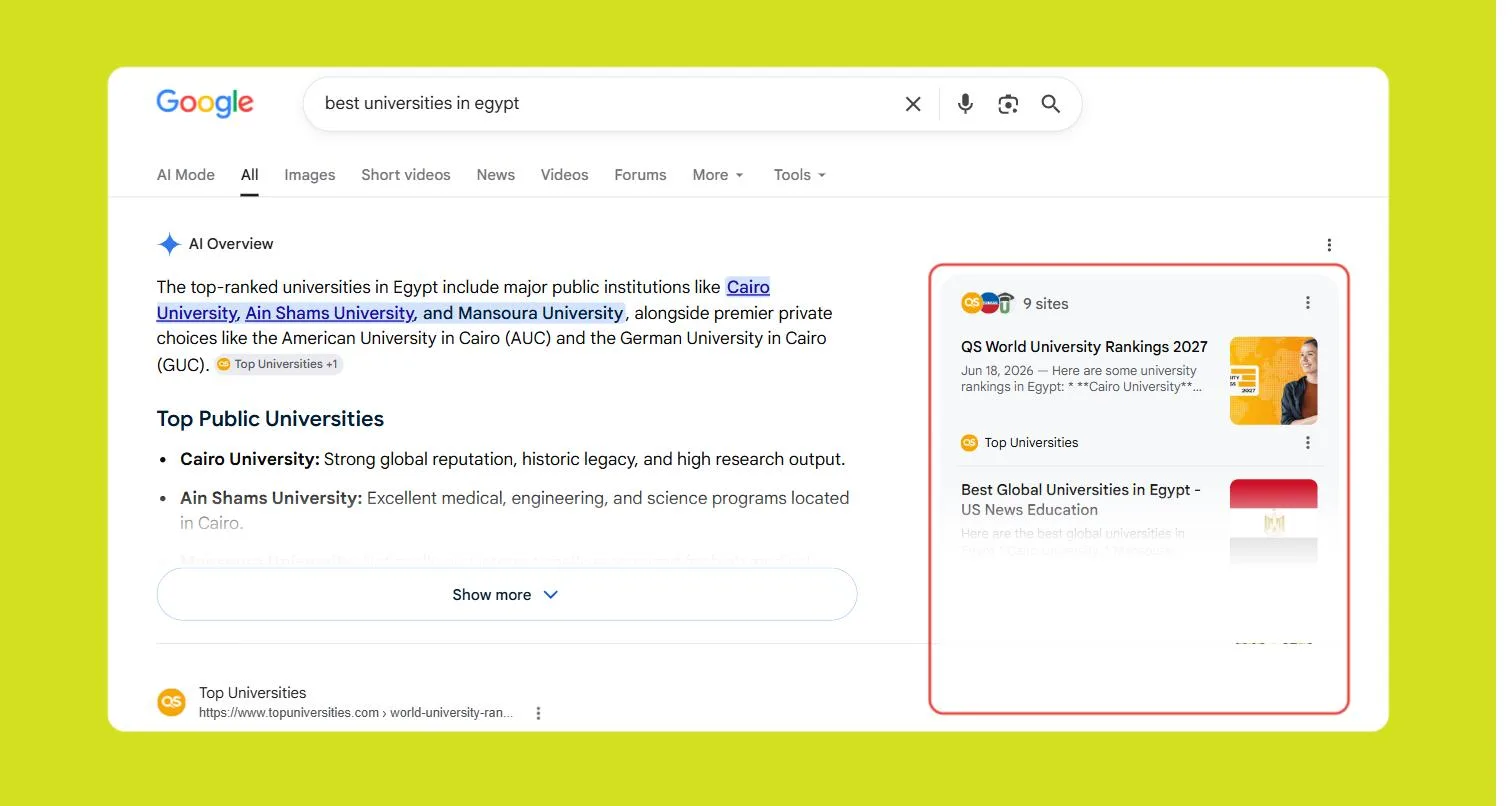
Picture a potential customer typing into search: how do I choose a CRM for a small business? Increasingly, the first thing they see is not a list of blue links but an AI-generated block that synthesizes information from across the web and cites a handful of sources.
The shift has been fast. A change of paradigm called Generative Engine Optimization (GEO) is under way: optimizing for generative AI search. Classic SEO fought for a top-10 position so a user would click through; GEO fights for your content to become the data source behind a ready-made AI answer. If you are new to this discipline, our overview of GEO (AI SEO) is a good starting point.
AI answers have become the norm
Generative answers are now core strategy for search engines, powered by large language models such as GPT and Gemini. When someone gets a confident, complete answer at the top of the page, many stop searching and never scroll to the organic results. In 2026 Google still handles around 90% of global search, and its AI Mode passed 75M users by late 2025, so the volume of AI-first interactions is enormous. Pairing ongoing SEO services with a deliberate GEO program is now the baseline, not the bonus.
How AI answers pick their sources
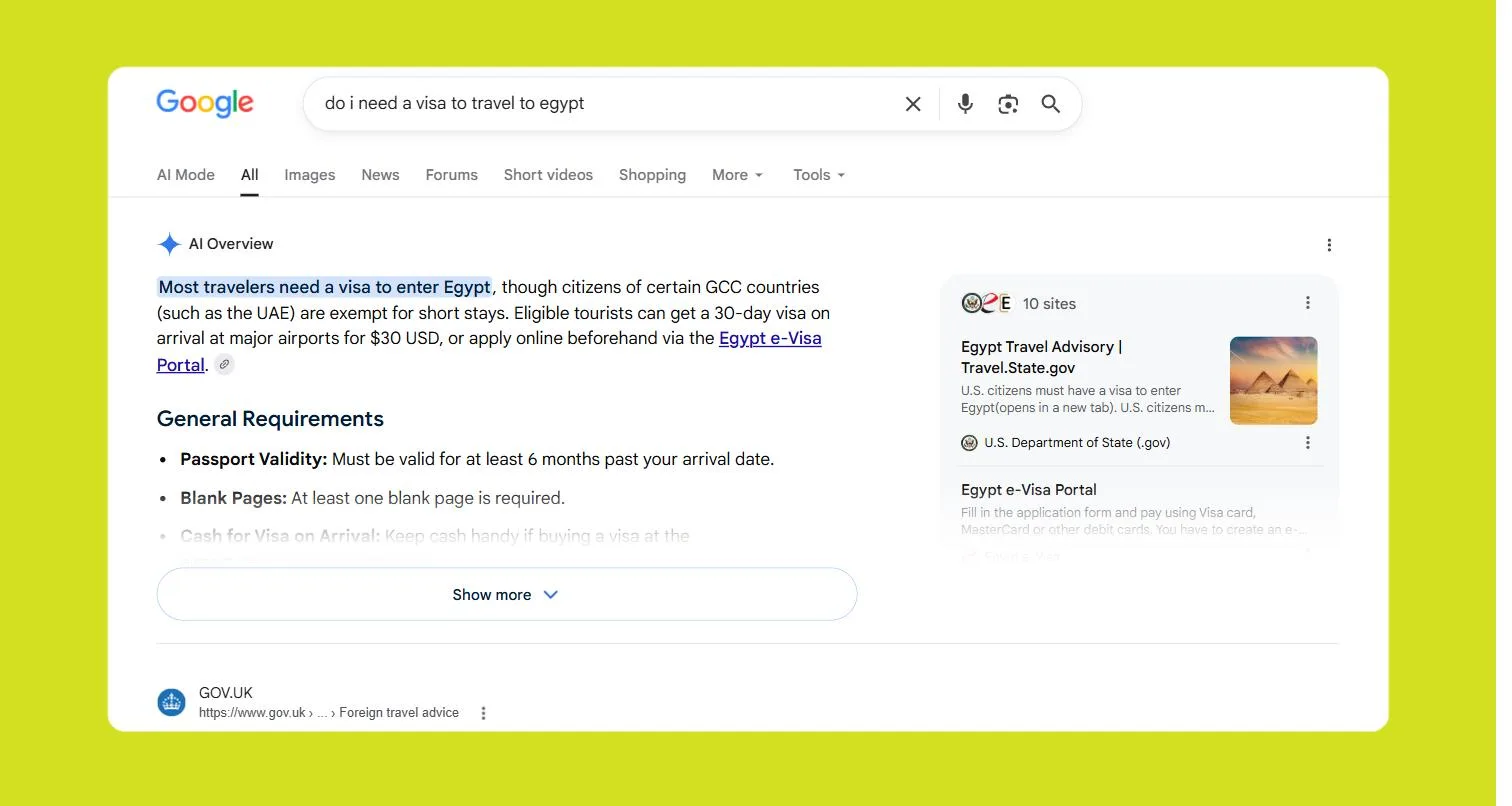
Google’s AI Overviews and AI Mode draw on the ranked index, so ranking for the query is the precondition; on top of that Google prioritizes source authority, transparent authorship and brand mentions. Learn more in our guide to Google AI Overviews. Perplexity retrieves live results for each query, while ChatGPT answers largely from training data and browses only on some queries; both favor pages that are easy to parse; see our notes on ChatGPT optimization and Perplexity optimization. Gemini, tied into Google and Maps, adds local relevance, reviews and ratings; see our Gemini and AI Mode guide.
How to appear in AI answers: GEO in practice
Rule 1: Give direct answers the AI can lift into a snippet
Engines scan pages for ready-made statements. If your answer is buried inside a long paragraph, it may be missed. Use a question-and-answer format with a clear heading and a direct answer immediately below; build detailed FAQs that cover situational, long-tail questions; and structure everything with short paragraphs, numbered steps and bulleted lists. This is the heart of Answer Engine Optimization: our AEO service page explains how question-first formatting feeds directly into AI citations.
Rule 2: Demonstrate expertise and build trust (E-E-A-T)
AI engines increasingly judge the source behind the text. Show your team with real experts and credentials, back claims with detailed case studies and numbers, and complete every commercial section (contact, pricing, guarantees). A structured SEO audit is the fastest way to find where these trust signals are missing before you scale content.
Rule 3: Help the AI understand your content structure
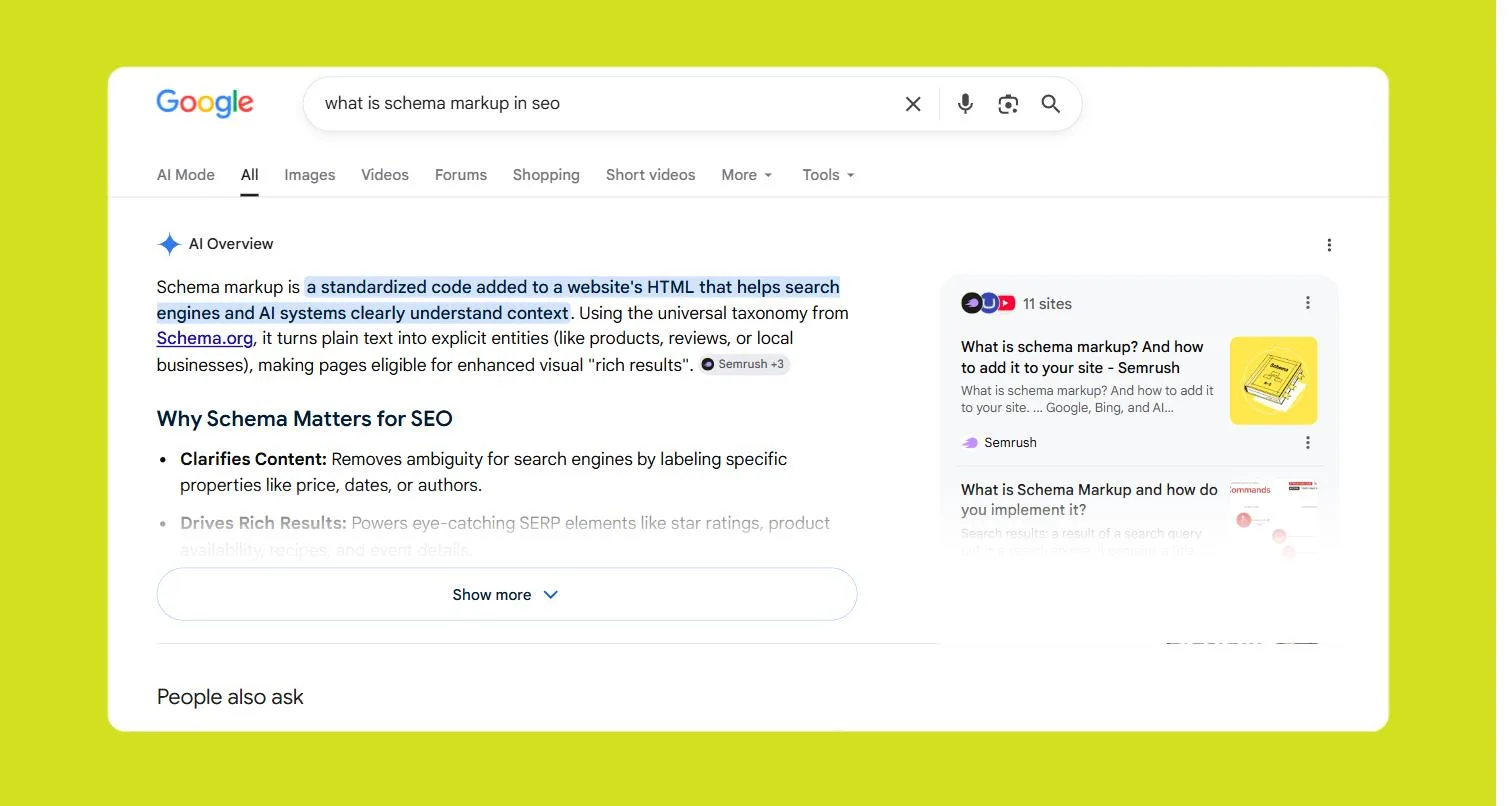
This is where Schema.org markup earns its keep: code that tells an engine this is a question and this is its answer. Core types for GEO include FAQPage, HowTo, Article, Product, LocalBusiness, Review and BreadcrumbList. Without markup, your excellent FAQ is just text; with it, the same content becomes structured data an AI is far more likely to use.
Common mistakes and false expectations
AI answers are not an ad channel: you cannot buy a place in them. Do not expect that simply optimizing the site will make the AI recommend you on a schedule; answers are generated dynamically and a business may appear intermittently. Manipulation such as keyword stuffing, mass-generated text with no expertise or fake reviews does not help. The only reliable path is genuine quality and trust.
A short checklist for the next month
- Audit and gather semantics. Collect real customer questions from support chats and map them to queries in Google Search Console.
- Rework 5-10 key pages. Rewrite main service, product and category pages with a question-and-answer structure and an expanded FAQ block.
- Implement markup. Add FAQPage or HowTo Schema.org markup to FAQ and instructional pages.
- Strengthen your proof. Publish a Team page, add fresh case studies, and complete every commercial section.
A strong content marketing program keeps this pipeline running so your coverage of customer questions grows over time. It is also worth publishing an llms.txt file to tell AI crawlers which content is most important and quotable.
What your business gains from AI answers
When an AI engine recommends your business, you gain trust, loyalty and a real edge over competitors still fighting for ordinary rankings. The AI answer is always in view, above every organic competitor and often above the ads, and users read it as an objective recommendation rather than an advertisement. Customers arrive pre-warmed, and in competitive niches where paid clicks are expensive, steady presence in AI answers becomes a serious lever for lowering customer acquisition cost.
Frequently asked questions
What is Generative Engine Optimization (GEO)?
GEO is optimizing your website and content so generative AI engines like Google AI Overviews, ChatGPT, Perplexity and Gemini cite and recommend your business. Unlike classic SEO, which fights for a clickable ranking, GEO aims to make your content the trusted source behind the AI answer.
Can I pay to appear in AI search answers?
No. There is no mechanism to buy a placement in an AI-generated answer. AI recommendations are earned through clear, well-structured content, genuine expertise and trust signals (E-E-A-T), and strong citations across the web. Keyword stuffing, mass-generated text or fake reviews do not produce durable visibility.
Which content formats do AI engines cite most often?
AI engines favor direct, explanatory passages: question-and-answer formats, detailed FAQs, short scannable paragraphs, numbered steps and bulleted lists. Content that answers a specific question immediately below a clear heading is far easier for a model to lift than promotional copy buried in long paragraphs.
Does structured data (Schema.org) help with GEO?
Yes. Markup such as FAQPage, HowTo, Article, Product, LocalBusiness and Review tells engines what each part of your content means. Without markup a great FAQ is just text; with it, the same content becomes structured data AI engines are more likely to reuse.
How long does it take to appear in AI answers?
There is no fixed timeline because AI answers are generated dynamically. Teams that add thorough FAQs, rewrite key pages around real customer questions and implement schema often see a meaningful lift in AI visibility within one to two months of consistent work.
Related guides
- How Google Search Algorithms Work: RankBrain, BERT, Core Web Vitals & AI Overviews (2026)
- Best AI Search & GEO Agency in the Middle East, Gulf & Egypt (2026)
- AI Search Optimization in 2026: SEO vs GEO vs AEO vs AIO, and How to Get Cited by AI
- Digital Visibility in 2026: The Complete Guide to Moving from SEO to AEO & GEO
Now check whether you appear. Free, in 60 seconds.
A free 60-second audit of your own site: 45 AI-visibility signals, plus live buyer questions put to ChatGPT, Perplexity and Gemini. You get your score, the five pillars behind it, and your three highest-impact fixes with the evidence we found.
- 45 visibility signals checked
- Live queries to ChatGPT, Perplexity & Gemini
- Evidence for every single finding
Confirm what we should test you on
We read this off your homepage. Correct it if it is not how your buyers would say it — this becomes the question we put to the engines.
This is a real audit, not a loading animation. Every line above is something we just found.
You have used this hour's free scans.
Leave your details and a VOCTOS strategist will run the full scan on — including the live AI engine queries — and send you the complete report. No wait, no limit.
We could not complete that scan
The paid alternative, and its limits. ChatGPT also shows sponsored placements below answers, in nine countries and only to Free and Go users. Details in ChatGPT Ads and the nine-country list.
Don't miss the chance to
make your website more visible!
Initial consultation and
audit of the current situation

Read also

Article VOCTOS Is a Top SEO, PPC and SEM Company in Egypt on Clutch for 2026

Article Commercial Ranking Factors: The Complete List

Article The Title Meta Tag: What It Is and How to Write It
Article The Role of Meta Tags in Search Engine Optimization
Article Can You Sue an AI for Defamation? Where the Law Stands

Article Cloudflare’s 15 September AI Crawler Defaults: The Check Gulf and Egypt Brands Should Run Today

Article What ChatGPT Optimization Guides Still Get Wrong in 2026
Article Two Lists Named 37 GEO Experts in 2026. None of Them Publish in Arabic





Real Results
More Wins
SEO & GEO for Delta Medical Labs
 GEO
GEO
1M+ monthly organic visits, 159,200 ranked keywords, 5,570 pages cited by AI engines, and 1,186 #1 rankings in KSA.

Arabic SEO, GEO & guest posting for VPNly
 SEO
SEO
65K peak monthly organic visits, 55 guest posts, and 149 pages cited by AI engines.

SEO & GEO for Ogaei Virtual Care
GEO
From 3 to 7,931 monthly organic clicks in 7 months, 2.9M+ impressions, and 40+ keywords in Google’s Top 10.

SEO for Eduverse
SEO
12× search traffic in 10 months, 45% of target keywords in the top 5, and 55% in the top 10.
Trusted by