
How Google Search Algorithms Work: RankBrain, BERT, Core Web Vitals & AI Overviews (2026)

Google search algorithms are the set of automated systems that decide which pages appear, and in what order, for every query. Google crawls and indexes the web, then ranks results using more than 200 signals grouped into five areas: the meaning of the query, the relevance of the page, content quality (E-E-A-T), page usability (Core Web Vitals and mobile-friendliness), and user context such as location and language. In 2026 Google still handles roughly 90% of global search (about 94% on mobile), so understanding how its algorithms work remains the foundation of any SEO strategy.
Below is a practical, up-to-date breakdown of the algorithms and systems that shape Google’s results today, from RankBrain and BERT to Core Web Vitals and the arrival of AI Overviews.
Key takeaways
- Google ranks pages in three stages: crawling, indexing, and ranking, weighing 200+ signals at once.
- There is no single most important factorquality, usability, relevance, and trust are judged together.
- E-E-A-T (Experience, Expertise, Authoritativeness, Trustworthiness) is critical for YMYL topics like health and finance.
- Core Web Vitals now use LCP, INP (which replaced FID in 2024), and CLS.
- In 2026, AI Overviews appear on ~20.5% of searches and cited brands earn ~120% more organic clicks, ranking well is how you become citable.
What a search algorithm is and how it works
A search algorithm is a set of rules Google uses to evaluate pages and order them for a specific query. Because the engine considers over 200 factors, and constantly re-weighs them, the process is less a single formula than a system of systems. Unlike a filter, which can drop a site from the index entirely, an algorithm usually just moves a page up or down.
The pipeline has three stages. First a crawler discovers and scans pages; then those pages are added to the index; finally, ranking selects and orders results for the user’s query. At the ranking stage Google leans on several groups of signals:
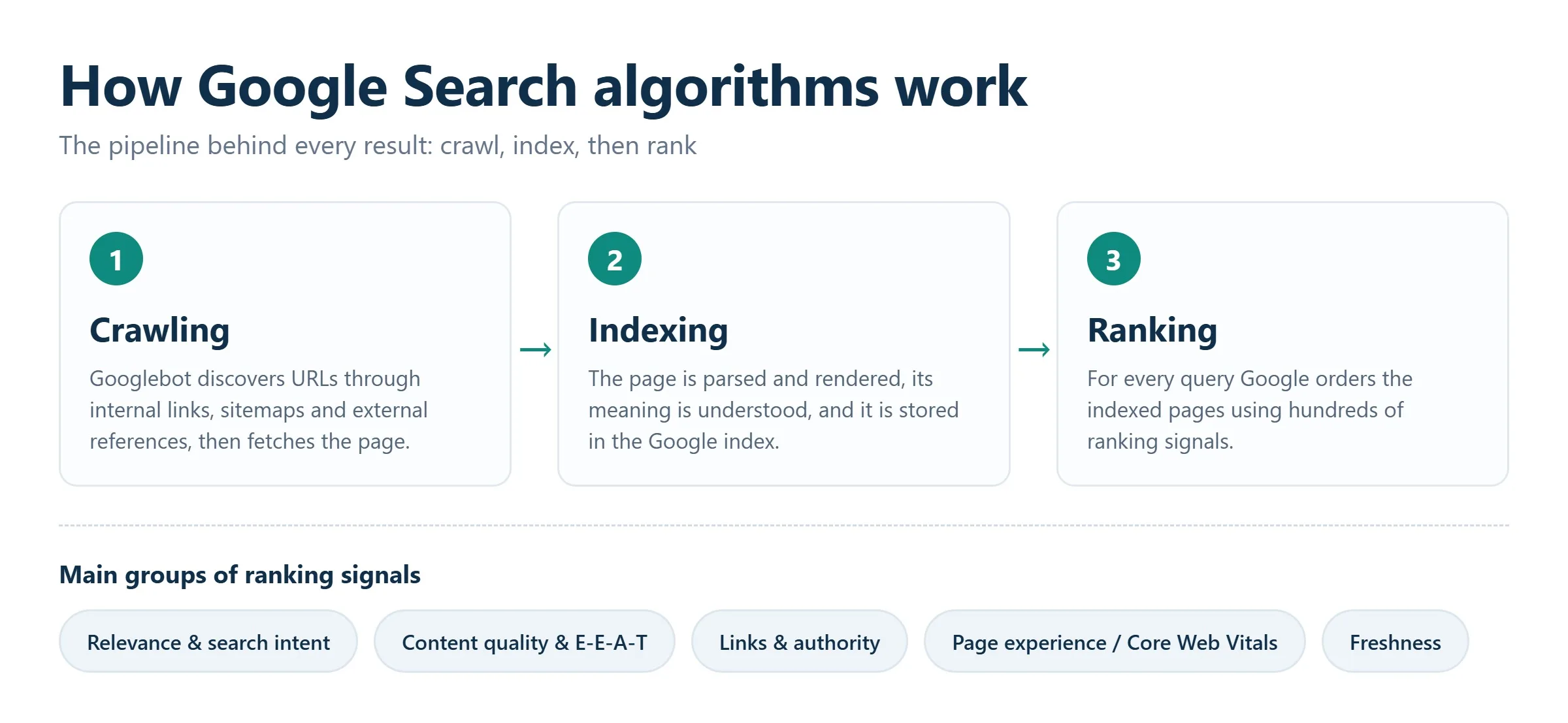
Query meaning
Google interprets the wording, fixes typos, expands synonyms, and works out the true intent behind the search.
Page relevance
The system checks how well your content matches the topic and the specific question being asked.
Content quality
Expertise, source authority, and how genuinely useful and readable the material is all factor in: this is where content marketing and E-E-A-T meet.
Usability
Loading speed, mobile-friendliness, and a secure HTTPS connection influence the final position.
User context
Location, language, and search history personalise results, so there is no single universal ranking.
Because these signals are weighed together, chasing one “magic” factor rarely works. Several times a year Google also ships core updates that re-evaluate the whole system, which is why rankings can move sharply overnight. A professional SEO audit is the fastest way to see which of these areas is holding a site back.
YMYL and E-E-A-T
YMYL, “Your Money or Your Life”, covers topics where bad advice can harm someone’s health, safety, or finances: medicine, finance, legal, and news. Google holds these pages to a higher quality bar. When its 2018 “Medic” update landed, many health sites without named authors or verified facts lost rankings overnight.
Quality here is judged through E-E-A-T: Experience, Expertise, Authoritativeness, and Trustworthiness. Google added the first “E” (first-hand experience) in late 2022. To satisfy it, name your authors and their credentials, cite reputable sources, keep information current, and never publish sensitive content without an expert’s involvement. For commercial pages, clear contact details, company information, and reviews all build trust: the same principles we apply to every SEO campaign.
Mobile-first indexing
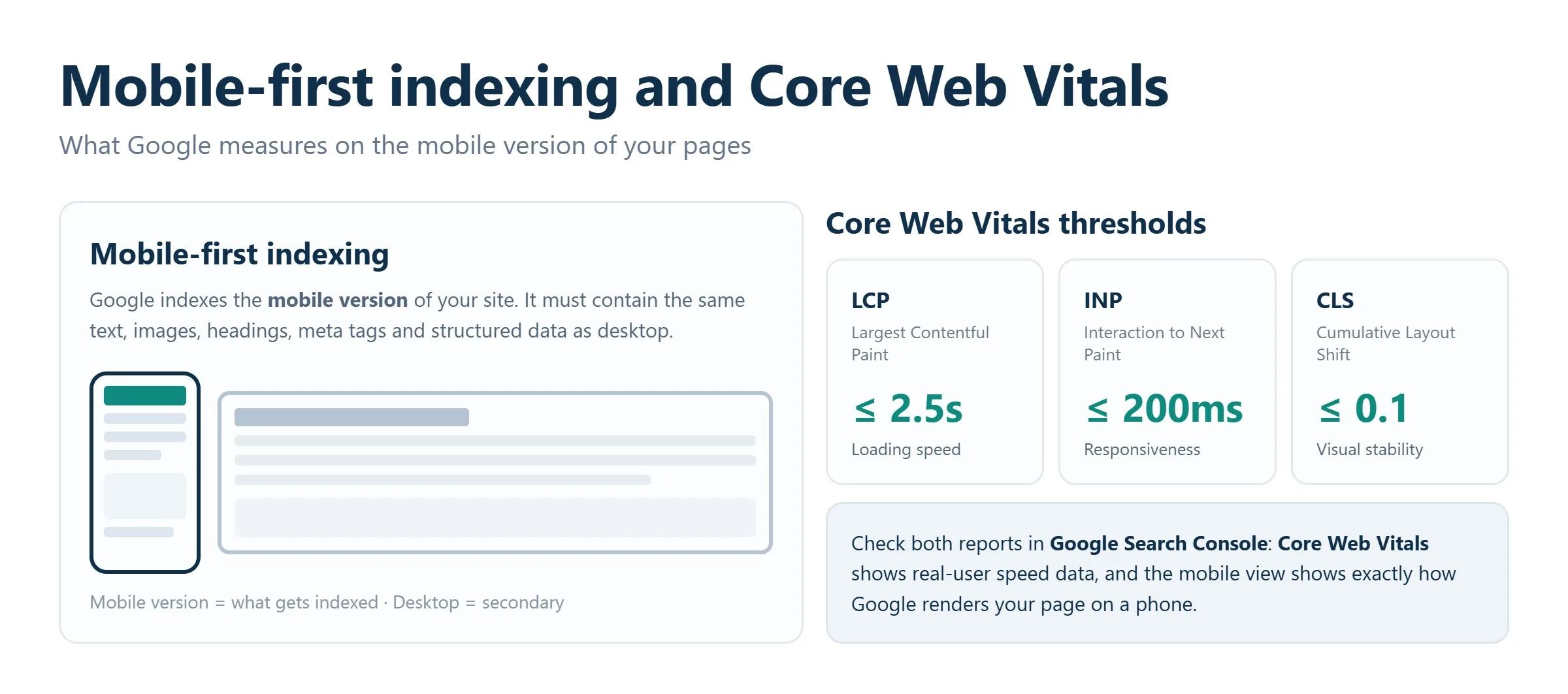
Mobile-first indexing means Google indexes and ranks your site based primarily on its mobile version. Since smartphones long ago overtook desktop for search, Google shifted the priority and, by 2023, moved virtually all sites to mobile indexing.
In practice, your mobile version must contain the same content as desktop: the same text, images, headings, meta tags, and structured data. If anything is hidden or trimmed on mobile, that reduced version is what gets indexed. Responsive design is the safest solution, and Google Search Console shows you exactly how the mobile page is seen.
Core Web Vitals
Core Web Vitals are the technical metrics Google uses to judge how comfortable a page feels to use. They became a ranking signal in 2021 with the Page Experience update and measure three things:
- LCP (Largest Contentful Paint)how fast the largest visible element loads. Aim for under 2.5 seconds.
- INP (Interaction to Next Paint)how quickly the page responds to clicks and taps. INP replaced FID in March 2024; aim for under 200 ms.
- CLS (Cumulative Layout Shift)how stable the layout is while loading. Keep it below 0.1.
These metrics won’t force you into the top spot, but between two comparable pages Google favors the faster one. Compress images, remove unused scripts, cache aggressively, and speed up server response: the kind of work our technical SEO team handles. Track results in the Core Web Vitals report and PageSpeed Insights.
RankBrain
Launched in 2015, RankBrain was Google’s first machine-learning ranking system. It helps the engine understand the meaning behind queries, including the huge volume of phrasings it has never seen before, and match results by intent even when the exact words aren’t on the page. It also learns from behavior: if users quickly bounce back to the results, that signals the page didn’t answer the question. In 2016 a Google engineer described RankBrain as one of its three most important ranking signals; Google has not repeated that framing since. The best way to “optimize” for it is simply to answer the query fully and clearly.
BERT and MUM
BERT, introduced in 2019, is a natural-language model that reads the context of words the way a person does. Before BERT, Google often stumbled over prepositions and word order; afterwards it could grasp the relationships between words and pinpoint intent, especially for long, conversational, and voice queries. Google later extended the idea into MUM, a more powerful multimodal, multilingual model. You can’t optimize for BERT directly, you optimize by writing naturally for humans instead of stuffing keywords.
The “Sandbox” effect
The Sandbox is an unofficial effect where brand-new domains rank lower than their content quality would suggest for the first few months. Google doesn’t confirm it exists, but many practitioners observe the same pattern: a fresh domain barely moves, then starts climbing. The logic is simple, it lets Google filter out short-lived sites and confirm a project is serious. Don’t fight it; spend that time publishing quality content, earning natural links, and building reputation.
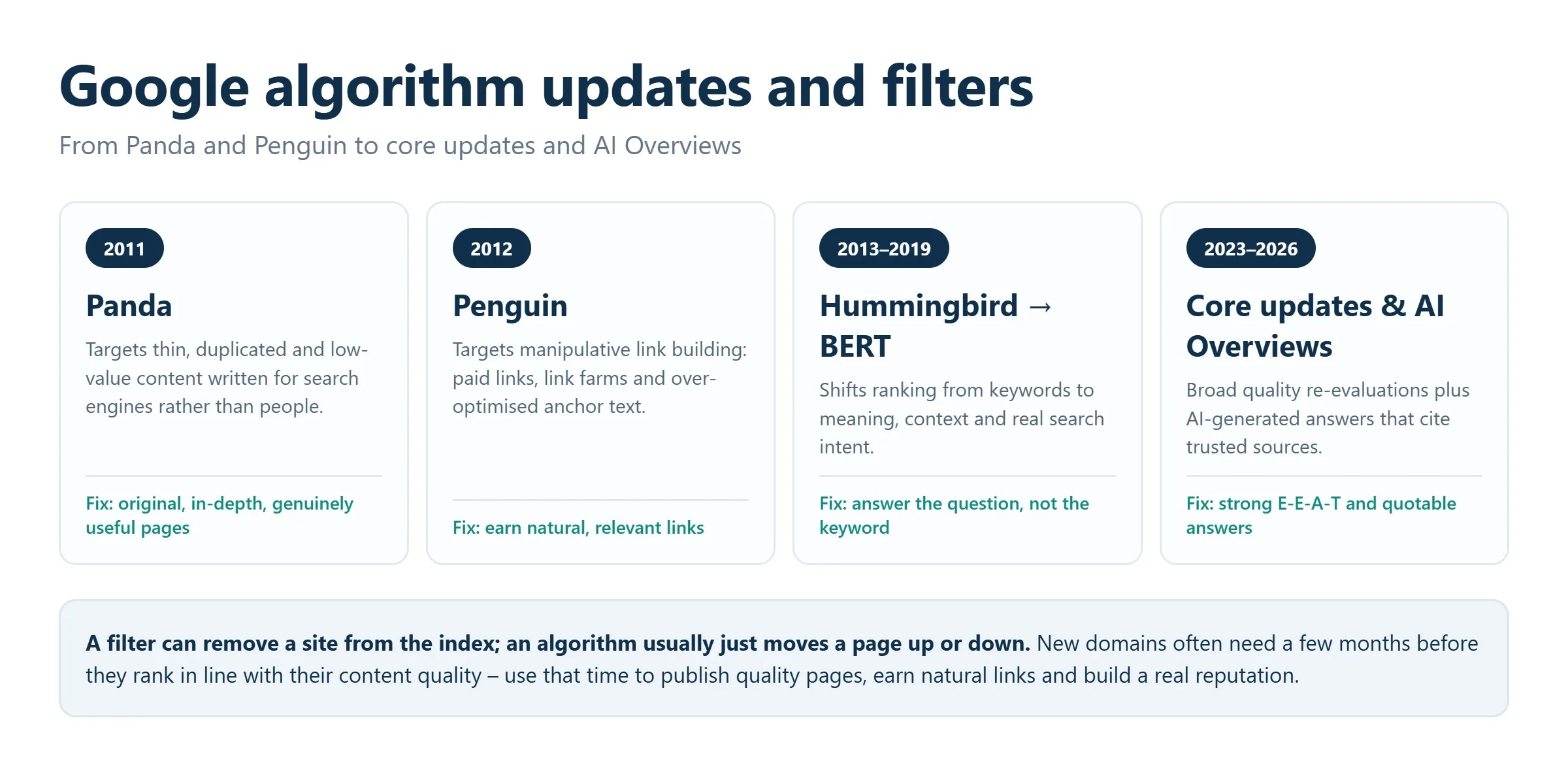
Panda
Panda, launched in 2011, targets low-quality content, thin, copied, or over-optimized pages stuffed with keywords. Since 2016 it has run inside the core ranking system, so content quality is assessed continuously. A frequent casualty is the online store with hundreds of near-identical product pages and no descriptions or reviews. The defense is straightforward: remove duplicates and empty pages, rewrite weak text, add expertise, and audit content every few months.
Penguin
Released in 2012 as Panda’s counterpart, Penguin focuses on the link profile. It detects unnatural backlinks, bought, spammy, or repetitive-anchor links, and demotes sites that inflated their link mass artificially. Since 2016 Penguin runs in real time inside the core algorithm, so cleaning up bad links can help a site recover faster. Build links naturally, vary your anchors, earn mentions from authoritative sources, and use the Disavow tool for genuinely toxic links.
How AI Overviews and AI Mode change the game in 2026
The biggest shift since these classic algorithms is generative search. In 2026 Google’s AI Overviews reach more than 2.5 billion monthly users and appear on roughly 20.5% of searches, and up to ~88% of health-related queries. Crucially, AI Overviews are built on the same ranking and quality systems described above: pages that already rank well and demonstrate strong E-E-A-T are the ones AI is most likely to cite.
This is why generative engine optimization (GEO) and answer engine optimization (AEO) now sit alongside classic SEO. Brands cited in AI Overviews earn about 120% more organic clicks per impression than uncited brands on the same query. In other words, the algorithms haven’t been replaced, they’ve become the eligibility layer for AI answers.
How to stay resilient to Google updates
Most algorithms come down to a handful of habits worth maintaining continuously:
- Real value on every page, named authors with credentials, and current, accurate data.
- Fast loading, clean responsiveness, and a full mobile version with nothing stripped out.
- A valid SSL certificate and HTTPS with no browser warnings.
- A healthy, natural backlink profile.
- Content that genuinely matches search intent.
Review these points every couple of months rather than once a year. Modern Google runs on a whole stack of algorithms, but they all point to one goal: showing people useful, usable, trustworthy pages. Build for the reader and most updates pass without damage, and if you want a second pair of expert eyes, our team offers a full SEO audit.
Frequently asked questions
How do Google search algorithms actually work?
Google first crawls and indexes pages, then ranks them for each query using a system of algorithms that weigh 200+ signals, query meaning, page relevance, content quality (E-E-A-T), usability (Core Web Vitals), and user context. No single factor guarantees a top position; Google balances all of them together.
How many ranking factors does Google use?
Google has publicly said it uses more than 200 ranking signals, and their weights are constantly re-tuned. Rather than chasing individual factors, focus on genuinely useful, trustworthy, fast, mobile-friendly pages that satisfy search intent.
What is the difference between a Google algorithm and a Google filter?
A filter (like the older manual-action systems) can remove a site from the index entirely, while an algorithm usually just changes a page’s position. Core updates re-evaluate the whole ranking system several times a year and can shift rankings widely.
Do Google’s algorithms still matter in the age of AI Overviews?
Yes. AI Overviews and AI Mode are built on the same ranking and quality systems. In 2026 AI Overviews appear on roughly 20.5% of searches and brands cited in them earn about 120% more organic clicks per impression, so ranking well organically is what makes you eligible to be cited by AI.
How do I recover after a Google core update?
Google advises against looking for a single fix. Strengthen the site as a whole: improve content depth and accuracy, add clear author expertise (E-E-A-T), fix Core Web Vitals, clean up thin or duplicate pages, and review your backlink profile. Recovery typically follows a later update once quality improves.
Related guides
- Google’s Search Generative Experience (SGE) and AI Overviews: What Egyptian Brands Need to Know in 2026
- How to Get AI Search Answers to Recommend Your Business (GEO Guide)
- How to Optimize for Google AI Overviews in 2026: The Complete Guide
- How to Optimize for Google AI Mode: 10 SEO Strategies That Actually Work in 2026
Don't miss the chance to
make your website more visible!
Initial consultation and
audit of the current situation

Read also

Article VOCTOS Is a Top SEO, PPC and SEM Company in Egypt on Clutch for 2026

Article Commercial Ranking Factors: The Complete List

Article The Title Meta Tag: What It Is and How to Write It
Article The Role of Meta Tags in Search Engine Optimization
Article Can You Sue an AI for Defamation? Where the Law Stands

Article Cloudflare’s 15 September AI Crawler Defaults: The Check Gulf and Egypt Brands Should Run Today

Article What ChatGPT Optimization Guides Still Get Wrong in 2026
Article Two Lists Named 37 GEO Experts in 2026. None of Them Publish in Arabic






Real Results
More Wins
SEO & GEO for Delta Medical Labs
 GEO
GEO
1M+ monthly organic visits, 159,200 ranked keywords, 5,570 pages cited by AI engines, and 1,186 #1 rankings in KSA.

Arabic SEO, GEO & guest posting for VPNly
 SEO
SEO
65K peak monthly organic visits, 55 guest posts, and 149 pages cited by AI engines.

SEO & GEO for Ogaei Virtual Care
GEO
From 3 to 7,931 monthly organic clicks in 7 months, 2.9M+ impressions, and 40+ keywords in Google’s Top 10.

SEO for Eduverse
SEO
12× search traffic in 10 months, 45% of target keywords in the top 5, and 55% in the top 10.
Trusted by