
ChatGPT Ads in the Arab World: 13 Countries Now Open, Including Saudi Arabia and the UAE
Update, 17 September 2026: this changed, and we were partly right about how.
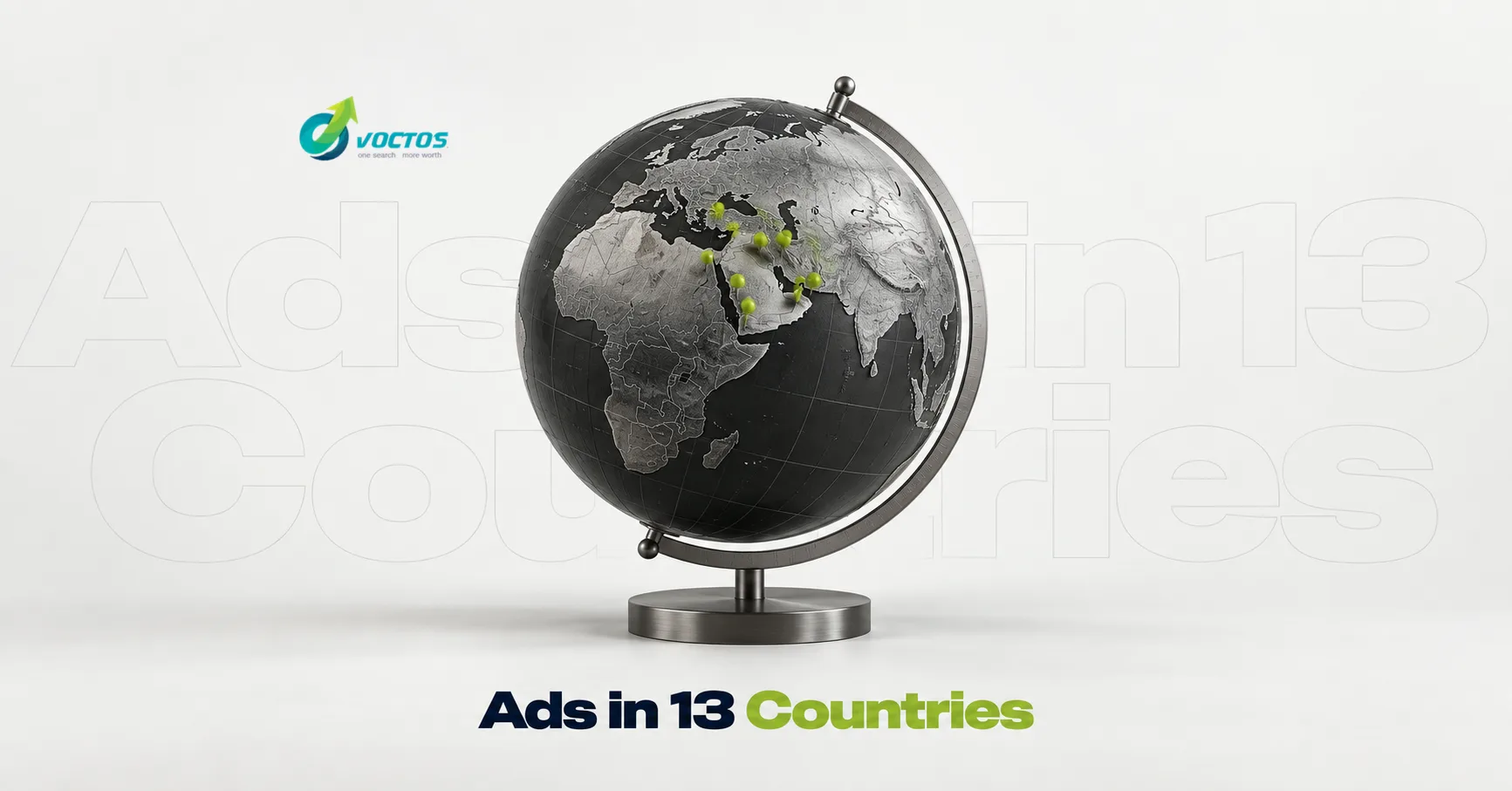
OpenAI added Saudi Arabia, the United Arab Emirates, Israel and Turkey to the self-service list. The availability page now shows 56 countries and 13 Arab markets, not 11. Saudi and UAE entities can open an account directly.
Three more things moved with it. SAR joined the billing currencies at 50 SAR a day and AED dropped from 70 to 65. New self-serve accounts are now restricted to advertising in their own home country until identity verification clears and the account reaches a spend threshold. And OpenAI rebuilt its geotarget catalogue: it now lists 249 targetable countries but sub-country regions in only seven of them, none of which is an Arab market.
The part of this article that has not changed is the category gate. Ad Policies reached v1.6 in September 2026, and the September revision only clarified OpenAI’s right to decline ads. Financial, health and legal services outside the United States remain prohibited, so for a Riyadh bank or a Cairo clinic the country opening still changes nothing. The rest of this article builds on the original 7 September reporting, updated where the facts have since changed.
Update, 28 September 2026: the global count moved again, Arab markets did not.
The Ads Manager availability list now shows 63 countries, up from 56. The seven new markets are Indonesia, Malaysia, the Philippines, Singapore, Taiwan, Thailand and Vietnam, none of them Arab. The 13 Arab markets and Ad Policies v1.6 (10 September 2026) are unchanged since the update above.
OpenAI has expanded ChatGPT Ads from 9 countries to 63. Thirteen of them are Arab markets: Algeria, Bahrain, Egypt, Iraq, Jordan, Kuwait, Lebanon, Morocco, Oman, Qatar, Saudi Arabia, Tunisia and the United Arab Emirates. Both Gulf holdouts have since opened, and for most regulated businesses in the countries that did open, little has actually changed.
Key takeaways
- Self-service ChatGPT Ads is live in 13 Arab countries as of 17 September 2026, up from zero in August.
- Saudi Arabia and the UAE joined the availability list on 17 September 2026. Still absent are Libya, Syria, Yemen, Palestine, Sudan, Mauritania, Djibouti, Somalia and Comoros.
- Ads for financial services, health services and legal services outside the United States remain prohibited under Ad Policies v1.6, published 10 September 2026.
- Allowed categories are household and consumer goods, local services, travel and entertainment, and digital products and education.
- Ads still reach only Free and Go users. Plus, Pro, Business, Enterprise and Edu accounts never see them, in any country.
- OpenAI added an Ads-Free option on the Free plan that trades ads for lower message limits.
- Buying is CPM or CPC with a suggested opening bid of $3 to $5 per click, selected through a relevance-weighted second-price auction. Targeting uses context hints, not exact-match keywords.
Which Arab countries can run ChatGPT ads today?
Thirteen, and the list is not the one most people would predict. OpenAI’s Ads Manager Availability page now shows 63 countries with self-service access, and the Arab markets on it are Algeria, Bahrain, Egypt, Iraq, Jordan, Kuwait, Lebanon, Morocco, Oman, Qatar, Saudi Arabia, Tunisia and the United Arab Emirates.
The rule that decides your eligibility is about your paperwork rather than your customers, and it catches out most of the regional groups we work with, because OpenAI states that the legal entity which advertises and is billed must itself be based in a listed country.
A company registered in an unlisted country, such as Libya, is not eligible whatever market it sells into. And since 17 September, a new account can advertise only in its own home country until identity verification clears and it reaches a spend threshold.
| Arab market | Self-service Ads Manager |
|---|---|
| Egypt, Qatar, Kuwait, Bahrain, Oman, Jordan | Available |
| Lebanon, Iraq, Morocco, Tunisia, Algeria | Available |
| Saudi Arabia, United Arab Emirates | Available |
| Libya, Syria, Yemen, Palestine, Sudan | Not listed |
Larger advertisers outside the list can approach the OpenAI Ads Solutions team directly, though OpenAI describes that route in the context of new European markets rather than the Gulf.
Why did Saudi Arabia and the UAE open later?
Nobody outside OpenAI knows, and I would not trust anyone who tells you they do. What I can say is that the delay was strange enough to be worth naming.
The UAE has the highest generative AI adoption rate of any country measured, at 70.1% against a global average of 17.8%. Saudi Arabia’s own regulator reported that 45.2% of Saudi internet users now use AI tools, more than double the previous year. We covered both figures and what they mean for retrieval in our guide to AI search optimization in the Middle East.
Those are the two markets a demand-led rollout would open first. Instead the 7 September list included Algeria, Iraq, Lebanon and Tunisia, and the two Gulf markets followed only on 17 September.
That pattern looks less like demand and more like the shape of a legal and payments rollout, which is how Google, Meta and TikTok each expanded into this region before it. Currency, entity verification, billing rails and local advertising law all have to clear before a market opens. None of that correlates neatly with how much your customers use the product.
If you are a Saudi or UAE brand, that wait is over: both markets opened on 17 September 2026, and Saudi and UAE entities can now open an account directly at ads.openai.com.
Does access mean you can actually advertise?
For most of the businesses that dominate paid search in this region, no. This is the part that gets lost in the announcement, and it is the more important half.
OpenAI’s Ad Policies, updated 10 September 2026, are explicit on three categories:
- Financial services. “Ads for financial services outside the US are generally prohibited.”
- Health services. “Ads for health services outside the US are generally prohibited.”
- Legal services. “Ads for legal services outside of the US are currently prohibited.” Version 1.5 of the policy clarified that legal services are permitted in the US only.
Read that against your own client roster. Clinics, laboratories, hospitals, banks, insurers, brokers, financing companies and law firms are the verticals that spend most on paid search across Egypt and the Gulf.
All of them now have a country that is open and a category that is closed.
What you can advertise during this phase: household and consumer goods, local services, travel and entertainment, and digital products and education. A Cairo furniture retailer, a Jordanian travel operator, a Kuwaiti restaurant group and an Egyptian online course platform can all buy ads today. A Cairo dental clinic cannot.
One nuance that gets misreported, and it will cost you a wasted account setup if you get it backwards. In April 2026 OpenAI stopped categorically blocking ads from appearing near medical, legal and financial advice conversations.
That is a placement rule about where an approved ad may appear. It did not change who is allowed to buy one. The two are separate systems.
We said this would happen, and now it is testable
On 19 August we published a line that I want to quote back, because it is the reason to trust the rest of this analysis: “Even a same-day Egypt launch would not unlock ChatGPT ads for healthcare, financial services or legal firms. Those categories are restricted globally, and two of the three are restricted to the US specifically.” That was in our piece on why ChatGPT Ads had not reached the Arab market and what to do instead.
Egypt opened. Those categories did not.
I am not claiming foresight about the country list. We wrote plainly that we did not know when Egypt would open, and that anyone quoting a date was guessing.
What we did claim is that the country gate was the smaller of the two barriers, and that the category gate had no announced timeline behind it. Three weeks later the country gate moved and the category gate did not.
Our reason for saying this out loud is not credit. It is that the same logic applies to the next announcement you read. Saudi Arabia and the UAE have since opened, as I expected they would, and Gulf clinics and banks stay prohibited unless the category policy changes on its own separate track.
What does a ChatGPT ad actually look like?
It sits below the answer, carries a Sponsored label, and looks almost nothing like a Google search ad. The example below is a real ad unit served in the ChatGPT mobile app, under an answer about lead generation for trades businesses.
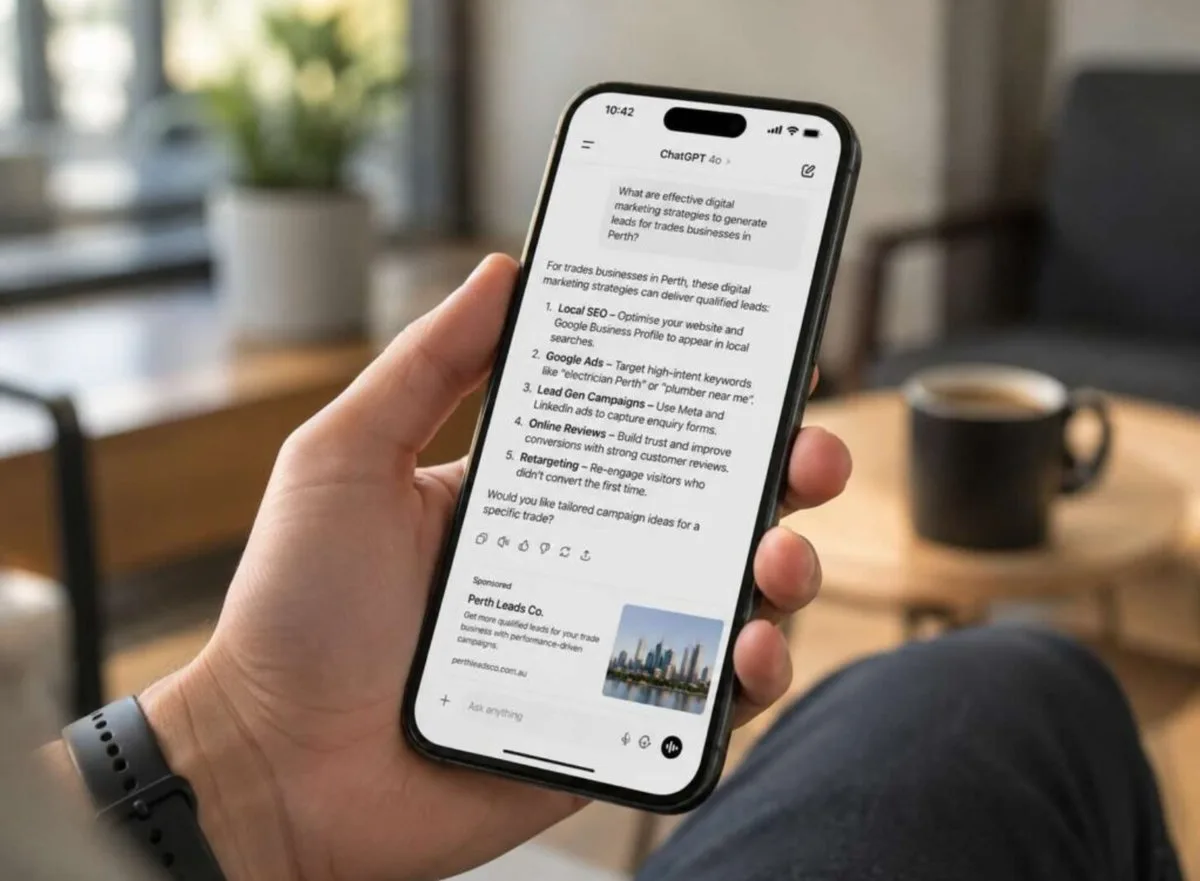
OpenAI documents six components in every unit: the advertiser name, a favicon, the title, the description copy, the landing page and an image asset. You can see all of them in that screenshot, and you can see what is missing too.
There is no keyword bid visible, no sitelink, no rating stars and no ad extensions. There is also no position to compete for. The ad does not appear above the answer or interrupt it, and OpenAI states that advertisers cannot shape, rank or alter what ChatGPT says.
Look at the placement in commercial terms. The user asked a question, received a complete five-point answer, and only then met an ad offering to do the thing the answer just described. Your ad is arriving after the user has already been informed, which is a very different job from arriving before they have.
That is why the creative discipline here is closer to a native placement than to paid search. The unit gets one headline, one line of copy and one image, and it has to make sense as a next step from an answer you did not write and cannot see.
How much does it cost and how are ads chosen?
You buy on CPM or CPC, you set a maximum bid at the ad group level, and OpenAI recommends starting between $3 and $5 per click. Selection runs through a relevance-weighted second-price auction, so the highest bid does not automatically win.
| Mechanic | How it works |
|---|---|
| Buying models | Reach objective pays per 1,000 impressions. Clicks objective pays per valid click. |
| Bidding | Maximum bid set at ad-group level. Ads Manager shows bid-strength guidance on whether your bid is competitive. |
| Suggested opening CPC | $3 to $5 USD, per OpenAI |
| Auction | Relevance-weighted, second-price |
| Targeting input | Context hints at ad-group level describing conversations, topics or keywords |
| Reporting | Impressions, clicks, spend, CTR, average CPC, average CPM, conversions |
The targeting model is the part most paid search teams get wrong on first contact. Context hints are not keywords. OpenAI states plainly that they guide matching but are not exact-match and do not guarantee delivery in any specific conversation.
So you cannot buy the phrase “electrician Perth” the way you would in Google Ads. You describe the situation your product belongs in, and the system weighs that against the live conversation, your landing page, your title and your copy.
Two consequences follow for your account structure. Ad groups should map to situations rather than keyword clusters, and your landing page stops being a destination and becomes a ranking input, because the system reads it when deciding whether your ad fits the conversation at all.
How do you open an account, and what cannot be undone?
Five steps, and three fields inside them are permanent. OpenAI documents the flow as: create the account at ads.openai.com, complete onboarding and verification, complete account information, set up billing and payment, then invite your team. Campaigns do not deliver until every step is finished.
The permanent fields are country, billing currency and time zone. OpenAI states these cannot be changed after the advertiser account is created, and that getting them wrong means creating a new account with the correct details.
For a regional group this is the single most expensive mistake available. If your Egyptian entity opens the account but your billing sits with a Dubai holding company, you have built the account on a country that does not match the entity that advertises, and that field cannot be changed later.
- Decide the advertising entity first. It must be registered in a listed country, and it is the entity that gets billed.
- Verification runs through Persona and applications are reviewed in a rolling queue. OpenAI says it cannot expedite review.
- Do not submit duplicates. OpenAI states duplicate applications do not bypass review and create confusion about which account is correct.
- Account name and logo gate delivery. After access is granted, ads will not serve until both are set exactly as they should appear in the unit.
- One account per advertiser, and each new account needs a different email address. One person can then be invited into several accounts and switch between them.
Agencies running several brands should read that last point carefully. You cannot reuse an email that already created an advertiser account, so plan your email addresses before you start rather than discovering the limit halfway through onboarding.
Will the ad platform work for Arabic campaigns?
OpenAI has published nothing specific about Arabic ad creative, Arabic context hints or Arabic-language targeting. That silence is worth stating plainly rather than filling with a guess.
What we do know is how selection works. The system weighs the context and intent of the live conversation against your landing page, title and copy. If the conversation is in Arabic and your landing page and copy are in English, you are asking a relevance system to bridge a language gap in your favour.
We would not assume it does that well. Arabic is roughly 0.67% of the crawled web, and retrieval systems demonstrably under-recover Arabic sources even when those sources hold the better answer. We set out the measured evidence for that in our study of the Arabic citation gap.
Until someone publishes a test, treat Arabic ChatGPT Ads as unmeasured rather than proven. If you run Arabic campaigns from Egypt or Jordan in the next quarter, log your own results, because right now nobody has that data and the first team to publish it will own the topic.
One practical note that does not depend on any of this. Your landing page must be crawlable by OAI-AdsBot or the ad is not eligible to run at all, and that applies whatever language you advertise in.
What changed for users, not just advertisers
Two things moved since February, and one of them is new enough that most coverage has not caught it.
The tier rule is unchanged, and it still caps your reach by design rather than by budget. Ads appear only for Free and Go users. Plus, Pro, Business, Enterprise and Edu accounts never see them. We wrote about what that tier ceiling does to a B2B media plan when the rule was first published.
Neither do accounts identified as belonging to under-18s. Ads also do not appear in Temporary Chats or, during this test, in the ChatGPT Atlas browser.
The new part is an Ads-Free option on the Free plan. Your prospect can now remove ads without paying, in exchange for lower message limits and reduced access to tools like image generation.
OpenAI presents it as a direct trade: ads buy you more usage. Every user who takes it leaves your addressable audience, and nobody has published data on how many do.
Two more placement limits apply whatever you sell. Ads are not eligible near personal health, mental health or political conversations, and personalised ads are not initially available in the European Economic Area or Switzerland.
My read on this
I think the country expansion is being read as a bigger event than it is, and the category policy is being read as a smaller one.
Sixty-three countries is a real infrastructure milestone. But the question your client asks is not whether they can open an account. It is whether they can run ads for their business.
For roughly half the regional paid search economy that answer is still no, and it has been no since March, across five policy revisions, with no published timeline for changing.
The part I find genuinely interesting is the tier rule. Your paid reach inside ChatGPT is capped to Free and Go users by policy, while the answer sitting above that ad reaches every subscriber on every plan in every country, Saudi Arabia and the UAE included.
A Riyadh brand locked out of the ad auction is not locked out of the answer. That asymmetry did not narrow with this announcement. It widened, because the ad platform now has 63 country gates and a category gate while the organic answer has neither.
What to do this week
Four situations, and we give a different answer to each of them. Whichever one you are in, read our companion report on what ChatGPT ads actually cost in the Arab world before you set a budget.
You are in an open country with an allowed category. Set up now. Country, billing currency and time zone are permanent at account creation, so decide which legal entity advertises before anyone on your team touches the sign-up flow. Then confirm OAI-AdsBot can crawl your landing pages, because a page it cannot read is not eligible to run. We check that first on every account we take on, and the full sequence is in our pre-launch checklist.
You are in an open country with a restricted category. We would not set up an advertiser account yet. Fix crawler access, build pages around the questions your buyers actually ask, and stand up conversion tracking. All three improve how AI engines describe you today and none of them expire.
You are in Saudi Arabia or the UAE. Both markets opened on 17 September, so the two situations above now apply to you, with one addition: a new account can advertise only in its own home country until identity verification clears and it reaches a spend threshold. Your buyers are already asking ChatGPT about your category, and the answer they get has no country gate on it.
You are an agency. Re-check the availability page before every client recommendation. We now do this weekly, because the page moved twice in three weeks and the version of the list your team memorised last month is wrong.
Objections we hear
“So we can finally advertise on ChatGPT in the Gulf.”
Only if your entity is registered in one of the 13 listed Arab countries and your category is allowed. Qatar, Kuwait, Bahrain, Oman, Saudi Arabia and the UAE are all open. And a Gulf clinic or bank is still prohibited even from an open country.
“Our category is restricted. Should we wait?”
Waiting is not a strategy when the restriction has no announced end date. Financial and health services outside the US have been prohibited since the policy was first published in March 2026, through five revisions. Build the organic side and treat any future category change as upside.
“Does opening the country change our GEO work?”
It makes one part of it more urgent. OAI-AdsBot must be able to crawl your landing pages for an ad to be eligible, and OpenAI recommends allowing OAI-SearchBot too. That is a single robots.txt and WAF fix that gates your paid eligibility and improves your organic understanding at the same time.
“How do we know this list will not change again next week?”
We do not, and neither does anyone else. The page moved from 9 countries to 52 between 19 August and 7 September. Treat any country list in a blog post, including this one, as accurate on its publication date and verify against OpenAI’s own page before you act.
The more useful question
The question is not whether ChatGPT ads reached your country. It is whether the channel can carry your category, and whether the audience it reaches is the audience that buys from you.
For an Egyptian furniture brand or a Jordanian tour operator, this is a genuine new channel and worth moving on this month. If that is you, our paid search team can scope it.
For a Cairo laboratory, a Riyadh bank or a Dubai law firm, the announcement changed nothing at all, and the advice we gave in August is the advice we would give you again today, because the barrier that actually blocks you was never the country list.
Either way the answer above the ad reaches every plan, every tier and every country. That is where we would still put your first dirham. Get your AI visibility audit and we will show you what ChatGPT says about your brand right now.
Sources: OpenAI Help Center, Ads Manager Availability and Ads in ChatGPT, both checked 7 September 2026. OpenAI Ad Policies, version 1.6, updated 10 September 2026. Adoption figures from the Microsoft AI Economy Institute Global AI Diffusion report for Q1 2026 and the fifth Saudi Internet Report from the Communications, Space and Technology Commission, published 19 July 2026.
Related guides
- ChatGPT Ads and the Arab Market: What Actually Works Right Now
- Google Ads in 2026: What Every Egyptian Brand Should Know (And the AdWords History That Still Matters)
- Social Media Marketing for Egyptian Brands in 2026: A Senior, Channel-by-Channel Playbook
- Why Egyptian Brands Hire a Digital Marketing Agency in 2026: A Senior, No-Sales-Pitch Take
Want more people
to find your website?
Strategy call and
full site audit

Read also

Article Screaming Frog for JavaScript Sites: How to Crawl What Search Engines Actually See
Article Retrieval or Memory? How to Tell Why an AI Got You Wrong
Article How to Choose a GEO Agency in Egypt and the Gulf: A Buyer’s Checklist

Article ChatGPT Referral Traffic Fell 46%: What Gulf Brands Should Check
Article 301 Redirects: What They Are and How to Set Them Up Correctly
Article AI Search Is Changing Where Business Inquiries Come From: The Data for the Gulf and Egypt



Real Results
More Wins
SEO & GEO for Delta Medical Labs
 GEO
GEO
1M+ monthly organic visits, 159,200 ranked keywords, 5,570 pages cited by AI engines, and 1,186 #1 rankings in KSA.

Arabic SEO, GEO & guest posting for VPNly
 SEO
SEO
65K peak monthly organic visits, 55 guest posts, and 149 pages cited by AI engines.

SEO & GEO for Ogaei Virtual Care
GEO
From 3 to 7,931 monthly organic clicks in 7 months, 2.9M+ impressions, and 40+ keywords in Google’s Top 10.

SEO for Eduverse
SEO
12× search traffic in 10 months, 45% of target keywords in the top 5, and 55% in the top 10.
Trusted by