
Best AEO Tools in 2026: Verified Prices, and Which Ones Actually Work in Arabic
There are now more than two dozen products selling the same promise: tell you whether ChatGPT, Gemini, Perplexity and Google’s AI answers mention your brand. Almost every article ranking them is written by one of them.
So this one is built differently. We opened every vendor’s pricing page on 5 August 2026 and recorded what it actually says. Where a vendor renders its prices in JavaScript, or hides them behind a demo form, we say so rather than repeating a number from someone else’s blog. Then we did two things nobody else has done: we checked the prompt limits against the sample sizes the published statistics say you need, and we built an Arabic and Gulf support matrix.
Key takeaways
How we checked, and what we did not do
Every price in the table below was read directly from the vendor’s own pricing page on 5 August 2026. Nothing was copied from another article. Where a figure could not be read at source, the cell says UNVERIFIED rather than carrying a guess.
What we did not do: we did not run a controlled accuracy test of these tools against each other. Nobody has, and we are not going to pretend otherwise, see the section on independent benchmarking below, which is the most important part of this page.
Verified pricing: what these tools actually cost
| Tool | Entry tier | Monthly | Annual | Prompts | Engines | Seats | API |
|---|---|---|---|---|---|---|---|
| Profound | Starter | $99 | $82.50/mo | 50 prompts, 1,500 responses | 1, ChatGPT only | 1 | Enterprise only |
| Growth | $399 | $332.50/mo | 100 prompts, 9,000 responses | 3 | 3 | Enterprise only | |
| Peec AI | Starter | $95 | $80/mo | 50 prompts, 1 project, 1 country | 3 of 6 | Unlimited | Enterprise only |
| Pro | $245 | $205/mo | 150 prompts, 2 projects | 3 of 6 | Unlimited | Enterprise only | |
| Otterly.AI | Lite | $29 | $25/mo | 15 prompts, 1,000 GEO audits | 4 | Unlimited | |
| Standard | $189 | $160/mo | 100 prompts | 4 + paid add-ons | Unlimited | 2,000 req/mo | |
| SE Ranking | Core | $129 | $103.20/mo | 100 AI prompts/day | 5 | 1 | 25K credits |
| Ahrefs | Lite | $129 | 5 prompts / 150 checks | not enumerated | 1 (+$40/user) | Yes | |
| Brand Radar standalone | from $199 | overage $0.010–0.020 per check | not enumerated | Yes | |||
| Semrush | Starter (SEO + AI Search) | $199 | $165.17/mo | 50 AI prompts/day | not enumerated | 1 (+$45) | MCP |
| ZipTie.dev | Basic | $69 | $703.80/yr | 500 AI searches/mo | 3 per search | 1 at every tier | not published |
| Scrunch AI | Core | $250 | UNVERIFIED | 125 prompts, 1 country | 4 | 5 | Enterprise only |
| Rankscale | Pro | $99 | UNVERIFIED | 1,200 credits ≈ 4,800 answers | 9 named | Unlimited | Growth tier |
| Nightwatch | Starter | €79 | €948/yr | 500 kw, 50 AI prompts | 6 | limited | Professional tier |
| Evertune | Pro | $800 | none published | 100,000 prompts tracked | 11 | not published | not published |
| Gauge | Growth | $599 | none published | 600 prompts daily | 6 + your own API key | 10 | Enterprise only |
| AthenaHQ | Essential | Free | 300 credits | 5 | Unlimited | Paid add-on, price not published | |
| Conductor | No price published anywhere on the page | 2,500 AI credits per year on Growth | not stated | not stated | not priced |
Why the prices are not comparable, and how to compare them anyway
Every listicle puts “$99” next to “$399” as though those buy the same thing. They do not, because no two vendors define a unit the same way.
- Profound, Peec, Scrunch and Gauge count prompts.
- ZipTie counts AI search checks, each of which covers three engines, so its 500 checks are worth roughly 1,500 single-engine prompts.
- Ahrefs counts a check as one prompt on one platform in one location. Five tracked prompts on Lite means five, not five per engine.
- Rankscale, AthenaHQ, Geneo and Conductor use abstract credits. AthenaHQ: one credit is one AI response. Rankscale: roughly 0.25 credits per query, but Claude costs 2 and DeepSeek 1.
Only Ahrefs publishes a per-unit overage rate, $0.010 to $0.020 per check depending on pack size. That is the only clean price benchmark in the market, and you can use it to sanity-check everyone else. If a vendor charges you materially more than two cents per prompt-engine-location, ask what the premium buys.
Two hidden multipliers matter more than headline price. Engine coverage is the real upsell lever: Profound’s $99 tier is ChatGPT only; Writesonic advertises ten engines but all three self-serve tiers get three, with ten reserved for Enterprise; Otterly’s Claude add-on is priced up to $439 a month, read from Otterly’s pricing page on 5 August 2026. Seats are the second: Otterly, Peec, Rankscale and AthenaHQ include unlimited seats from their entry tier, while ZipTie gives you one seat at every tier including the $159 Pro plan, and Ahrefs charges $40 to $100 per extra user per month.
The question that decides whether any of this is real
Before you spend anything, understand what these tools are measuring against. Generative engines do not return the same answer twice.
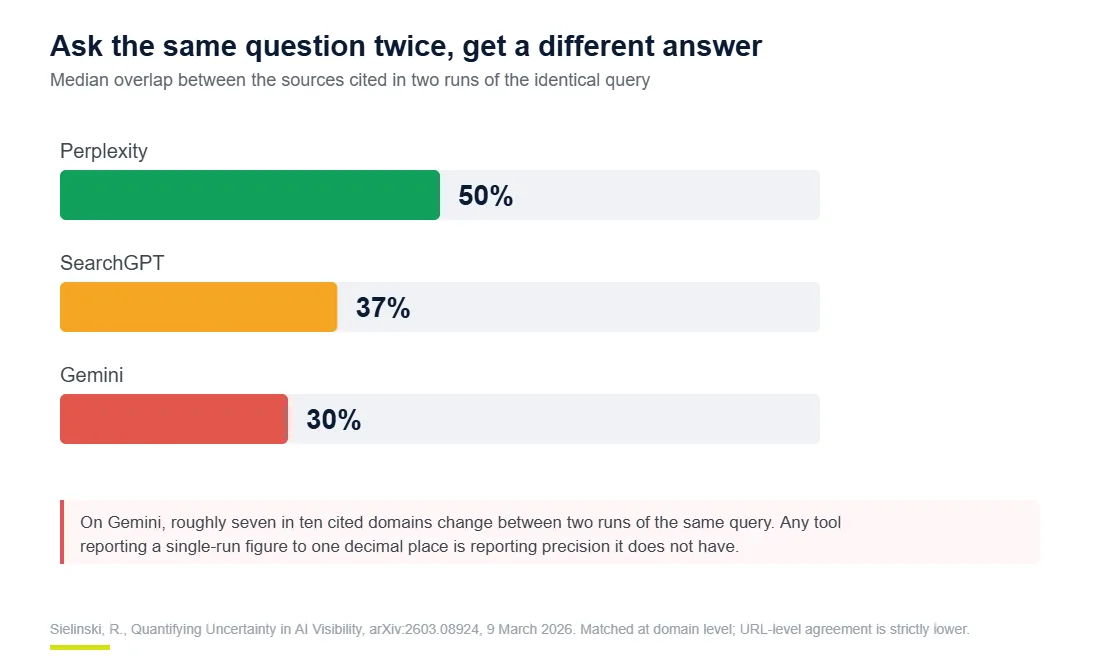
An independent academic study sampled the same queries repeatedly across Perplexity, OpenAI SearchGPT and Google Gemini. Median domain-level overlap between two runs was 0.50 on Perplexity, 0.33 to 0.40 on SearchGPT and 0.29 to 0.31 on Gemini. On Gemini, between one and two runs in a hundred shared no cited domains at all. The paper matched at domain level and notes that URL-level agreement would be strictly worse.
Its conclusion is the sentence every buyer in this category should read before signing anything: single-run metrics give “a misleadingly precise picture”, and many apparent differences between domains fall inside the noise floor of the measurement process.
How many prompts you actually need
The same paper publishes the thresholds. To get a 95% confidence interval spanning five percentage points on citation share you need roughly 40 to 50 prompts on Gemini, around 100 on Perplexity, and 150 or more on SearchGPT.
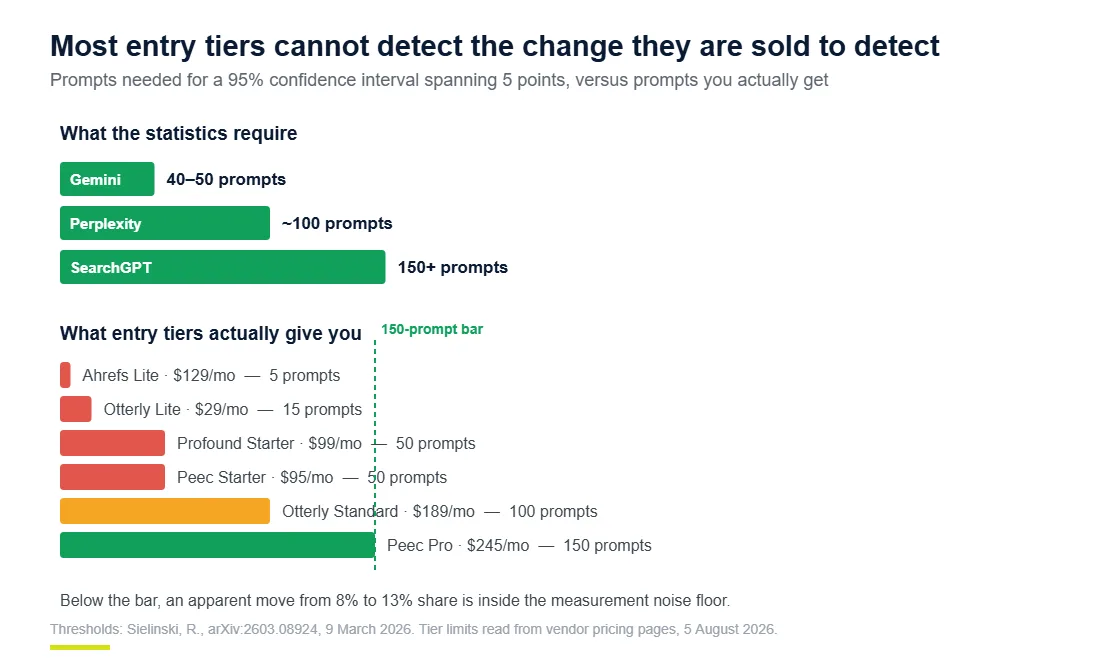
Now compare that with the pricing table. Ahrefs Lite gives you five tracked prompts for $129 a month. Otterly Lite gives fifteen for $29. Profound Starter and Peec Starter give fifty. None of those can produce an interval narrow enough to distinguish an eight percent citation share from three percent or thirteen percent. The cheapest tiers that clear the bar on a single engine are around Peec Pro at $245 and SE Ranking Core at $129 for 100 prompts a day.
Which ChatGPT is your vendor actually asking?
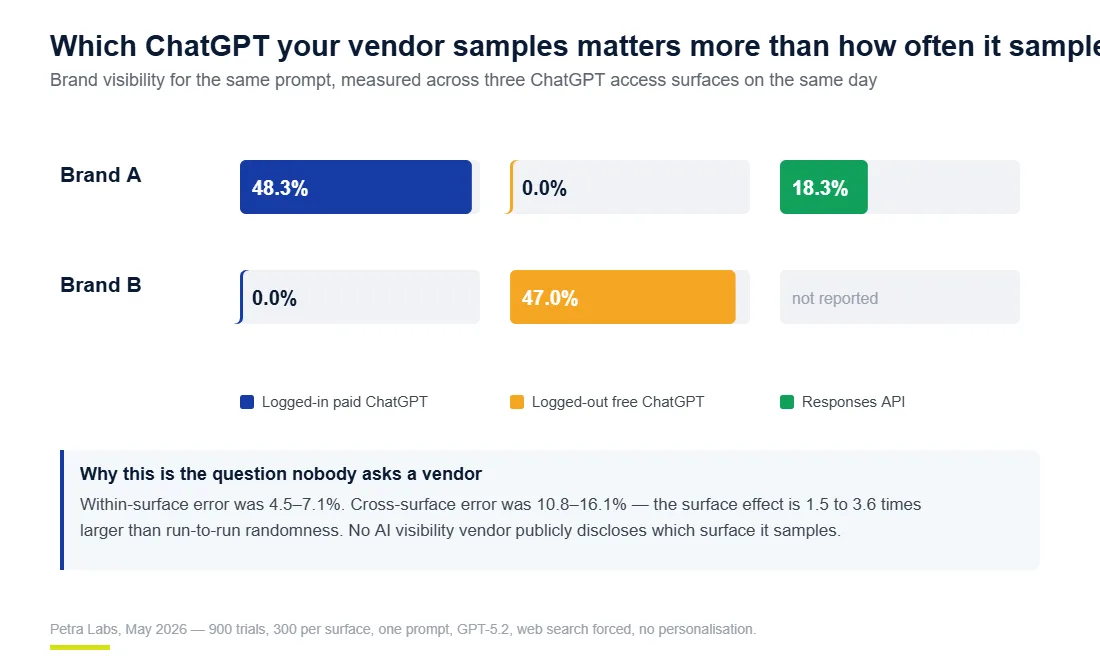
An agency ran 900 controlled trials in one day, 300 per surface, one prompt, the same model, web search forced, no personalization, comparing logged-in paid ChatGPT, logged-out free ChatGPT and the Responses API. One brand appeared in 48.3% of logged-in answers, 0% of logged-out answers and 18.3% of API answers. Another brand had the inverse: 0% logged-in, 47.0% logged-out.
Split-half controls put within-surface error at 4.5–7.1% and cross-surface error at 10.8–16.1%. The surface effect is one and a half to three and a half times larger than run-to-run randomness. No vendor in this category publicly discloses which surface it samples. Zapier is the only publisher we found that even raises the issue, noting that some tools scrape front-end LLM interfaces rather than using APIs.
Arabic and the Gulf: the support matrix nobody publishes
This is the section that does not exist anywhere else in English. Country coverage and language coverage are two different things, and vendors routinely publish the first while leaving the second unstated.
| Tool | Arabic prompts | UAE | Saudi Arabia | Egypt | Qatar | Kuwait | Country list published? |
|---|---|---|---|---|---|---|---|
| Conductor | Yes, Arabic named per country | Yes* | Yes, all engines | Yes* | Yes* | Yes* | Yes, full locale table |
| Otterly.AI | Yes, Arabic named | Yes | Yes | Yes | Yes | No, absent | Yes, 65+ countries × 7 engines |
| Knowatoa | Yes, ISO 639-1 “ar” | Yes | Yes | Implied | Implied | Implied | Yes |
| Semrush | No language list published | Yes | Yes | No | No | No | Yes, 42 countries |
| Evertune | No, Arabic absent from its 33-language list | Yes | Yes | Yes | Yes | Yes | Yes, 140 countries |
| ZipTie.dev | Not verified | Yes | No | No | No | No | Yes, 28 countries |
| SE Ranking | Free tracker yes, paid product no | Free only | Free only | Free only | Free only | Free only | Paid = 7 markets, none Arab |
| Ahrefs Brand Radar | Arabic absent from its 15-language UI list | Country code only | Country code only | Country code only | Country code only | Country code only | No, API codes only |
| Profound | Implied, “30+ languages” | ? | ? | ? | ? | ? | No |
The commercial details nobody mentions
- No tool prices in AED or SAR. Not one. USD is the default; Otterly and Rankscale also show EUR; Nightwatch is EUR-only; Trakkr displays GBP but bills in USD.
- GCC VAT is essentially unhandled. Only Semrush documents GCC registration, at 5% for the UAE and 14% for Egypt on B2C. Ahrefs and SE Ranking publish tax-jurisdiction lists with no GCC state on them.
- Right-to-left interface support barely exists. Profound is the only vendor that has said anything on the record, stating in November 2025 that RTL support would be added in a future update. Every dashboard we inspected is left-to-right and English-only.
- No vendor publishes an Arabic-language interface or an Arabic marketing site. Not Semrush, Ahrefs, SE Ranking, Profound, Peec, Otterly, Conductor, Scrunch, Rankscale, Writesonic or Geneo.
The Arabic LLM blind spot
Four state-backed Arabic language models are live and in public use: Falcon-H1 Arabic from TII in Abu Dhabi, ALLaM from SDAIA powering HUMAIN Chat in Saudi Arabia, Jais 2 from Inception and G42, and Fanar 2.0 from QCRI in Qatar. ALLaM handles Gulf, Egyptian and Levantine dialects.
Cross-checked against a 33-tool industry inventory, not one AEO tool tracks any of them. Neither does Statcounter. If your brand matters inside a Gulf state’s own national model, there is currently no vendor solution and no dashboard. It has to be measured manually, on a fixed prompt set, at a fixed cadence, which is worth doing precisely because nobody else is.
There is also a dialect problem that no tracker addresses. Google supports Modern Standard Arabic in AI Mode, rolled out in October 2025, not Gulf, Egyptian or Levantine dialects, and no tool distinguishes dialects either. Buyers ask in dialect. Your prompt set should too, even though nothing will help you measure it automatically.
What you can get for free, accurately
Three official sources now give AI visibility data at no cost. Most articles describe them incorrectly, so here is what each actually does.
| Source | What you get | What you do not get |
|---|---|---|
| Google Search Console | A generative-AI performance report announced 3 June 2026, covering AI Overviews and AI Mode. AI traffic is also merged into the standard Web search type. | Impressions only. No clicks, no click-through rate, no position, no queries dimension. Still rolling out to a subset of site owners. There is no AI Mode search-type filter. |
| Bing Webmaster Tools | AI Performance, in public preview since 10 February 2026: total citations, average cited pages, page-level citation trends, and grounding queriesthe phrases the AI used when retrieving your content. This is the only official query-side signal for AI answers anywhere. | A sample, not a complete record. Covers Copilot and Bing AI summaries, not ChatGPT or Gemini. |
| Cloudflare AI Crawl Control | Free on all plans: per-crawler requests and bytes by operator, status-code distribution, most-requested paths, robots.txt compliance tracking, per-crawler allow/block, CSV export and a GraphQL API. | AI referral data is paid-plan only. The widely repeated claim that Cloudflare gives free AI referral attribution is wrong, its own documentation flags the top-referrers feature as paid. |
Add free tiers of paid tools, AthenaHQ Essential is genuinely free with 300 credits across five engines, and XFunnel offers 50 one-time queries, plus raw server-log analysis, which on a Cloudflare free plan is the only route to AI referral data at all.
Nobody has ever independently benchmarked these tools
We searched specifically for this, in several forms, and the answer is a clean negative: there is no rigorous independent benchmark of AI visibility tracker accuracy. Every accuracy figure in circulation, the “85 to 96% across leading platforms” claims, the “97.3% versus 94 to 96%” comparisons, appears with no stated ground truth, no sample size, no date, no author and no replication protocol. Several trace back to affiliate blogs. A vendor cannot self-report accuracy against an undisclosed reference standard.
An academic survey reviewing 45 studies put it plainly: commercial audits reveal “low source overlap, substantial run-to-run variability, and persistent fidelity gaps”, and no reviewed technique shows a stable, longitudinal, cross-platform causal effect.
There is a live example of why cross-tool comparison is unreliable. Ahrefs published data in June 2025 showing Reddit does not appear in ChatGPT’s top ten cited domains. Semrush published data from August 2025 showing ChatGPT cited Reddit in about 60% of responses. Both are probably correct, they measure different things, mention share of all citations versus the percentage of responses containing a citation, and both companies sell trackers. That definitional divergence is the reason two dashboards pointed at the same brand can disagree and both be defensible.
When you should not buy one of these at all
No article in this category argues against the purchase, which should itself tell you something.
If brand identity accounts for roughly 1.5% of the variance in a single AI answer, and ranking reliability at a full crossed design reaches only about 0.36, then a small brand paying $29 to $99 a month for 15 to 50 prompts is buying noise with a dashboard attached to it. The dashboard will move. The movement will not mean anything.
How to read a vendor listicle
Six of the eight competing articles we analyzed rank their own product first. None carries a conflict statement. One publishes a full four-tier pricing table for itself and leaves the pricing heading empty for six of its competitors. One describes a prompt-tracking tool as a meeting-transcription product, having confused two companies with similar names.
- Check whether the publisher sells a tool on the list. If they do and they are ranked first, that is the finding.
- Check whether prices are published for competitors, not just for the author. Empty pricing sections are the clearest possible signal.
- Look for a stated methodology with dates. Ratings to one decimal place with no rubric are invented precision.
- Spot-check two prices at source. We found material errors in circulating figures for ZipTie, Nightwatch, SE Ranking and Gauge.
- Check the FAQ schema. At least one vendor has engineered its FAQPage markup so that AI engines extract its own brand name as the answer to “what is the best AI visibility tool”.
So which one should you buy?
The honest answer depends on three things: how many prompts you need, which engines matter in your market, and whether you work in Arabic.
| If you are… | Start with | Why |
|---|---|---|
| Testing whether any of this matters | Nothing. Bing Webmaster Tools, Search Console, Cloudflare AI Crawl Control and a manual 30-prompt audit | Free, official, and it teaches you what the dashboards are doing before you pay for one |
| A single brand on a small budget | Otterly Lite at $29, upgrading to Standard at $189 when you need statistical power | Cheapest credible entry point, unlimited seats from the first tier, Arabic explicitly supported |
| Already paying for Semrush or Ahrefs | Whatever you already have | Neither is best-in-class for AI visibility, but the marginal cost is zero and the data is adequate for a first baseline |
| An agency running many clients | Peec AI Pro at $245, or Scrunch (agency tier price not published at source, request a quote) | Unlimited seats, multiple projects, and prompt counts that clear the statistical bar |
| Operating primarily in Saudi Arabia in Arabic | Conductor | The only vendor documenting full engine coverage for Saudi Arabia in Arabic, per its own published exceptions table |
| Operating in the UAE in Arabic | Otterly, and verify at trial | Conductor documents that UAE Arabic loses ChatGPT (Crawl); Otterly names Arabic and covers the UAE. Test before committing |
| Needing attribution, not just visibility | Profound Growth at $399 | Its Agent Analytics layer integrates with Cloudflare, Vercel, Akamai and log sources: the strongest traffic-attribution story in the category |
Frequently asked questions
What is the best AEO tool in 2026?
There is no single best one, and any article that names one without disclosing whether it sells that tool should be discounted. For a single brand on a small budget Otterly is the cheapest credible entry point at $29 a month. For agencies, Peec AI Pro at $245 gives unlimited seats and enough prompts to be statistically meaningful. For traffic attribution rather than visibility alone, Profound has the strongest integration layer. If you work in Arabic, Conductor is the only vendor publishing per-country engine coverage, and it is the only one documenting full engine support for Saudi Arabia in Arabic.
How much do AEO tools cost?
Verified entry prices in August 2026 range from free, at AthenaHQ Essential, to $800 a month at Evertune Pro, with most credible tiers between $99 and $399. The spread between the cheapest and dearest paid entry tiers is roughly twenty-seven times, from $29 to $800. Nine of the twenty-six vendors we checked publish no usable price at all and require a demo. Ahrefs is the only vendor publishing a per-unit rate, at one to two cents per prompt-engine-location check.
Do AEO tools support Arabic?
Some do, and country coverage is not the same as language coverage. Conductor names Arabic per country and documents which engines are unsupported in each Gulf market. Otterly names Arabic and covers the UAE, Saudi Arabia, Egypt and Qatar but not Kuwait. Knowatoa supports Arabic by ISO code. Evertune sells 140 countries including the entire Gulf and does not list Arabic among its supported languages. SE Ranking offers Arabic in its free tracker but not in its paid product.
How accurate are AI visibility tools?
Nobody independent has ever checked. Every accuracy figure in circulation is vendor-published against an undisclosed reference standard. What is documented is the underlying instability: median citation overlap between two runs of the same query is around 0.50 on Perplexity and 0.30 on Gemini, and brand visibility for one prompt varied by up to 48 percentage points depending on whether the tool queried logged-in ChatGPT, logged-out ChatGPT or the API.
How many prompts do I need to track?
Roughly 40 to 50 on Gemini, around 100 on Perplexity and 150 or more on SearchGPT, if you want a 95% confidence interval spanning five percentage points on citation share. Most entry tiers fall well below this: Ahrefs Lite gives five tracked prompts, Otterly Lite gives fifteen. Below the threshold you cannot distinguish a real change from measurement noise.
Can I track AI visibility for free?
Partly, and better than most articles suggest. Bing Webmaster Tools has offered AI Performance data since February 2026, including grounding queries, which is the only official query-side signal for AI answers anywhere. Google Search Console added a generative-AI report in June 2026, though it shows impressions only with no clicks or queries. Cloudflare AI Crawl Control is free on all plans for crawler analytics, but AI referral data requires a paid plan.
Related guides
- How to Become a GEO Expert in 2026: The Complete Career Guide
- How to Measure AI Visibility (Share of Model): A 2026 Playbook
- Arabic GEO: How to Get Your Arabic Content Cited by ChatGPT, Gemini and AI Overviews
- Best GEO Agencies in the Middle East & Gulf (2026)
- llms.txt: What It Is and Does It Actually Help AI Search?
Tools are the measurement half. No tracker on this list corrects a false statement an engine repeats about you. That work is described in the four GEO layers most agencies skip.
Beyond tools. None of these trackers touches paid placement. For ChatGPT Ads eligibility, categories and setup, read how to prepare for ChatGPT Ads before they launch.
Don't miss the chance to
make your website more visible!
Initial consultation and
audit of the current situation

Read also

Article Behavioral Factors in SEO: What They Are and How to Improve Them
Article JavaScript Links Are Hiding MENA Sites From ChatGPT and Claude

Article VOCTOS Is a Top SEO, PPC and SEM Company in Egypt on Clutch for 2026
Article Commercial Ranking Factors: The Complete List

Article The Title Meta Tag: What It Is and How to Write It
Article The Role of Meta Tags in Search Engine Optimization
Article Can You Sue an AI for Defamation? Where the Law Stands

Article Cloudflare’s 15 September AI Crawler Defaults: The Check Gulf and Egypt Brands Should Run Today

Real Results
More Wins
SEO & GEO for Delta Medical Labs
 GEO
GEO
1M+ monthly organic visits, 159,200 ranked keywords, 5,570 pages cited by AI engines, and 1,186 #1 rankings in KSA.

Arabic SEO, GEO & guest posting for VPNly
 SEO
SEO
65K peak monthly organic visits, 55 guest posts, and 149 pages cited by AI engines.

SEO & GEO for Ogaei Virtual Care
GEO
From 3 to 7,931 monthly organic clicks in 7 months, 2.9M+ impressions, and 40+ keywords in Google’s Top 10.

SEO for Eduverse
SEO
12× search traffic in 10 months, 45% of target keywords in the top 5, and 55% in the top 10.
Trusted by