

Commercial Ranking Factors: The Complete List

Commercial ranking factors are the trust, usability and transactional signals that tell Google a page is a credible place to buy a product or hire a service, not just an article about it. They cover everything from a complete product card and transparent pricing to visible contact details, delivery and payment information, genuine reviews and a fast mobile experience. Get them right and you improve two things at once: how confidently search engines rank your commercial pages, and how readily real visitors convert into customers.
Key takeaways
- Commercial ranking factors are the site characteristics that signal a page is built to sell safely and conveniently, helping search engines separate genuine e-commerce and service pages from purely informational ones.
- They matter most for online stores and service businesses, where trust and a frictionless path to purchase directly affect both rankings and conversion rate.
- The main groups are assortment and pricing, contacts and trust signals, delivery and payment information, usability and product cards, reviews and reputation, and design and mobile experience.
- Google does not label these as a separate “commercial” bucket the way some regional engines do, but it rewards the same underlying qualities through E-E-A-T, page experience and helpful-content systems.
- Because these factors also lift conversions, improving them delivers a return even before rankings move, which is why they belong in every commercial SEO roadmap.
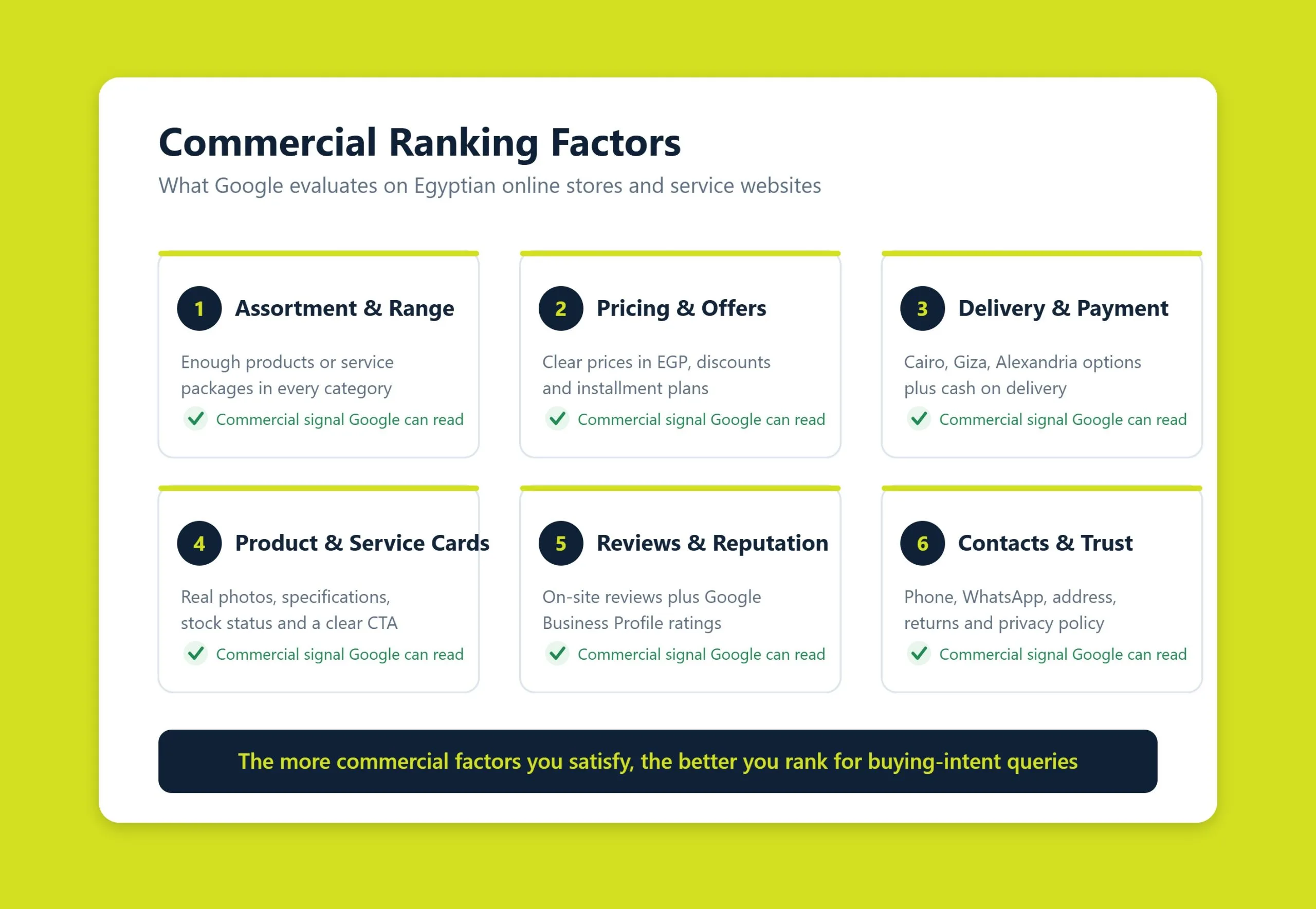
What commercial ranking factors are
Commercial ranking factors are the combination of features and elements on a website that make it easy and safe to order a service or buy a product. They shape your reputation, build user trust and influence how your pages perform in search results. Just as importantly, they help search engines tell the difference between a resource built to sell and an informational portal that only explains a topic. For any business project, that distinction is a core part of effective SEO.
The exact checklist varies by business model. A company that provides services and an online store are judged on different signals: the store leans heavily on product cards, stock levels and cart usability, while the service site leans on cases, portfolios, certificates and clear pricing for engagements. Even so, a set of shared criteria applies across both. These are the elements that modern search algorithms weigh when ranking a commercial page, and the same elements that lift conversion by making a business look more credible and easier to deal with than its competitors.
Why they matter, especially for e-commerce and services
When someone searches with commercial intent, they are close to a decision. They are comparing shops, weighing suppliers, checking whether a company is legitimate and easy to buy from. A page that answers those unspoken questions instantly keeps the visitor engaged; a page that hides prices, buries contact details or ships a broken mobile layout sends them straight back to the results to click a competitor. Search engines observe those behavioral patterns, so weak commercial signals quietly erode rankings even when your content is otherwise strong.
For e-commerce, the stakes are highest because every missing detail on a product page is a reason not to add to cart. For service businesses, credibility signals carry the weight: prospects who are still deciding on a provider are reassured by transparent pricing, real cases and visible expertise. In both scenarios, commercial factors are not a nice-to-have layer on top of SEO. They are the part of SEO that turns visibility into revenue, which is exactly why they sit at the center of any serious SEO strategy.
The main groups of commercial ranking factors
Assortment and pricing
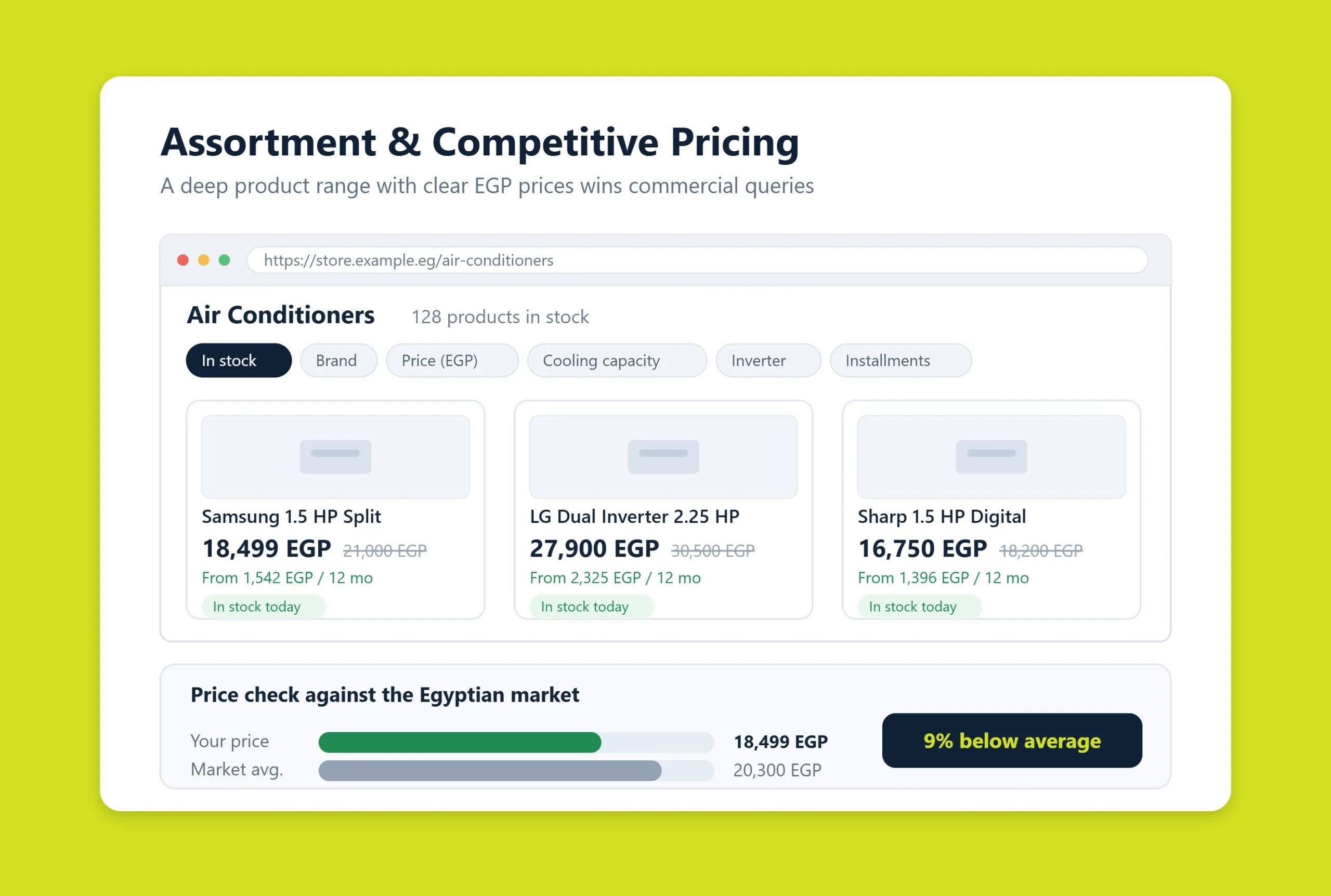
Breadth of range is a strong signal, particularly for stores. Aim to cover as many of your audience’s real problems as your products can solve, and if your catalog is small, extend it with complementary and related offerings so the site reads as a genuine destination rather than a thin listing. Pricing must be competitive and, crucially, visible next to every item in the assortment. A price shown openly beside each product removes friction and doubt; a price hidden behind a form or a phone call adds both. Keep a dedicated discounts and promotions page as well, but only with current offers: describe loyalty and bonus schemes in plain language, and move expired campaigns to an archive promptly so you never mislead a customer.
Contacts and trust signals
Detailed, easy-to-find contact information is one of the clearest trust signals a commercial site can send. Duplicate the primary channels in the site header and provide a dedicated contacts page that includes:
- Company detailsthe official legal name and registration information, presented as a structured list rather than a wall of text.
- Addressnot only the location and a photo of the premises, but opening hours and an interactive map (embedded and live, not a screenshot) showing sales points, pickup locations and regional offices.
- Phone numberswritten as selectable text so search engines can index them, ideally with department names, staff names, working hours and a free regional number.
- Email addresseswhere possible, several, each tied to a named responsible person or team.
- MessengersWhatsApp, Telegram, Viber and similar apps relevant to your audience, with buttons that let a user copy the handle or jump straight into a chat.
Add a contact form and, on many pages, a live chat option so visitors always have a low-effort way to reach a person. Certificates, licences and any relevant accreditations belong here too: publishing them reassures cautious buyers and reinforces the legitimacy of the business.
Delivery and payment information
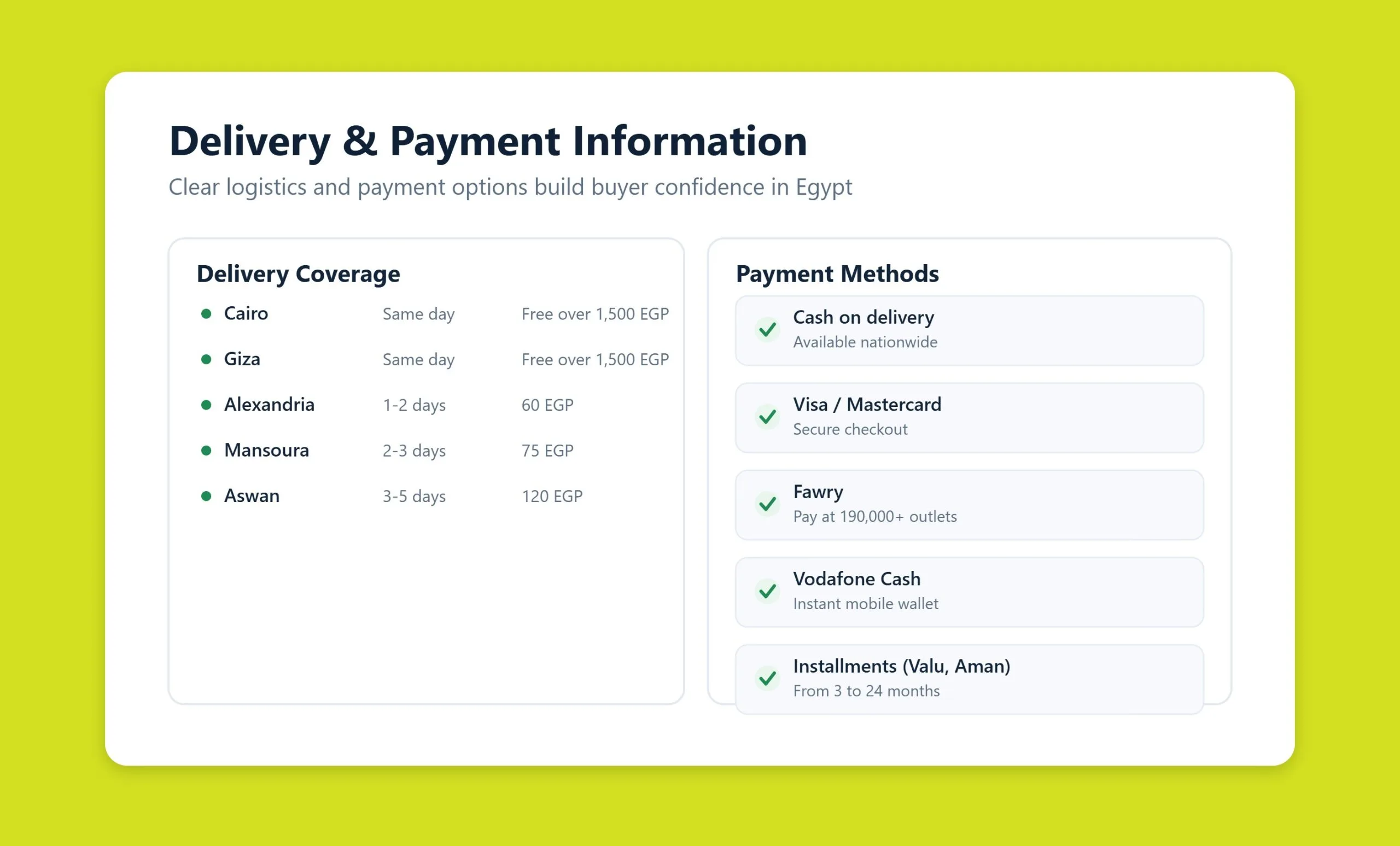
A “Payment” section should be prominent and easy to reach, listing the main ways a customer can pay along with short explanations of how each method works. The “Delivery” section should cover as many shipping options as you offer, and for each one spell out the cost, timeframes and regions served. Where it helps, note the pros and cons of each method and link to the apps of the delivery services you use. Nothing kills a purchase faster than a shopper who cannot work out whether you can deliver to them, by when, and for how much.
Usability and product cards
Navigation should be simple and intuitive so visitors find what they need with minimal effort. Organise the catalog into clear categories and subcategories, but avoid an over-branched menu in which the right section is hard to locate; analyze your most popular categories and surface them near the top. Use in-text hyperlinks that stand out visually, and turn the most important actions into buttons. Offer product filters that neither overcomplicate nor oversimplify the search, open the pages you want ranked for indexing (each with its own H1, Title and meta description), and close the rest. Watch for empty categories, too: a section with no content frustrates users and undermines trust, so cover it politely during maintenance or remove it from the menu entirely.
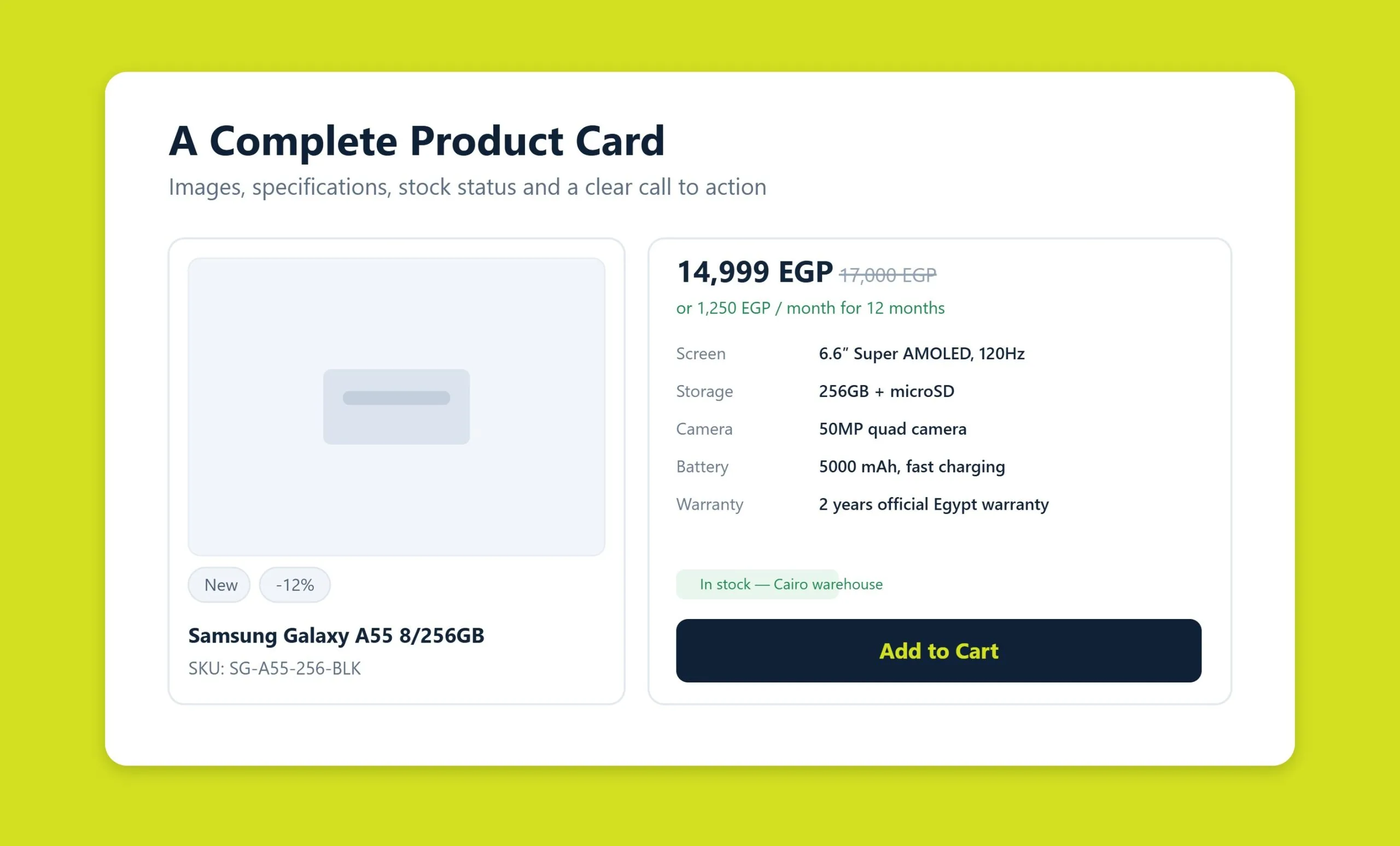
Product cards deserve special attention because their completeness is one of the most heavily weighted commercial factors for online stores. A strong card includes a detailed description, configuration or variant options, stock availability in units, a competitive price shown on the card, full specifications (size, weight, colour and other parameters), the manufacturer (optionally linking to their official site), photographs from several angles, and a clear “Buy”, “Order” or “Add to cart” button. Rich media, high-quality images, 3D views and video, holds attention, increases time on page and lifts conversion. The cart itself should be reachable from any page, ideally via a button in the top right showing the item count, and clicking it should open a dedicated cart page with a “continue shopping” link rather than a cramped dropdown.
Reviews and reputation
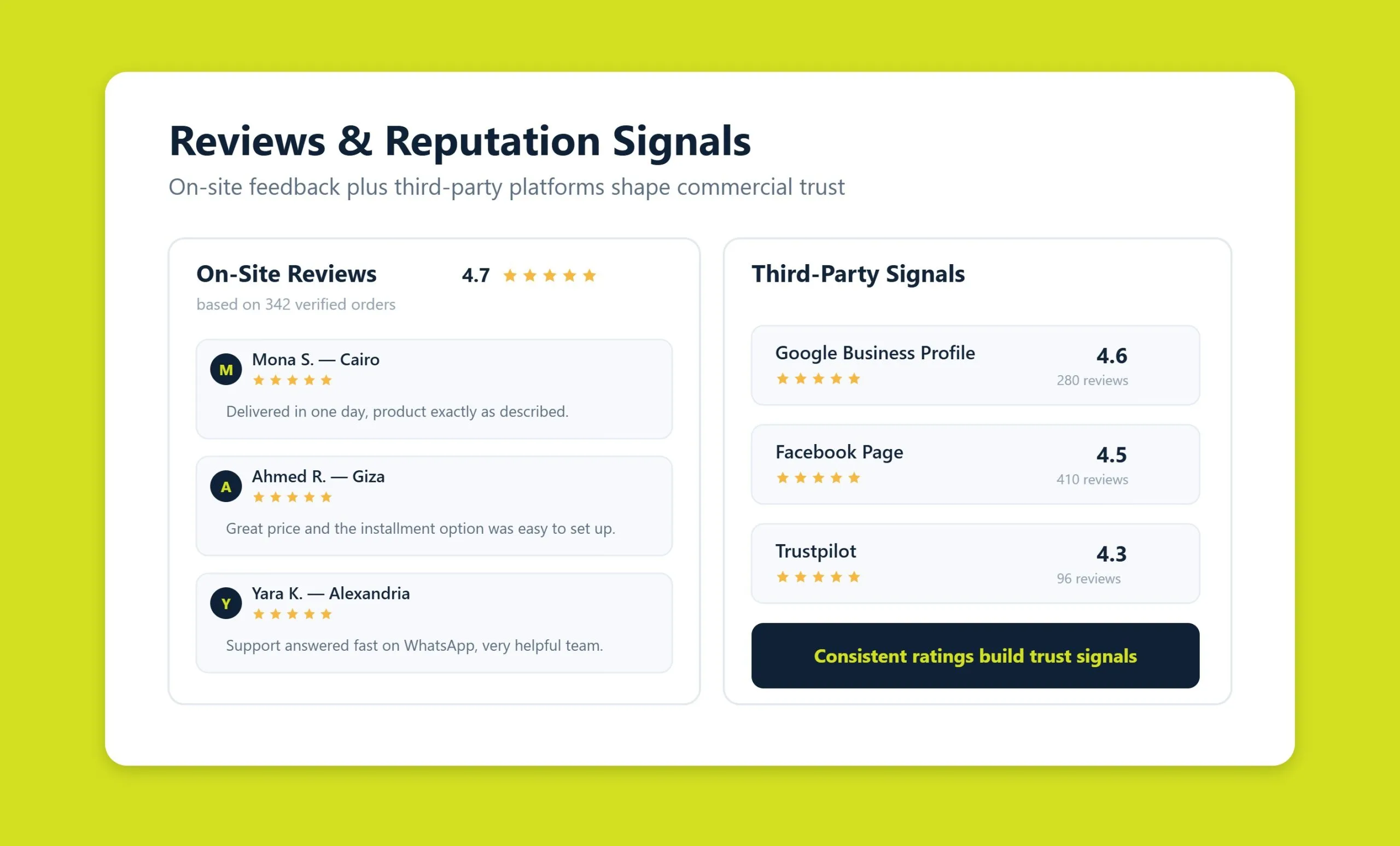
Genuine reviews are powerful social proof. Beyond hosting reviews on your own site, link to customer opinions on independent, reputable third-party platforms so prospects can see that the feedback is real and unbiased. Where possible, pair an on-site review with a customer photo of the product in use and a link to their social profile, that authenticity is hard to fake and does a lot of persuasive work.
Reputation extends beyond the site. Mentions of your brand across the web, positive coverage on relevant forums and blogs, and reviews in trusted directories all feed the picture search engines and shoppers build of you. Monitor brand mentions, respond politely to criticism, thank people for praise and address objections with clear, factual explanations. When negative posts appear, patience and a courteous, helpful reply protect your reputation far better than silence. A structured approach here overlaps with content marketing and ongoing reputation management, and it compounds over time.
Design and mobile experience
A secure, well-built, mobile-ready site is table stakes. Any commercial site that takes payments or even runs a contact form needs an SSL certificate and HTTPS, both to protect the data passing between customer and business and because secure pages are favoured in search results. A large and growing share of shoppers buy from phones and tablets, so a responsive layout that works flawlessly on small screens directly increases sales. Keep landing pages shallow, ideally no more than two clicks from the home page, because the lower the click depth, the easier it is for both users and crawlers to reach your key pages. Round this out with a corporate blog, a maintained news section, portfolio cases with client details and outcomes, photo and video reports of your work, active and genuinely updated social profiles, and a thank-you page after checkout that confirms the order, builds the relationship and can cross-sell related products.
How commercial factors map to Google E-E-A-T and conversions
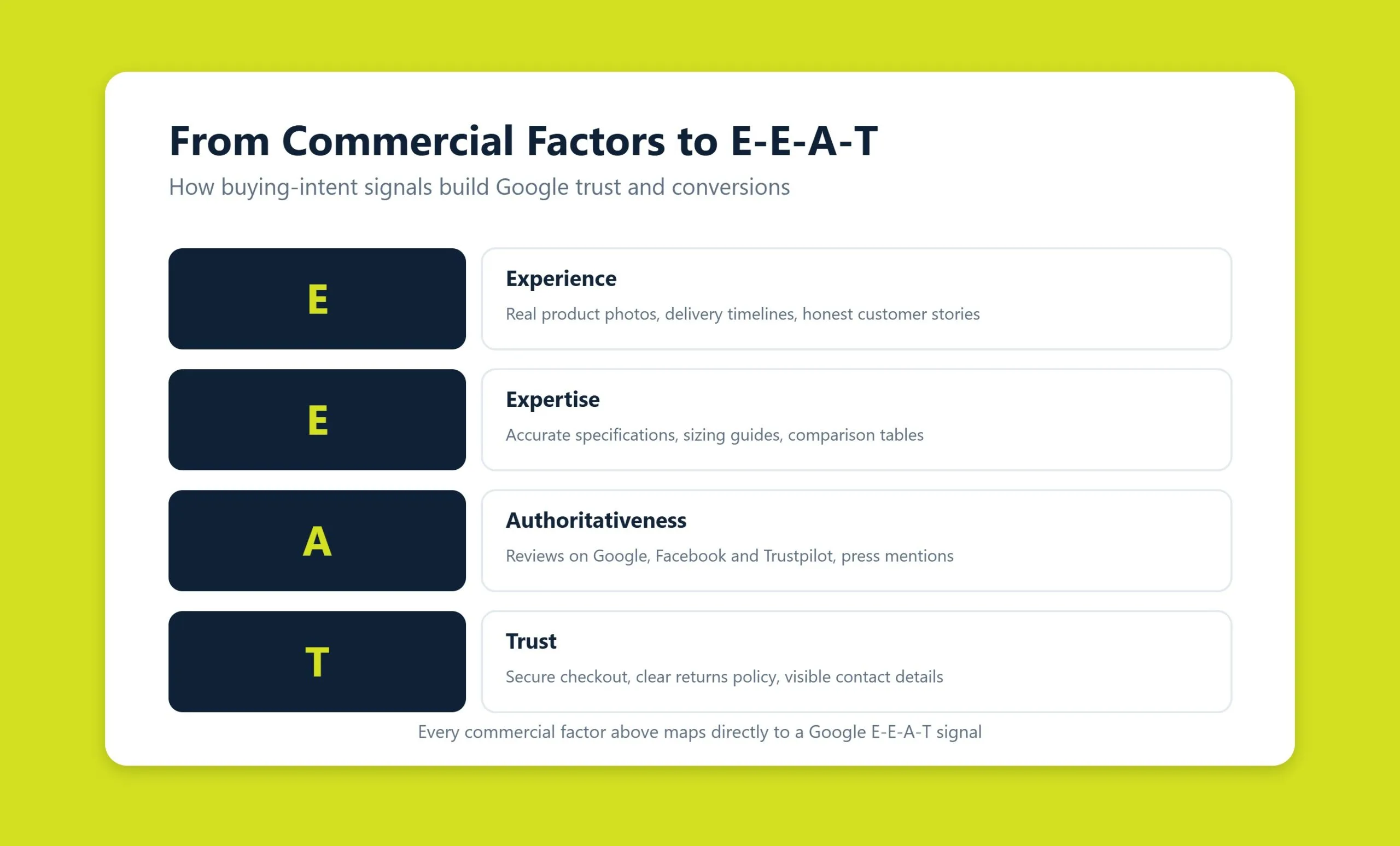
Unlike some regional search engines that call out commercial factors as a distinct ranking group, Google does not label them separately, but it absolutely accounts for them. It does so through the qualities described in its E-E-A-T framework (Experience, Expertise, Authoritativeness, Trustworthiness), its page experience signals and its helpful-content systems. Map the groups above onto E-E-A-T and the overlap is obvious.
- Experience and Expertisedetailed product cards, portfolio cases, photo and video reports and a substantive blog demonstrate first-hand knowledge of what you sell.
- Authoritativenessbrand mentions on reputable sites, reviews on independent platforms and links from relevant directories and industry portals build recognized standing in your niche.
- TrustworthinessHTTPS, transparent pricing, complete contact and legal details, visible licences and clear delivery and payment terms are exactly the signals Google associates with a site people can safely transact with.
The same elements that satisfy these systems also remove friction from the buyer’s journey, which is why commercial factors pay off twice. A visible price, a reachable cart and an honest delivery estimate raise conversion whether or not they move a single ranking position, and because engagement and satisfaction feed back into search performance, the two effects reinforce each other. If you sell across third-party channels as well, the same trust-and-usability principles carry over to marketplace SEO, where complete listings and strong reviews decide visibility inside the platform.
A commercial ranking factors checklist
Use this as a working audit for any commercial page or site:
- Prices shown clearly next to every product, with a current, honest promotions page.
- Broad, well-organized assortment that covers your audience’s real needs.
- Complete product cards: description, specs, stock, manufacturer, multi-angle images or video, and a clear buy button.
- Cart accessible from every page, opening to a dedicated cart page.
- Prominent payment section and a detailed delivery section with costs, timeframes and regions.
- Full contact information in the header and on a dedicated page, legal details, indexable phone numbers, address with a live map, email and messengers.
- Contact form and live chat available.
- On-site and third-party reviews, plus active brand-mention monitoring.
- HTTPS everywhere, a responsive mobile layout and shallow click depth.
- Licences, certificates, cases, portfolio, blog, news and a post-purchase thank-you page.
Working through this list is best paired with a structured SEO audit so you can prioritize the gaps that cost you the most traffic and revenue. And because search is increasingly answered by AI systems as well as classic results, the same trust and clarity signals now feed GEO (AI SEO), where being cited by AI assistants depends on the same credibility your commercial pages already need to earn.
Frequently asked questions
What are commercial ranking factors in SEO?
They are the trust, usability and transactional signals that show a page is a credible, convenient place to buy a product or hire a service, such as clear pricing, complete product cards, visible contacts, delivery and payment details, genuine reviews and a secure, mobile-friendly site. They help search engines distinguish selling pages from informational ones and directly influence both rankings and conversions.
Does Google use commercial ranking factors?
Google does not label them as a separate group the way some regional engines do, but it clearly rewards the same qualities through its E-E-A-T framework, page experience signals and helpful-content systems. Transparent pricing, strong reviews, complete contact details and HTTPS all map onto the trust and experience signals Google already weighs, so improving them supports Google rankings.
Which commercial factors matter most for online stores?
For e-commerce, product card completeness is one of the heaviest factors: detailed descriptions, specifications, stock levels, competitive on-card pricing, multi-angle images or video, and a clear buy button. A cart reachable from any page, transparent delivery and payment information, and genuine reviews follow closely, because together they remove the friction that stops a shopper from checking out.
How do commercial ranking factors affect conversion rate?
Every commercial factor doubles as a conversion lever. A visible price answers the shopper’s first question, a reachable cart shortens the path to purchase, honest delivery estimates remove hesitation, and reviews provide the social proof that tips a decision. Because these improvements raise engagement and satisfaction, they lift conversion even before rankings move, and better engagement then feeds back into search performance.
How do I audit my site’s commercial factors?
Work through a checklist covering assortment and pricing, contacts and trust signals, delivery and payment information, usability and product cards, reviews and reputation, and design and mobile experience. Pair that review with a structured SEO audit to prioritize the gaps that cost the most traffic and revenue, then fix them in order of commercial impact rather than tackling everything at once.
Related guides
Don't miss the chance to
make your website more visible!
Initial consultation and
audit of the current situation

Read also

Article Behavioral Factors in SEO: What They Are and How to Improve Them
Article JavaScript Links Are Hiding MENA Sites From ChatGPT and Claude

Article VOCTOS Is a Top SEO, PPC and SEM Company in Egypt on Clutch for 2026

Article The Title Meta Tag: What It Is and How to Write It
Article The Role of Meta Tags in Search Engine Optimization
Article Can You Sue an AI for Defamation? Where the Law Stands

Article Cloudflare’s 15 September AI Crawler Defaults: The Check Gulf and Egypt Brands Should Run Today

Article What ChatGPT Optimization Guides Still Get Wrong in 2026







Real Results
More Wins
SEO & GEO for Delta Medical Labs
 GEO
GEO
1M+ monthly organic visits, 159,200 ranked keywords, 5,570 pages cited by AI engines, and 1,186 #1 rankings in KSA.

Arabic SEO, GEO & guest posting for VPNly
 SEO
SEO
65K peak monthly organic visits, 55 guest posts, and 149 pages cited by AI engines.

SEO & GEO for Ogaei Virtual Care
GEO
From 3 to 7,931 monthly organic clicks in 7 months, 2.9M+ impressions, and 40+ keywords in Google’s Top 10.

SEO for Eduverse
SEO
12× search traffic in 10 months, 45% of target keywords in the top 5, and 55% in the top 10.
Trusted by