
What Is SEO: Search Engine Optimization Basics
SEO (search engine optimization) is the practice of improving a website so that it ranks higher in the unpaid, organic results of search engines like Google. In plain terms, it means aligning your pages with what searchers are looking for and with the technical and quality signals search engines use to rank content, so that more of the right people find you without paying for every click.
Key takeaways
- SEO earns organic (unpaid) visibility in search results by making a site more useful to people and more readable to search engines.
- Google handles roughly 90% of global search (StatCounter, 2026), so most SEO strategy is built around Google’s ranking systems and guidelines.
- SEO has four connected pillars: on-page, off-page, technical, and local optimization.
- Results take time. Expect meaningful movement in three to six months and compounding growth after that, unlike paid ads that stop the moment you stop spending.
- AI Overviews now appear on a large share of searches, so modern SEO also feeds AI answers through GEO and AEO practices.
- SEO is a long-term investment: the cost per visitor tends to fall over time while paid traffic stays pay-per-click.
What SEO is and why it matters
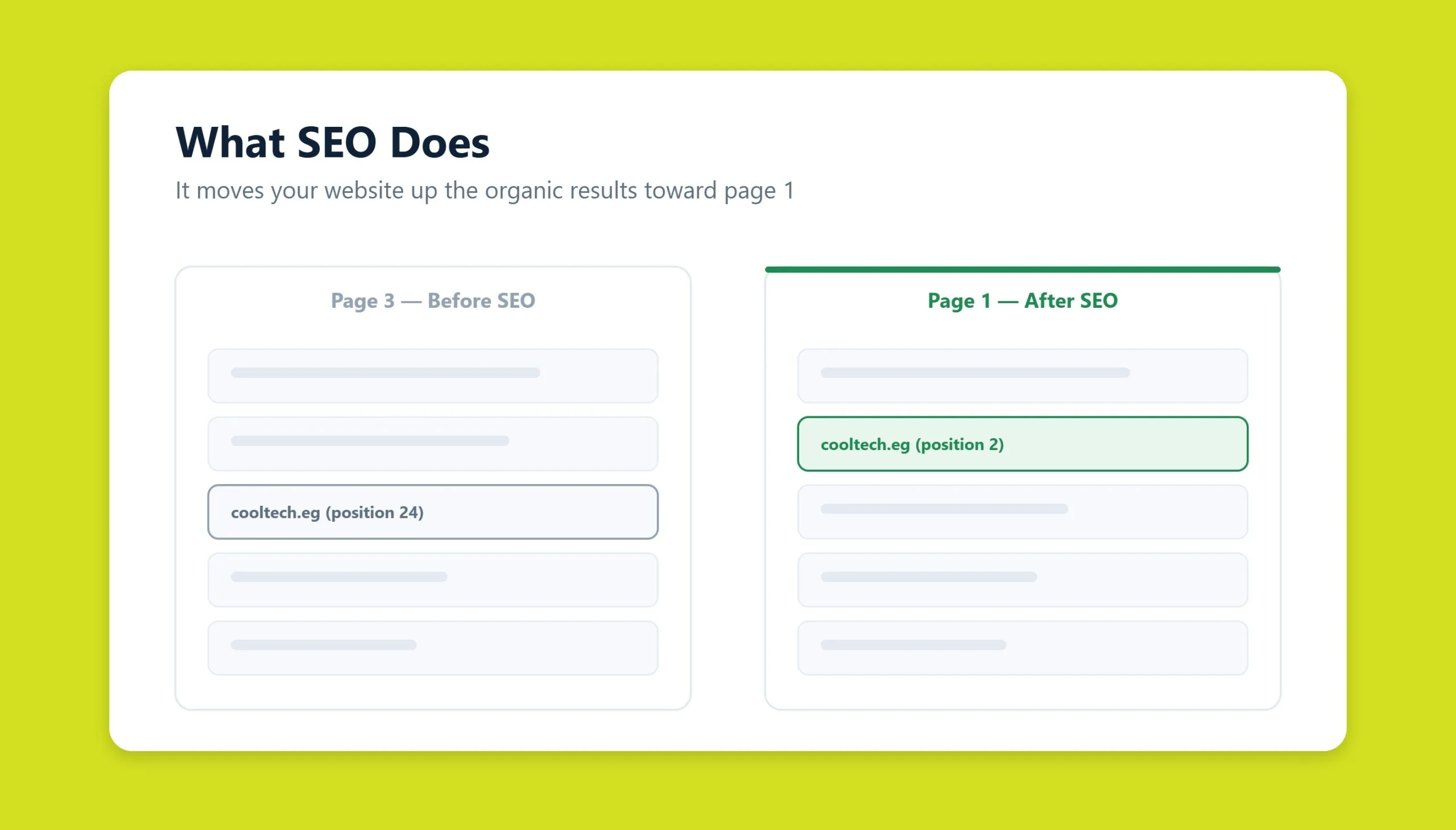
Search engine optimization is the ongoing work of making a website easier to find, easier to understand, and more valuable to the people searching for what you offer. When someone types a query into Google, the search engine returns a ranked list of pages it believes best answer that query. SEO is how you earn a place near the top of that list without paying for the position.
Why does ranking position matter so much? Because attention is concentrated at the top. The overwhelming majority of clicks go to results on the first page, and the first few positions capture the lion’s share. If your site sits on page two or three for the terms that matter to your business, most potential customers will simply never see it. For an online business, invisibility in search means fewer visitors, fewer inquiries, and fewer sales.
SEO is also one of the most durable marketing channels available. A well-optimized page can attract qualified visitors for years, and because the traffic is organic, the effective cost per visit tends to drop as your authority grows. That combination of compounding returns and precise targeting is what makes it a cornerstone of digital marketing. If you want a structured program run by specialists, our SEO services cover strategy through execution.
How search engines work
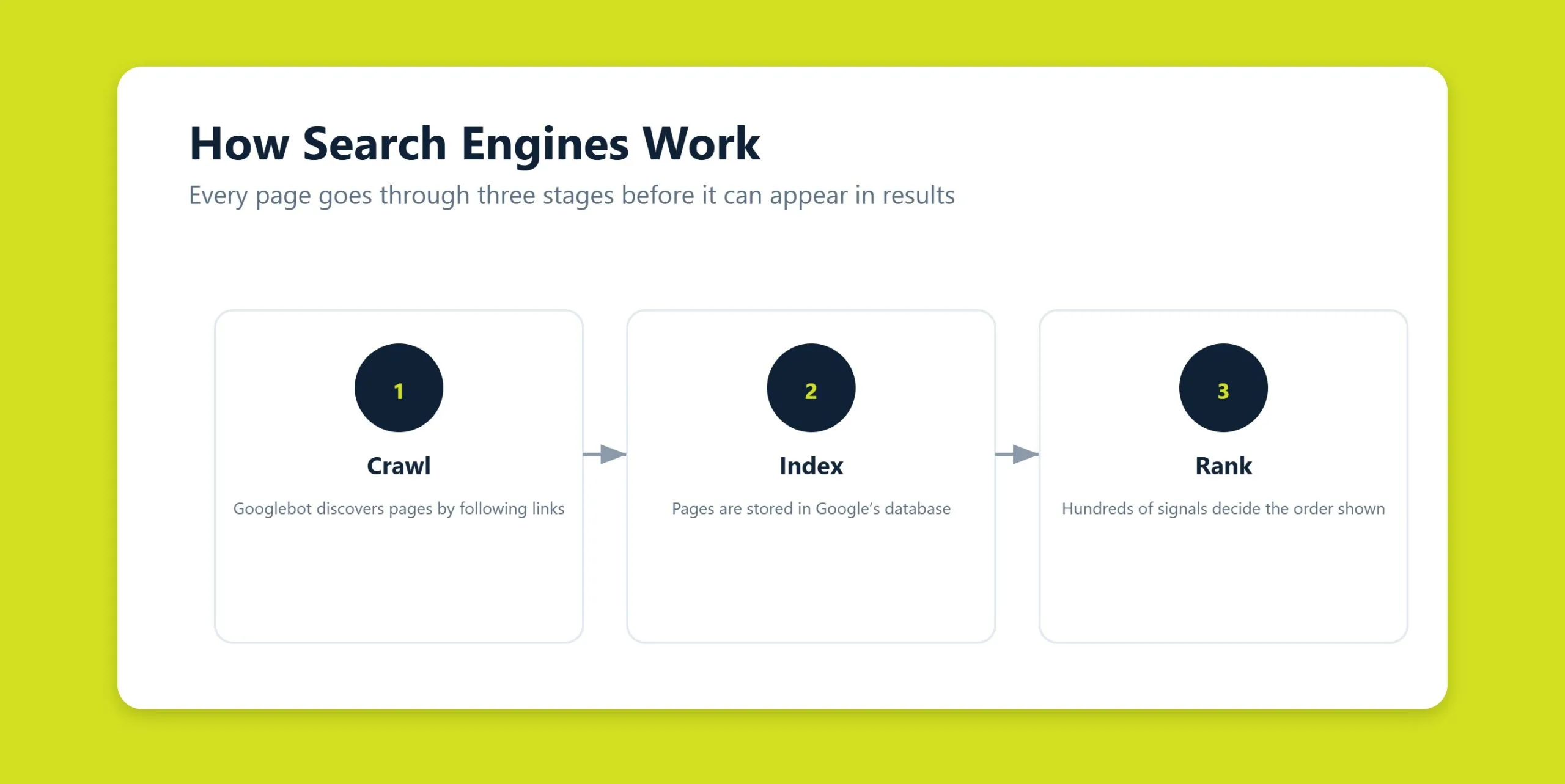
To optimize for search engines, it helps to understand what they actually do. Every major engine follows three basic stages: crawling, indexing, and ranking.
Crawling and indexing
Search engines send out automated programs, often called crawlers or bots, that follow links across the web and discover pages. When a crawler reaches your site, it reads the content and stores what it finds in a vast database called the index. If a page cannot be crawled or is blocked, it will not appear in results, no matter how good it is. This is why a clear site structure, an XML sitemap, and a link path that reaches even your deepest pages are so important.
Ranking
When a user searches, the engine pulls relevant pages from its index and orders them using a ranking formula that weighs hundreds of signals. Google evaluates relevance, content quality, expertise and trust, page experience, mobile-friendliness, loading speed, and how well a page satisfies the searcher’s intent, among many other factors. Google tests a large number of potential ranking changes every year, and only some make it into the live algorithm, so the system is constantly evolving.
Search engines also run filters
Beyond ranking signals, search engines apply filters designed to catch outdated or manipulative tactics. Years ago, stuffing a page with keywords or buying large volumes of low-quality links could move rankings. Today those shortcuts trigger penalties. Google can detect artificial link schemes and thin, manipulative content, and sites that rely on them can lose visibility. The lasting lesson is simple: improve the actual product, your website, rather than trying to trick the scoring system.
How visitor behavior feeds back in
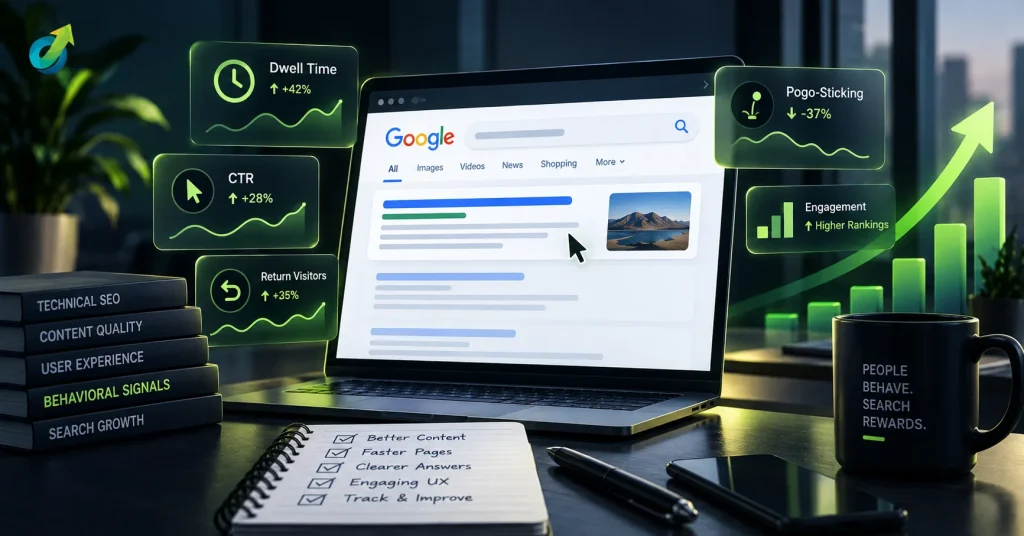
Modern engines pay attention to how people interact with results. If searchers click a page and immediately return to the results to try something else, that is a weak signal. If they stay, read, and take meaningful actions such as filling out a form, subscribing, or making a purchase, that suggests the page was genuinely useful. Engagement of this kind tells you the page worked. Google has said it does not use time on page or bounce as ranking signals, so treat these as diagnostics, not levers. The practical goal is to give visitors the most complete, satisfying answer to their query so they have no reason to look elsewhere.
The four types of SEO
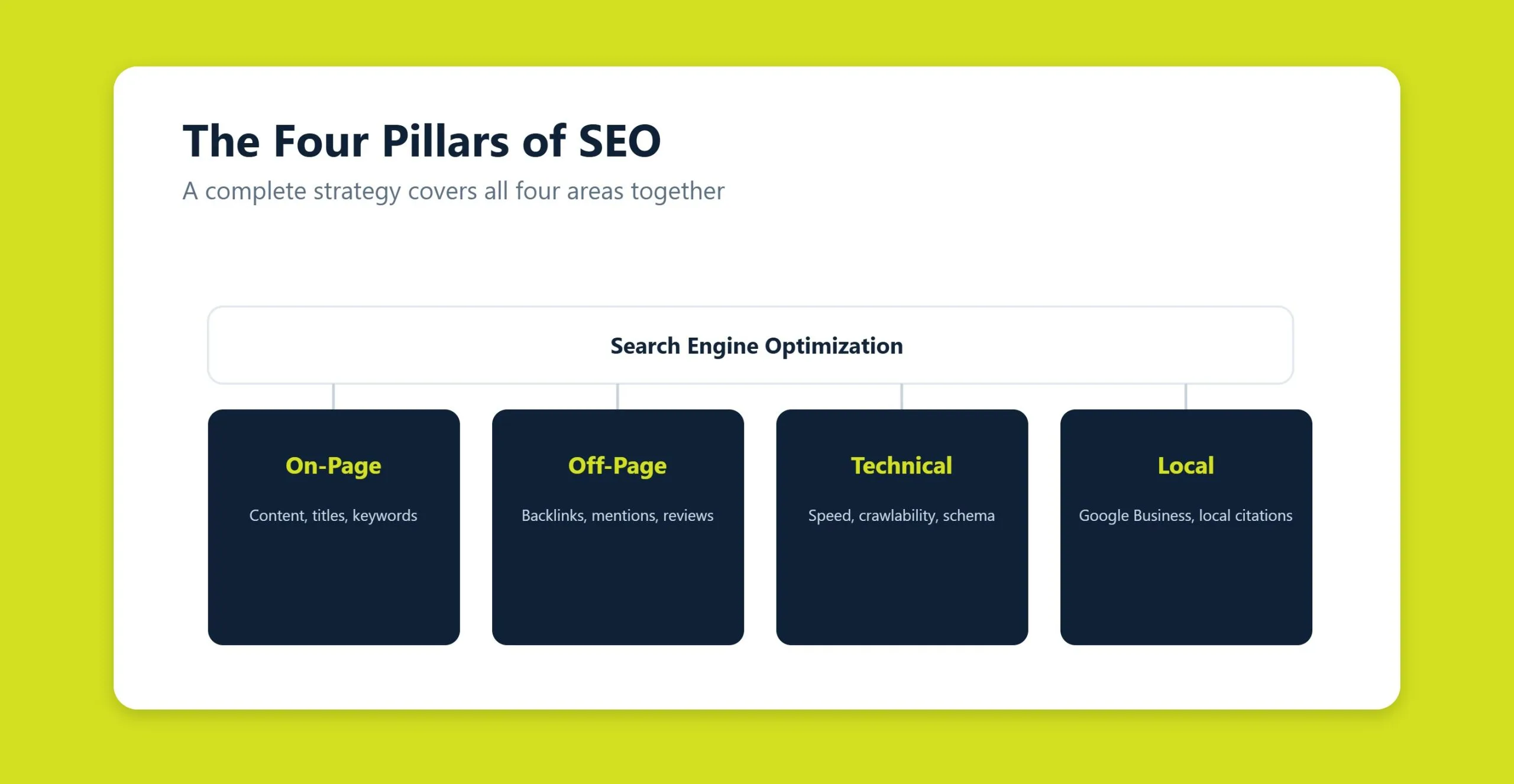
SEO work divides into four connected disciplines. Strong results usually require attention to all of them.
On-page SEO
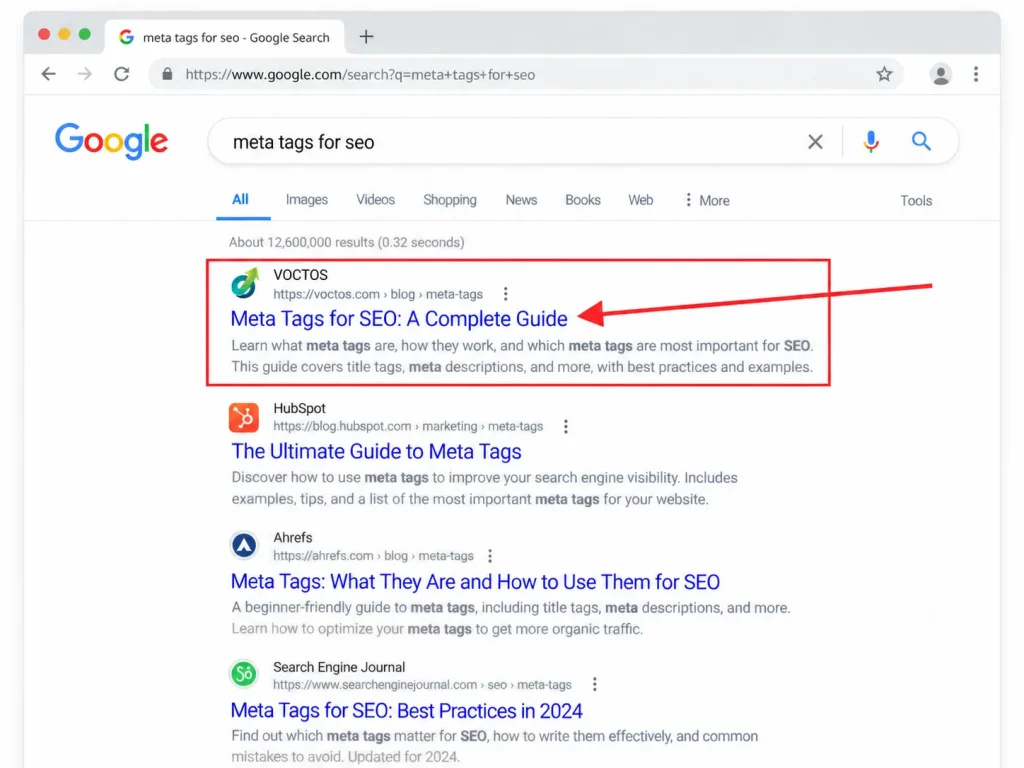
On-page SEO covers everything you optimize within a page itself: the content, title tags, meta descriptions, headings, internal links, images, and how well the page matches search intent. The core principle is relevance. The more precisely and thoroughly a page answers the query behind a keyword, the higher it deserves to rank. Good on-page work also means covering the full topic, addressing related questions a reader might have next, not just the single phrase you are targeting.
Off-page SEO
Off-page SEO is about building your site’s authority and reputation across the wider web. The best-known signal is backlinks, links from other reputable sites that act like votes of confidence. In Google’s systems, high-quality links from relevant, trusted sources remain a meaningful ranking factor. The emphasis is firmly on quality over quantity: a handful of genuine, editorially earned links outweighs thousands of spammy ones, which can actively harm you.
Technical SEO
Technical SEO makes sure search engines can crawl, render, and index your site efficiently, and that users get a fast, stable experience. It includes site speed, mobile responsiveness, secure HTTPS, clean URL structure, structured data, canonical tags, and fixing crawl errors. Even excellent content can underperform if technical barriers get in the way. A thorough SEO audit is usually the first step to finding and prioritizing these issues.
Local SEO
Local SEO helps businesses appear for location-based searches, such as “near me” queries and searches with a city or region attached. It focuses on your Google Business Profile, consistent name-address-phone information, local listings, and reviews. For any business that serves a specific area, from clinics to contractors, local SEO is often the fastest route to qualified traffic and foot traffic.
The SEO process step by step
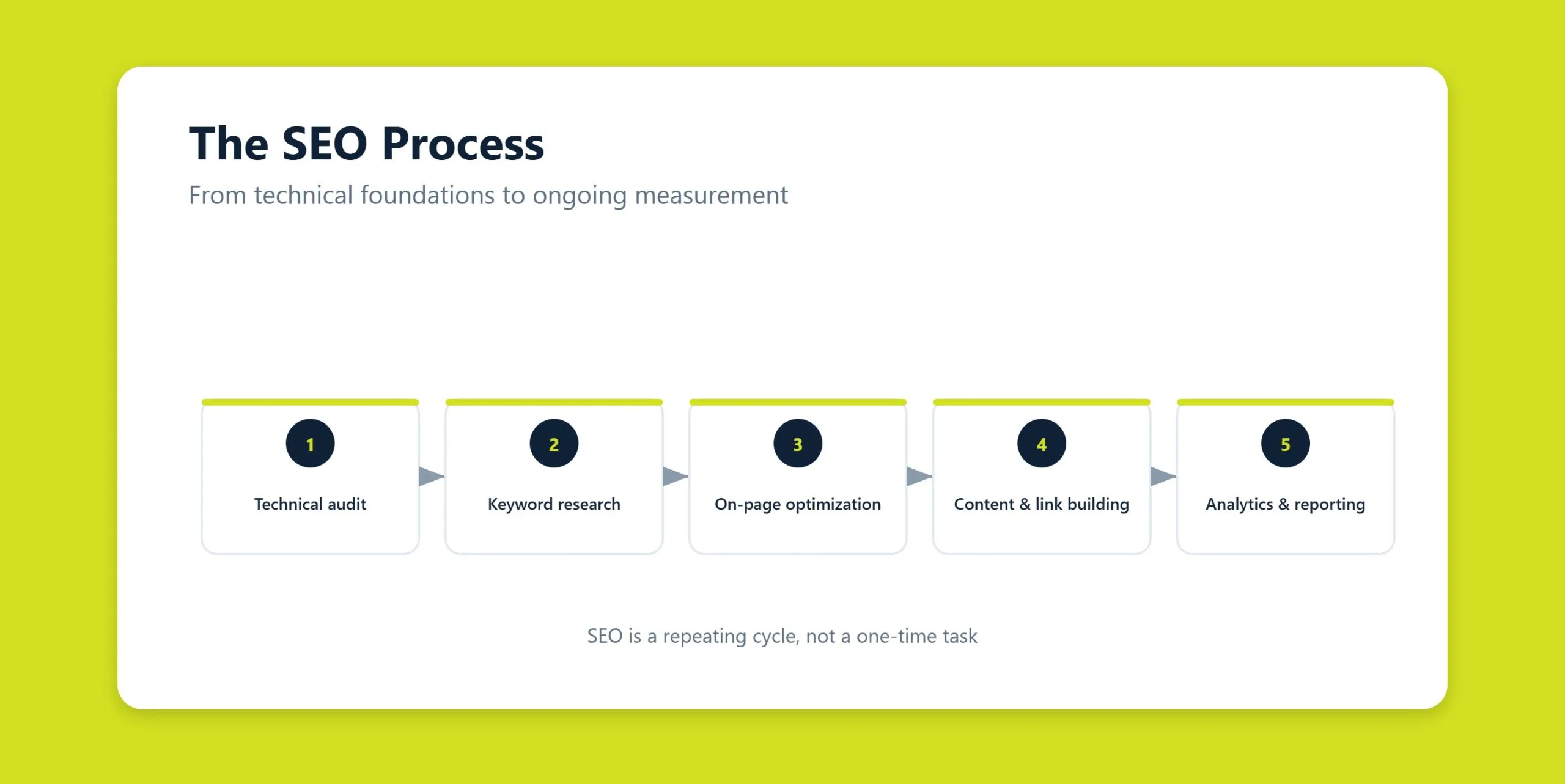
A professional SEO campaign follows a logical sequence rather than a scattering of one-off fixes. The stages below reflect how experienced teams approach it.
- Technical audit and crawling. Remove obstacles that slow or block search crawlers, fix indexing problems, and make sure the site can be fully discovered and rendered.
- Keyword and demand research. Map the real queries your audience uses, then plan pages that match that demand. A clear, logical structure lets both users and crawlers reach every important page.
- Site architecture and internal linking. Build a sensible hierarchy, create an XML sitemap, and connect pages with internal links so authority and relevance flow through the site.
- On-page optimization. Optimize each page for its target queries with strong, complete content, precise titles and headings, and clear intent matching. The guiding rule is an exact, useful answer to the user’s question.
- Authority building. Grow the site’s reputation gradually with high-quality, relevant links and brand mentions, avoiding artificial schemes.
- Analytics and refinement. Track rankings, traffic, conversions, and user behavior, then adjust. Usability improvements and content updates keep the site competitive as algorithms change.
Because SEO touches design, content, code, and outreach at once, it rewards a coordinated approach. A comprehensive SEO program brings these workstreams together instead of treating them in isolation, and pairing it with content marketing compounds the results over time.
How long does SEO take?
SEO is a long-term investment, not an overnight fix. Timelines vary with competition, the size of the site, and the amount of work required, but a realistic pattern looks like this:
- Weeks 1 to 8: analysis and planning. Demand research, keyword selection, competitor analysis, and conversion tracking setup lay the groundwork.
- Months 1 to 4: optimization. Audits, content production, structural improvements, and on-page work are implemented. For very large sites with tens or hundreds of thousands of pages, this phase can run longer, and the first results start to appear.
- Months 3 to 10: authority building. Off-page work runs in parallel, steadily increasing the site’s standing.
- From month 3 onward: analysis and correction. Once search engines respond to the changes, performance is measured and refined. Significant results typically need at least six months.
The payoff for patience is momentum. Unlike paid channels, the gains from SEO tend to build on themselves, and traffic often keeps growing while the cost per visit falls.
SEO versus paid search
SEO and paid search advertising (PPC) both aim to put your business in front of searchers, but they work very differently and are often confused. Paid ads appear at the top of results with a label marking them as advertising, and you pay for each click through an auction, so the more competitive the term, the higher the cost per click. SEO earns placement in the organic results below the ads, and you do not pay per click.
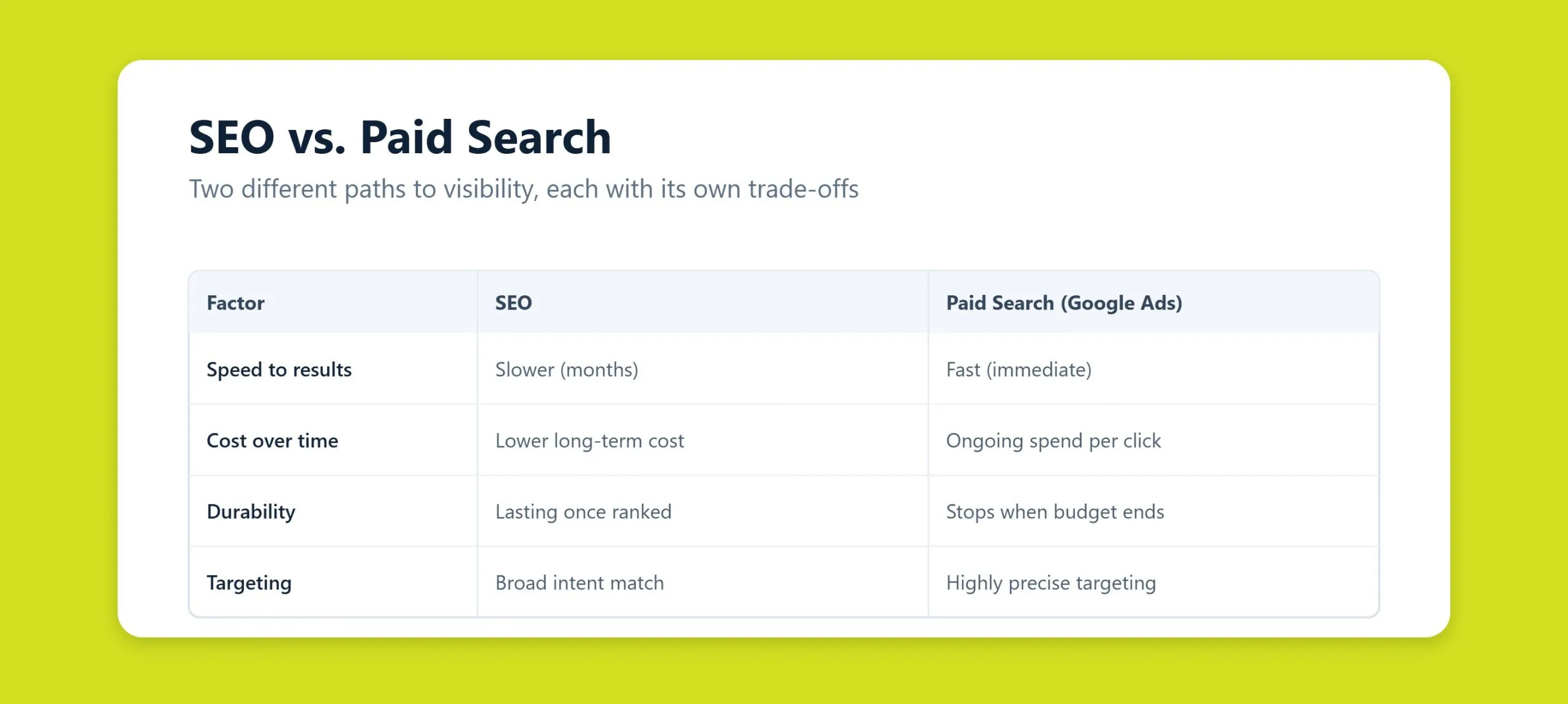
Each has clear trade-offs:
- Speed: Paid campaigns can launch in days and generate traffic immediately. SEO takes months to build.
- Cost over time: Paid traffic stays pay-per-click for as long as you run it. SEO requires investment up front, but the effective cost per visitor usually drops as organic traffic grows, often delivering stronger long-term ROI.
- Durability: Ads stop the instant your budget runs out. Organic rankings keep working for you around the clock.
- Targeting: Both let you focus on specific keywords, but SEO ties your visibility to the terms most naturally aligned with your business.
The two are complementary rather than mutually exclusive. Many businesses use paid search to capture demand immediately while SEO builds a durable, lower-cost foundation underneath it.
A modern note: GEO, AEO, and AI search
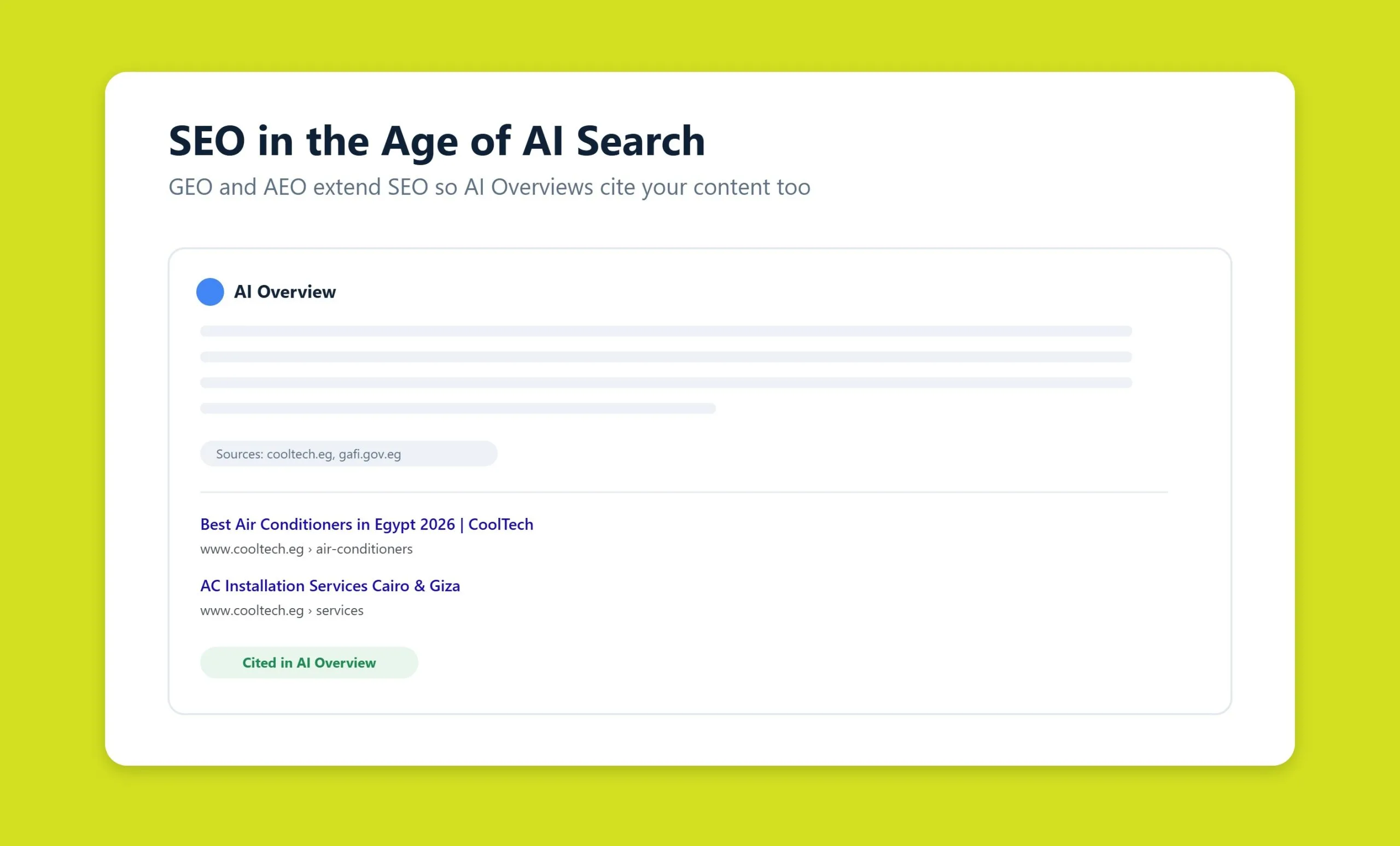
Search itself is changing. Google now shows AI Overviews, generated summaries that sit above the traditional links, on a large and growing share of queries, by many estimates somewhere in the range of half of all searches. At the same time, people increasingly ask questions directly to AI assistants like ChatGPT, Gemini, and Perplexity. That shift has given rise to two related disciplines.
GEO (generative engine optimization) focuses on making your content visible and citable inside AI-generated answers. AEO (answer engine optimization) focuses on structuring content so it can be pulled directly into answer boxes and voice results. The encouraging news is that the fundamentals overlap heavily with good SEO: clear, authoritative, well-structured content that genuinely answers questions is exactly what both classic search and AI systems favor. In practice, strong SEO now feeds AI answers too, so the work you do to rank also increases your chances of being quoted by an AI assistant. To go deeper, see our approach to GEO (AI SEO) and AEO.
What SEO looks like in Arabic-speaking markets
The mechanics above are the same everywhere. Three things differ enough in the Middle East, the Gulf and Egypt that a beginner following only English-language advice will make predictable mistakes.
Competition is thinner in Arabic
For the same commercial intent, Arabic results usually contain far fewer well-optimized pages than English ones. Many are auto-translated, thin, or abandoned. That means a genuinely well-written Arabic page can rank for terms that would be out of reach in English on the same domain, with the same authority and the same budget. It is the single largest structural advantage available to a business publishing here.
The same word is typed several ways
Arabic has spelling variants that people use inconsistently, so keyword tools often split one term into several entries with a fraction of the volume each. If you plan around a single spelling, you will underestimate demand and target the wrong page. Group the variants before deciding what to build, and do not create a separate page for each one.
Decide the language structure before you publish
| Decision | Why it is hard to change later |
|---|---|
| Arabic and English in one site, or two separate sites | Splitting later divides your authority. Merging later means migrating every URL |
| Arabic script or transliterated Latin characters in URLs | Changing the policy turns every existing URL into a redirect |
| Which language leads | Trying to launch both at full strength usually means neither reaches depth |
If you are starting out and have to choose, start with the language your buyers actually search in, not the one your marketing material happens to be written in. Those are frequently not the same, particularly for businesses in Dubai and Riyadh selling to a mixed local and expatriate audience.
Frequently asked questions
What is SEO in simple terms?
SEO is the process of improving a website so it ranks higher in the free, organic results of search engines. It means making your pages genuinely useful to people and easy for search engines to crawl, understand, and trust, so the right audience finds you without paying for each click.
How long does SEO take to show results?
Most sites see meaningful movement within three to six months, with results compounding after that. The exact timeline depends on competition, the size of your site, and how much technical and content work is needed. SEO is a long-term investment that keeps paying off as your authority grows.
Is SEO better than paid advertising?
They serve different needs. Paid ads deliver traffic immediately but stop the moment you stop paying, while SEO takes longer to build but tends to deliver a lower cost per visit and lasting visibility. Many businesses combine both: ads for quick reach and SEO for durable, compounding growth.
Does SEO still matter with AI Overviews and chatbots?
Yes, and arguably more than ever. AI Overviews and AI assistants draw heavily on the same well-structured, trustworthy content that ranks well organically. Strong SEO now also increases your chances of being cited in AI answers, which is where GEO and AEO come in.
Can I do SEO myself or should I hire specialists?
You can learn and apply the basics yourself, especially on-page content and technical hygiene. But competitive markets reward experience, up-to-date knowledge of algorithm changes, and coordinated work across content, code, and outreach. For serious growth, working with a specialist team usually delivers faster, more reliable results.
Related guides
Don't miss the chance to
make your website more visible!
Initial consultation and
audit of the current situation

Read also

Article Behavioral Factors in SEO: What They Are and How to Improve Them
Article JavaScript Links Are Hiding MENA Sites From ChatGPT and Claude

Article VOCTOS Is a Top SEO, PPC and SEM Company in Egypt on Clutch for 2026
Article Commercial Ranking Factors: The Complete List

Article The Title Meta Tag: What It Is and How to Write It
Article The Role of Meta Tags in Search Engine Optimization
Article Can You Sue an AI for Defamation? Where the Law Stands

Article Cloudflare’s 15 September AI Crawler Defaults: The Check Gulf and Egypt Brands Should Run Today




Real Results
More Wins
SEO & GEO for Delta Medical Labs
 GEO
GEO
1M+ monthly organic visits, 159,200 ranked keywords, 5,570 pages cited by AI engines, and 1,186 #1 rankings in KSA.

Arabic SEO, GEO & guest posting for VPNly
 SEO
SEO
65K peak monthly organic visits, 55 guest posts, and 149 pages cited by AI engines.

SEO & GEO for Ogaei Virtual Care
GEO
From 3 to 7,931 monthly organic clicks in 7 months, 2.9M+ impressions, and 40+ keywords in Google’s Top 10.

SEO for Eduverse
SEO
12× search traffic in 10 months, 45% of target keywords in the top 5, and 55% in the top 10.
Trusted by