
The Role of SEO in Digital Marketing
Key takeaways
- SEO is a long-term marketing asset, not a rented channel. Rankings you earn can hold their position for months or years with steady maintenance.
- Organic traffic is the highest-intent traffic you can attract, because users are actively searching for what you sell.
- Over time, SEO usually delivers a lower cost-per-acquisition than paid channels, improving overall marketing ROI.
- SEO amplifies every other channel: content marketing, Google Ads, and social media all perform better on an optimized foundation.
- In 2026, Google still handles roughly 90% of global search, and AI Overviews appear on an estimated 48-60% of queries, so visibility now spans classic listings and AI answers alike.
- Strong user experience, fast pages, and helpful content are inseparable from ranking well and converting visitors.
What SEO means in digital marketing and why businesses need it
SEO is a coordinated set of actions that helps search engines like Google better understand your website and rank it prominently for relevant queries. Put simply, imagine the internet as an enormous library holding billions of books. The search engine is the librarian. Your job as a site owner is to make sure that librarian understands what your “book” is about, judges it genuinely useful, and places it on the most visible shelf whenever someone asks for material on that topic.
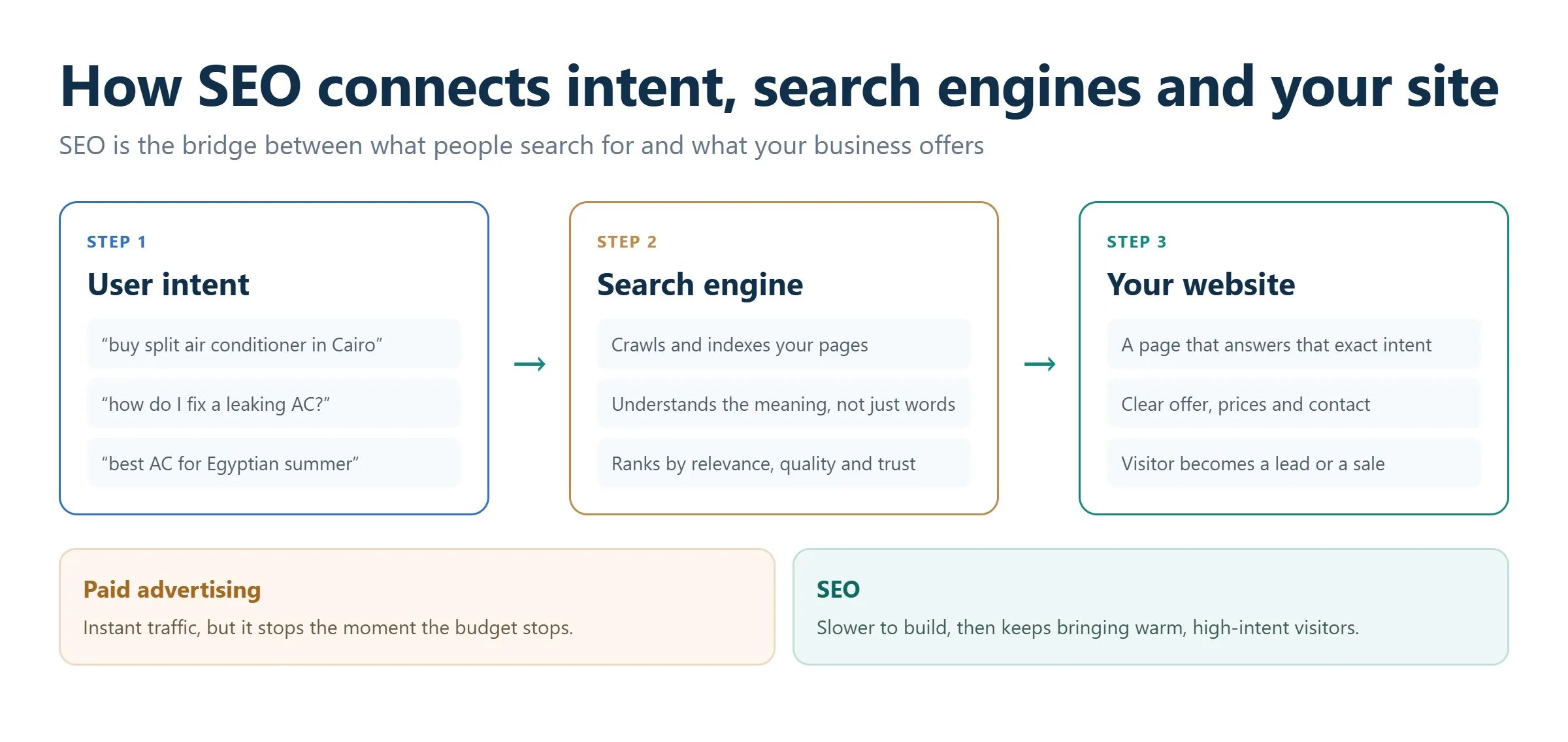
In a digital marketing context, SEO is the process that links user intent, whether that is “I want to buy” or “I am looking for a solution to a problem,” with a business’s offer. This is where it differs from paid advertising. Paid ads deliver an instant but short-lived effect: the moment you stop funding them, the traffic disappears. SEO works for the long haul, building a stable flow of organic visitors that keeps arriving after the initial investment. If you want a structured way to build that foundation, professional SEO services turn scattered tactics into a repeatable system.
The role of SEO in growing a business
The goal of SEO is not only to lift a site’s ranking. It also shapes buyer trust, improves reputation, and creates the systemic groundwork that the rest of your marketing stands on.
Building trust and reputation
Many people subconsciously treat sites in the top of the results as reliable, vetted, and trustworthy. Appearing on the first page is a kind of quality signal in the eyes of consumers. Google rewards sites that publish helpful, expert content and that respect the visitor’s comfort with clear navigation and mobile-friendly design. When your brand shows up in both the paid block and the organic results at once, it reinforces the impression that you are a leader in your field and reduces the doubts a buyer feels while choosing.
Creating a long-term asset
If paid search is like renting, where the traffic vanishes the moment you stop paying, SEO is more like building your own house. It is a long-term investment that begins to pay dividends over time without the constant, often substantial spend that advertising demands. Running SEO and paid campaigns together, so a company is visible across several touchpoints simultaneously, proves market leadership and minimizes buyer hesitation. A regular SEO audit keeps that asset healthy by catching technical issues before they erode your rankings.
Lowering customer acquisition cost
Unlike paid search, where every click carries a price, organic traffic is far more economical to sustain. Earning it requires creating genuinely useful content, optimizing the site, and improving usability. But once a page reaches the top of the results, it draws visitors without a fee attached to each click. From that point forward, the ranking needs maintenance rather than constant heavy spending, which is why SEO typically produces a lower cost-per-acquisition than paid channels over the long run.
What SEO is designed to achieve in digital marketing
SEO solves a set of concrete objectives that translate directly into business outcomes.
Growing organic traffic
This is the primary and most obvious objective. A user typing “buy winter down jacket” or “order a website build” is signaling clear commercial intent. By optimizing for those key queries, a company draws in an audience that is already interested in its product or service. Organic traffic is considered the “warmest,” with the highest conversion potential, because users are actively searching for a solution to their own problem.
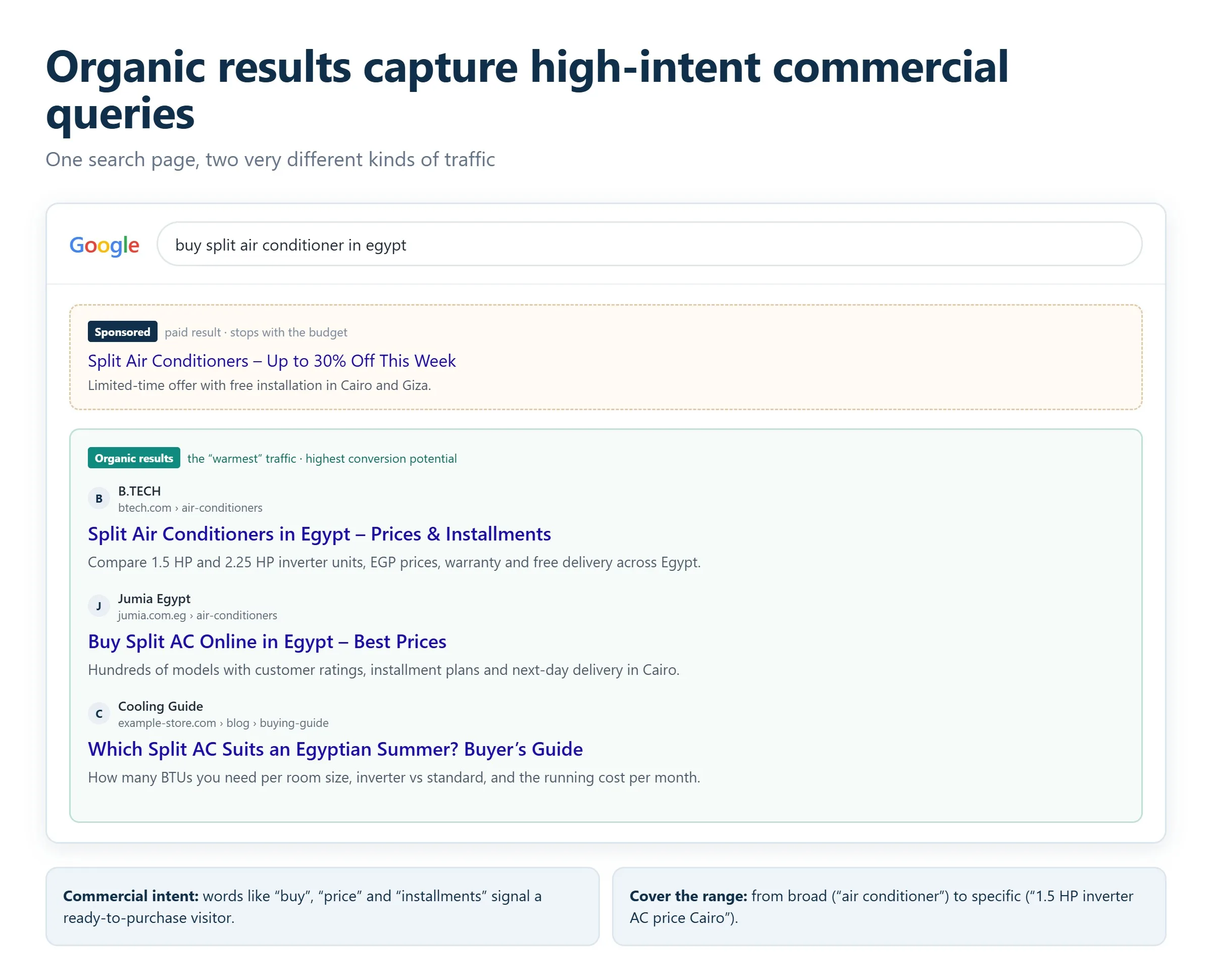
A well-developed keyword map, or semantic core, lets you cover every variation of your buyers’ queries, from broad terms like “smartphone” to highly specific ones like “best smartphone for photography 2026.” Mapping that full spectrum is where strong content marketing and SEO meet.
Increasing brand visibility
Visibility in search is about more than click counts. It is a constant presence in your target audience’s field of view. Even if a user does not click, they have seen your company name, and that is another coin in the jar of brand recognition. The effect compounds when a brand holds several positions at the top, for example in both ads and organic listings. Many people also instinctively trust organic results more than paid ads, viewing them as the search engine’s more objective recommendation.
Attracting a qualified audience
Unlike some channels, SEO lets you reach an audience whose demand has already formed. Someone searching “buy reverse osmosis water filter” is sitting at a lower stage of the sales funnel, close to a decision. SEO’s task is to guide them to the right page, with detailed product information, a clear range of options, and a convenient path to purchase.
How SEO connects with other channels
SEO does not exist in a vacuum. It acts as the framework that strengthens every other marketing tool.
Within content marketing, SEO defines the topics for articles and blog posts based on the real queries users type. Without optimization, even the most brilliant content can go unnoticed. When it comes to PPC and Google Ads, optimized landing pages improve Quality Score inside the ad platform, which can lower your effective cost per click. And social media cannot be left out: activity there generates direct traffic through post links and influences behavioral signals, while likes, shares, and comments expand reach and recognition. A coordinated SMM program feeds that loop and keeps your brand in circulation.
SEO and the rise of AI search
Search itself is changing. With AI Overviews now surfacing on an estimated 48-60% of queries in 2026, being cited inside AI-generated answers has become a distinct visibility layer alongside classic blue links. The fundamentals still apply, helpful content, clear structure, and technical soundness, but optimizing for how AI systems read and quote your pages, often called GEO or AI SEO, is now part of a complete search strategy.
The business advantages of SEO
If we distill it to the fundamentals, a few advantages stand out.
- Long-term results. The effect of SEO accumulates. Once it has earned high positions, a site can hold them for a long time, provided the content and technical foundations are kept current. Advertising, by contrast, stops working the instant you stop paying for it.
- High return on investment. Despite a higher upfront commitment, over the long term the cost of acquiring a customer from organic search is significantly lower than from paid channels.
- Better user experience. Page speed, mobile adaptation, and convenient navigation are exactly what keep a user on your site longer. UX shapes rankings indirectly: Google has said bounce rate and time on page are not ranking signals, but a clear architecture, fast pages and satisfied visitors are what the ranking systems reward. Poor UX can undo all your traffic-generation efforts.
- Data for smarter decisions. SEO supplies a large body of data through tools like Google Search Console and GA4, from engagement signals to conversions, that helps a business make better decisions.
Conclusion: why SEO remains essential to digital marketing
Ultimately, the role of SEO comes down to one simple task: connecting a user with the obvious solution to their problem at the precise moment they are searching for it.
As long as people use search engines to find products and services, SEO will remain a critically important channel for companies. It is not a quick sprint but a marathon that rewards patience and consistent, systematic work. The payoff for finishing that marathon is a steady stream of customers, a recognizable brand, and a reliable digital asset. Is it worth the effort? That is your call. But one thing is certain: ignoring SEO today means voluntarily surrendering a meaningful share of the market and capping your own growth.
Frequently asked questions
What is the role of SEO in digital marketing?
SEO connects a user’s search intent with a business’s offer at the moment of demand. It builds a stable stream of organic traffic, strengthens brand trust, and provides the technical and content foundation that makes content marketing, Google Ads, and social media all perform better.
How is SEO different from paid advertising?
Paid advertising delivers instant but short-lived traffic that stops the moment you stop paying. SEO is a long-term investment: rankings you earn can hold for months or years with maintenance, and over time it typically produces a lower cost-per-acquisition than paid channels.
How long does SEO take to show results?
SEO is a marathon rather than a sprint, and meaningful results usually build over several months as pages gain authority and climb the rankings. The effect compounds, so once positions are earned they tend to remain stable with minimal upkeep, unlike paid traffic that disappears immediately.
Does SEO still matter with AI search and AI Overviews?
Yes. In 2026 Google still handles roughly 90% of global search, and AI Overviews appear on an estimated 48-60% of queries. Helpful, well-structured, technically sound content is what earns both classic rankings and citations inside AI answers, making SEO more relevant, not less.
How does SEO lower customer acquisition cost?
Paid search charges for every click, while organic traffic keeps arriving after a page reaches the top of the results without a per-click fee. Once earned, that ranking needs maintenance rather than constant heavy spend, which lowers the average cost of acquiring each customer over time.
Related guides
Don't miss the chance to
make your website more visible!
Initial consultation and
audit of the current situation

Read also

Article Behavioral Factors in SEO: What They Are and How to Improve Them
Article JavaScript Links Are Hiding MENA Sites From ChatGPT and Claude

Article VOCTOS Is a Top SEO, PPC and SEM Company in Egypt on Clutch for 2026
Article Commercial Ranking Factors: The Complete List

Article The Title Meta Tag: What It Is and How to Write It
Article The Role of Meta Tags in Search Engine Optimization
Article Can You Sue an AI for Defamation? Where the Law Stands

Article Cloudflare’s 15 September AI Crawler Defaults: The Check Gulf and Egypt Brands Should Run Today





Real Results
More Wins
SEO & GEO for Delta Medical Labs
 GEO
GEO
1M+ monthly organic visits, 159,200 ranked keywords, 5,570 pages cited by AI engines, and 1,186 #1 rankings in KSA.

Arabic SEO, GEO & guest posting for VPNly
 SEO
SEO
65K peak monthly organic visits, 55 guest posts, and 149 pages cited by AI engines.

SEO & GEO for Ogaei Virtual Care
GEO
From 3 to 7,931 monthly organic clicks in 7 months, 2.9M+ impressions, and 40+ keywords in Google’s Top 10.

SEO for Eduverse
SEO
12× search traffic in 10 months, 45% of target keywords in the top 5, and 55% in the top 10.
Trusted by