
The Four GEO Layers Most Agencies Skip

Digital PR, schema markup and a dashboard are necessary but not sufficient. In Semrush’s AI Visibility measurement for July 2026, our client Delta Medical Labs scored 18 in the Saudi market against 14 for its two closest rivals and 0 for a third. Only a government body scored higher, at 22. That gap came from four layers underneath the three pillars.
We launched our GEO practice in 2023 and now run it for clients across 22 countries. This piece explains each one and how we execute it.
It also marks the line between a technique and a manipulation that gets your brand removed from the platforms it depends on.
Why do digital PR, schema and dashboards stop working on their own?
Because all three manage what you say about yourself. That is the whole problem.
Schema explains your page to a parser, digital PR earns a mention in publications, and a dashboard reports the outcome after the fact. If the distinction between SEO, GEO, AEO and AIO is still fuzzy, start there. None of them reaches the source a model builds its opinion from. None reshapes a sentence so an engine can lift it. None corrects a false claim a model has started repeating to every person who asks.
The context makes that expensive. We see the bill on every account we audit.
SparkToro and Similarweb put 68% of US Google searches ending without a click across the first four months of 2026, up from 60% in 2024. In G2’s March 2026 survey of 1,076 B2B software buyers, 51% now open their research with an AI chatbot rather than a search engine. Pew Research found that when an AI summary appears, people click a traditional result on 8% of visits instead of 15%.
You are no longer competing for a click. You are competing for a sentence inside somebody else’s answer.
Layer 1: where do AI models actually read about you?
Models do not read your site and the news alone. Not close.
They ingest open discussion platforms, code repositories and public databases at scale: Reddit, Quora, GitHub, Wikipedia, Stack Overflow, G2 and Trustpilot. That matters more here than in the US. Deloitte surveyed 2,000 consumers aged 18 to 50 in the UAE and Saudi Arabia and found 58% already using generative AI tools, ahead of the UK and most of Europe. Those platforms are pulled live during retrieval, which makes them the layer deciding whether your name reads as consensus or as a claim you made about yourself.
The practical consequence is uncomfortable for most marketing teams, and we deliver it early.
A mention inside a real Reddit thread outweighs the best page you will ever publish about why you are the right choice. So does a verified G2 review from an actual customer, or a clean Wikidata entry.
Engines separate what you say from what others say. This layer only moves the second category, which is why we treat it as owned media’s opposite, and why our GEO program budgets for it separately.
We start by building a source map: the platforms engines actually return to when answering questions in the client’s category, derived from engine behavior rather than from a generic list of big sites. It almost always contains platforms the client had never tracked.
Four workstreams then run in parallel. A named specialist from our team, or from the client’s, contributes genuinely useful answers where the problem gets discussed. We run a structured program that asks real customers for reviews. We clean the entity data across Wikidata and industry directories.
And we publish assets worth citing, such as original data or a free tool.
Where the line sits. There is another version of this layer that plants discussions and manufactures reviews, and we neither run it nor recommend it. Fabricated reviews breach the terms of G2, Trustpilot and Reddit, get removed on detection, and fall under the FTC rule on fake consumer reviews. The capability worth paying for is knowing which sources matter, not a willingness to pollute them.
Layer 2: what makes a sentence quotable by an AI engine?
Generative engines prefer a specific kind of sentence: direct, unambiguous, carrying a figure with a timeframe, written in a neutral register. Promotional prose gets skipped because there is nothing in it to extract.
Two pages can hold the same fact and only one gets cited, and the difference is sentence shape rather than page authority.
The working rule is simple. Every H2 opens with a self-contained answer of 40 to 60 words that survives being quoted with no surrounding context.
Numbers arrive early and always carry three things: a timeframe, the scope of the sample, and a comparison point. A bare “400% growth” gives an engine nothing to verify, so it gets ignored.
The second half of this layer is entity density, and we score it before we rewrite anything.
A model decides you are a specialist when your pages connect the right entities in your field: the tools, the standards, the sub-concepts, in the vocabulary the industry actually uses. A page naming Search Console, GA4, Schema.org and Core Web Vitals in correct context reads as a specialist source. A page offering integrated solutions and years of experience reads as nothing at all.
Arabic adds a difficulty most tooling ignores, and we hit it on every Arabic-language account we run.
Machine translation from English produces grammatical sentences that miss how people phrase questions in Cairo or Riyadh, a problem we cover in detail in Arabic GEO. We write the Arabic layer in Arabic, then check it against real queries rather than translated ones.
Layer 3: why do keyword pages lose to prompt pages?
On Google a user types “best accounting software”. Four words.
In ChatGPT the same user writes a paragraph: an ecommerce startup in Dubai, limited budget, needs Shopify integration and VAT support. That prompt carries five constraints, and the model filters on all five before it names anyone.
A page built around one keyword loses that filter because it answers part of the question. A page built around the prompt wins because it states the constraints outright: the sector, the market, the budget band, the integrations, the tax compliance.
| Traditional Google query | Prompt inside an AI engine | |
|---|---|---|
| Length | 2 to 4 words | 25 to 60 words |
| Constraints | one, implied | three to six, explicit |
| What the user wants | a list of links to filter | one or two recommendations with a reason |
| What wins | highest authority on the keyword | the page matching most constraints |
| Content shape that fits | comprehensive guide | conditional answer, comparison table, selection criteria |
We build these pages from a list of real prompts rather than imagined ones. We collect the questions clients are actually asked on calls, in forms and in chat, then run each one against four engines to see who appears today and which sources the answer was assembled from.
The output is not a keyword list ranked by monthly volume. It is a question list ranked by who currently owns the answer. That list is also what our AEO work is built from.
A keyword tells you how many people ask. A prompt tells you what the asker is weighing before they decide.
Layer 4: how do you correct something a model gets wrong about you?
You trace the source and update it. Nothing else works.
A model may state a false fact about your company, or recommend a competitor from data that is years old. That is not a ranking problem and it is not a sentiment problem.
It is a wrong sentence the engine will repeat to everyone who asks, and no visibility chart will ever surface it.
Execution starts with us asking each engine hundreds of varied questions about the brand and the category on a fixed cadence, and storing every answer verbatim. We built this into the VOCTOS Client Portal as a module called Brand Health, and the portal reports four engines separately: ChatGPT, Claude, Gemini and Perplexity.
Once a month the portal puts five direct questions to every connected engine: who you are, what you offer, where you are, who you serve, what you are known for. A human then marks each answer correct or wrong and writes the correction underneath it.
In one run an engine reported that a medical laboratory had branches in Alexandria. It does not. All 14 sit in Cairo and Giza.
The answer was well ranked, positive in tone and wrong at the same time, which is exactly the combination a dashboard cannot catch.
After detection comes the reverse trace, and this is the part clients rarely expect us to do by hand.
We find the source carrying the stale fact, which is usually an old directory, a press piece, or a page on the client’s own site nobody updated. We correct or remove it, publish the current version on a page the engine already cites, then ask the same question again in the next cycle.
The same module tracks four citation states: new, lost, broken, and cited without you. For the scoring behind those states, see how to measure AI visibility. The last state is the most useful, because an engine already trusts that source and did not name you, which turns the list into a ranked outreach plan.
Brand accuracy is more urgent than rank. An answer that puts you first and describes your service wrongly costs more than an answer leaving you out.
My read on which layer to fund first
This section is my opinion rather than a description of a service. Read it that way.
The four layers do not return equally, and they do not suit every brand at the same time.
Given one budget and a new client, I start with layer four. Every time.
Correcting what models say wrongly is the cheapest work with the fastest effect, and a first audit usually shows the problem is a wrong description rather than absence. Layer two comes next, because reshaping what you already own costs less than producing more of it.
Layer three is third, since it needs new pages at real cost. Layer one goes last, and not because it matters least. It is simply the slowest: earning genuine community mentions and real reviews takes months, and it cannot be rushed without faking it.
One thing gets said too rarely, so I will say it.
None of the four layers moves a brand nobody knows and nobody vouches for, because models reflect an existing consensus rather than inventing one. An agency selling you control over AI answers before you have a real market position is selling something it does not have.
How do you check an agency actually runs these layers?
Ask for evidence rather than a description. The six requests below separate a team running the work from a team renaming an old SEO retainer, and a team that runs them answers with a file or a screen instead of a paragraph.
- The source map. Show me the platforms engines return to in my category, and where that list came from. If it reads Reddit, Quora and Wikipedia, it was written from memory rather than derived.
- The answer log. Show me the engine’s answer to a question about me two months ago, one month ago, and today. Generative engines rewrite continuously, so one screenshot proves nothing.
- The prompt list. Show me the composite questions you track for me, and who appears in each one besides me.
- Citation states. Do you track lost and broken citations, or only the current list? A lost citation is the earliest warning available.
- Detected errors. How many false statements about my brand did the last audit find, and what source produced each one?
- The limits. What can you not measure? A team without an answer here is not measuring.
What these layers have produced
The figures below are published on VOCTOS case study pages, each tied to a named client and a date you can check.
No single layer produced any of them. They are the cumulative effect of running all four alongside conventional SEO, over engagements of nine months or longer.
| Client and sector | Result, with its scope |
|---|---|
| Delta Medical Labs, medical laboratories, Saudi Arabia | Semrush AI Visibility, July 2026: 18 against 14 for its two closest rivals and 0 for a third, with only a government body higher at 22. Over 1M monthly organic visits, 159,200 ranked keywords, around 3,600 citations inside Google AI Overviews and 1,800 inside AI Mode, and 1,186 keywords at position one in Saudi Arabia. Within the 326-keyword sample tracked monthly on google.com.sa, 197 sit at position one and 240 in the top three. |
| Al Hokail, medical group, Saudi Arabia | 27.5K monthly organic visits, 30 keywords at position one, cited on 128 pages across ChatGPT, AI Overviews, AI Mode and Gemini. |
| Ovasave, FemTech, UAE | 140 pages cited by AI engines, with 12,300 backlinks from 252 referring domains, measured in Semrush in July 2026. |
| Eduverse, online school, Egypt | 78,600 estimated monthly organic visits, 8,700 ranked keywords, 171 pages cited by AI engines (65 in Google AI Mode, 59 in AI Overviews, 47 in ChatGPT) and 328 backlinks from 59 referring domains, measured in Semrush in August 2026. |
Here is what those numbers do not say, and we would rather say it than have you find it later.
All four clients operate in markets where Arabic content was thinly represented, and that makes a citation gain faster than in a crowded English category. An agency showing you comparable results in a saturated US market without mentioning that difference is selling you an unfair comparison.
Objections we hear
“We published excellent content for a year and ChatGPT still recommends our competitor”
This is the most common pattern we see, and the cause is usually one of three.
The content is written in a shape no engine can extract. Or the sources the engine trusts in your category never mention you. Or the engine is carrying a stale fact about you. Diagnosis starts by asking the engine your question and reading the sources behind its answer, not by publishing another article.
“Every tool gives me a different visibility score, so which do I believe?”
None of them alone. We do not either, and the tools we have tested disagree with each other often enough to prove the point.
Generative engines return different answers to the same question on different runs, so the honest figure averages repeated samples, attaches a confidence value, and reports each engine separately. A tool showing one blended number with no sampling is hiding the variance rather than measuring it.
“Should we pay someone to write positive reviews about us?”
No, and we turn down the request when it comes up.
Paid or fabricated reviews breach platform terms, get removed on detection, and fall under fake review rules in regulated markets. The alternative works better anyway: ask real customers at the moment they are most satisfied. In our accounts that produces enough volume within two to three months, with none of the exposure.
“How long before I see a difference?”
Correcting a false fact can show within weeks of the source being updated. First new citations typically land between 45 and 90 days. Becoming the default answer for your main queries takes 6 to 12 months, and it moves faster in Arabic markets because the competition is thinner. Nobody can guarantee a date, and anyone who does is guessing.
The more useful question
The question is not how to control AI answers. Nobody controls them.
An agency promising that is describing something it does not own. The more useful question is what models say about you today, in their exact words, and which sources they built that from. Answering those two decides which layer you start with, and it saves you a year of budget.
That leaves two paths, and we will tell you which one you are on before you sign anything.
If you have satisfied customers and a real market position but no presence in AI answers, the problem is most likely wording and sources, and we usually fix that inside a quarter. If you are early, with no reviews and no third-party mentions, build something worth citing first, because GEO spend before that buys noise.
VOCTOS has worked in search since 2017, holds Google Premier Partner status, and sits inside the top three of Clutch’s Egypt SEO rankings as of July 2026 with 5.0 from 8 verified client reviews.
Get my AI visibility audit, or read the full walkthrough of the VOCTOS Client Portal to see how the measurement side works. Arabic readers can find the same framework in the Arabic edition on SEO Stars.
Frequently Asked Questions About Advanced GEO Layers
Why are digital PR, schema markup and dashboards not enough for GEO?
All three manage what a brand says about itself. Schema explains a page to a parser, digital PR earns a mention in publications, and a dashboard reports the outcome after the fact. None reaches the source a model builds its opinion from, none reshapes a sentence so an engine can extract it, and none corrects a false claim a model has started repeating.
Which sources do AI models read about a brand besides its website?
Models ingest open discussion platforms, code repositories and public databases at scale, including Reddit, Quora, GitHub, Wikipedia, Stack Overflow, G2 and Trustpilot. Those platforms are pulled live during retrieval, which is why a mention inside a real Reddit thread or a verified G2 review carries more weight with a model than a brand’s own page.
Is planting fake reviews and discussions an effective GEO tactic?
No, and VOCTOS does not run it. Fabricated reviews breach the terms of G2, Trustpilot and Reddit, get removed on detection, and fall under the FTC rule on fake consumer reviews. The alternative is a structured program asking real customers for reviews, genuine contributions from a named specialist, and entity hygiene across Wikidata and industry directories.
What is the difference between a keyword and a prompt in AI search?
A traditional Google query runs 2 to 4 words and carries one implied constraint. A prompt inside an AI engine runs 25 to 60 words and carries three to six explicit constraints, such as sector, market, budget band, integrations and compliance. The page matching the most constraints wins the recommendation, not the page with the highest keyword authority.
How do you correct a false fact an AI model repeats about your company?
Ask each engine hundreds of varied questions on a fixed cadence and store the answers verbatim, then have a human mark each one correct or wrong. Trace the source carrying the stale fact, which is usually an old directory, a press piece or an unupdated page, correct or remove it, publish the current version on a page the engine already cites, and re-ask the question in the next cycle to verify.
How long does it take to improve visibility inside AI answers?
Correcting a false fact can show within weeks of the source being updated. First new citations typically land between 45 and 90 days. Becoming the default answer for a brand’s main queries takes 6 to 12 months, and moves faster in Arabic markets because competition for citable Arabic content is thinner. No agency can guarantee a date.
How can I tell whether an agency really runs advanced GEO work?
Ask for evidence rather than a description: the source map of platforms engines return to in your category and how it was derived, a stored log of engine answers about you across three time points, the composite prompts tracked for you and who else appears in them, whether lost and broken citations are tracked, how many false statements the last audit found and their sources, and what the agency cannot measure.
Related guides
- 12 Best Generative Engine Optimization (GEO) Agencies in 2026
- 9 Best Answer Engine Optimization (AEO) Agencies in 2026
- The VOCTOS Method: Prompt-Gap Analysis and the Four Pillars of AI Visibility
- 8 Best GEO Agencies for B2B SaaS in 2026, Ranked
What about the paid side? As of 19 August 2026 ChatGPT sells ad placements below its answers in nine countries, and only to Free and Go users. See ChatGPT Ads and the nine-country list and why ChatGPT ads never reach Plus, Pro, Business, Enterprise or Edu subscribers.
Don't miss the chance to
make your website more visible!
Initial consultation and
audit of the current situation

Read also

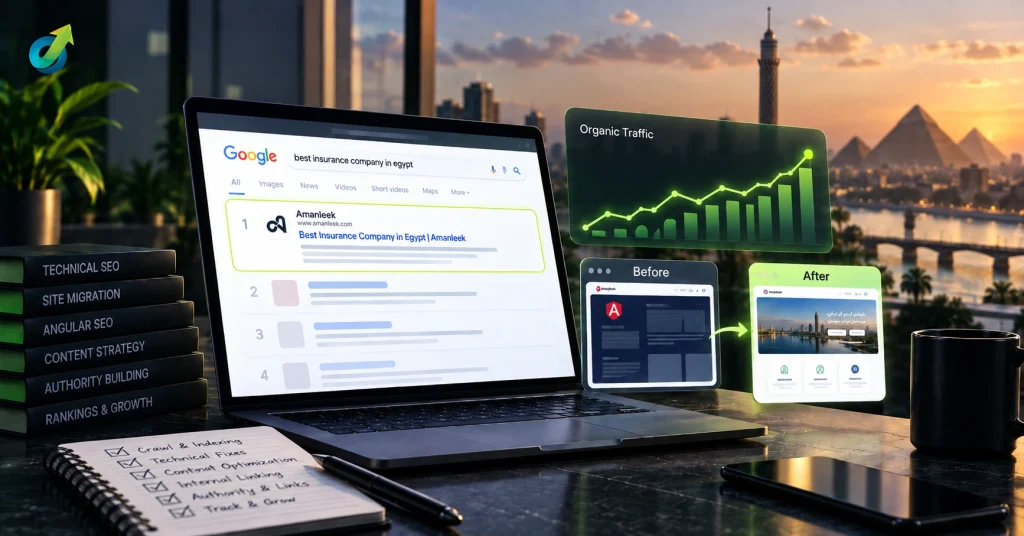
Article Amanleek SEO Case Study: From an Unreadable Angular Site to #1 for “Best Insurance Company” in Egypt
Article AI Search Citations Just Shifted: What It Means for MENA Brands

Article Tag Clouds in SEO: What They Are and How to Use Them
Article What Are Duplicate Pages and Why Are They Dangerous
Article Why AI Still Describes Your Old Brand: Knowledge Cutoffs Explained
Article Behavioral Factors in SEO: What They Are and How to Improve Them
Article JavaScript Links Are Hiding MENA Sites From ChatGPT and Claude

Real Results
More Wins
SEO & GEO for Delta Medical Labs
 GEO
GEO
1M+ monthly organic visits, 159,200 ranked keywords, 5,570 pages cited by AI engines, and 1,186 #1 rankings in KSA.

Arabic SEO, GEO & guest posting for VPNly
 SEO
SEO
65K peak monthly organic visits, 55 guest posts, and 149 pages cited by AI engines.

SEO & GEO for Ogaei Virtual Care
GEO
From 3 to 7,931 monthly organic clicks in 7 months, 2.9M+ impressions, and 40+ keywords in Google’s Top 10.

SEO for Eduverse
SEO
12× search traffic in 10 months, 45% of target keywords in the top 5, and 55% in the top 10.
Trusted by