
Ask Engine Optimization in 2026: What Works, and What Provably Does Not
Search “ask engine optimization” and you will find agency pages telling you to write FAQ pages, add schema markup, optimize for voice search, and keep your answers between forty and sixty words. Almost none of that survives contact with the published evidence, and the top-ranking page for the term does not implement the schema it tells you to implement.
This guide takes the opposite approach. Every claim below is linked to a primary source, including the ones that argue against things we sell. Where the evidence is genuinely uncertain, it says so.
Key takeaways
What an answer engine actually does before it quotes you
Most guides skip the mechanism and go straight to tactics, which is why the tactics are usually wrong. Google has documented the process in its own words.
When you ask a question, the engine does not run one search. It performs query fan-outbreaking your question into subtopics and issuing a multitude of queries simultaneously. Google’s own worked example: “how to fix a lawn that’s full of weeds” becomes “best herbicides for lawns”, “remove weeds without chemicals” and “how to prevent weeds in lawn”. Deep Search can issue hundreds of these.
It then grounds the answer by relying on core Search ranking systems to retrieve relevant, up-to-date pages from the Search index. The gate is simple and worth memorizing: a page must be indexed and eligible to be shown in Google Search with a snippet. If you block snippets, you are not eligible.
| SEO | AEO (Answer Engine Optimization) | GEO (Generative Engine Optimization) | |
|---|---|---|---|
| What it optimizes | A page, to be clicked | A passage, to be quoted as the answer | A brand entity, to be synthesized into a generated response |
| Where the answer appears | On your site, after a click | In the results page itself, featured snippets, People Also Ask, AI Overviews | Inside ChatGPT, Perplexity, Gemini, Copilot |
| Primary success signal | Position and click-through rate | Being the extracted answer | Being mentioned and described accurately, with or without a link |
| Does the user visit you? | Yes, that is the point | Often not | Usually not: about 19% click through to a cited source |
| Is it a separate discipline? | Google’s position: no, it is still SEO | Google’s position: no, it is still SEO. Practitioners disagree on the measurement layer, not the fundamentals | |
| What genuinely differs | Answer placement and structure within the page | Sources off your own site, and engine-specific, non-deterministic measurement |
What the evidence says actually drives citation
The most rigorous experiment published on this ran 252,000 controlled trials across six large language models and eighteen content factors, varying one factor per trial, anonymizing brands and counterbalancing order. Its conclusion: topical relevance and list position are the biggest drivers, explicit price information and a recent timestamp also help, and formatting-only edits have little impact.
That last clause is the one to sit with, because formatting is what most AEO advice consists of.
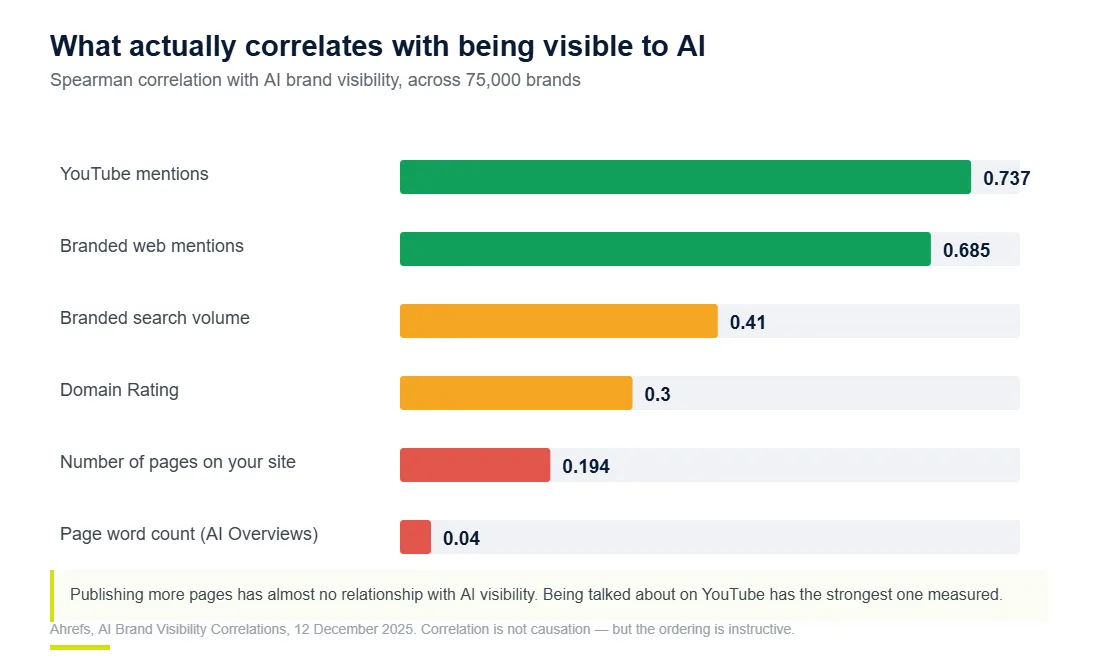
A separate analysis of 75,000 brands found the strongest correlate of AI visibility is YouTube mentions, at a Spearman correlation of 0.737, ahead of branded web mentions (0.66–0.71), branded search volume (0.35–0.47) and Domain Rating (0.27–0.33). The number of pages on your site correlates at 0.194, which the authors describe as almost no relationship.
And on the length question that every FAQ guide answers confidently: Ahrefs analyzed 174,048 pages cited across 560,346 AI Overviews and found the correlation between word count and citation is 0.04, essentially zero. The average cited page runs 1,282 words, but 53.4% of cited pages are under 1,000 words and 16.6% are under 350. More than 95% of citations to very short content land in the top three citation positions.
Three things you have been told to do that the evidence does not support
1. Schema markup
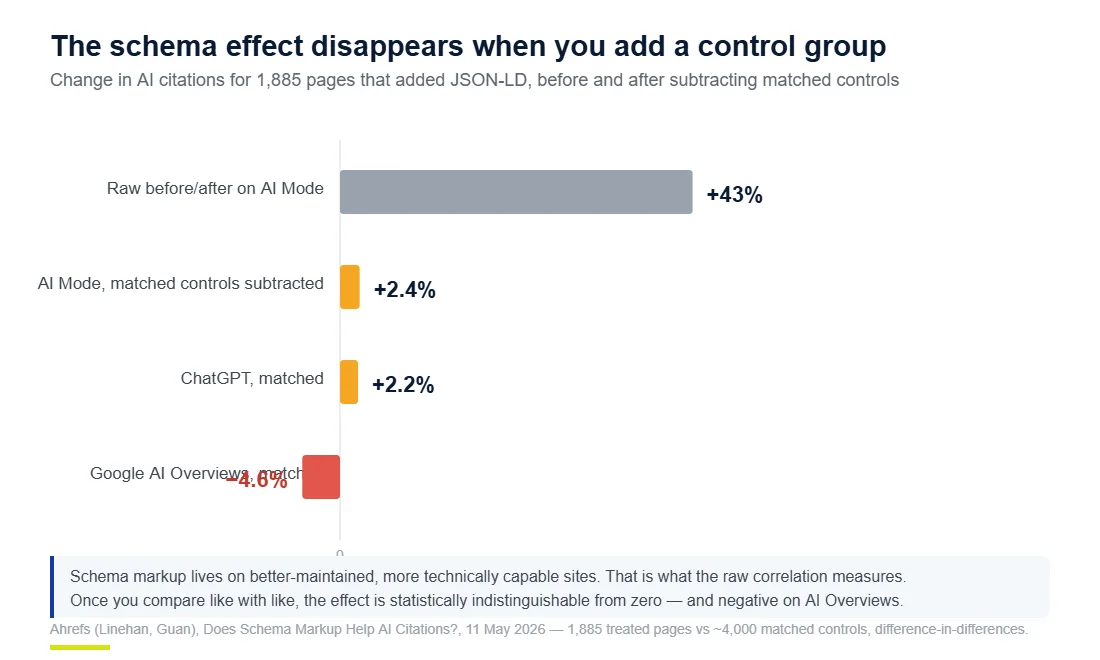
The correlation is real and it is misleading. AI-cited pages are almost three times more likely to carry JSON-LD, and 53% of AI-cited pages run schema. That is the statistic every AEO guide quotes.
Then someone ran the causal test. Ahrefs took 1,885 pages that added JSON-LD between August 2025 and March 2026 and compared them against roughly 4,000 matched controls. Raw before-and-after growth on AI Mode was +43%. After subtracting the controls it was +2.4%, statistically indistinguishable from zero. ChatGPT came in at +2.2%, also indistinguishable. Google AI Overviews came in at −4.6%, and that one was statistically significant.
Their explanation is the important part: schema markup tends to live on better-maintained, more technically sophisticated sites. The correlation was measuring the site, not the markup.
A separate experiment tested whether AI systems can even read it. Researchers exposed a price only in JSON-LD and asked five systems to retrieve it. Zero of five extracted it. Hidden Microdata and hidden RDFa also scored zero of five.
And Google states it plainly: “Structured data isn’t required for generative AI search, and there’s no special schema.org markup you need to add.” It then recommends continuing to use structured data anyway, for rich results, which is a different and still-valuable job.
2. llms.txt
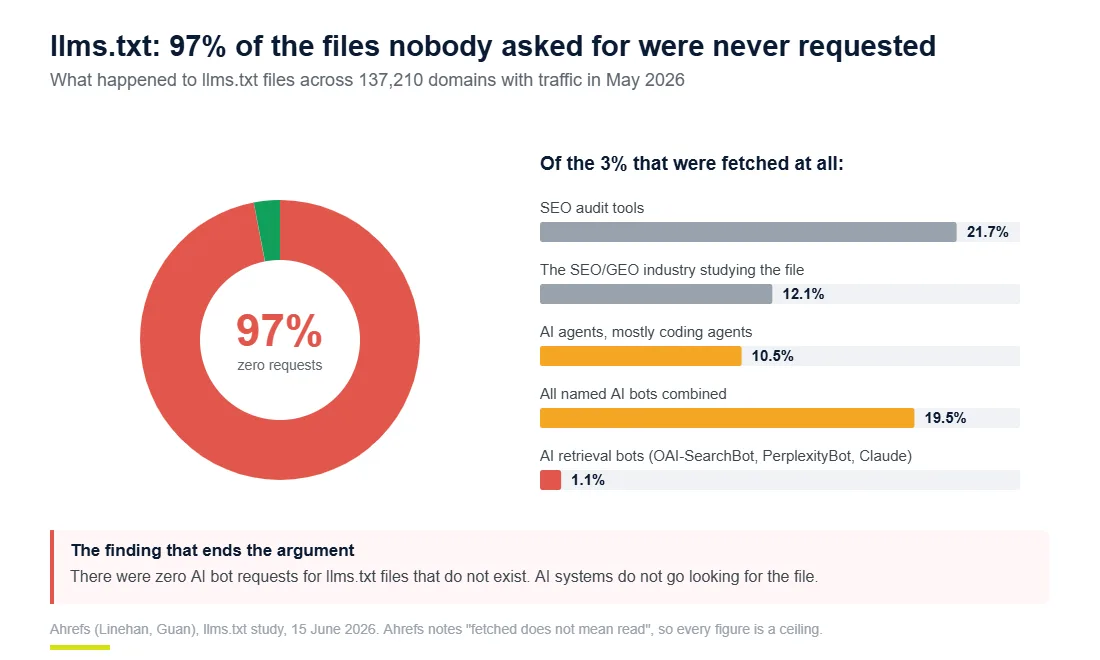
Ahrefs checked 137,210 domains with traffic in May 2026. About 28% published an llms.txt file. 97% of those files received zero requests that month. Of the 3% that got any traffic, 96% was bots and the single largest category was SEO audit tools at 21.7%, followed by the SEO and GEO industry itself studying the file at 12.1%. Actual AI retrieval bots, OAI-SearchBot, PerplexityBot, Claude’s search crawler, accounted for 1.1%.
The finding that ends the debate: there were zero AI bot requests for llms.txt files that do not exist. The 404 probes were 98% human. AI systems do not go hunting for the file; they fetch it when a link, an index or a user instruction tells them it is there. Ahrefs also notes that Slackbot fetched llms.txt files more often than PerplexityBot did.
Google is unambiguous: “Google Search itself doesn’t use them… Google Search ignores them.” No vendor, not OpenAI, not Anthropic, not Perplexity, documents its crawler reading yours, even though several publish one of their own.
3. Voice search optimization
The statistic underneath a decade of voice search advice is misattributed. “Fifty percent of all searches will be voice by 2020” was said by Andrew Ng, then chief scientist at Baidu, in September 2014and what he actually said was “images or speech”, about Baidu, in China. comScore, to whom it is routinely credited, told a researcher in writing that it never published the prediction.
Google’s only official voice figure is Sundar Pichai’s May 2016 statement that 20% of queries on the Google mobile app and Android were voice. It has not been updated in a decade. The modern “20.5% use voice search” figure is a different metric, share of internet users, not of queries, and it peaked at 22.5% in 2022 and has declined since.
The measurement infrastructure has been dismantled. Edison Research’s Infinite Dial 2026 dropped voice assistant usage entirely and replaced it with an AI usage module. In that same study, 57% of Americans aged 12 and over have used a generative AI assistant. Pew found 49% of US adults now use AI chatbots and 42% use them to search for information.
The assistants themselves have been rebuilt as answer engines. Alexa+ runs on Amazon Nova and Anthropic models; Apple’s next-generation Siri goes to the web and generates an answer. Across four official Amazon and Apple announcements, neither company mentions source citations, publisher attribution or clickable links.
What does work, ranked by strength of evidence
| What to do | Why it is on this list | Evidence strength |
|---|---|---|
| Be indexed and snippet-eligible | Google states a page must be indexed and eligible to be shown with a snippet to appear in AI features. This is the entry gate, not an optimization. | PrimaryGoogle documentation |
| Rank well for the topic, not just the query | Citation probability tracks organic rank: 43% at position one, 31% at position three, 7% at position twenty. Ranking is no longer the gate it was, but it is still the strongest lever you control. | Strong362,000 queries, 5.1M citations |
| Get talked about on YouTube and across the web | YouTube mentions correlate with AI visibility at 0.737, branded web mentions at 0.66–0.71, far ahead of anything on your own site. | Correlational, 75,000 brands |
| Publish ranked comparison content | The ranked best-of listicle is the single most-cited content format, at roughly 21–22% of all AI citations, and is cited 2.7 times more often for informational queries. | Two independent datasets agree |
| Put the answer in the first section | 44.2% of AI citations are extracted from a page’s introduction or first section. This is placement, not formatting. | Moderate, 25,000 URLs |
| Add citations, quotations and statistics | The foundational GEO paper measured 30–40% improvements from these. Read the caveat below before you act on it. | Primarybut conditional |
| Keep a visible, honest last-updated date | Recency is one of the factors the 252,000-trial study found does help, and pages with a clear timestamp are reported to receive more citations. | Moderate |
| Improve fluency and readability | The GEO paper measured a 15–30% visibility boost from stylistic clarity alone. | Primary |
There is also a field-level verdict worth knowing before you buy any of this from anyone. A survey of 45 studies published between November 2023 and July 2026 concluded that no reviewed technique shows a stable, longitudinal, cross-platform causal effect on organic discoverability, that the GEO paper’s gains are conditional on a source already being present in a fixed context, and that citation-oriented rewrites can impair retrieval.
The traffic reality, stated honestly
Two things are true at once, and most articles only tell you one of them.
Zero-click search has accelerated. 68.01% of US Google searches ended without a click between January and April 2026, up from 60.45% in 2024. Pew found that when an AI summary appears, 8% of visits produced a click on a traditional result versus 15% without one, and 1% clicked a link inside the summary itself. Click-through rate at position one is down 58% where an AI Overview appears.
But AI referral traffic is still tiny. Semrush measured AI at 0.14% of all web visits across 50,000+ sites in 2025, against organic search at 16.04%. Google AI Mode was 0.01%. SparkToro found AI Mode accounts for 0.34% of searches and noted plainly that if you theorised AI Mode caused the zero-click acceleration, it is not there yet.
Answer engines in the Gulf and Egypt
Everything above is the global picture. Here is what changes when your market is Riyadh, Dubai or Cairo, and this section does not exist in any competing guide on this term.
| Capability | Status in Egypt and the GCC | Source |
|---|---|---|
| AI Overviews | Live in Egypt, Saudi Arabia, the UAE, Qatar, Kuwait, Bahrain and Oman. Arabic is a supported language. | Google Search Help |
| AI Mode | Live across the same markets, with Arabic supported. | Google Search Help |
| Gemini 3 Pro inside AI Mode | English only. Egypt and the Gulf are on the eligible country list, but the frontier model is gated to English. | Google Search Help |
| Turning AI Overviews off | Not possible. They are a core Search feature; only the post-search Web filter removes them. | Google Search Help |
| Apple Siri in Arabic | Not supported. Arabic is absent from Apple’s Richer Language Understanding, All New Design, Product Knowledge and Type to Siri lists. Arabic support is input-only: dictation and voice control. | Apple |
| Arabic-language models | Falcon-H1 Arabic (UAE), ALLaM (Saudi Arabia), Jais (UAE) and Fanar (Qatar) are all live and state-backed. Fanar includes a customized Islamic RAG system and dialect-aware speech recognition. | Vendor and academic publications |
What this means practically
- Your Arabic pages are eligible, but the best model is not reading them. Gemini 3 Pro in AI Mode being English-only means the highest-capability answer surface in your market is currently reading English. If you serve bilingual buyers, both language versions matter for different surfaces.
- There is no pan-Arab hreflang region code. Valid tags are
ar,ar-EG,ar-SA,ar-AE,ar-QA,ar-KWand so on. You cannot specify a country code alone, and non-standard regional groupings are unsupported. Tags must be bidirectional or Google ignores them. - Google does not use hreflang or the HTML lang attribute to detect language. It uses its own algorithms. Hreflang tells it which version to serve to whom; it does not tell it what language your page is in. Write clean Arabic, do not rely on markup to declare it.
- Arabic model capability still lags. ArabicMMLU, the first multi-task Arabic understanding benchmark, found the best Arabic-centric model reached 62.3% while several major multilingual models could not clear 50%. Expect more factual drift in Arabic answers than in English ones, and check them more often.
- Dialect is unhandled everywhere. Google supports Modern Standard Arabic in AI Mode, not Gulf, Egyptian or Levantine dialects, and no measurement tool distinguishes dialects either. Buyers ask in dialect. Build your prompt set that way anyway.
A checklist that only contains things with evidence behind them
- Confirm you are indexed and snippet-eligible. Check for
nosnippet,max-snippetanddata-nosnippetbefore anything else. This is the gate. - Verify AI crawler access in your server logs. Not in robots.txt, in the logs. Know which agents actually fetched you in the last thirty days.
- Fix the topical basics that drive rank. Citation probability still tracks organic position closely, and rank is the lever you most directly control.
- Put the answer in the first section. Nearly half of extracted citations come from a page’s opening. This is about placement, not word count.
- Build a ranked comparison asset for your category if you do not have one. It is the single most-cited content format.
- Earn mentions off-site, especially on YouTube. This is the strongest correlate measured, and it is the part most agencies skip because it is the hardest.
- Add real citations, quotations and statistics, to pages that are not already dominant. Remember the reversal at rank one.
- Set a baseline and measure repeatedly. Roughly 70% of AI Overview citations change within two to three months. A single reading tells you nothing.
- Run Arabic as a separate tracked set if you operate in the Gulf or Egypt. Do not assume English results transfer.
- Keep schema for rich results and llms.txt for coding agentsand stop billing either as an AI visibility tactic.
Frequently asked questions
What is Ask Engine Optimization?
It is a coined variant of Answer Engine Optimization, which is the established term. Both describe the practice of making content likely to be selected, quoted and attributed by AI answer engines such as Google AI Overviews, AI Mode, ChatGPT and Perplexity. Google’s own documentation uses AEO for Answer Engine Optimization and GEO for Generative Engine Optimization, and the agency that popularized “Ask” has since published an editor’s note recommending “Answer” instead.
Is AEO different from SEO?
Less than the marketing suggests. Google’s position, published in July 2026, is that optimizing for generative AI search is optimizing for the search experience and is therefore still SEO, and that many suggested AEO and GEO hacks are not effective or supported by how Search actually works. What genuinely differs is the unit of optimization, a passage to be quoted rather than a page to be clicked, and the fact that most sources shaping an AI answer sit outside your own website.
Does schema markup help AI citations?
The best available causal evidence says no. A study of 1,885 pages that added JSON-LD, compared against roughly 4,000 matched control pages, measured minus 4.6 percent on Google AI Overviews and effects statistically indistinguishable from zero on AI Mode and ChatGPT. Google states directly that structured data is not required for generative AI search. Keep schema for rich results and for making commerce data machine-readable, but do not sell it as an AI citation tactic.
Does llms.txt do anything?
Almost nothing, as of August 2026. Across 137,210 domains, 97 percent of published llms.txt files received zero requests in a month, and there were zero AI bot requests for files that do not exist, which means AI systems do not go looking for it. Google states that Search ignores the file entirely. The one evidenced exception is AI coding agents consuming developer documentation.
Should I still optimize for voice search?
Not as a separate discipline. The founding statistic was said by Baidu’s chief scientist in 2014, referred to images and speech, and was about Baidu; comScore has denied publishing it. Google’s only official voice figure dates from 2016 and has never been updated. Edison Research dropped voice assistant usage from its 2026 study entirely and replaced it with an AI module. Alexa and Siri have both been rebuilt as answer engines, so the work that matters is answer engine work.
How long should an answer be to get cited?
There is no evidenced number, and the common forty to sixty word prescription has no study behind it. Across 174,048 cited pages the correlation between word count and citation was 0.04, essentially zero. More than half of cited pages are under 1,000 words. What did show an effect in controlled testing was topical relevance, list position and recency, not formatting or length.
Does AEO work in Arabic?
Yes, and with caveats worth knowing. Arabic is a supported language for both AI Overviews and AI Mode, and both are live across Egypt, Saudi Arabia, the UAE, Qatar, Kuwait, Bahrain and Oman. However Gemini 3 Pro inside AI Mode is currently English-only, Apple’s Siri does not support Arabic beyond dictation, and no valid pan-Arab hreflang region code exists so each market needs its own tag. Arabic model accuracy also lags English, so answers should be checked more frequently.
How much traffic does AI search actually send?
Very little so far, and this matters for how you justify the work. Semrush measured AI referrals at 0.14 percent of all web visits across more than 50,000 sites in 2025, against organic search at 16.04 percent. At the same time 68 percent of US Google searches now end without a click, and click-through rate at position one falls 58 percent where an AI Overview appears. The case for AEO is mostly defensive and brand-level, not a traffic acquisition case.
Related guides
- AEO vs GEO: What’s the Difference in 2026?
- llms.txt: What It Is and Does It Actually Help AI Search?
- Arabic GEO: How to Get Your Arabic Content Cited by ChatGPT, Gemini and AI Overviews
- How to Become a GEO Expert in 2026: The Complete Career Guide
- Best AEO Tools in 2026: Verified Prices, and Which Ones Actually Work in Arabic
What works underneath. For the four execution layers behind ask engine optimization, including hallucination correction, read the four GEO layers most agencies skip.
Ads sit below the answer. Ask engine optimization targets the answer itself, which is the half no budget can buy. Why that matters: why ChatGPT ads never reach Plus, Pro, Business, Enterprise or Edu subscribers.
Don't miss the chance to
make your website more visible!
Initial consultation and
audit of the current situation

Read also

Article Behavioral Factors in SEO: What They Are and How to Improve Them
Article JavaScript Links Are Hiding MENA Sites From ChatGPT and Claude

Article VOCTOS Is a Top SEO, PPC and SEM Company in Egypt on Clutch for 2026
Article Commercial Ranking Factors: The Complete List

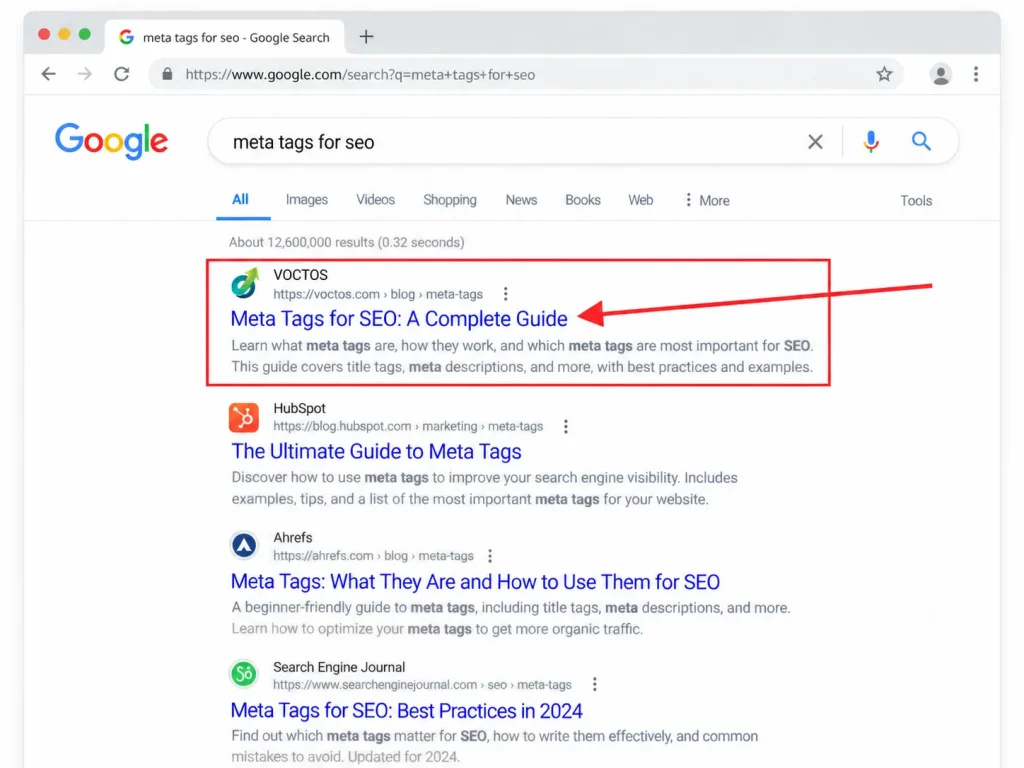
Article The Title Meta Tag: What It Is and How to Write It
Article The Role of Meta Tags in Search Engine Optimization
Article Can You Sue an AI for Defamation? Where the Law Stands

Article Cloudflare’s 15 September AI Crawler Defaults: The Check Gulf and Egypt Brands Should Run Today

Real Results
More Wins
SEO & GEO for Delta Medical Labs
 GEO
GEO
1M+ monthly organic visits, 159,200 ranked keywords, 5,570 pages cited by AI engines, and 1,186 #1 rankings in KSA.

Arabic SEO, GEO & guest posting for VPNly
 SEO
SEO
65K peak monthly organic visits, 55 guest posts, and 149 pages cited by AI engines.

SEO & GEO for Ogaei Virtual Care
GEO
From 3 to 7,931 monthly organic clicks in 7 months, 2.9M+ impressions, and 40+ keywords in Google’s Top 10.

SEO for Eduverse
SEO
12× search traffic in 10 months, 45% of target keywords in the top 5, and 55% in the top 10.
Trusted by