
The Role of Meta Tags in Search Engine Optimization

Meta tags are snippets of HTML placed in the <head> of a page that describe the document to browsers, search engines and social platforms. They will not single-handedly rank a page in 2026, but the ones that still matter , the title tag, meta description, robots directives, viewport, charset and canonical, plus Open Graph and Twitter Card tags , directly shape how Google crawls, indexes and displays your content, and how it looks when shared. Get them right and you win more clicks; get them wrong and you can quietly block your own pages from search.
Key takeaways
- The title tag and meta description do not boost rankings on their own, but they control your search snippet and heavily influence click-through rate which does affect performance.
- Robots, canonical, viewport and charset tags are technical must-haves: they govern indexing, duplicate-content handling, mobile rendering and character encoding.
- The
meta keywordstag is obsolete Google has ignored it since 2009 and stuffing it can signal low-quality intent. - Open Graph and Twitter Card tags decide how your links appear on social media and in messaging apps, improving shares and referral traffic.
- Google may rewrite your title or description when it thinks a query-relevant alternative serves users better, so write concise, accurate, unique tags for every page.
- In WordPress, an SEO plugin such as Rank Math or Yoast lets you edit these tags per page without touching code.
What meta tags are and what they do
Meta tags live inside the <head> section of an HTML document, before any visible content. Visitors never see them on the page itself, yet they carry structured information that browsers and crawlers rely on: what the page is about, how it should be indexed, which language and encoding it uses, and how it should be previewed when shared. Search engines read this metadata during crawling and use parts of it , notably the title and description , to build the snippet shown on the results page. A few years ago, meticulously optimized meta tags could move rankings on their own. Search engines then rewrote their algorithms to fight manipulative tactics, and the direct ranking weight of most meta tags fell sharply. That does not mean meta tags belong to the past. They remain a core part of technical and on-page SEO because they control crawl behavior, presentation and shareability all of which feed into real-world results. Treating them as part of a broader SEO strategy is far more productive than expecting any single tag to do the heavy lifting.
The meta tags that matter today
Title tag
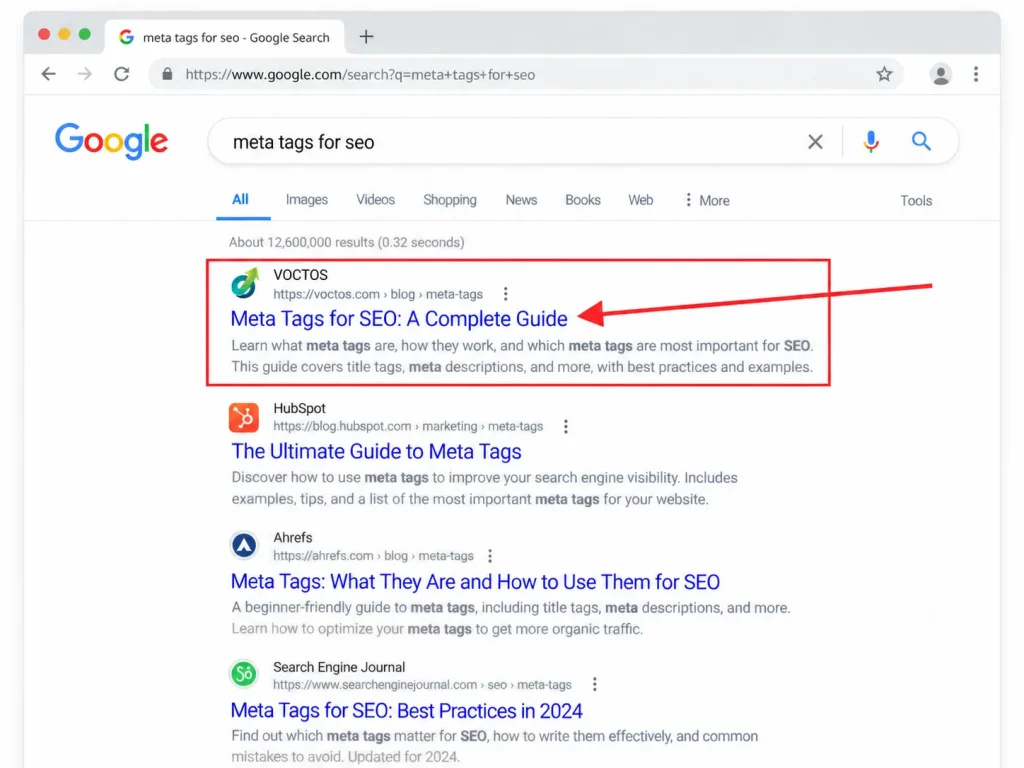
Technically an element rather than a <meta> tag, the <title> is still the single most important piece of metadata. It appears as the clickable headline in search results, in browser tabs and as the default title when a page is shared. Write a unique, descriptive title for every page, lead with the primary keyword where it reads naturally, and keep it distinct from other pages on your site. Google may replace a title it deems unhelpful, so accuracy and relevance beat keyword stuffing.
Meta description
The meta description is the short summary Google often shows beneath the title. It is not a ranking factor, but a compelling, benefit-led description raises click-through rate. Match it to search intent, include the target keyword (matched query terms are bolded in the snippet), and treat it as ad copy that earns the click. If you leave it blank, Google will generate one from on-page text usually less persuasive than a purpose-written line.
Meta robots
The robots meta tag tells crawlers how to handle the page: whether to index it (index / noindex) and whether to follow its links (follow / nofollow). Use noindex for thin, duplicate or private pages you do not want in search, and leave crawlable pages on the default indexable behavior. Misplaced noindex tags are a common reason valuable pages silently disappear from Google, so audit them carefully a technical SEO audit will flag any that are blocking the wrong URLs.
Viewport
The viewport tag controls how a page scales on mobile devices. With Google using mobile-first indexing, <meta name="viewport" content="width=device-width, initial-scale=1"> is essential for a responsive, mobile-friendly layout. Avoid disabling user scaling (user-scalable=no or a locked maximum-scale), as it harms accessibility.
Charset
The character-encoding declaration, <meta charset="utf-8">, ensures text renders correctly across languages and symbols. It should be the first element in the <head>. UTF-8 is the modern standard and prevents the garbled characters that appear when encoding is missing or mismatched.
Canonical
The canonical link element (<link rel="canonical">) tells search engines which URL is the master version when similar or duplicate content exists at multiple addresses for example, pages with tracking parameters or filter variations. Correct canonicals consolidate ranking signals onto one URL and prevent duplicate-content dilution.
Open Graph and Twitter Cards
Open Graph tags (og:title, og:description, og:image, og:url, og:type) control how your page looks when shared on Facebook, LinkedIn, Slack and most messaging apps. Twitter Card tags (twitter:card, twitter:title, twitter:image) do the same for X. A well-chosen image and title turn a bare link into a rich preview that earns more clicks and shares a small but high-leverage part of any content marketing program.
Quick reference table
| Meta tag | Primary purpose | Still relevant? |
|---|---|---|
| Title | Search headline and browser-tab label | Yes critical |
| Meta description | Snippet summary; drives click-through rate | Yes |
| Meta robots | Index / follow directives for crawlers | Yes technical |
| Viewport | Mobile responsive scaling | Yes |
| Charset | Character encoding (UTF-8) | Yes |
| Canonical | Master URL for duplicate content | Yes |
| Open Graph / Twitter | Social and messaging previews | Yes |
| Meta keywords | Legacy keyword list | No ignored |
The meta tag that no longer matters: meta keywords
The meta keywords tag once held a list of target terms for a page. It was abused so heavily that Google confirmed back in 2009 it does not use the tag for ranking web search results, and other major engines followed. Today it offers no benefit and, at worst, hands competitors a free list of your target keywords. You can safely remove it. Older tags like meta refresh (auto-refreshing or redirecting a page) and meta content-language are similarly discouraged use server-side redirects and the lang attribute or hreflang instead.
Best-practice lengths and tips
- Title: aim for roughly 50–60 characters (about 600 pixels) so it does not truncate in results. Front-load the key term and keep every title unique.
- Meta description: around 150–160 characters. Write for humans, include the keyword once, and give a clear reason to click.
- Uniqueness: never duplicate titles or descriptions across pages duplication weakens both.
- Intent match: mirror the wording searchers actually use so Google is less likely to rewrite your snippet.
- Open Graph images: use a 1200×630px image for crisp previews on social platforms.
- Avoid over-optimization: stuffing tags with unrelated or repeated keywords can trigger spam signals and hurt trust. Restraint wins.
- Think beyond classic search: as AI assistants and answer engines summarise pages, clean titles, descriptions and structured metadata help your content surface there too the focus of generative engine optimization (GEO).
How to add meta tags in WordPress with Rank Math
You do not need to edit theme files to manage meta tags in WordPress. An SEO plugin handles it per page. Using Rank Math as an example:
- Install and activate Rank Math (or Yoast SEO) and run the setup wizard once.
- Open any post or page and scroll to the Rank Math meta box, then click Edit Snippet.
- Set the SEO title and meta description the live preview shows how the snippet will look and warns you if a value is too long.
- Use the Advanced tab to control robots directives (index / noindex, follow / nofollow) and set a canonical URL when needed.
- Add or override Open Graph and Twitter Card data, including the social preview image, under the Social tab.
- Set sensible site-wide defaults under Rank Math’s title and meta settings so new pages inherit good templates automatically.
For custom themes or performance-tuned builds, a developer can output these tags programmatically something our WordPress development team handles as part of a technically sound foundation.
Frequently asked questions
Do meta tags still affect SEO in 2026?
Some do, indirectly. The title tag, robots, canonical, viewport and charset tags all influence how search engines crawl, index and display your pages. The meta description shapes click-through rate rather than rankings. The meta keywords tag has no effect at all.
What is the ideal length for a title and meta description?
Keep titles to about 50–60 characters and meta descriptions to about 150–160 characters so neither gets truncated in Google’s results. Both should be unique to each page and written to match search intent.
Should I still use the meta keywords tag?
No. Google has ignored meta keywords for search ranking since 2009, and it can expose your keyword strategy to competitors. It is safe , and generally advisable , to remove it.
Why did Google change my title or description in search results?
Google rewrites snippets when it judges that a more query-relevant title or description would serve users better often pulling from on-page headings or content. Writing accurate, concise, intent-matched tags reduces how often this happens.
What are Open Graph tags used for?
Open Graph tags control the title, description and image shown when your page is shared on social networks and messaging apps. Well-crafted Open Graph and Twitter Card tags produce rich link previews that attract more clicks and referral traffic.
Related guides
Don't miss the chance to
make your website more visible!
Initial consultation and
audit of the current situation

Read also

Article Behavioral Factors in SEO: What They Are and How to Improve Them
Article JavaScript Links Are Hiding MENA Sites From ChatGPT and Claude

Article VOCTOS Is a Top SEO, PPC and SEM Company in Egypt on Clutch for 2026
Article Commercial Ranking Factors: The Complete List

Article The Title Meta Tag: What It Is and How to Write It
Article Can You Sue an AI for Defamation? Where the Law Stands

Article Cloudflare’s 15 September AI Crawler Defaults: The Check Gulf and Egypt Brands Should Run Today

Article What ChatGPT Optimization Guides Still Get Wrong in 2026





Real Results
More Wins
SEO & GEO for Delta Medical Labs
 GEO
GEO
1M+ monthly organic visits, 159,200 ranked keywords, 5,570 pages cited by AI engines, and 1,186 #1 rankings in KSA.

Arabic SEO, GEO & guest posting for VPNly
 SEO
SEO
65K peak monthly organic visits, 55 guest posts, and 149 pages cited by AI engines.

SEO & GEO for Ogaei Virtual Care
GEO
From 3 to 7,931 monthly organic clicks in 7 months, 2.9M+ impressions, and 40+ keywords in Google’s Top 10.

SEO for Eduverse
SEO
12× search traffic in 10 months, 45% of target keywords in the top 5, and 55% in the top 10.
Trusted by