
Text Uniqueness in SEO: How to Check Your Content
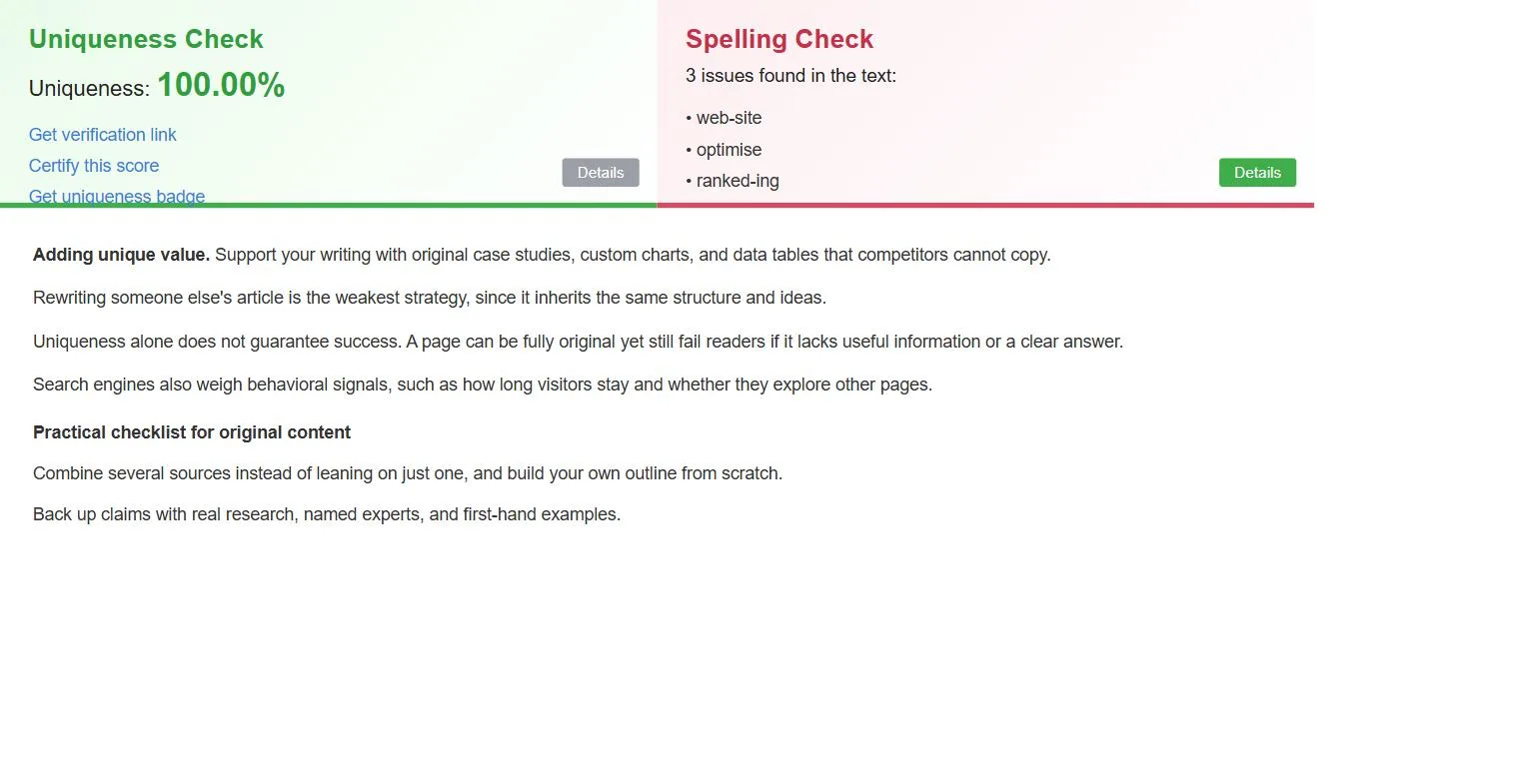
Text uniqueness measures how much of your content is original rather than copied from other pages on the web. It matters for SEO because search engines struggle to rank duplicated material, but a high uniqueness score alone will never guarantee top positions. Google rewards content that is original and genuinely helpful, expert, and relevant to the query. The fastest way to check uniqueness is to run your text through a plagiarism checker such as Copyscape, Originality.ai, Quetext, or Siteliner, and to spot-check suspicious passages manually in Google. This guide explains what uniqueness really means, why it influences rankings, how to test it properly, and how to make your content stand out for the right reasons.
Key takeaways
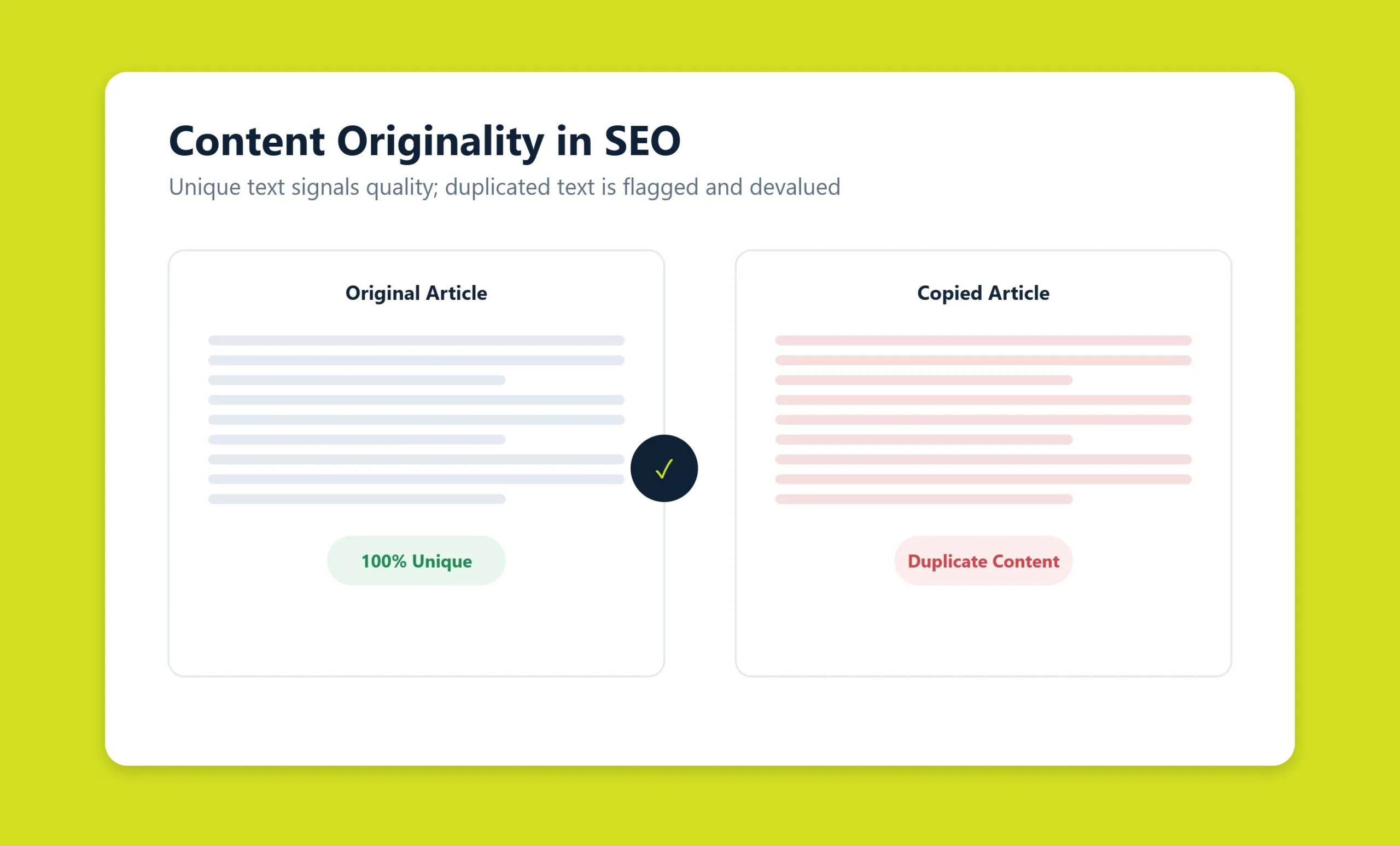
- Uniqueness prevents duplicate and thin-content problems, but on its own it does not push pages up the rankings.
- Google’s Panda-era and Helpful Content systems reward original, useful, expert content and demote copied or low-value pages.
- Use tools like Copyscape, Originality.ai, Quetext, and Siteliner, plus manual Google checks, to verify originality.
- Aim for close to 100% technical uniqueness, but prioritize semantic and informational originality over raw percentages.
- AI-assisted writing is acceptable when a human adds expertise, verifies facts, and makes the piece genuinely helpful.
- Monitor your published pages regularly so stolen copies do not erode your originality signals.
What text uniqueness means in SEO
In SEO, “uniqueness” describes the share of your text that does not match content already published elsewhere. A checker compares your words against an index of web pages and reports a percentage: 100% means no verbatim matches were found, while a lower score flags passages that appear on other sites. That number is useful, but it only measures one narrow dimension of quality.
It helps to think about uniqueness in four layers rather than a single score:
- Technical uniquenessthe absence of word-for-word matches with other articles. This is what plagiarism tools measure, and it does not guarantee value.
- Semantic uniquenessan original angle, interpretation, or framing of a topic, even when the underlying facts are well known.
- Informational uniquenessexclusive data such as your own research, case studies, expert opinions, or proprietary statistics.
- Structural uniquenessa distinctive way of presenting material through original headings, formatting, tables, or interactive elements.
A page can score 100% on the technical layer and still fail readers because it offers nothing new. The layers that move the needle for modern search are the semantic and informational ones.
Why Google cares about unique content
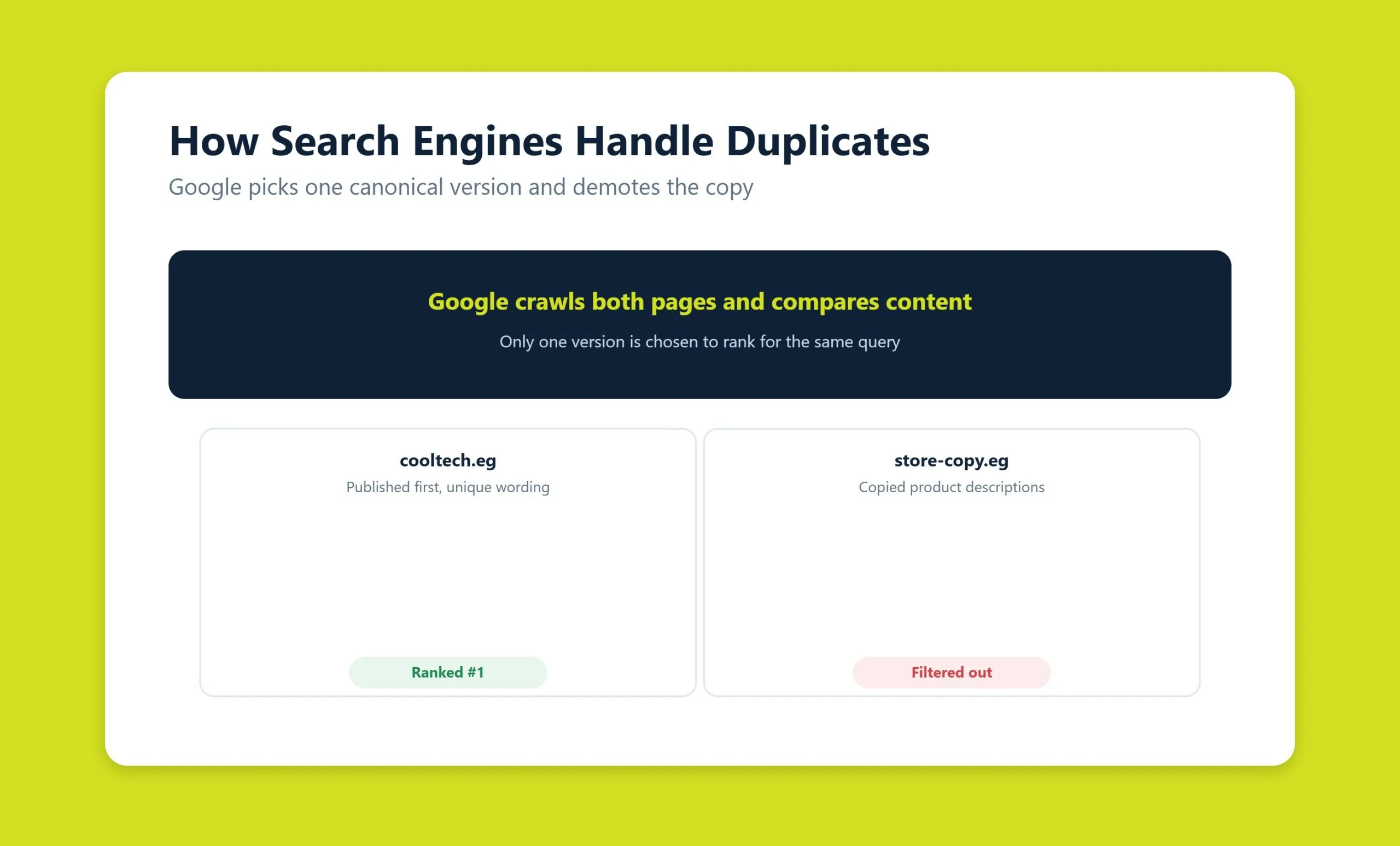
Search engines exist to surface relevant, trustworthy information. When the same text appears across many domains, Google has to decide which version is the original source and which are copies. Duplicated pages waste crawl budget, split ranking signals, and rarely deserve to rank, so the engine filters or ignores most of them.
Duplicate content and thin content
Two related problems hurt sites most often. Duplicate content is text that is substantially the same as content on another URL, either on your own domain or someone else’s. Thin content is text that adds little value, such as spun rewrites, doorway pages, or descriptions stitched together from a synonym tool. Both dilute quality and can suppress a page’s visibility. A regular SEO audit is the most reliable way to catch internal duplication, near-duplicate templates, and pages that are too thin to compete.
Panda and the Helpful Content system
Google’s Panda update, first rolled out in 2011 and later folded into the core algorithm, was designed to demote low-quality, duplicative, and thin pages. Its successors, most notably the Helpful Content system, extended the same philosophy: reward content created for people, penalize content created mainly to rank. The lesson across every iteration is consistent. Copying does not just fail to help, it can actively drag a whole domain down.
Uniqueness is necessary, not sufficient
Originality earns algorithmic trust, but behavioral and quality signals decide rankings. A site full of unique text can still perform poorly if the design is clumsy, the structure is confusing, or the information does not solve the visitor’s problem. Conversely, some pages that republish news or reviews with attribution rank well because they have built a loyal audience that returns for updates. Uniqueness raises your odds; it is not a shortcut. This is why originality works best as part of a broader content marketing strategy rather than a box to tick.
How to check text uniqueness
You can verify originality manually or with dedicated tools. In practice, the two methods complement each other: automated checkers scan at scale, and manual checks confirm the flagged passages.
Manual checking in Google
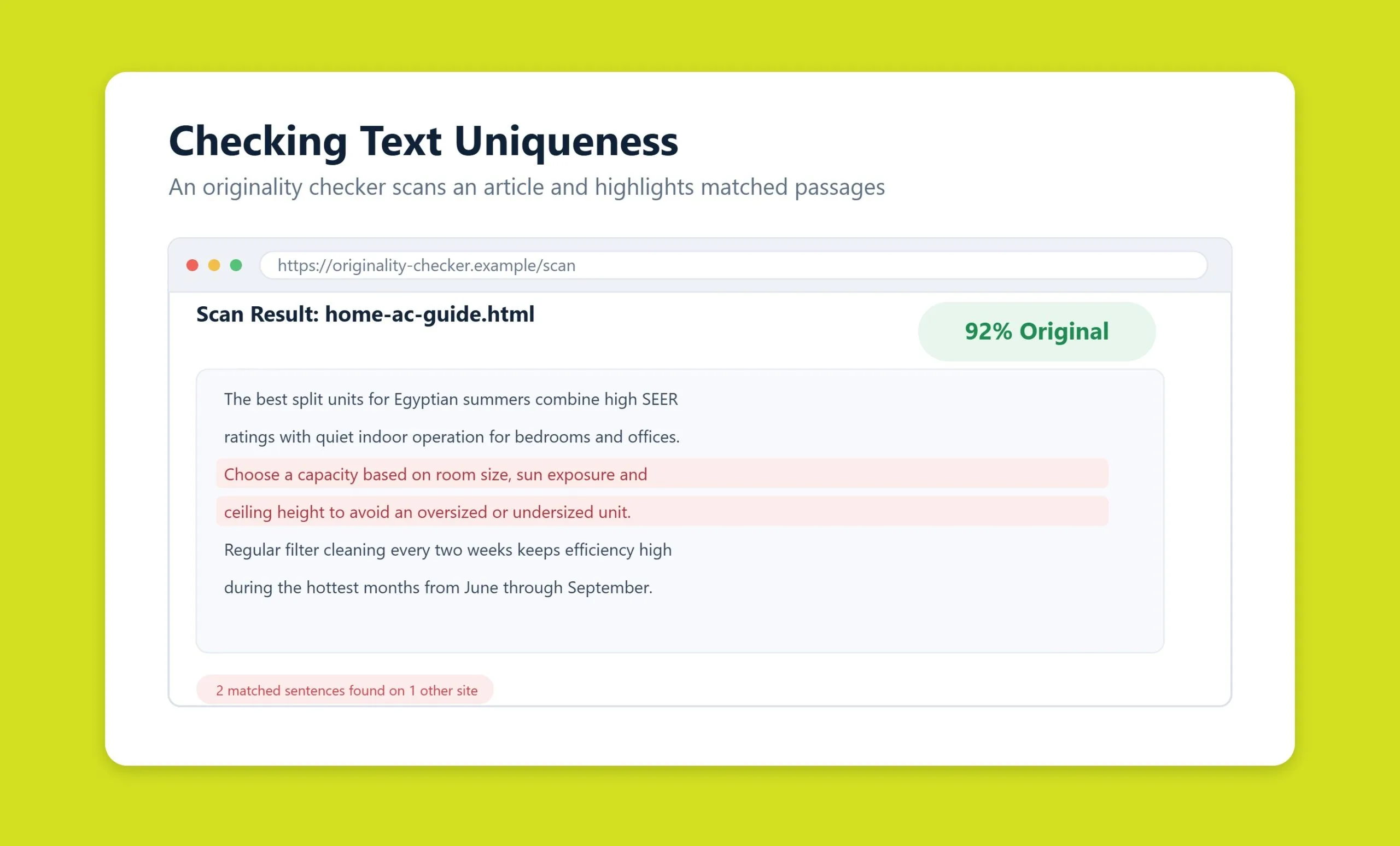
Copy a distinctive sentence or short phrase from the text and paste it into Google inside quotation marks. If identical snippets appear on other domains, that passage is not unique and should be rewritten. This costs nothing and is perfect for spot-checking a suspicious paragraph, verifying a quote, or confirming whether a competitor has lifted your copy. It is slow for long articles, so treat it as a targeted tool rather than a full audit.
Copyscape
Copyscape is one of the longest-established plagiarism checkers and a de facto standard for editors and agencies. Paste a URL or block of text and it returns the pages that match, highlighting the overlapping sections. Its Premium tier and Batch Search let you scan large volumes of content and check drafts before they go live, which makes it well suited to editorial workflows.
Originality.ai
Originality.ai combines a plagiarism scan with AI-content detection in a single report, which is increasingly valuable as more teams write with AI assistance. It scores text for both copied passages and the likelihood that it was machine-generated, and it supports team accounts, full-site scans, and readability grading. If your priority is publishing content that is both original and demonstrably human-refined, this is a strong choice.
Quetext
Quetext is a user-friendly checker built around what it calls DeepSearch, which looks for contextual and paraphrased matches rather than only exact strings. It offers a limited free check and a paid tier with larger word limits, citation assistance, and color-coded results. It is a good option for writers who want fast, readable feedback on individual drafts.
Siteliner
Siteliner (from the makers of Copyscape) is designed for internal duplication rather than external plagiarism. It crawls your own site and reports duplicate content across pages, broken links, and average originality per page. This is invaluable for large sites and e-commerce stores where boilerplate templates and repeated product descriptions quietly create duplicate-content problems.
Building a checking routine
No single tool catches everything, so combine them. A practical routine is to draft, run the text through one plagiarism checker such as Copyscape or Quetext, add an AI and originality pass with Originality.ai when relevant, and periodically crawl the whole domain with Siteliner to catch internal duplication. Reserve manual Google checks for the passages that tools flag as borderline.
What uniqueness percentage is acceptable
For most informational and blog content, aim for a technical uniqueness score in the high 90s, effectively as close to 100% as natural writing allows. Some overlap is unavoidable and harmless: brand names, product specifications, legal disclaimers, quoted statistics, and common industry phrases will always match other pages. Do not chase a perfect score by mangling sentences with a synonym tool, because that destroys readability and search engines detect the result easily.
For pages like product listings, uniqueness works differently. Manufacturer descriptions are duplicated across thousands of retailers, so the practical goal is to add original value, genuine reviews, comparisons, usage tips, or specifications presented in your own structure, rather than to hit an arbitrary percentage. The right target is always “original enough to be useful,” not a number in isolation.
How to make content genuinely unique
Rewriting an existing article is the weakest approach, because it inherits someone else’s structure and ideas. Truly original content is built, not spun. Focus on the following:
- Research the topic and competitors. Study what already ranks, identify the key points everyone covers, and look for gaps, outdated claims, or angles no one has taken. That gap is your opportunity.
- Form your own expert position. Draw on first-hand experience and your own analysis instead of paraphrasing existing posts. This is the “experience” and “expertise” at the heart of Google’s E-E-A-T framework.
- Work from primary sources. Cite official studies, original data, and named experts to make the piece trustworthy and hard to replicate.
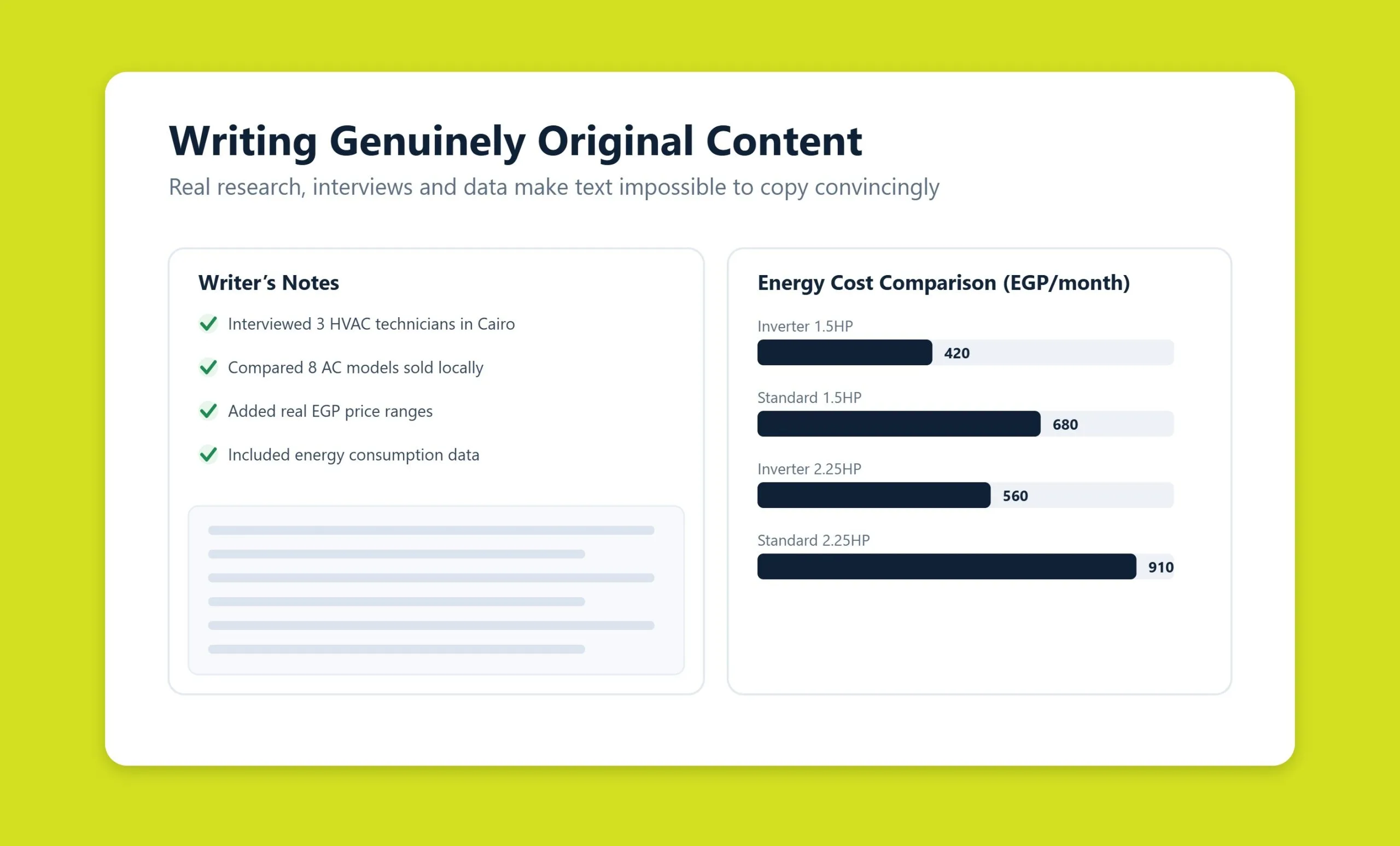
- Add unique value. Include your own case studies, infographics, comparison tables, and data points. Elements a competitor cannot copy are what make a page stand out.
- Structure for readers. Use clear headings, short paragraphs, and logical flow so people can find what they need quickly. Good structure improves both usability and the behavioral signals that influence rankings.
Combining several sources, an original outline, and your own supporting elements produces content that is unique on every layer, technical, semantic, informational, and structural. If you want this handled end to end, professional SEO services can align content production with keyword strategy and technical health from the start.
Uniqueness versus value
Uniqueness and value are not the same thing, and confusing them is a common mistake. A text can be 100% original yet poorly written, shallow, and useless, visitors will bounce within seconds, sending Google a clear signal that the page did not satisfy the query. Behavioral factors such as time on page and clicks to other pages feed directly into how well a page performs over time.
Google evaluates content through the lens of E-E-A-T: experience, expertise, authoritativeness, and trustworthiness. In practice that means the author should know the subject, rely on credible sources, and verify every fact. To create content that is both unique and valuable, express a genuine expert viewpoint, back claims with data and case studies, research what your audience actually cares about, keep pages up to date, and format them for easy reading.
AI content still has to be original and helpful
AI can now draft articles, product descriptions, and even analytical pieces, but generating and publishing unedited output carries real risks. Because models write from patterns in existing text, they tend to repeat standard phrasing and rarely offer a distinctive angle. They also have no first-hand experience, so they cannot supply the expertise that expert content demands.
Google can recognize characteristics common in unedited machine text, repetitive constructions, predictable transitions, a lack of depth or critical thinking, and unnaturally smooth, generic delivery, and it treats content produced mainly to game rankings as spam, regardless of how it was written. The company’s guidance is clear: how content is produced matters less than whether it is helpful, original, and people-first.
Used well, AI is a capable assistant for outlining, research, and first drafts. The published result still needs a human to add expert judgment, verify data, inject original examples, and build an original structure. The same rules for optimizing content for AI-driven search apply here: whether you are pursuing generative engine optimization (AI SEO) or answer engine optimization, the content must be trustworthy and genuinely useful to earn visibility.
Protecting your content from theft
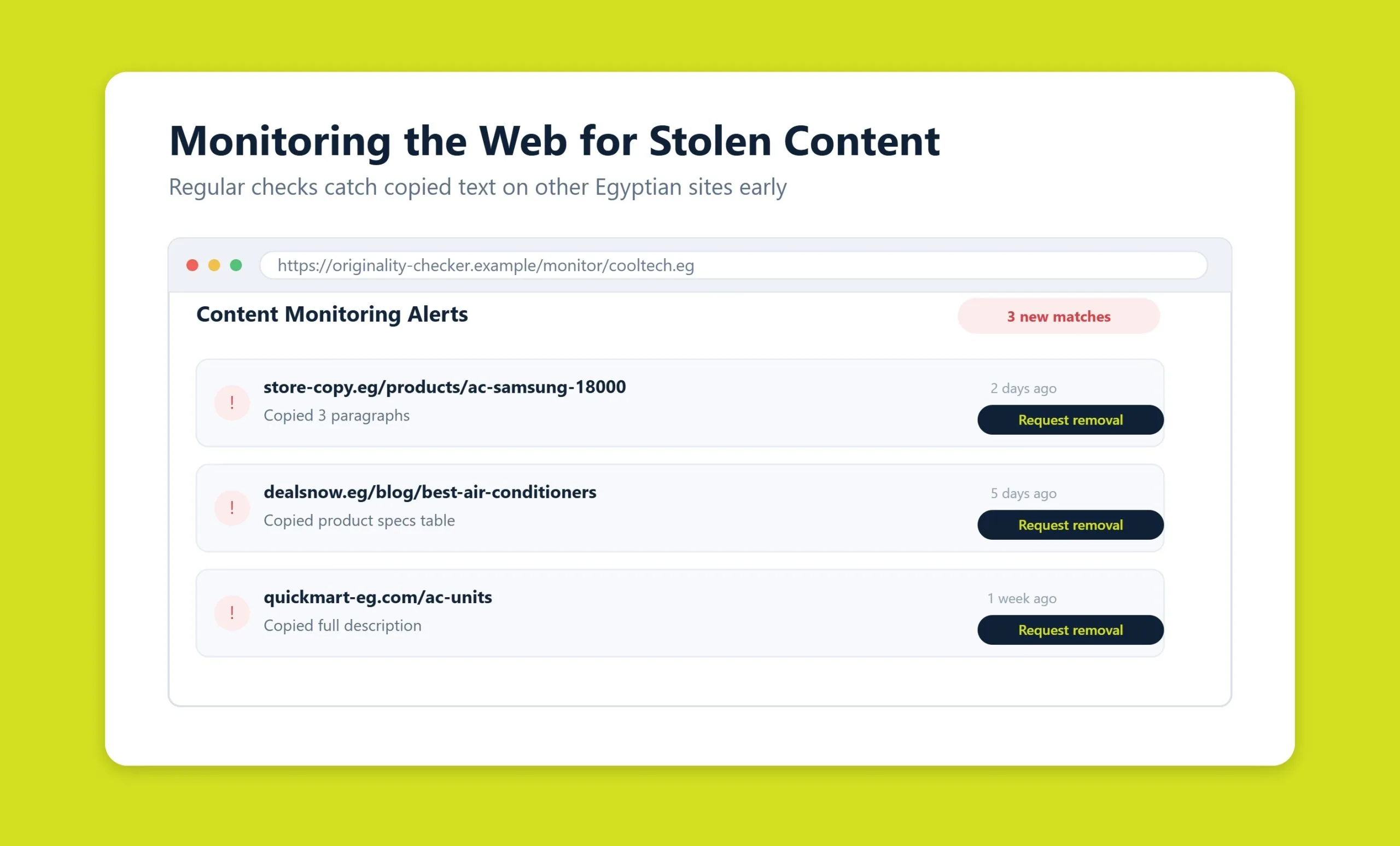
Publishing original content is only half the job; keeping it original is the other half. When someone copies your text and republishes it elsewhere, your site’s overall uniqueness can drop and search engines may struggle to identify the true source. Protect yourself by scanning your key pages regularly, Copyscape and Siteliner both make it easy to find copies of your work across the web.
When you discover theft, act promptly. Request removal from the offending site, file a copyright complaint where appropriate, and refresh any of your own pages whose uniqueness has slipped. Consistent monitoring keeps your originality signals intact and protects the rankings you have worked to earn.
Frequently asked questions
Does 100% unique text guarantee top rankings?
No. Uniqueness is a prerequisite, not a ranking booster. Google also weighs helpfulness, expertise, relevance, page experience, and behavioral signals. A perfectly original page that fails to answer the query will still rank poorly, while a genuinely useful page with minor unavoidable overlap can rank well.
What uniqueness percentage should I aim for?
For articles and blog posts, target the high 90s, as close to 100% as natural writing allows. Minor matches from brand names, quotes, specifications, and common phrases are normal and harmless. For product pages, focus on adding original value rather than hitting a specific number, since manufacturer descriptions are shared across many retailers.
Which tool is best for checking text uniqueness?
There is no single best tool. Copyscape and Quetext are excellent for individual drafts, Originality.ai adds AI-content detection, and Siteliner scans your whole site for internal duplication. Combining a plagiarism checker with periodic site-wide crawls and manual Google spot-checks gives the most reliable picture.
Is AI-generated content bad for SEO?
Not inherently. Google judges content by whether it is helpful and original, not by how it was produced. Unedited AI output tends to be generic, repetitive, and lacking real expertise, which can be flagged as spam. AI works best as a drafting aid, with a human adding expertise, verifying facts, and refining the piece before publishing.
What should I do if someone steals my content?
Scan your pages regularly with tools like Copyscape or Siteliner to detect copies. When you find stolen text, request its removal, file a copyright complaint if needed, and update any of your own pages whose uniqueness has been affected. Ongoing monitoring keeps your originality signals strong.
Related guides
Don't miss the chance to
make your website more visible!
Initial consultation and
audit of the current situation

Read also

Article Behavioral Factors in SEO: What They Are and How to Improve Them
Article JavaScript Links Are Hiding MENA Sites From ChatGPT and Claude

Article VOCTOS Is a Top SEO, PPC and SEM Company in Egypt on Clutch for 2026
Article Commercial Ranking Factors: The Complete List

Article The Title Meta Tag: What It Is and How to Write It
Article The Role of Meta Tags in Search Engine Optimization
Article Can You Sue an AI for Defamation? Where the Law Stands

Article Cloudflare’s 15 September AI Crawler Defaults: The Check Gulf and Egypt Brands Should Run Today







Real Results
More Wins
SEO & GEO for Delta Medical Labs
 GEO
GEO
1M+ monthly organic visits, 159,200 ranked keywords, 5,570 pages cited by AI engines, and 1,186 #1 rankings in KSA.

Arabic SEO, GEO & guest posting for VPNly
 SEO
SEO
65K peak monthly organic visits, 55 guest posts, and 149 pages cited by AI engines.

SEO & GEO for Ogaei Virtual Care
GEO
From 3 to 7,931 monthly organic clicks in 7 months, 2.9M+ impressions, and 40+ keywords in Google’s Top 10.

SEO for Eduverse
SEO
12× search traffic in 10 months, 45% of target keywords in the top 5, and 55% in the top 10.
Trusted by