

What Is Relevance in SEO, Explained Simply

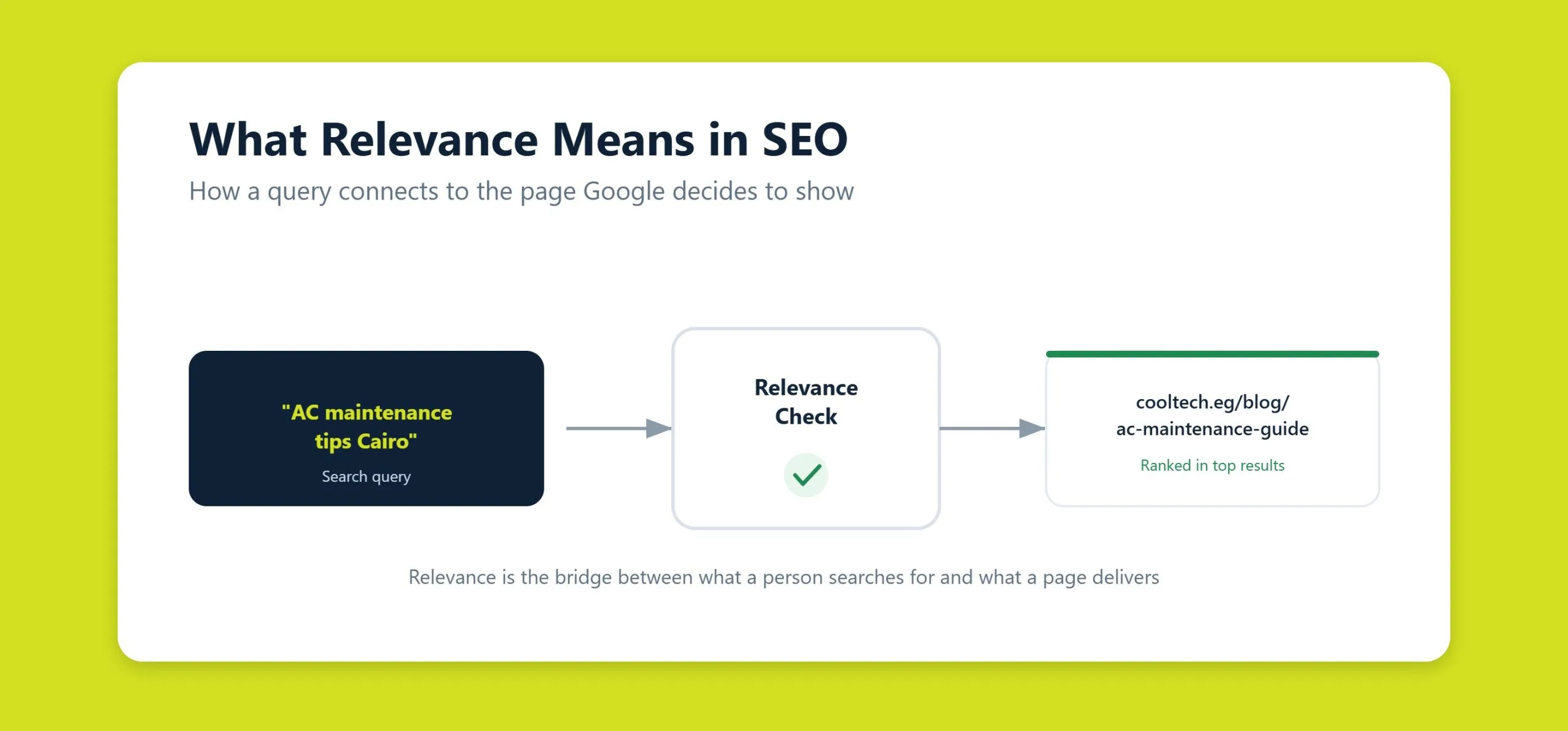
Relevance in SEO is how closely a web page matches what a person actually wants when they type a query into Google. The word comes from the Latin relevare, “to lift up” or “to matter,” and in search it measures one thing: did the page answer the question? If someone searches “how to clean ceramic tile” and lands on a step-by-step guide with practical cleaning tips, that result is relevant. A page that only repeats the keyword without useful instructions, or that recommends methods no one uses anymore, is not. Relevance is the single most important signal that decides whether your content ranks or disappears on page five.
Key takeaways
- Relevance is the degree to which a page satisfies the searcher’s intent, not just the presence of matching keywords.
- Google measures relevance with language models and ranking systems that read meaning, context, and topic coverage, not literal word matches.
- Textual relevance (words on the page) and semantic relevance (related concepts and entities) work together, and modern search leans heavily on the semantic side.
- You make content more relevant by understanding your audience, mapping real queries, structuring the page around intent, and keeping it current.
- You can audit relevance with SEO tools, Google Search Console query data, and a simple manual review against the top-ranking results.
What relevance really means
Relevance describes the match between the information a search engine returns and the need behind a person’s query. In plain terms, it is user satisfaction: did the result solve the problem the searcher came to solve?
The concept shows up in several forms, and people often use the word loosely, so it helps to separate the pieces.
Relevant information and pages
Information is relevant when it aligns with the audience’s expectations and goals. Imagine someone wants to bake a specific cake and searches for the recipe. If the page they open tells the history of the dessert and lists similar sweets instead of giving the method, the information is not relevant, no matter how well written it is. Page relevance is the same idea applied to the whole page, including images, video, and layout, not just the body text.
Relevant queries
When you plan a site, choosing the right keywords is half the battle. If a site is about consumer lending, queries like “loans with no guarantor,” “best loans for retirees,” or “apply for a loan online” are highly relevant: they lift rankings and bring in people who might actually convert. Phrases such as “what does APR mean” or “how to cancel loan insurance” are far weaker for that business. They may match the topic on the surface, but the people searching them have usually already signed a contract and are looking for help, not a new loan. And a phrase like “types of loans download essay” contains the keyword yet is completely irrelevant, because the searcher is a student, not a customer.
Relevant links and headings
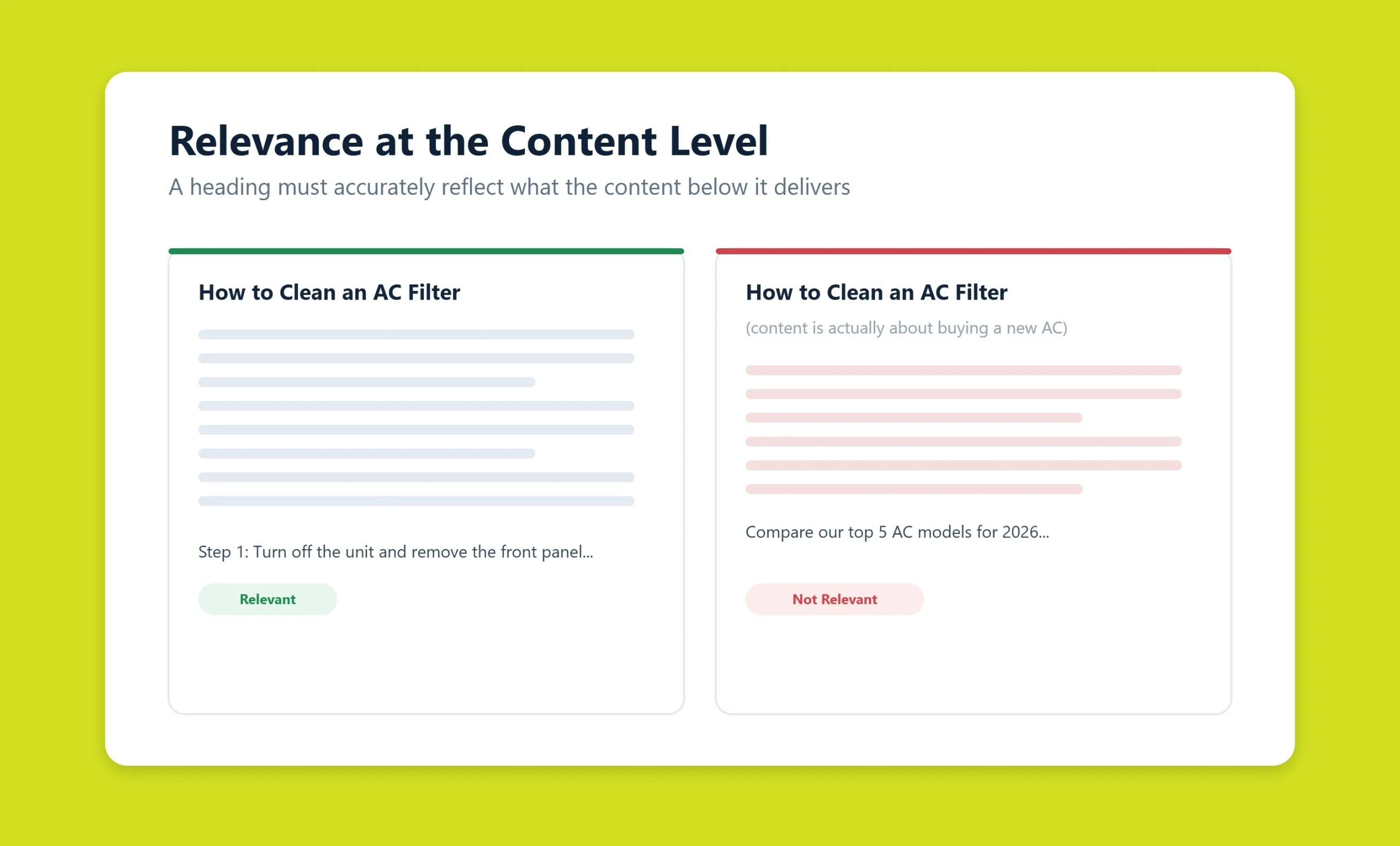
A link is relevant when its anchor text matches the content of the page it points to. If “buy Samsung tablets” links to a tablet catalog, that is relevant; if it opens an “about the company” page, it is not. The same logic applies to headings. A heading that promises “Shimano fishing rods” but sits above a mixed list of other brands and reels does not match its content, so it fails the relevance test. Relevant internal and external links also help rankings, especially when real users click them, because they signal that the destination genuinely fits the context.
How Google measures relevance
Google does not simply count how many times a keyword appears. Its ranking systems read a page the way a person would, using natural-language models to understand meaning, context, and how thoroughly a topic is covered.
Several layers feed into the relevance judgment:
- Query understanding. Google interprets what the searcher means, including synonyms, spelling variants, and the likely intent behind ambiguous words.
- Content matching. Systems built on language understanding evaluate whether the page discusses the query’s topic in depth, not just whether the exact phrase is present.
- Helpfulness and quality. Signals tied to Google’s helpful-content approach reward pages written for people, with first-hand experience and genuine expertise, and demote thin or purely search-engine-first pages.
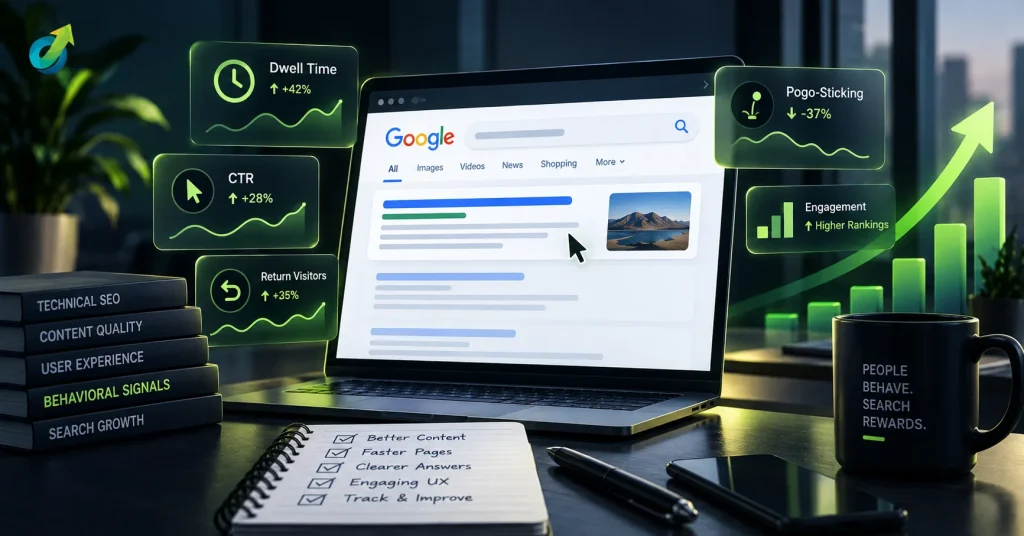
- User behavior. Whether people find what they need and stay, or bounce straight back to the results, feeds indirectly into how well a page is judged to serve a query.
The most relevant pages, in Google’s estimation, sit at the top of the results. The better a page answers the query, the higher it ranks, and the reverse is just as true. If you want a structured way to close the gap between your pages and searcher intent, a professional SEO service can map your content to the queries that matter.
Content versus query intent
The heart of relevance is intent. Two people can type nearly identical words and want very different things, and Google tries to serve the dominant intent behind a query.
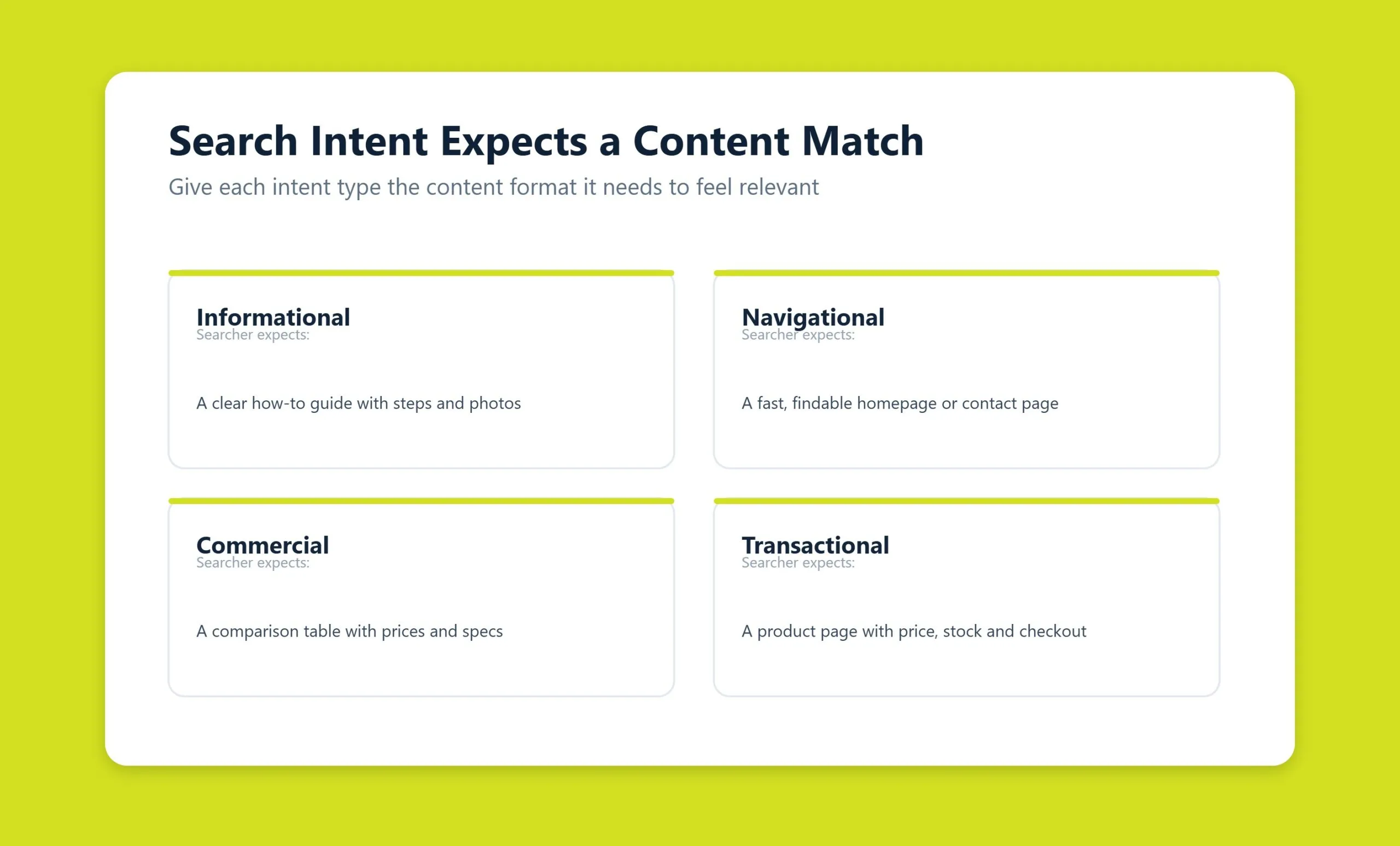
Search intent generally falls into four buckets:
- Informationalthe searcher wants to learn something (“how to fix a computer yourself”).
- Navigationalthey want a specific site or brand.
- Commercialthey are researching before a purchase (“best noise-cancelling headphones”).
- Transactionalthey are ready to act (“buy garden tools online”).
Mismatched intent is one of the most common reasons a technically optimized page still fails to rank. Consider someone who searches “how to repair a computer yourself” and finds only commercial pages offering paid repair. That result is irrelevant, because the information they wanted is missing. A list of DIY repair guides, by contrast, is relevant to the query. Before you write a single word, look at what already ranks: it tells you which intent Google has decided the query represents.
Textual and semantic relevance
It helps to think of relevance in two connected layers.
Textual relevance is the classic layer: the words on the page. Does the query, and do close variants of it, appear in the title, headings, opening paragraph, image alt text, and body in a natural way? This still matters, but it is the floor, not the ceiling. Stuffing a keyword into every sentence hurts more than it helps.
Semantic relevance is where modern search lives. Google understands topics as networks of related concepts, entities, and questions. A genuinely relevant page about, say, mortgages will naturally mention interest rates, down payments, amortization, and eligibility, because those concepts belong together. Covering the topic completely, using the vocabulary a real expert would use, signals depth far more convincingly than repeating one phrase. This is the same principle behind answer engine optimization and generative engine optimization (AI SEO): AI-driven answer systems reward content that fully and clearly resolves a question, not content that merely contains the right words.
How to make content more relevant
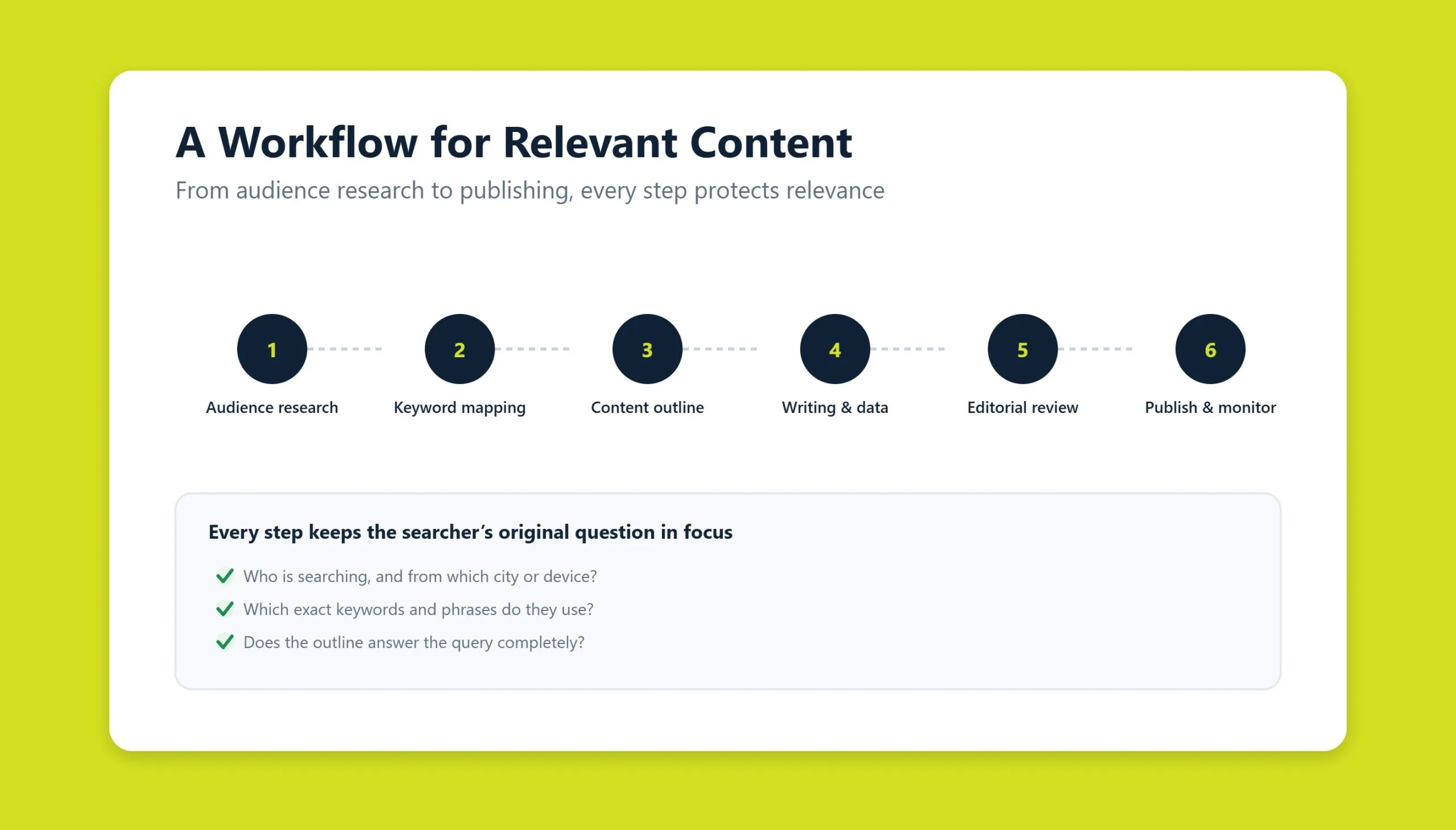
Relevant content is never just keywords in the text and meta tags. The information has to match what the audience is asking and fully resolve their problem. A dependable process looks like this:
- Define your audience. Know exactly who you are writing for, what they want, and why they arrived. Everything downstream depends on this.
- Map real queries. Turn those audience needs into a list of keywords and questions to build the page around. This is the foundation of any solid content marketing program.
- Plan a logical structure. Outline the page so it answers the audience’s questions in a sensible order, with headings that reflect real subtopics.
- Write for people first. Use your keywords in headings, body, and image captions where they fit naturally, but prioritize readability, accuracy, and completeness. Avoid over-optimizing.
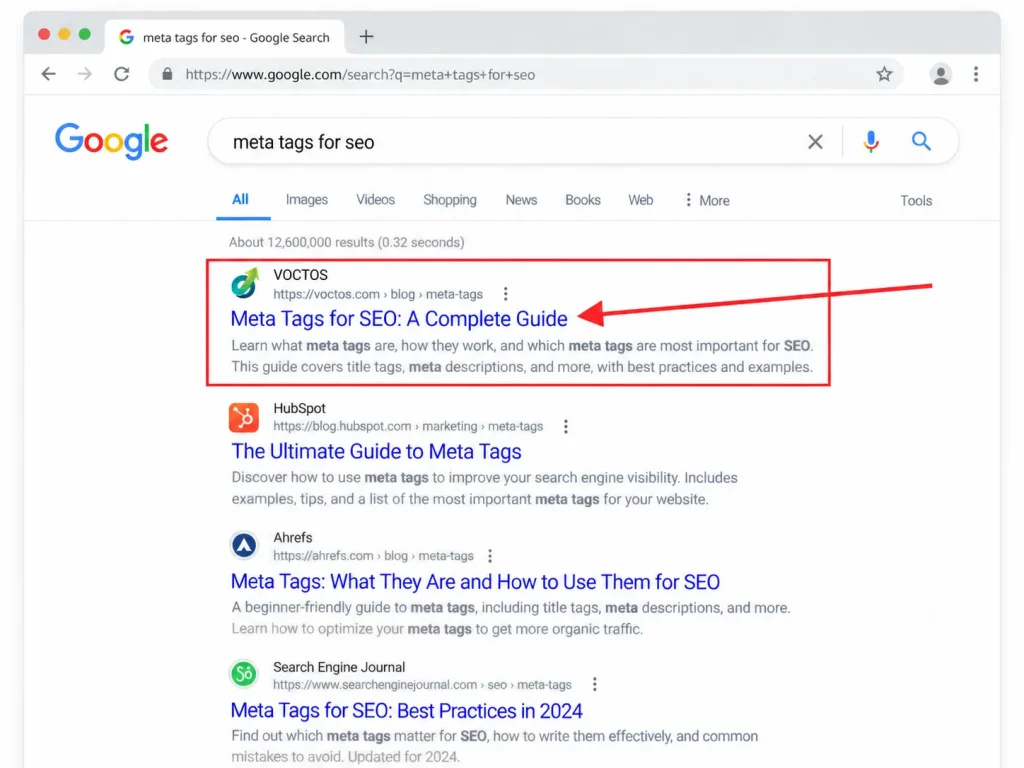
- Optimize the meta tags. Make sure the primary query is reflected clearly in the title tag and meta description.
Relevance work does not end at publication. Refresh content periodically, verify that facts are still current, and reorganize as topics evolve. Information that was relevant a year ago can quietly go stale, and stale is a synonym for irrelevant.
Why irrelevant content still shows up
Search algorithms judge relevance page by page and decide which queries a page should appear for. Despite constant improvement, irrelevant results still surface, for a few reasons:
- Manipulation. Deceiving search engines has become much harder, but some low-quality operators still game the system temporarily.
- Thin topic coverage. When little good information exists on a subject, algorithms are forced to surface weaker pages that touch the query without truly solving the problem.
- Imperfect algorithms. Ranking systems follow rules and models, and they occasionally get it wrong.
As a searcher, you can sharpen results with Google’s search operators to filter out the noise. As a publisher, the fix is the opposite of manipulation: cover the topic better than anyone else.
How to check relevance
You do not have to guess whether a page is relevant. A few practical methods:
- Compare against the top results. Search your target query, read the pages that rank in the top positions, and honestly ask whether yours answers the intent as well or better. This manual check is the most revealing of all.
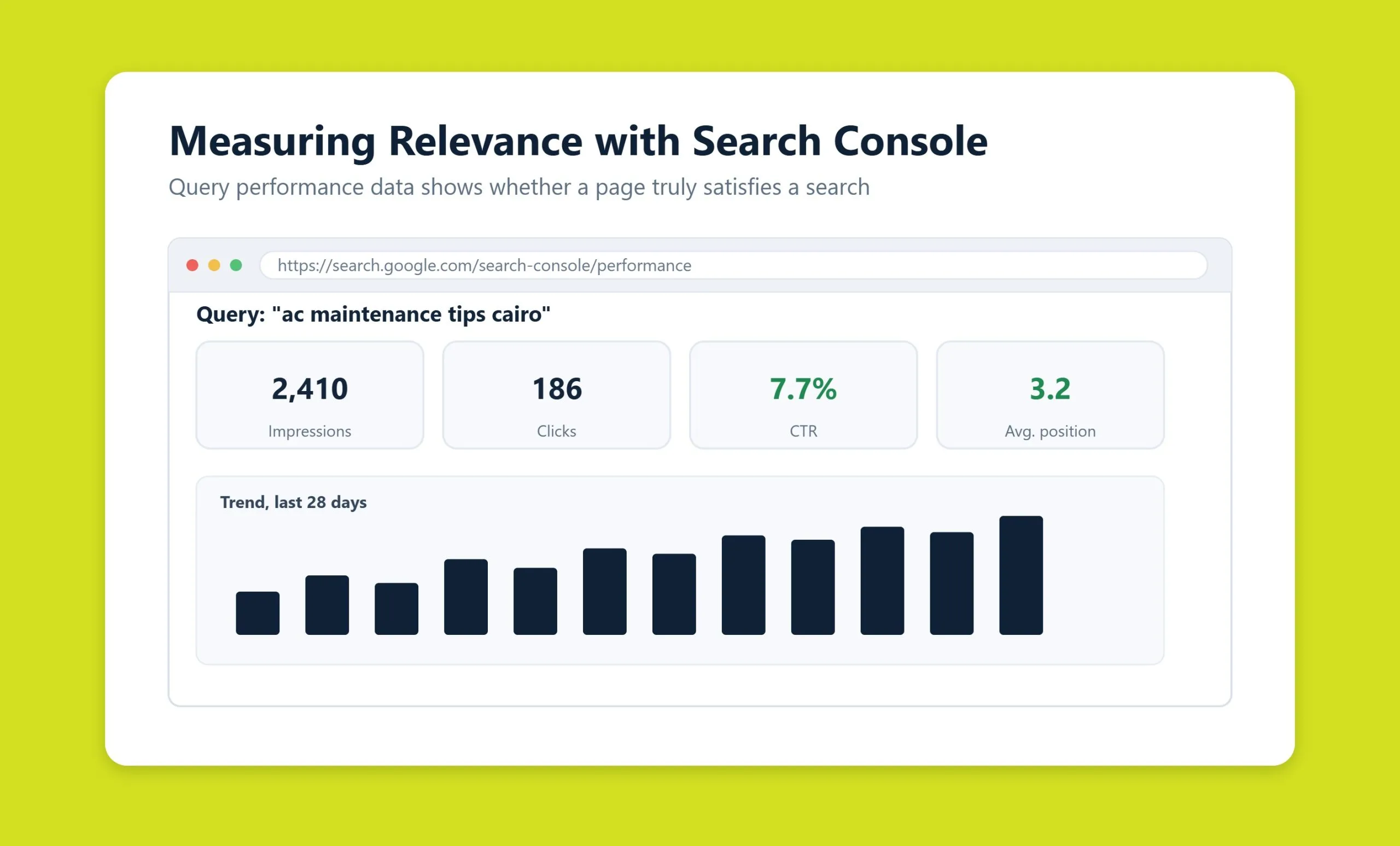
- Use Google Search Console. The performance report shows the exact queries a page already earns impressions and clicks for. If a page is showing up for queries it does not actually answer, that is a relevance gap to close.
- Run an SEO content tool. Platforms such as Semrush, Ahrefs, Surfer, and Clearscope score how well a page covers a topic against competitors, flagging missing subtopics, related terms, and structural gaps.
- Commission a full audit. For a site-wide view of where content fails intent, an SEO audit maps every important page to the queries it should own and pinpoints the mismatches.
The goal of every check is the same: confirm that the page delivers what the searcher wanted, in enough depth that they never need to click back to Google.
Relevance beyond SEO
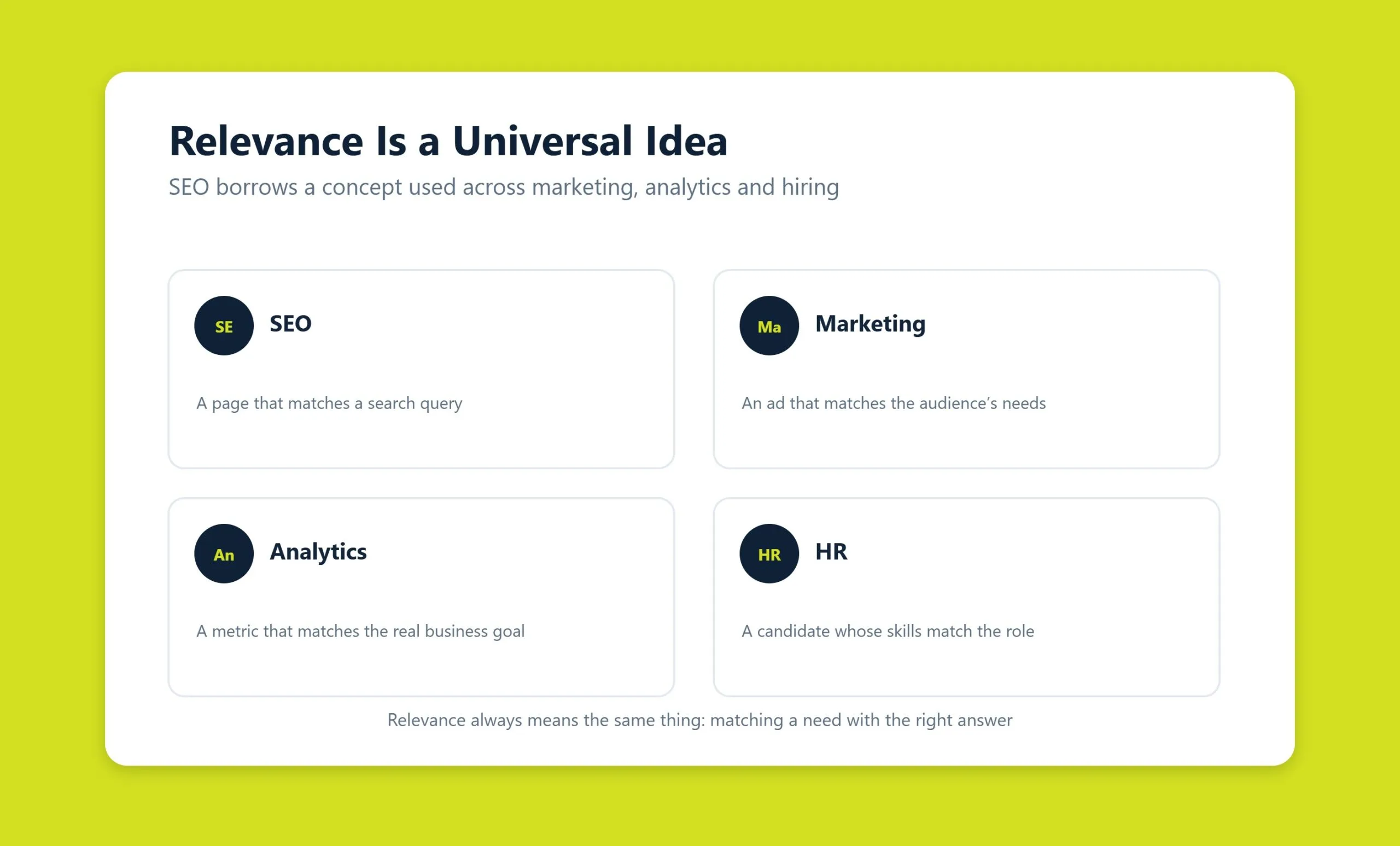
The word “relevance” travels well beyond search, and the core meaning holds everywhere: the fit between one thing and another under specific conditions.
In marketing, relevance means matching the message to the audience, the channel, and the stage of the funnel. An ad for garden tools should reach people shopping for garden tools, not people looking for fertilizer. Relevant hashtags, relevant audiences, and relevant placements all follow the same rule: reach people who actually care about the offer.
In analytics and statistics, relevant data is the data that answers your research question. To judge whether paid search is worth it, order value, ROI, and revenue are relevant; impressions and CTR alone are not. A relevant sample is one drawn from the population that matches your study, such as surveying people who genuinely intend to buy the product.
In HR, relevance measures how well a candidate fits a role: relevant experience, relevant education, and relevant past projects that map to the job ahead.
Across every field, relevance comes down to correspondence, one thing matching another for a given purpose. In SEO, that purpose is always the searcher, and building your content around their intent is the most durable ranking strategy there is.
Frequently asked questions
What is relevance in SEO in simple terms?
Relevance in SEO is how well a page matches what a searcher actually wants. If the content answers the question behind the query completely and clearly, Google considers it relevant and is more likely to rank it near the top of the results.
How is relevance different from keywords?
Keywords are the words a page uses; relevance is whether the page truly satisfies the intent behind those words. A page can contain the exact keyword and still be irrelevant if it does not answer the searcher’s real question, which is why modern search focuses on meaning and topic coverage rather than word matching.
How does Google decide which page is most relevant?
Google uses natural-language understanding and ranking systems to interpret query intent, evaluate how thoroughly a page covers the topic, and weigh quality and helpfulness signals. Pages that best serve the dominant intent behind a query rank highest, while thin or mismatched pages rank lower.
How can I check if my page is relevant to a query?
Compare your page against the current top-ranking results, review the queries it earns in Google Search Console, and run an SEO content tool to score topic coverage against competitors. If your page answers the intent as well or better than what ranks now, it is relevant.
Does relevance matter for AI search and answer engines?
Yes. AI answer engines and generative search reward content that fully and clearly resolves a question. Complete, well-structured, genuinely helpful pages are more likely to be cited in AI-generated answers, which is the focus of answer engine optimization and generative engine optimization.
Related guides
Don't miss the chance to
make your website more visible!
Initial consultation and
audit of the current situation

Read also

Article Behavioral Factors in SEO: What They Are and How to Improve Them
Article JavaScript Links Are Hiding MENA Sites From ChatGPT and Claude

Article VOCTOS Is a Top SEO, PPC and SEM Company in Egypt on Clutch for 2026
Article Commercial Ranking Factors: The Complete List

Article The Title Meta Tag: What It Is and How to Write It
Article The Role of Meta Tags in Search Engine Optimization
Article Can You Sue an AI for Defamation? Where the Law Stands

Article Cloudflare’s 15 September AI Crawler Defaults: The Check Gulf and Egypt Brands Should Run Today






Real Results
More Wins
SEO & GEO for Delta Medical Labs
 GEO
GEO
1M+ monthly organic visits, 159,200 ranked keywords, 5,570 pages cited by AI engines, and 1,186 #1 rankings in KSA.

Arabic SEO, GEO & guest posting for VPNly
 SEO
SEO
65K peak monthly organic visits, 55 guest posts, and 149 pages cited by AI engines.

SEO & GEO for Ogaei Virtual Care
GEO
From 3 to 7,931 monthly organic clicks in 7 months, 2.9M+ impressions, and 40+ keywords in Google’s Top 10.

SEO for Eduverse
SEO
12× search traffic in 10 months, 45% of target keywords in the top 5, and 55% in the top 10.
Trusted by