
AI-Powered SEO: How Neural Networks Are Used in Website Promotion

AI SEO is the practice of using neural networks and machine learning tools to automate, accelerate, and sharpen search engine optimization, from keyword research and content creation to technical audits and competitor analysis. Neural networks now handle the repetitive, data-heavy work at a speed no human team can match, while experienced specialists focus on strategy, judgment, and brand voice. In 2026, with Google powering roughly 90% of global search and AI Overviews appearing on nearly half of all queries, treating AI as a core part of your SEO workflow is no longer optional; it is how competitive sites stay visible.
Key takeaways
- AI SEO combines classic optimization with tools like ChatGPT, Claude, Gemini, Surfer, Ahrefs, and Semrush to automate routine tasks and surface hidden opportunities.
- Neural networks excel at large data sets: keyword research, semantic clustering, technical audits, and competitor monitoring at scale.
- AI-generated content is a strong first draft, not a finished product; human editing for accuracy, tone, and expertise remains essential.
- The biggest wins come from a hybrid model: automation for speed, deep analytics for insight, and expert review for quality and brand voice.
- With AI Overviews on roughly 48-60% of searches and 2.5 billion-plus monthly users, optimizing for AI-driven results is now a core part of visibility.
What AI SEO is and how it works
The world of SEO is changing in real time, and the main driver is artificial intelligence. Search specialists increasingly rely on neural networks to automate tedious tasks, uncover non-obvious growth points, and push websites toward the top of the results pages. Traditional tactics deliver diminishing returns as algorithms grow smarter, so learning to promote sites with AI has become a core skill rather than a nice-to-have.
AI SEO supplements and automates classic optimization with tools built on machine learning. In practice, neural networks take on three broad categories of work:
- Search query analysis. AI maps out a full keyword map, finds long-tail and related queries, and predicts emerging trends.
- Content creation. Models generate draft copy, meta tags, and product descriptions, and help structure articles, while analyzing competitor content for ideas.
- Technical audits. Neural networks scan a site for critical issues such as broken links, duplicate pages, indexing problems, slow load times, and poor mobile adaptation.
If you want a foundation to build on, a professional SEO service that pairs these tools with human oversight typically delivers far better results than automation alone.
How to promote a website with AI
Search algorithms keep getting more complex. Neural networks let marketers adapt strategies quickly because they process huge data sets in seconds and perform deep analysis of user behavior, studying how visitors interact with a site, which sections attract interest, and where users drop off. That behavioral insight is essential for predicting audience behavior, personalizing pages, and improving performance, and it feeds directly into answer engine optimization, where understanding user intent is everything.
Where AI is applied in SEO
Keyword research and semantic analysis
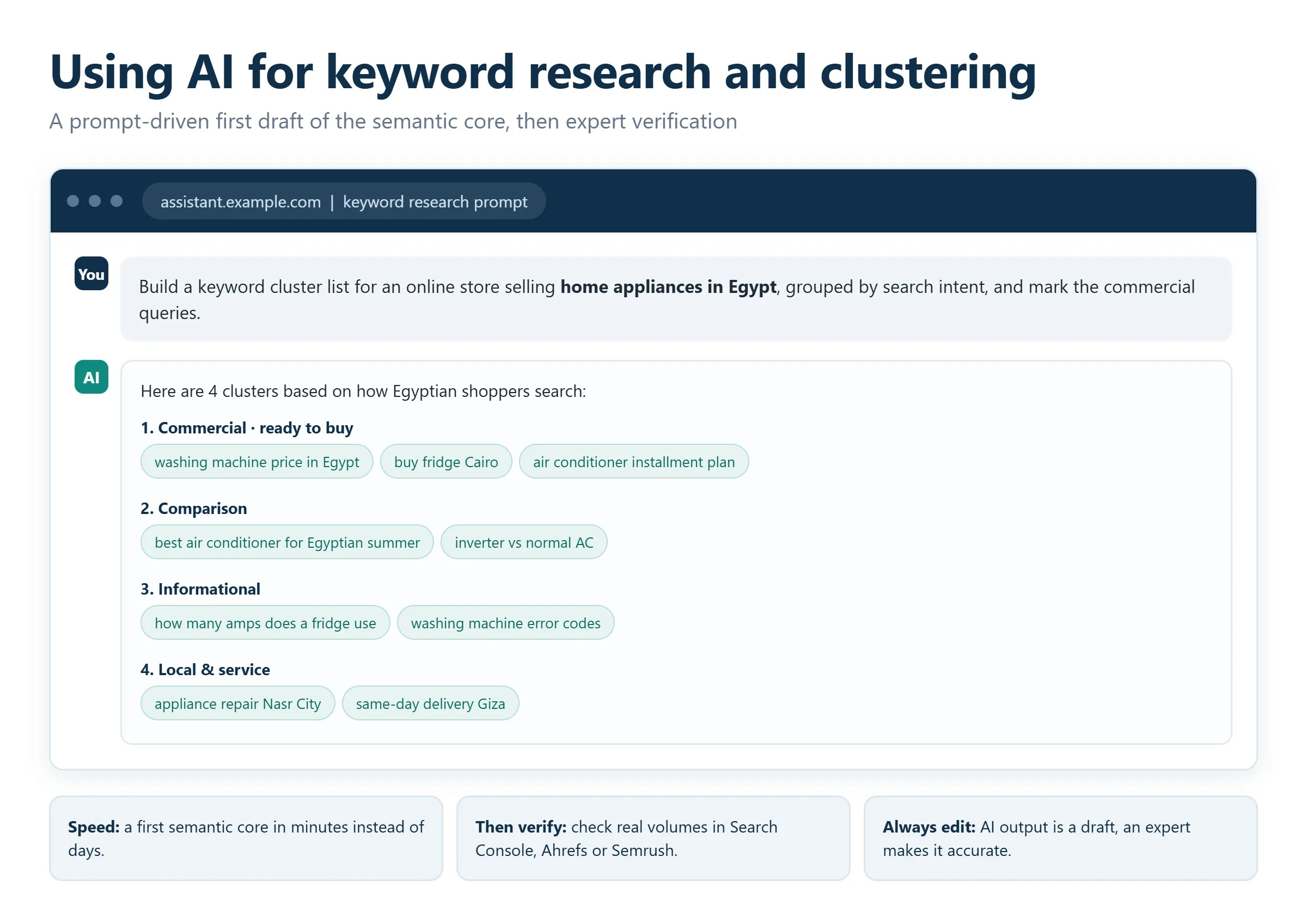
Machine learning models review billions of data points quickly, spotting hidden relationships that manual analysis would miss, then group queries into logical topic clusters. A valuable byproduct is the discovery of long-tail keywords: narrow, specific phrases with high commercial value. Instead of a generic query like buy sneakers, a user might search buy blue leather running shoes in Manchester. That searcher is deep in the funnel; competition is lower, so ranking costs a fraction of broad terms while bringing high-converting visitors. Tools like Ahrefs, Semrush, and Google Search Console make mining these queries straightforward.
Content creation and optimization
Drafting an outline, writing an article, and generating meta tags are easy work for a neural network, but AI output is essentially a rough draft. Generated content needs human refinement: deep editing and fact-checking, adaptation to real search intent and the right register, and SEO optimization of keywords, headings and meta tags. A structured content marketing process, where AI accelerates production and editors add expertise, turns a draft into a page that ranks and converts.
SEO audits powered by AI
A neural network can run a comprehensive check quickly, analyzing load speed from both the user and crawler perspective and flagging bottlenecks such as unoptimized images. Since Google replaced FID with INP as a Core Web Vital in March 2024, this performance analysis matters even more to rankings. AI can also find broken links and redirect chains, detect duplicate content, verify robots files and XML sitemaps, and assess mobile adaptation. With tools like Screaming Frog, GA4, and Google Search Console feeding the analysis, owners can fix flaws before they harm visibility. If you would rather have specialists handle it, a full SEO audit combines automated scanning with expert interpretation, and ongoing technical support keeps those fixes in place.
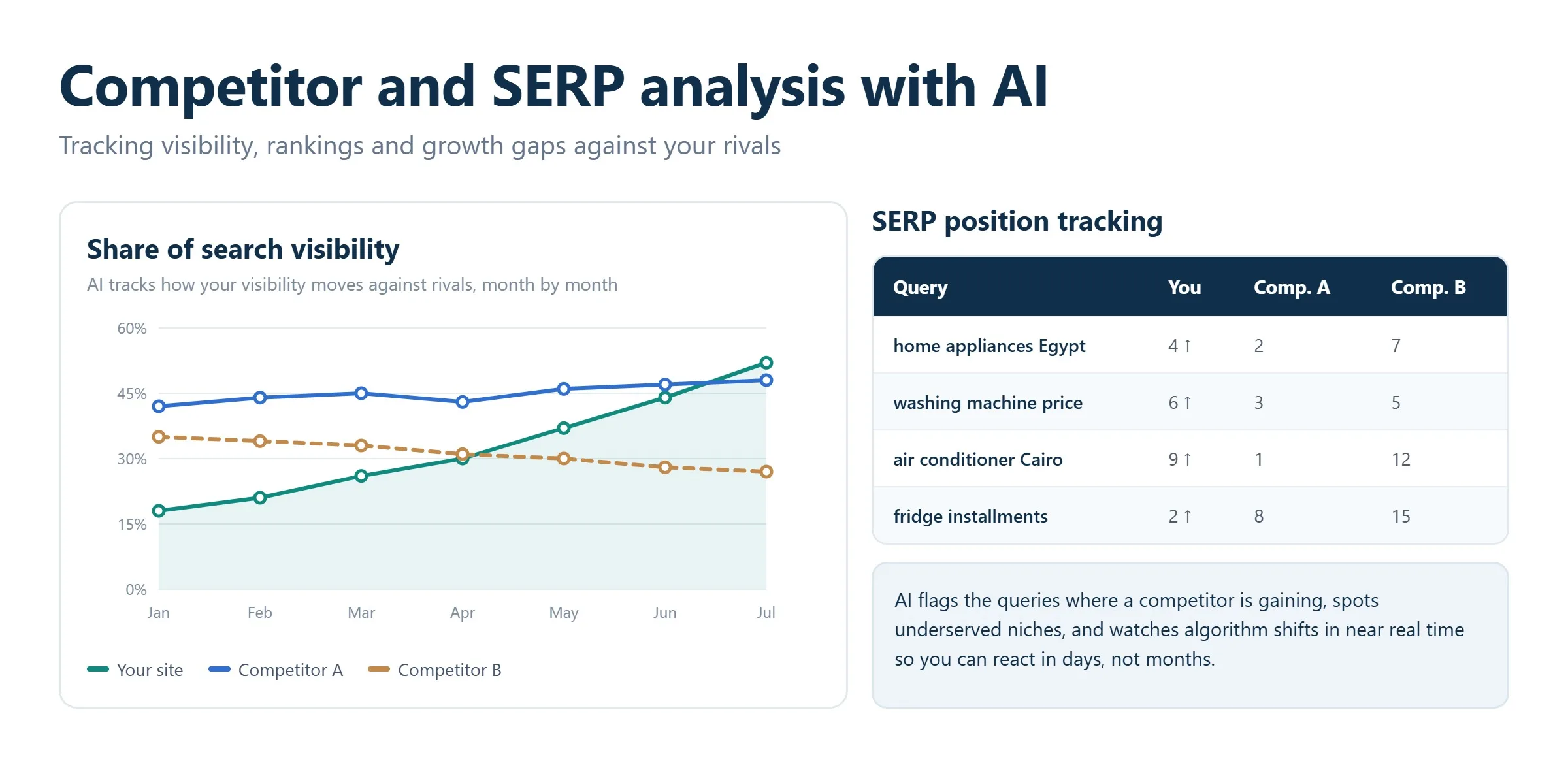
Competitor and SERP analysis
AI studies rivals’ content strategies in detail and identifies hidden growth points such as promising niches and underserved segments, leading to sharper decisions. It can also monitor algorithm changes in near real time so marketers adjust fast.
The main use cases
Faster analysis and strategy
AI services help you test new directions, expand your keyword map, and experiment with page structures. The classic cycle of hypothesis, implementation, result that once took weeks is compressed several times over.
Automating routine tasks
Rough drafts, first-pass data analysis, and basic page checks can be handed to AI, freeing specialists for harder, higher-value problems.
Improving content quality
AI measures keyword density, tracks natural term distribution, and identifies synonyms and related terms (LSI), helping you create relevant content without over-optimization, while evaluating structure, internal linking, load speed and mobile adaptation. Surfer and similar platforms make this content scoring accessible to any team.
Benefits and opportunities
Neural networks save time on routine work, deliver more accurate analysis of large data volumes for better decisions, and scale effortlessly, which is especially valuable for large projects and e-commerce.
Limitations and risks
A neural network cannot fully replace the strategic thinking of a qualified specialist. It does not always account for business specifics, market conditions, or customer nuances, and it tends to fall back on templates, which hurts uniqueness. There is also a visibility dimension: as AI Overviews expand, how your content is written and structured determines whether AI systems cite you. Optimizing for Google AI Overviews and broader generative engine optimization is now part of protecting your presence in AI-driven results.
Where AI does not replace the specialist
AI has no real-life experience, so it can overlook the subtleties of a specific field, miss professional jargon or emotional nuance, and ignore legal considerations and industry conventions. It offers the most logical solution, but in the real world that solution may be unacceptable given circumstances or ethics. Human review catches these gaps.
How to use AI the right way
The best results combine three ingredients: automation for speed, deep analytics to predict user behavior and trends, and expert review that adds corrections and creative touches. Automation supplies the speed; human expertise supplies the judgment.
Conclusion
The future of SEO is inseparable from AI. Companies that combine AI tools with analytics and expert work gain a significant advantage. AI is moving toward a central role in data analysis, content generation, and technical optimization, but it cannot yet do without a specialist. The winning formula is human plus machine, not one instead of the other.
Frequently asked questions
What is AI SEO?
AI SEO is the use of neural networks and machine learning tools to automate and enhance search engine optimization, covering keyword research, content drafting, technical audits, and competitor analysis, while specialists focus on strategy and quality.
Can AI fully replace an SEO specialist?
No. AI is excellent at processing data and automating routine work, but it lacks real-world experience, strategic judgment, and knowledge of your specific market. Content and decisions still need human review for accuracy, brand voice, and business relevance.
Which AI tools are useful for SEO?
Common tools include ChatGPT, Claude, and Gemini for content and ideation; Ahrefs and Semrush for keyword and competitor research; Surfer for content optimization; Screaming Frog for technical crawls; and Google Search Console and GA4 for performance data.
Is AI-generated content good for SEO?
AI-generated content works well as a first draft, but it should always be edited by a human. Google rewards helpful, accurate, original content, so fact-checking, adding real expertise, and refining tone are essential before publishing.
How does AI help with technical SEO audits?
AI can quickly scan a site for broken links, duplicate content, indexing issues, slow load times, and poor mobile adaptation. Paired with tools like Screaming Frog and Google Search Console, it helps teams fix problems before they damage rankings.
Related guides
Don't miss the chance to
make your website more visible!
Initial consultation and
audit of the current situation

Read also

Article Behavioral Factors in SEO: What They Are and How to Improve Them
Article JavaScript Links Are Hiding MENA Sites From ChatGPT and Claude

Article VOCTOS Is a Top SEO, PPC and SEM Company in Egypt on Clutch for 2026
Article Commercial Ranking Factors: The Complete List

Article The Title Meta Tag: What It Is and How to Write It
Article The Role of Meta Tags in Search Engine Optimization
Article Can You Sue an AI for Defamation? Where the Law Stands

Article Cloudflare’s 15 September AI Crawler Defaults: The Check Gulf and Egypt Brands Should Run Today






Real Results
More Wins
SEO & GEO for Delta Medical Labs
 GEO
GEO
1M+ monthly organic visits, 159,200 ranked keywords, 5,570 pages cited by AI engines, and 1,186 #1 rankings in KSA.

Arabic SEO, GEO & guest posting for VPNly
 SEO
SEO
65K peak monthly organic visits, 55 guest posts, and 149 pages cited by AI engines.

SEO & GEO for Ogaei Virtual Care
GEO
From 3 to 7,931 monthly organic clicks in 7 months, 2.9M+ impressions, and 40+ keywords in Google’s Top 10.

SEO for Eduverse
SEO
12× search traffic in 10 months, 45% of target keywords in the top 5, and 55% in the top 10.
Trusted by