
The State of Arabic AI Citations in 2026
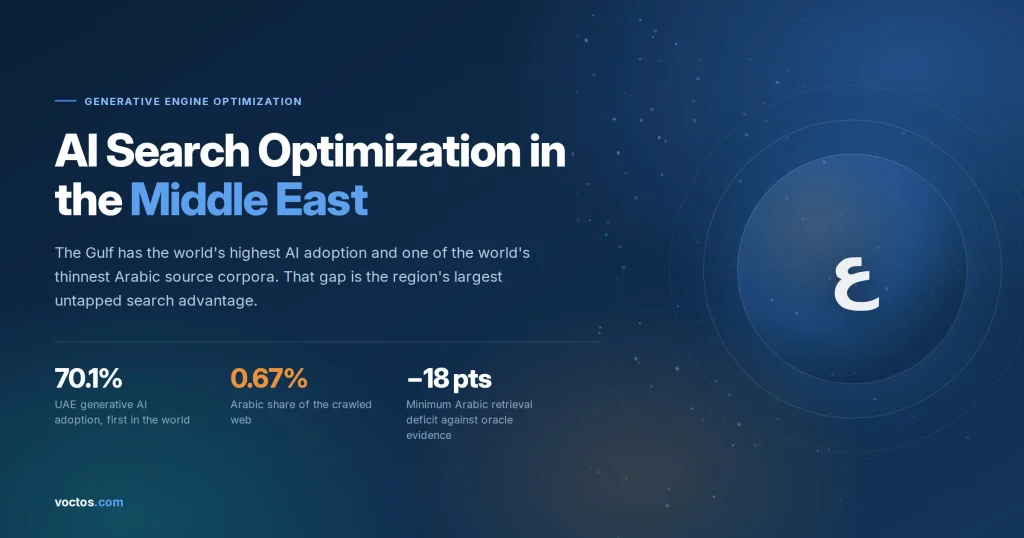
Arabic accounts for 0.6% of the web’s content while serving one of the world’s largest language populations and two of its fastest-adopting AI markets. That imbalance is not a footnote about digital inequality. It is the single most important structural fact for any brand trying to be cited by ChatGPT, Gemini, Claude or Perplexity in Arabic — and it cuts both ways.
What this report covers
We reviewed every substantial published study on AI citation behaviour available as of August 2026, extracted what applies to Arabic-language search, and separated it from what remains genuinely unmeasured. Nine primary sources are cited throughout. Where the evidence runs out, we say so rather than filling the gap with inference.
The supply side: a citation pool that is structurally thin
Arabic represents 0.6% of websites whose content language is known, against English at 49.5%, according to W3Techs data surveyed on 26 August 2026. Arabic sits below Spanish, German, Japanese, French, Portuguese, Russian and Italian — languages with far smaller speaker populations.
The same thinness shows in the source generative engines lean on most heavily. Arabic Wikipedia held 1,319,469 articles as of June 2026 — the 15th largest edition by article count, though 4th by depth. It also carries one of the lowest new-editor retention rates and highest edit-reversion rates among the major editions.
Retrieval systems can only cite what exists. When the corpus in a language is one-eightieth the size of English, every query in that language draws from a shallower pool — which means the barrier to entering it is correspondingly lower.
The demand side: adoption is not thin at all
Saudi Arabia’s Communications, Space and Technology Commission reported in its 2026 Saudi Internet Report that 45.2% of internet users in the Kingdom now use AI tools — more than double the prior year. Adoption skews young and female: 55.7% among ages 20–29, and 52.8% among women against 39.4% among men.
The World Bank’s World Development Report 2026: The Promise of Artificial Intelligence placed the UAE among the world’s top ten countries for ChatGPT usage relative to internet users. Google brought AI Mode to Modern Standard Arabic in October 2025, and reported that early users ask questions two to three times longer than traditional search queries.
Arabic AI search has first-world demand and a developing-world content supply. That gap is the entire opportunity, and it will not stay open.
Finding 1: query language rewires the entire citation graph
The most consequential evidence for Arabic markets comes from Profound’s analysis of 3.25 billion citations across seven AI models and fourteen countries, with the UAE and Saudi Arabia included and prompts filtered to each country’s native language.
Two results matter for anyone publishing in Arabic. Social platform citations in Google AI Overviews range from 20% in Spanish down to near-elimination in Arabic and Swedish markets. In ChatGPT the pattern inverts but the direction holds: social citations fall from roughly 10% in English to 3–5% in every non-English market studied.
The mechanism is straightforward. Social citation share in English rests heavily on Reddit, an English-first platform with no meaningful Arabic equivalent. Strip Reddit out and the citation graph reorganises around whatever else the engine can find.
The practical consequence is that advice imported from English-language GEO is often wrong for Arabic. A playbook built on Reddit seeding and community presence describes an English citation graph. In Arabic AI Overviews, that channel is close to absent.
Finding 2: the sources engines prefer are unstable
Semrush tracked over 100 million citations from 230,000+ prompts across three LLMs during a thirteen-week window from 14 July to 12 October 2025. The headline ranking looks familiar: Reddit, Wikipedia, LinkedIn, YouTube, Forbes, Medium.
The volatility underneath it does not. Within that single quarter, Reddit’s presence in ChatGPT responses fell from roughly 60% to about 10%. Wikipedia dropped from around 55% to under 20%. PR Newswire, Forbes and Medium gained.
| Source | Behaviour, Jul–Oct 2025 | Implication for Arabic strategy |
|---|---|---|
| ~60% → ~10% of ChatGPT responses | Already marginal in Arabic; now unreliable in English too | |
| Wikipedia | ~55% → <20% of ChatGPT responses | Still high-weight, but not a durable single bet |
| ~15% citation frequency in Google AI Mode | Has real Arabic-language usage; underexploited regionally | |
| Wire services / editorial | Gained share on ChatGPT | Argues for earned media over owned content alone |
A visibility strategy anchored to one platform is a strategy with a quarterly expiry date. Diversification across source types is not a hedge here; it is the baseline requirement.
Finding 3: what actually predicts citation, and what does not
Three independent studies converge on the same uncomfortable conclusion: being talked about predicts AI citation far better than being linked to.
Ahrefs analysed 75,000 brands and found branded web mentions correlate with AI Overview visibility at 0.664 — roughly three times more strongly than backlinks at 0.218. Brands in the top quartile for web mentions averaged 169 AI mentions; the next quartile down averaged 14.
| Factor | Correlation with AI Overview visibility |
|---|---|
| Branded web mentions | 0.664 |
| Branded anchors | 0.527 |
| Branded search volume | 0.392 |
| Domain Rating | 0.326 |
| Referring domains | 0.295 |
| Backlinks | 0.218 |
| Paid advertising | 0.216 |
Seer Interactive reached a compatible result by a different route, running 10,000 questions through GPT-4o drawn from more than 300,000 keywords. Google page-one presence correlated with brand mentions in AI answers at approximately 0.65. Backlinks, in their words, showed impact that was “weak or even neutral”.
The academic foundation points the same way. The Princeton-led paper that introduced the term Generative Engine Optimization (Aggarwal et al., KDD 2024) built GEO-bench, a large-scale benchmark of user queries across multiple domains, and tested a range of content strategies against it. Adding statistics, quotations and cited sources produced visibility gains of up to 40%, with effectiveness varying by domain.
Read together: engines cite content that is quotable and brands that are discussed. Link acquisition — still the largest line item in many regional SEO budgets — is the weakest of the measured signals.
Finding 4: the dialect problem nobody has priced
Arabic-language AI carries a complication no other major market has. Users type in dialect. Models are trained predominantly on Modern Standard Arabic. Published content is written in MSA. Nobody has measured what that mismatch does to citations.
The 2025 survey of Arabic large language models states the problem directly: because current models are trained primarily on MSA, they struggle to understand or generate colloquial input, while users frequently interact in dialect rather than MSA. The same survey notes Arabic models still lag their English counterparts in reasoning and multi-step tasks.
The AraDiCE benchmark (COLING 2025) quantified part of it, building roughly 45,000 human-post-edited samples across Gulf, Egyptian and Levantine dialects plus MSA. Arabic-specialised models such as Jais and AceGPT outperformed multilingual models on dialectal tasks, but significant challenges persisted across all systems in dialect identification, generation and translation.
What none of this tells you is the commercial question: does asking the same question in Gulf Arabic instead of MSA change which brands get recommended? No published study answers it. For a regional business, that is the difference between appearing in a buying conversation and being invisible in it.
Finding 5: the four engines are not one channel
Treating “AI visibility” as a single blended score hides the largest actionable difference in the data. The same source category behaves in opposite directions across engines, and the divergence widens once the query is not in English.
Semrush’s thirteen-week tracking recorded LinkedIn appearing in roughly 15% of Google AI Mode citations while Wikipedia sat near 2% on the same engine — an inversion of the Wikipedia-heavy pattern visible in ChatGPT over the same period. Reddit’s presence held far more steadily in Google AI Mode and Perplexity than in ChatGPT, where it collapsed within the quarter.
| Engine | Observed pattern, Jul–Oct 2025 | Effect of a non-English query |
|---|---|---|
| ChatGPT | Sharpest volatility; Reddit and Wikipedia both fell steeply while wire-service and editorial domains gained | Social citations fall from ~10% to 3–5% |
| Google AI Mode / AI Overviews | LinkedIn ~15% of citations; Wikipedia ~2%; Reddit comparatively stable | Social citations near-eliminated in Arabic markets |
| Perplexity | Most consistent citation patterns across the window | Not separately reported by language |
Two engines moving in opposite directions on the same source type is not a rounding error. It means a brand optimising for a blended score is optimising for an average that describes no engine its buyers actually use.
Note what is missing here. Neither study reports engine-level citation behaviour within Arabic specifically — Profound measures language effects on source categories, Semrush measures engine patterns without a language split. The intersection of the two, which is the number a regional strategist actually needs, has not been published by anyone.
Finding 6: the click is no longer the unit of visibility
Pew Research tracked 68,879 Google searches from 900 US adults in March 2025. Users who saw an AI summary clicked a traditional result in 8% of visits, against 15% for those who did not. Only 1% clicked a source link inside the summary itself.
Ahrefs measured a 34.5% decline in click-through rate for the top-ranking page on informational queries once an AI Overview appears. SparkToro, using Similarweb panel data for January–April 2026, put US zero-click searches at 68.01% — up from 60.45% in 2024, the fastest two-year climb in a decade.
These figures are US-centric, and no equivalent Arabic-market measurement has been published. The direction is unlikely to reverse in a market where AI Mode arrived in Arabic less than a year ago and adoption doubled in twelve months.
What is still unmeasured in Arabic
Five questions matter commercially and have no published answer. We list them because an honest map of the field should show its blank areas.
- What share of citations inside Arabic answers point to English-language sources? Profound’s work establishes that language reshapes the citation graph, but not the cross-language composition of individual answers.
- Does dialect change brand recommendations? AraDiCE measures linguistic competence, not commercial outcomes.
- How much has Arabic click-through actually fallen? Every zero-click figure in circulation is US or EU data.
- Does machine-translated Arabic content get cited less than natively written Arabic? Translation is standard practice across the region and its effect on retrieval is entirely unmeasured.
- How long do Arabic citations last? No published study anywhere reports citation persistence — whether a cited page stays cited.
What the evidence supports doing now
- Shift budget from links to mentions. Two independent studies rank branded mentions well above backlinks as a predictor. Earned editorial coverage is the mechanism, and wire-service and editorial domains gained citation share during the measured window.
- Stop importing Reddit-centric playbooks. Social citation is near-eliminated in Arabic Google AI Overviews and sits at 3–5% in non-English ChatGPT. Spending there is spending against the measured citation graph.
- Make pages quotable rather than comprehensive. The GEO benchmark result is specific: statistics, quotations and cited sources raise visibility. Length does not appear in the findings.
- Publish natively in Arabic, and publish an English twin. Arabic is 0.6% of web content; the English corpus a model draws on for the same topic is eighty times larger.
- Measure per engine, not as a blended score. Google AI Overviews and ChatGPT show opposite language effects on the same source category.
- Treat Arabic Wikipedia as infrastructure. It is the 15th largest edition serving one of the largest language populations. Improving coverage in your category with genuine secondary sources is legitimate, and the gap is unusually wide.
Frequently asked questions
Is it easier to get cited by AI in Arabic than in English?
The evidence suggests yes, structurally. Arabic makes up 0.6% of web content against English at 49.5%, so retrieval systems answering Arabic queries draw from a far shallower pool of candidate sources. Fewer competing documents means a lower barrier to entering the citation set. This is an inference from corpus size rather than a measured citation rate, and it will erode as Arabic publishing volume grows.
Should Arabic brands invest in Reddit for AI visibility?
The measured data argues against it. Profound’s analysis of 3.25 billion citations found social platform citations near-eliminated in Arabic Google AI Overviews, and falling to 3–5% in non-English ChatGPT markets against roughly 10% in English. Reddit’s weight in English citation graphs does not transfer to Arabic, and Semrush recorded its ChatGPT presence dropping from about 60% to 10% within a single quarter even in English.
Do backlinks still matter for AI citations?
Less than the industry prices them. Ahrefs found backlinks correlate with AI Overview visibility at 0.218 against 0.664 for branded web mentions across 75,000 brands. Seer Interactive independently described backlink impact on AI answer mentions as weak or neutral across 10,000 GPT-4o questions. Both findings are correlational, but they point the same direction: coverage outperforms links.
Does writing in dialect help or hurt Arabic AI visibility?
Nobody knows, and any confident answer is unsupported. Published research establishes that models are trained predominantly on Modern Standard Arabic and struggle with dialectal input, and the AraDiCE benchmark documents persistent difficulty in dialect identification and generation across systems. What no study measures is whether asking the same commercial question in Gulf or Egyptian Arabic changes which brands the engine recommends.
How much Arabic search traffic has AI actually taken?
No Arabic-market measurement has been published. The available figures are US-based: Pew found clicks fall from 15% to 8% of visits when an AI summary appears, Ahrefs measured a 34.5% CTR decline for top-ranking pages on informational queries, and SparkToro put US zero-click searches at 68.01% in early 2026. Applying these to Arabic markets is an assumption, not a finding.
Which single change moves AI citations most?
On the strongest available evidence, making content quotable. The GEO benchmark study found that adding statistics, quotations and cited sources raised visibility in generative responses by up to 40%, and it remains the only controlled experimental result in the field rather than a correlation. Everything else in this report describes what cited pages look like; that study describes what changing a page does.
Method and limitations
This is a synthesis of published research, not original measurement. We reviewed studies available through August 2026 and included those that state sample size and method. Every figure links to its primary source; where a study reports ranges or approximations, we reproduce them as ranges.
Four limitations apply. The Ahrefs and Seer findings are correlational and cannot establish that adding mentions causes citations. Most underlying data is US or English-market, and its transfer to Arabic is an assumption we have flagged rather than tested. AI engines change continuously — the Semrush volatility figures are themselves evidence that any snapshot ages quickly. And most citation measurement runs through APIs, which do not always return what a user sees in the product interface.
Reproduce any table or figure from this report with attribution and a link.
Don't miss the chance to
make your website more visible!
Initial consultation and
audit of the current situation

Read also

Article AI Search Optimization in the Middle East: The Arabic Citation Gap

Article Best Tools for Testing Website Responsiveness (Mobile-Friendliness)

Article Eduverse Online School SEO Case Study: 151K Sessions and 75% Organic Share in 1 Year

Article FBS.com SEO & GEO Case Study: +109% Organic Sessions and 2x AI Mentions

Article What Is Pagination and How to Implement It on Your Site

Article How to Prepare for ChatGPT Ads Before They Launch in Your Market
Article ChatGPT Won’t Show Ads to Its Highest-Value Users. Here’s Why That Changes Your Strategy

Article ChatGPT Ads Aren’t Available in Any Arab Market Yet. Here’s What Actually Works Right Now


Our cases
All cases
GEO Services for Delta Medical Labs
 GEO
GEO
1M+ monthly organic visits and 159,200 ranked keywords, 3,600 Google AI Overview citations, while ranking #1 for 1,186 keywords in KSA.

Arabic SEO, GEO & guest posting for VPNly
 SEO
SEO
65K peak monthly organic visits, 55 guest posts, and 149 pages cited by AI engines.

SEO & GEO for Ogaei Virtual Care
GEO
From 3 to 7,931 monthly organic clicks in 7 months, 2.9M+ impressions, and 40+ keywords in Google’s Top 10.

SEO for Eduverse
SEO
Increased search traffic 12 times in 10 months: 45% of target keywords in the top 5, 55% in the top 10
Trusted by