
The Complete Local SEO Guide for 2026: How to Rank in Your City

Something broke in local search this year, and most businesses haven’t noticed yet. The share of consumers using AI tools such as ChatGPT, Gemini and Google AI Mode to find a local business jumped from 6% to 45% in a single year, while Google’s own share of local discovery fell from 83% to 71% (BrightLocal Local Consumer Review Survey, 2026). Local SEO didn’t get easier. It got wider.
This guide covers the whole surface: how Google actually ranks local results, how to build a Google Business Profile that earns the map pack, how to research local keywords in a bilingual market, and how to keep your name, address and phone data consistent when half your listings are in Arabic and half in Latin script. Everything here is sourced, and the parts specific to Egypt and the Gulf are the parts you won’t find in a generic guide.
Key Takeaways
- Google Business Profile signals carry roughly 32% of local pack ranking weight, the largest single controllable group (Whitespark, 2026).
- Reviews now drive about 20% of local pack weight, up from 16% in 2023.
- 97% of consumers read reviews before choosing a local business, and 41% always do.
- AI assistants became the third-largest local discovery channel in 2026.
What is local SEO, and how is it different from regular SEO?
Local SEO is the practice of earning visibility for searches with geographic intent, and it runs on a partly separate algorithm. Google states that local results are based primarily on relevance, distance and prominence (Google Business Profile Help). Classic SEO has no equivalent of distance, which is why a weaker site can outrank a stronger one across the street.
In practice that gives local SEO two ranking surfaces instead of one. There’s the local pack, the boxed set of three business listings with a map, and there’s the ordinary organic listing below it, and the two are scored quite differently. Whitespark’s 2026 survey found that local pack rankings are dominated by Business Profile signals, while local organic rankings weight on-page content and links far more heavily (Whitespark Local Search Ranking Factors, 2026).
Which one should you chase? Both, but not with the same tactics. A perfectly optimized Business Profile will not lift your service pages in organic results, and a beautiful set of service pages will not put you in the map pack if your profile is thin.
There’s a third surface now, and it changes the math. AI assistants answer local questions without showing a map pack at all. We’ll come back to that in the section on AI visibility, because the signals that win it are not the ones most agencies are optimizing for.
For the broader mechanics of how search works before location enters the picture, see our SEO services overview.
How does Google decide which local businesses rank?
Google names three factors: relevance, distance and prominence. Its documentation adds that prominence is based partly on how many websites link to your business and how many reviews you have (Google Business Profile Help). Two of the three are things you can change; the third mostly isn’t.
Relevance is the match between the query and everything Google knows about you: primary category, services, attributes, description, and the content on your site. Distance is the gap between the searcher and your verified address. Prominence is your reputation, measured through reviews, links, citations and offline notability.
Distance is powerful, but people consistently overestimate how absolute it is. Google’s own wording is that its algorithms might decide a business farther away is more likely to have what the searcher wants, and rank it higher anyway. That single sentence contains the entire opportunity in local SEO. You can’t move your office, but you can be so much more relevant and prominent that Google widens the radius it’s willing to consider for you.
Independent survey data puts numbers on the balance. Among the experts Whitespark surveyed, primary Business Profile category scored 227, proximity to the searcher scored 225, and keywords in the Business Profile name scored 223, making category selection roughly as influential as physical location (Whitespark, 2026).
Note what sits at the bottom of that chart. Citations carry only about 7% of local pack weight, yet they absorb a disproportionate share of most local SEO budgets. Hold that thought, because their value changes completely once AI enters the picture.
How do you set up a Google Business Profile that actually ranks?
Your Business Profile is the single most important asset in local SEO, carrying around 32% of local pack ranking weight (Whitespark, 2026). Completeness matters, but two fields matter more than the rest combined: your primary category and your business name.
Start with the primary category. Pick the most specific one that describes your core service, not the broadest one that describes your ambitions. A clinic that offers dermatology and general practice should not choose “Medical Center” if dermatology is the money service. You get additional categories for the rest.
Then work through the fields that feed relevance:
- Business name. Use your real-world name. Keyword stuffing here violates Google’s guidelines and risks suspension, even though the survey data shows keywords in the name correlate strongly with rankings.
- Services. List every service as a separate entry with its own description. This is the most under-used relevance field on the profile.
- Attributes. Fill all of them. Wheelchair access, parking, payment methods, languages spoken.
- Hours. Keep them accurate. Being open at the time of search entered the top five individual local pack factors for the first time in 2026 (Whitespark, 2026).
- Photos. Add them on a schedule rather than in one burst.
- Description. Write it for a human who’s deciding whether to call you.
One tactic worth retiring: Google Posts as a ranking play. A controlled nine-week study tracking 441 keywords found no ranking movement from Business Profile posts (Sterling Sky, reported 2026). Posts are still useful for conversion and for communicating offers. They just aren’t a ranking lever, and treating them as one wastes hours every month.
If your business serves customers at their location rather than yours, configure your profile as a service area business and hide the street address. The ranking behavior changes, and a hidden address handled incorrectly is a common cause of sudden local visibility loss.
How do you find the local keywords worth targeting?
Local keyword research is a different exercise from national research, because volume tools underreport city-level demand and Arabic search adds variant spellings that most tools treat as separate terms. Start from the services you sell, then multiply by location modifiers and intent modifiers.
Build your list from four inputs:
- Service plus city. “dermatology clinic Cairo”, “عيادة جلدية القاهرة”
- Service plus neighborhood. Neighbourhood terms are lower volume and far lower competition. In Cairo that means Maadi, Zamalek, Nasr City. In Riyadh, Olaya, Al Malqa.
- Near me and implicit local. Searches where Google infers location without the user naming it.
- Question and comparison queries. “best dermatologist in Cairo”, “how much does a dermatology consultation cost in Riyadh”
Now the part no English-language guide will tell you. Arabic search fragments in ways that break standard keyword tooling. The same query gets typed with and without hamza, with and without definite article, in singular and plural, and frequently in Franco-Arab, which is Arabic written in Latin characters with numerals standing in for letters. A Cairo clinic might see meaningful volume across “عيادة جلدية”, “عياده جلديه”, and “3eyada geldeya” for what is functionally one keyword. Most tools report these as three unrelated terms with low individual volume, so agencies discard all three.
The answer is to cluster manually by intent rather than by string match, then check Google’s autocomplete and the People Also Ask box directly rather than trusting volume estimates. Autocomplete reflects what people actually type, including the misspellings.
Practical note: Volume figures for Arabic long-tail terms are unreliable enough that we treat them as directional only. Search intent verification through live SERP inspection beats any volume number for local Arabic queries.
For how this feeds a wider publishing plan, see our content strategy framework.
Why does bilingual NAP data break in Arabic markets?
Name, address and phone consistency is how Google confirms you’re one business rather than several, and it’s the quiet failure point for almost every business operating across Arabic and English. Citation signals carry about 7% of local pack weight (Whitespark, 2026), but inconsistency doesn’t just reduce that 7%. It splits your prominence across duplicate entities.
This is what the problem looks like in practice for a single clinic:
| Platform | Name | Address | Phone |
|---|---|---|---|
| Google Business Profile | Delta Medical Lab | 12 Al Olaya St. | +966 11 234 5678 |
| Facebook page | Dalta Laab | 12 Shar Al Olaya | +9661234 5678 |
| Website footer | Delta Lab Saudi | 12 Al Olaya Street | 011 234 5678 |
| Local directory | Delta Medical Laboratory | 12 Al Ulaya St | 00966112345678 |
| Apple Maps | Delta Lab | Al Olaya St 12 | +966 11234 5678 |
Five listings, five names, five address formats, five phone formats. A crawler has no reliable way to merge those into one business. Three specific things cause most of it: transliteration variance, since Arabic street names have no single agreed Latin spelling; Arabic-Indic numerals, which look like digits to a human and like different characters to a machine; and inconsistent country-code formatting.
The remedy is unglamorous, and it works. Choose one canonical Latin-script NAP string and one canonical Arabic string. Document both. Then replicate them character for character everywhere, including the Arabic version on Arabic-language platforms. Don’t translate your business name on some platforms and transliterate it on others. Pick one convention per language and never deviate.
What we see in audits: Bilingual NAP fragmentation is one of the most common problems we find on a first audit for MENA clients, and it is almost always invisible to the client, because every individual listing looks perfectly correct when you view it on its own. The damage only becomes visible when you line all of them up side by side.
How do you turn reviews into a ranking advantage?
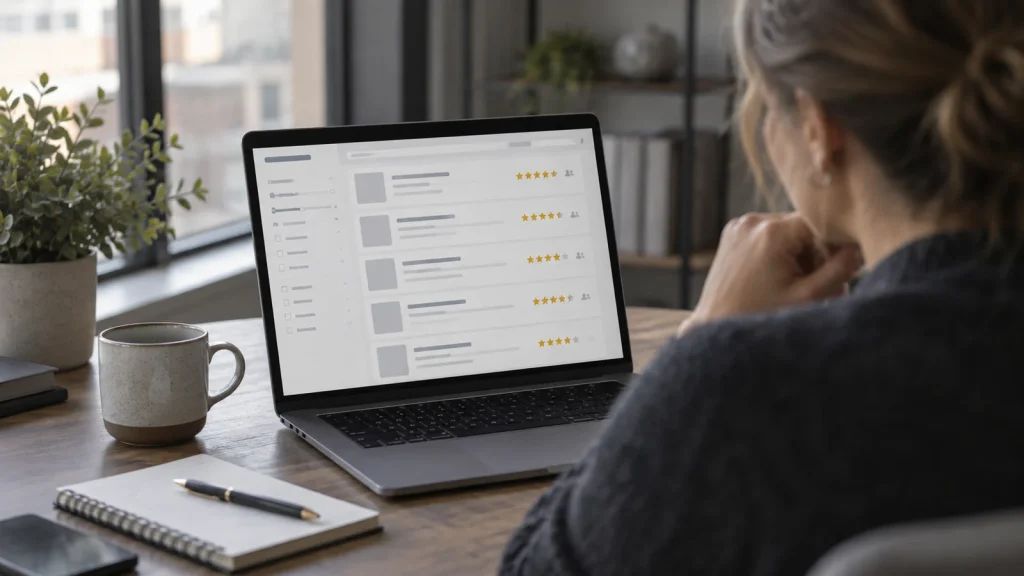
Reviews are the strongest ranking factor you fully control, accounting for roughly 20% of local pack weight, up from 16% in 2023 (Whitespark, 2026). They’re also the deciding factor for the human on the other end: 97% of consumers read reviews when evaluating a local business, and 85% are more likely to use a business after reading positive ones (BrightLocal, 2026).
The bar has risen. 41% of consumers now always read reviews when browsing, up from 29% a year earlier, and 31% require a rating of 4.5 stars or higher before they’ll consider a business (BrightLocal, 2026). A 4.2 rating used to be fine. It now filters you out for roughly a third of the market.
What actually moves the needle:
- Velocity over volume. A steady weekly trickle of reviews signals an active business better than 200 reviews earned two years ago. Which would you trust more as a customer?
- Response rate. Reply to everything, positive and negative. Consumers increasingly reject templated replies, so write like a person.
- Recency. Old reviews carry less weight with both Google and customers.
- Spread. Consumers routinely check more than one review platform before deciding, so a Google-only strategy leaves gaps.
Never buy reviews. Beyond the platform risk, it’s now a regulatory one: the US Federal Trade Commission’s Rule on the Use of Consumer Reviews and Testimonials (2024) directly targets fake reviews, and similar scrutiny is spreading.
How do you build local links that count?
Link signals carry roughly 15% of local pack weight and considerably more in local organic results (Whitespark, 2026). For a local business, a link from a genuinely local source generally outperforms a higher-authority link from an unrelated national site, because it reinforces geography as well as trust.
Where local links actually come from:
- Local business associations and chambers of commerce
- Sponsorships of local events, teams and charities
- Local press coverage of something you actually did
- Supplier and partner pages
- Universities and training institutions you work with
- Genuinely useful local resources you publish yourself
The MENA reality deserves honesty. Editorially independent local publications that will link without payment are scarce across much of the region, and a large share of sites that offer links are selling them openly. That pushes the practical strategy toward earned and relationship-based links: partnerships, original data, local research nobody else has published, and sponsorships with a real footprint. It takes longer than buying links, and it is also the only version that survives a spam update.
For how link building fits a wider organic program, see our SEO services.
How do you measure local SEO properly?
Rank position alone is close to meaningless in local search, because results shift with the searcher’s exact location. Two people three kilometers apart see different map packs for the same query. What exactly are you reporting, then, when you report a rank? Measurement has to account for geography, and it has to include the actions people take, not just impressions.
Track these five:
- Grid-based rankings. Rank across a geographic grid around your location rather than a single position. This is the only honest way to report local rank.
- Business Profile actions. Calls, direction requests, website clicks and message volume, all available in your profile insights.
- Organic performance for local queries. Filter Search Console by query to isolate city and neighborhood terms.
- Review metrics. New reviews per month, average rating trend, response rate.
- Attributed inquiries. Tag your Business Profile website URL with UTM parameters so profile-driven traffic separates cleanly from general organic in analytics.
Behavioral engagement signals, meaning clicks, calls, photo views and direction requests, carry around 8% of local pack weight (Whitespark, 2026). That makes your insights data a ranking input as well as a report.
Why local visibility now includes AI assistants
Local SEO gained a third surface in 2026, and it’s the fastest-growing one. 45% of consumers now use AI tools for local business recommendations, up from 6% a year earlier, making AI the third-largest local discovery channel behind only Google and Facebook (BrightLocal, 2026). ChatGPT specifically was used by 31%, and Google AI Mode by 23%.
The generational split matters for planning. 64% of consumers aged 30 to 44 have asked an AI assistant for a business recommendation, and 42% now trust AI-platform recommendations as much as written reviews (BrightLocal, 2026). This isn’t an early-adopter niche any more. It’s the middle of most service businesses’ customer base.
Tactically, this inverts a few familiar assumptions. Whitespark added AI search visibility as a formal ranking category for the first time in 2026, and the weightings invert some familiar assumptions. Business Profile signals matter considerably less for AI visibility. Citations matter roughly twice as much. On-page content and links carry close to double their local pack weight (Whitespark, 2026).
Remember those citations sitting at 7% of local pack weight? They’re one of the highest-value AI visibility signals, because a language model that has never crawled your Business Profile still learns you exist from consistent mentions across the web. The unglamorous consistency work turns out to be the AI work.
Practically, that means writing service pages that answer specific questions in extractable form, keeping your entity data consistent everywhere, and earning mentions on sites AI systems actually ingest. Our generative engine optimization service covers the full framework.
Working with a local SEO partner in Egypt and the Gulf
Local SEO in MENA carries execution problems that a generic playbook doesn’t address: bilingual entity data, transliteration decisions that compound over years, Arabic keyword clustering that no tool handles well, and a link market where the easy options are the dangerous ones. Getting these wrong is expensive to unwind.
VOCTOS works on all three local surfaces together: the map pack, local organic results, and AI assistant visibility. That means Business Profile optimization and bilingual NAP consolidation, city and neighborhood keyword architecture built for Arabic search behavior, review systems that generate steady velocity rather than bursts, and grid-based reporting that shows real coverage instead of a single flattering rank number.
Want to know where you currently stand? Send us the business name and we’ll audit your Business Profile and your bilingual citation footprint, then send back what we find. Request a free local SEO audit.
The questions we get asked most about local SEO
How long does local SEO take to show results?
Business Profile improvements can move rankings within weeks, since Google reprocesses profile data quickly. Review velocity and link building compound over months. Some local campaigns show measurable movement in profile actions within one to two months, though this varies by competition and starting position, with competitive map pack positions typically taking longer depending on how many established competitors sit inside the search radius.
Can I rank in a city where I don’t have an address?
It’s difficult, because distance is one of the three factors Google names for local results (Google Business Profile Help). You can compete in nearby areas through strong relevance and prominence signals plus dedicated location pages, but you cannot appear in the map pack for a city with no verified presence there. Service area configuration helps for mobile businesses.
Do Google Posts help my rankings?
No. A controlled nine-week study tracking 441 keywords found no ranking movement attributable to Business Profile posts (Sterling Sky, reported 2026). Posts remain useful for showing offers, events and updates to people already viewing your profile, so they support conversion rather than ranking. Treat them as a communication channel, not an SEO tactic.
How many reviews do I need to compete?
There’s no fixed number, because it’s relative to the businesses ranking in your radius. What’s measurable is the quality bar: 31% of consumers require 4.5 stars or higher, and 41% always read reviews before choosing (BrightLocal, 2026). Match the top three competitors in your map pack on rating first, then on recency, then on count.
Should my Google Business Profile be in Arabic or English?
Use the language your customers search in, and keep both versions consistent if you maintain both. Google supports multi-language profile data. The failure mode isn’t choosing wrong, it’s choosing differently on different platforms. Pick one canonical Arabic name and one canonical Latin-script name, then apply them identically everywhere.
Why would an AI assistant recommend my competitor instead of me?
Because AI visibility runs on different signals. Citations carry roughly twice the weight for AI search that they do for the local pack, and on-page content carries close to double (Whitespark, 2026). A competitor with consistent mentions across the web and clearer service pages can be recommended by ChatGPT even while ranking below you in the map pack.
Where to start
Local search rewards the businesses that get the boring parts right. Your primary category, your hours, one canonical NAP string per language, a steady flow of recent reviews, and service pages that answer real questions. Those five things account for most of the work.
Three things to do this week:
- Audit your primary Business Profile category against the most specific option available
- Pull every listing of your business you can find and compare the name, address and phone strings
- Check your current average rating against the top three competitors in your map pack
Then decide where the gap is widest. If reviews are your weak point, fix reviews before touching links. If your entity data is fragmented across five spellings, nothing else you do will compound properly until that’s consolidated.
Next, read our healthcare SEO playbook if you’re in a regulated vertical, or our guide to E-E-A-T to understand how Google judges whether your local content deserves to rank at all.
Related guides
- Healthcare SEO: A Practical Playbook for Clinics and Medical Centers
- AI Search Optimization in 2026: SEO vs GEO vs AEO vs AIO, and How to Get Cited by AI
- SEO Copywriting: How to Write Content That Ranks on Google and AI
- The Complete SEO Glossary: 89 Essential Terms & Definitions (2026 Edition)
- Salads UP Local SEO Case Study: #1 on Google in Ann Arbor & Madison
Don't miss the chance to
make your website more visible!
Initial consultation and
audit of the current situation

Read also

Article VOCTOS Is a Top SEO, PPC and SEM Company in Egypt on Clutch for 2026

Article Commercial Ranking Factors: The Complete List

Article The Title Meta Tag: What It Is and How to Write It
Article The Role of Meta Tags in Search Engine Optimization
Article Can You Sue an AI for Defamation? Where the Law Stands

Article Cloudflare’s 15 September AI Crawler Defaults: The Check Gulf and Egypt Brands Should Run Today

Article What ChatGPT Optimization Guides Still Get Wrong in 2026
Article Two Lists Named 37 GEO Experts in 2026. None of Them Publish in Arabic



Real Results
More Wins
SEO & GEO for Delta Medical Labs
 GEO
GEO
1M+ monthly organic visits, 159,200 ranked keywords, 5,570 pages cited by AI engines, and 1,186 #1 rankings in KSA.

Arabic SEO, GEO & guest posting for VPNly
 SEO
SEO
65K peak monthly organic visits, 55 guest posts, and 149 pages cited by AI engines.

SEO & GEO for Ogaei Virtual Care
GEO
From 3 to 7,931 monthly organic clicks in 7 months, 2.9M+ impressions, and 40+ keywords in Google’s Top 10.

SEO for Eduverse
SEO
12× search traffic in 10 months, 45% of target keywords in the top 5, and 55% in the top 10.
Trusted by