How to Find Related Keywords and Use Them Properly in 2026
A senior agency guide to finding related keywords and using them to build topical authority that wins in both Google and AI search.

SEO Content Strategy 2026: A Practical Plan for Egyptian Brands
The Voctos framework for building an SEO content strategy that drives commercial outcomes for Egyptian businesses.
SEO Guide 2026: How to Win Search and AI Visibility in Egypt
A complete, no-fluff SEO playbook for Egyptian businesses in 2026. Built from 290+ Voctos projects across 60+ countries.

Why Voctos Is the Best AI-First Digital Marketing Agency in Egypt for 2026
“Best agency in Egypt” is a phrase used freely in this market. We use it carefully. This article is the honest case for why Voctos is the best AI-first digital marketing agency for Egyptian brands in 2026 — backed by what we actually do, not what we claim.
What “AI-first” should actually mean in 2026
“AI-first” has become a marketing label attached to every agency in Egypt that uses ChatGPT for ideation. That is not AI-first work. AI-first means three things at once:
- The output is engineered for AI search surfaces — ChatGPT, Gemini, Perplexity, Copilot, Google AI Overviews — alongside classic search.
- The production process uses AI as a senior tool, with senior human editing, original research, and strategic direction that AI cannot replicate.
- The measurement framework includes AI search KPIs — citation rate on a prompt set, AI Overview presence, AI referral traffic — not just classic rank tracking.
By that definition, very few agencies in Egypt qualify. Voctos was built around it.
Six concrete reasons Egyptian brands choose Voctos
1. A senior team operating across the full search stack
SEO, Generative Engine Optimization, Answer Engine Optimization, AI search optimization, paid search, and the technical and content work that ties them together — all run by one integrated senior team.
2. 2025 Google Premier Partner
Premier Partner status is held by a small percentage of agencies in any market. It signals sustained certified expertise, meaningful spend volume, and demonstrated performance. Egyptian brands working with us benefit from the access and benchmarking that comes with this status.
3. Four years of operating history, 290+ projects, 60+ countries, 140+ clients
Founded in Cairo in 2021. Long enough to have real data and a track record. Recent enough to have built the agency around AI search from the ground up — not bolted onto a legacy practice.
4. Original content, not translated templates
Every page and article we ship for clients is original, locally grounded, and built for senior craft. Translated content from US/UK competitors is the single biggest mistake we see Egyptian brands make. We do the opposite.
5. Measurement that survives a CFO
Decision-grade reporting tied to business outcomes — not channel-level vanity dashboards. Brands that work with us know what the work delivered, and why.
6. Honest scoping
We turn down work that isn’t a fit — budgets that can’t support senior craft, brands without product-market fit, engagements that would underperform because the relationship is set up wrong. That discipline is part of why our clients stay.
How we work differently from the typical Egyptian agency
One team, one editorial calendar. SEO, GEO, paid, creative, and content work off a single plan. No silos.
Prompt-set monitoring as standard. Every engagement that touches search includes monthly prompt-set tracking across major AI engines. Most Egyptian agencies don’t offer this yet.
Citation-worthy content production. Original surveys, frameworks, definitions — the kinds of assets LLMs preferentially cite. Generic blog content doesn’t earn AI citations; we do not ship generic blog content.
Schema layering beyond the basics. Article, FAQPage, HowTo, Service, SpeakableSpecification, Organization, BreadcrumbList — every page audited and equipped with the schema it deserves.
Continuous authority work. Earned mentions, contributed bylines, and senior outreach as a sustained program, not a one-quarter push.
What working with Voctos looks like in practice
Engagements typically begin with a 90-day foundation phase — audit, top-page rebuild, authority sprint, measurement setup, editorial cadence — followed by ongoing monthly retainers tuned to the client’s goals. Reporting cadence is monthly with quarterly strategic reviews.
We work with brands that take their organic and paid channels seriously enough to invest in senior craft. If that’s where you are, our Cairo team is ready to talk.
Frequently Asked Questions about Voctos as an AI-First Agency
What makes Voctos different from other Egyptian digital marketing agencies?
Integrated senior practice across SEO, GEO, AEO, AI search, paid search, content, and creative — all run by one team, with measurement that ties to business outcomes. We were built around the AI search shift, not retrofitted for it.
Do you work with brands outside Egypt?
Yes. We’ve delivered 290+ projects across 60+ countries from our Cairo base. Brands in MENA and globally hire us specifically because of our integrated AI-first practice.
What kinds of brands does Voctos work best with?
Brands that take search seriously, expect strategic challenge from their partner, and want measurable outcomes over executive theater. Our best engagements are with leadership teams that invest in senior craft.
What is the minimum engagement size?
Our engagements are sized to support senior craft. Below a certain monthly investment, the only work that’s deliverable is junior execution — which we don’t sell. We’re upfront about fit during early conversations.
How do I start working with Voctos?
Reach out through our contact page. Initial conversations are scoping discussions, not sales pitches — we use them to understand whether the engagement will deliver the outcomes both sides want.

GEO: Generative Engine Optimization – Your Guide to Ranking on ChatGPT
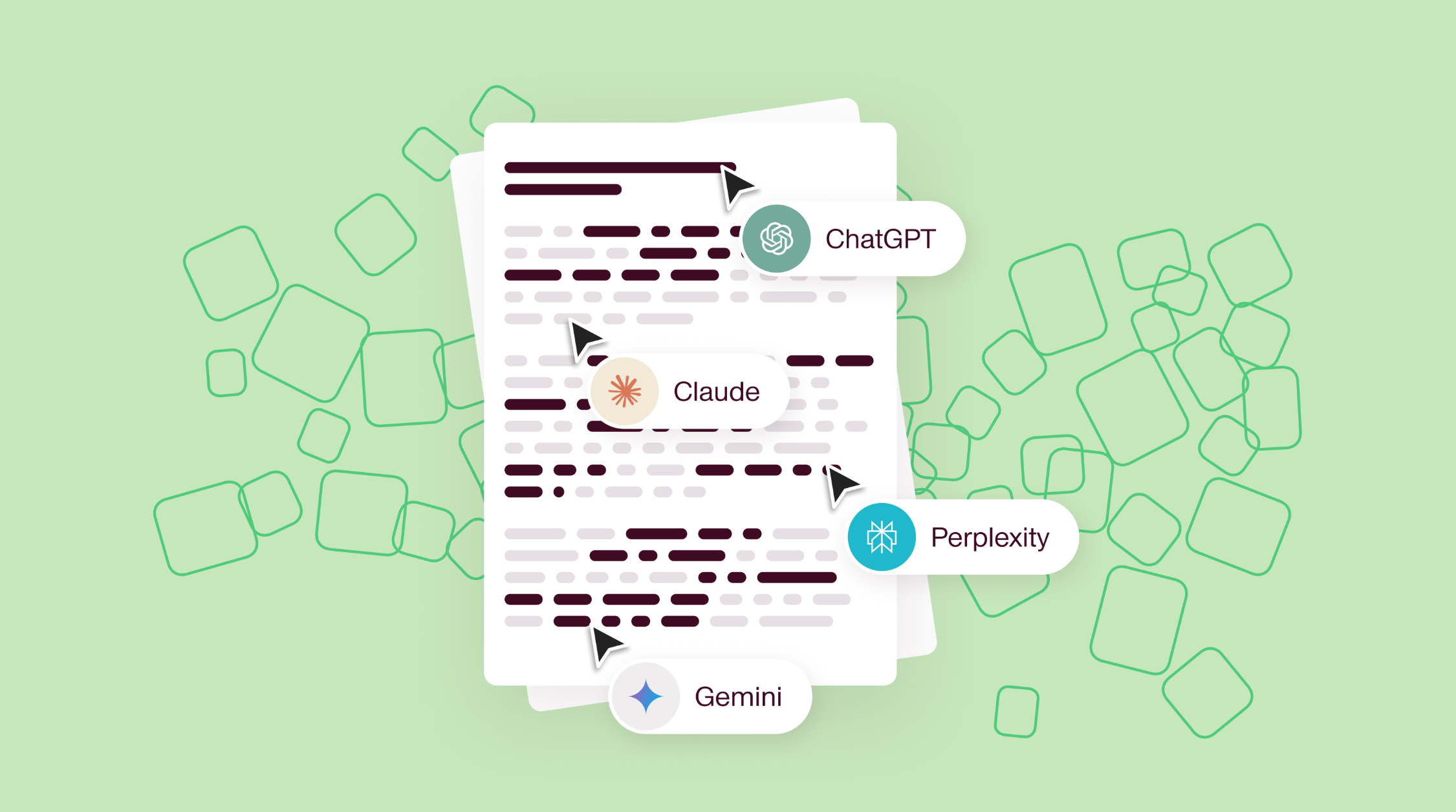
Six years ago, our agency was helping Egyptian brands climb the ten blue links on Google. Today, more than half of those same brands tell us a different story: their customers are quoting answers they read inside ChatGPT, Google AI Overviews, Gemini, and Perplexity — without ever clicking a search result. That shift is exactly why Generative Engine Optimization (GEO) stopped being a buzzword and became a budget line for serious Egyptian marketing teams in 2026.
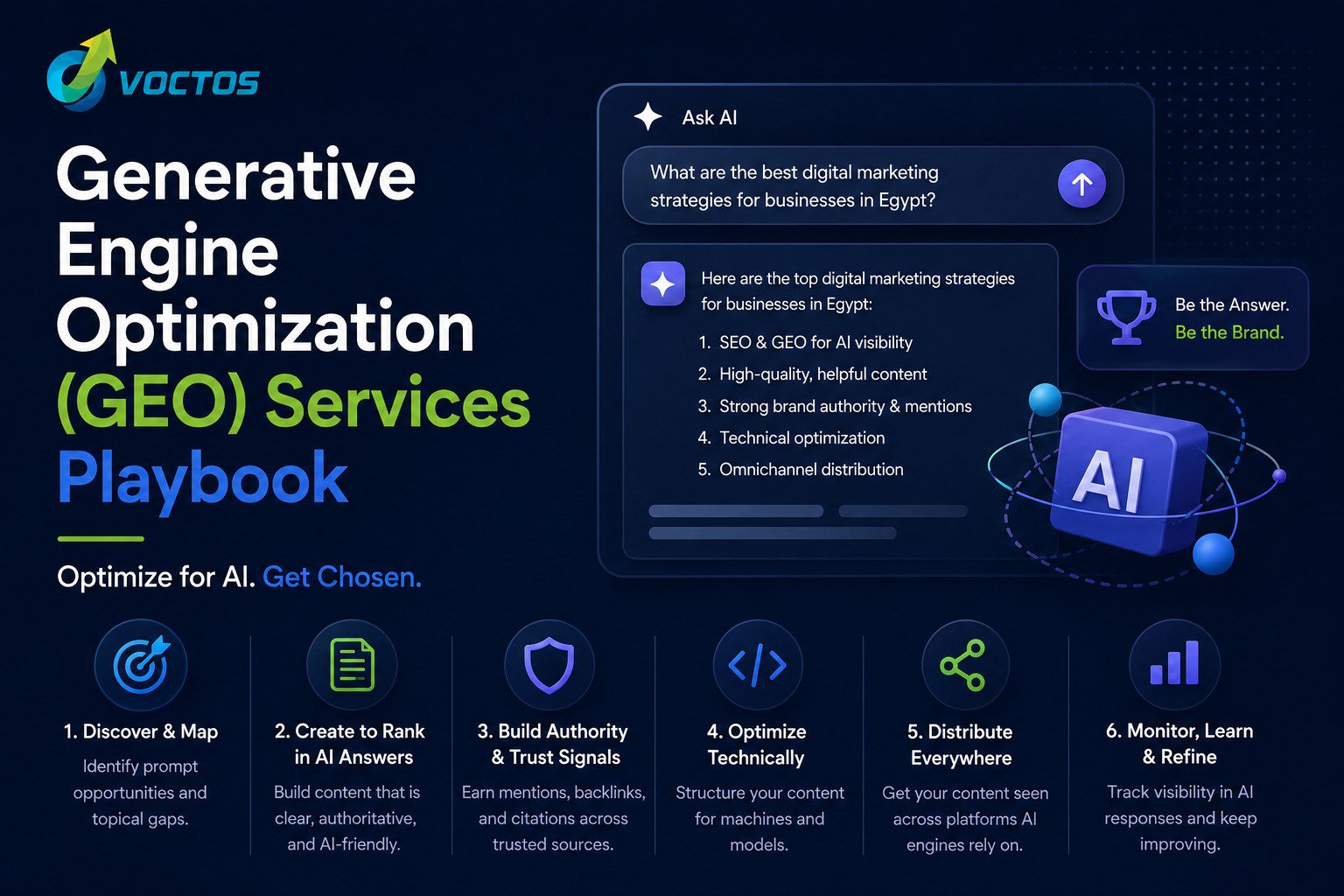
This guide is the same playbook our senior team at Voctos uses to position Egyptian brands inside generative answers. It covers what GEO actually is, why it is urgent for Cairo and Alexandria brands right now, the five pillars of execution, how we measure it, what mistakes cost brands the most, and what a real GEO engagement delivers. No fluff — the same document our strategists work from.
GEO and Answer Engine Optimization (AEO) share most of the same technical foundation. The distinction: AEO targets explicit question-answer pairs (Featured Snippets, PAA, voice answers); GEO targets broader generative responses where an AI model synthesises multiple sources into a recommendation, comparison, or summary. In practice, the content assets built for one almost always serve the other.
What Generative Engine Optimization Actually Means in 2026
GEO is the discipline of structuring a brand’s entire web presence — content, schema, entity signals, off-domain authority — so that large language models (LLMs) cite it when they generate answers. It is not “SEO with a new label.” The differences are structural:
- Traditional SEO optimises for ranking on a results page — position 1–10 for a target keyword.
- GEO optimises for being extracted, summarised, and cited inside an AI-generated answer — where the metric is share of voice within generative responses, not a SERP position number.
The LLMs powering generative search do not rank pages. They reason about entities, evaluate credibility signals, and extract from sources they have been trained to trust. A brand that ranks at position one on Google but has no structured entity presence, no original data, and no off-domain mentions may have zero GEO visibility in the same query space.
For Egyptian businesses, the practical difference is significant. A clinic in Maadi can no longer rely on a Google Business Profile alone — when a patient asks ChatGPT “best dermatology clinic in Cairo for adult acne,” the model does not open Google Maps. It pulls from indexed text, structured data, and authoritative mentions across the open web. The clinic that wins that answer is the one with the clearest entity definition, the most specific and helpful content, and the strongest off-domain credibility signals. That combination is what GEO builds.
Why GEO is Urgent for Cairo and Alexandria Brands Right Now
Three signals confirm that 2026 is the inflection year for the Egyptian market:
- AI Overviews are now default for English informational queries served from Egypt — including high-intent commercial terms like “digital marketing agency Cairo,” “best CRM for SMEs Egypt,” and “real estate investment New Cairo.” If your brand is not cited inside those overviews, you are invisible at the top of the funnel.
- ChatGPT browsing and Perplexity are now standard research tools for Egyptian B2B buyers, particularly in fintech, real estate, SaaS procurement, and healthcare. These buyers formulate their shortlists inside AI conversations before they visit a single website.
- Click-through rates from classic SERPs are collapsing for informational and navigational queries. If your content lives on page one of Google but never gets cited by an LLM, your organic traffic curve will flatten and then decline regardless of your rankings.
At Voctos — founded in Cairo in 2021, with 290+ projects delivered across 60+ countries for 140+ clients, named a 2025 Google Premier Partner — we started rebuilding our deliverables around generative visibility in 2024. The brands appearing inside AI answers today were optimised 12–18 months ago. The window to build GEO visibility before competitors is narrowing.
The Five Pillars of a Serious GEO Strategy
Pillar 1: Entity Establishment and Brand Grounding
LLMs reason in entities, not keywords. Before a model can recommend your brand, it must know your brand exists, understand what category you compete in, and have access to attributes that describe you accurately. Without this foundation, even excellent content gets ignored — the model simply does not have enough grounding to cite you confidently.
The entity work we do for every GEO client:
- Wikidata entity creation or enrichment with verified attributes (founding date, location, industry, founders, products/services, clients).
schema.org/Organizationandschema.org/LocalBusinessmarkup on the homepage and key landing pages, validated and kept current.- Consistent NAP (Name, Address, Phone) citations across Egypt’s major directories and global databases (Google Business Profile, Yelp, Foursquare, data aggregators).
- Authoritative co-mentions in Egyptian trade publications that establish your brand’s existence in the context of your industry.
- Founder and leadership profiles on Crunchbase, LinkedIn, and sector-specific databases — LLMs use these to assess team credibility and organisational legitimacy.
Pillar 2: Answer-First Content Architecture
Generative engines extract sentences, not pages. If your most important claim is buried in paragraph six, it loses to a competitor who stated the same thing in paragraph one. The content architecture that wins generative citations follows a consistent pattern: answer → evidence → expansion.
- Answer: A direct, self-contained response to the implied question — 40–60 words, grammatically complete, free of jargon that requires surrounding context to understand.
- Evidence: The data point, study, case example, or logical chain that substantiates the answer. LLMs prefer claims backed by verifiable evidence — citing a statistic from your own research is significantly more powerful than asserting a general principle.
- Expansion: Additional depth, caveats, internal links, and a natural path forward for human readers who want more.
This pattern applies to every content type: service pages, blog articles, case studies, FAQs, and even product descriptions. For the full editorial framework we build GEO content inside, read our SEO Content Strategy 2026 for Egyptian Brands.
Pillar 3: Citation-Worthy Assets
LLMs strongly prefer to cite original data, proprietary frameworks, named methodologies, and primary research. A brand that publishes an Egypt Digital Spending Benchmark 2026 will be cited far more reliably than one rewriting listicles sourced from global templates. The reason is structural: original data has a unique provenance that the model can attribute, while generic content is indistinguishable from thousands of similar pages.
The citation-worthy assets we produce for GEO clients:
- Proprietary surveys and benchmarks (even a 150-response survey of Egyptian businesses in your sector qualifies as original research).
- Named frameworks and methodologies — if you have a repeatable process, name it, document it, and publish it with clear attribution.
- Field studies and case data drawn from real client engagements, with specificity about outcomes, timeframes, and conditions.
- Data stories pitched to Egyptian and regional media, creating off-domain citations that reinforce the brand’s role as a primary source.
Pillar 4: Structured Data Depth
Schema markup is the machine-readable bridge between human content and model reasoning. For GEO we go well beyond the basics, deploying a schema stack tailored to the page’s intent and the brand’s sector:
- Article + author markup with full E-E-A-T signals (named expert, credentials, publication date, review date).
- FAQPage and HowTo for question-heavy and process-driven content.
- SpeakableSpecification marking the specific sections optimised for voice extraction.
- Dataset for research and benchmark content — signals to models that the page contains structured, referenceable data.
- ClaimReview for fact-checking and evidence-based content categories.
- Service, Product, and LocalBusiness for commercial pages targeting location and category queries.
Every schema block is validated against Google’s Rich Results Test and the Schema.org validator before deployment. Mass-generated, duplicate schema across pages is a pattern Google’s quality systems now explicitly penalise — we build each block specifically for its page.
Pillar 5: Off-Domain Authority Signals
LLMs are trained and grounded on the open web. If your brand is only visible on your own domain, you are essentially invisible to them during the grounding phase when the model assesses citation candidates. Real GEO requires a parallel off-domain programme:
- Earned mentions in Egyptian business press (Daily News Egypt, Al-Mal, Amwal Al Ghad) and regional tech media (Wamda, MENAbytes, Magnitt).
- Presence in respected industry roundups, “best of” lists, and category directories that LLMs treat as credibility validators.
- Consistent expert profiles for founders and senior team members on platforms that models actively draw from: Crunchbase, LinkedIn, Forbes Middle East contributor pages.
- Review acquisition on Google Business Profile, Clutch, and G2 — review content is indexed and contributes to entity credibility in the model’s grounding.
For the full off-domain authority programme, see our guide on Off-Page SEO in 2026: The Tactics That Still Boost Visibility.
Local Context: What Is Different About GEO for Egypt
Generic global GEO advice misses two structural features of the Egyptian market that change the execution significantly.
Bilingual answer competition. Many Cairo professionals and B2B buyers query in English but expect locally relevant answers. At the same time, a large portion of Egyptian B2C consumers query in Arabic — and Arabic GEO is dramatically less competitive than English GEO for most categories. A bilingual GEO programme with proper hreflang, Arabic entity signals, and Arabic-language answer-first content typically expands a brand’s generative share of voice by 40–60% beyond what an English-only programme achieves.
Trust signals are relationship-driven. In Egypt, reviews on Google, Facebook, and category-specific platforms feed model grounding far more heavily than they do in mature Western markets — because high-quality Egyptian-language review content is relatively scarce, making each review proportionally more impactful in the model’s entity assessment. An aggressive review acquisition programme is therefore a higher-leverage GEO investment in Egypt than it would be for a comparable European brand.
How We Measure GEO Success at Voctos
Measurement is where most “GEO services” in Egypt fall apart — because there is no Google Search Console for ChatGPT. We track GEO performance across five measurable dimensions:
- Brand citation rate: We maintain a fixed prompt set of 30–50 queries where the client should appear. Monthly, we test each prompt across ChatGPT, Gemini, Perplexity, and Copilot. We record whether the brand is cited, where in the response, and how the citation is framed. The citation rate (% of prompts where the brand appears) is the primary GEO KPI.
- AI Overview presence: For target keywords with AI Overview triggers, we track whether the client’s domain is included in the overview sources. Semrush and Ahrefs now flag AI Overview presence in their SERP features data.
- Referral traffic from AI engines: GA4 now captures direct referrals from Perplexity, ChatGPT browsing mode, and Copilot as identifiable sources. We track sessions, engagement rate, and conversion rate from these sources monthly.
- Branded search volume: AI visibility that builds brand recall drives direct and branded search. We track branded query impressions in Search Console as a downstream GEO indicator — growing branded search is often the first measurable signal that GEO is working before citation-rate data matures.
- Citation-worthy content velocity: How many original, quotable assets (data studies, named frameworks, case data) the client publishes per quarter. This is a leading indicator of future citation share growth.
To connect GEO signals to revenue outcomes inside GA4, read our guide on How to Use GA4 Reports to Define Your SEO Priorities for 2026.
Common GEO Mistakes We Fix When We Audit Egyptian Sites
Treating GEO as a content problem only. The most expensive mistake. Without entity work and structured data, beautifully written articles still get ignored by LLMs — the model has no reliable grounding signal to cite the brand confidently. Content and entity work must run together from the first sprint.
AI-generated FAQ stuffing. Publishing mass-generated FAQ blocks across every page pollutes topical authority, creates thin redundant pages, and triggers Google’s quality classifiers — hurting both classic SEO and GEO simultaneously. We routinely strip 40–60% of FAQ content during GEO audits and rebuild the remaining entries around questions with demonstrable search volume and genuine informational value.
Publishing translated competitor content. Common among Egyptian SMEs trying to match global competitors quickly. LLMs detect near-duplication at the semantic embedding level — a paraphrase of a US agency’s GEO services page will not win citations, because the model already has the original. Original data, original frameworks, and original Egyptian-market specificity are the only reliable path to citation inclusion.
No off-domain programme. Investing in GEO content without simultaneously building off-domain mentions and authority signals is like building a house on sand. The model’s grounding pass evaluates your brand across the entire web — if you only exist on your own domain, your citation rate will plateau regardless of how good your content is.
Expecting results in 30 days. GEO operates on a 60–120 day feedback loop between content publication, model training/grounding updates, and citation appearance. Clients who expect immediate returns misallocate their attention — the right frame is a 6–12 month compounding programme, not a quick-win campaign.
What Our GEO Engagement Looks Like
A typical Voctos GEO engagement runs 90 days for the foundation phase:
- Week 1–3: Full entity audit, structured data gap analysis, content audit against AI answer patterns, competitor citation-rate benchmarking, and prompt-set construction.
- Week 4–6: Entity remediation (schema deployment, Wikidata, directory citations), content brief production for the first cohort of GEO-optimised pages, and off-domain outreach planning.
- Week 7–12: First cohort of citation-worthy content published, schema validated and deployed, off-domain mentions secured in at least two Egyptian or regional publications, baseline prompt-set measurement established.
From month four onward, the engagement moves into a continuous GEO programme: monthly prompt-set monitoring, fresh primary research published quarterly, ongoing authority outreach, and a competitive displacement protocol — when a competitor appears in a prompt where we target citation, we respond with a content or authority action within 30 days.
Frequently Asked Questions about GEO in Egypt
Is GEO replacing SEO?
No. GEO and SEO share most of the technical foundation — crawlability, structured data, content quality, and off-page authority. GEO adds entity establishment, answer-first content engineering, and prompt-set measurement on top of that foundation. A brand that abandons SEO to chase GEO will lose both: without strong SEO signals, LLMs have insufficient grounding to cite you confidently. The brands winning in 2026 treat GEO as an extension of SEO, not a replacement. For a detailed breakdown, see our guide on GEO vs SEO for Egyptian Businesses: What Actually Changes in 2026.
How long before GEO results show up?
For Egyptian brands with an existing domain authority profile (DR 30+), brand citation rate inside ChatGPT and Perplexity typically begins moving within 60–90 days of the foundation sprint. AI Overview presence on Google tends to follow at 90–120 days, because the underlying SEO signals need to mature alongside the entity work. Brands starting from a low authority base should plan for 6–9 months before citation rates become reliable and defensible.
What budget range makes sense for GEO in Egypt?
GEO requires the same resource categories as a serious SEO programme — content, technical implementation, and off-domain authority work — plus the additional layer of entity establishment and prompt-set monitoring. Most of our GEO retainers in Egypt are structured as SEO programmes with GEO layered on top, priced at a meaningful premium over basic SEO. Anything below the cost of a single mid-level in-house marketer is unlikely to produce the entity work, citation-worthy content, and authority outreach that GEO requires to work.
Can we do GEO without doing SEO first?
Only if your site is already technically clean and domain-authoritative. In practice, we run both together — every GEO sprint at Voctos delivers SEO improvements as a structural by-product, because the same fundamentals (schema, content depth, authoritative links) power both disciplines. For a site with significant technical debt, we recommend a parallel-track programme that addresses technical SEO and GEO foundations simultaneously rather than sequentially.
How do you measure GEO for Arabic queries?
We maintain separate Arabic-language prompt sets for clients with Arabic GEO programmes, tested monthly in ChatGPT (which handles Arabic well) and Gemini. Arabic GEO measurement is less tooled than English at the moment — most third-party platforms do not yet track Arabic AI Overview presence reliably — so we supplement automated tracking with manual prompt testing by native-Arabic speakers on our team.
What makes Voctos different from other GEO agencies in Egypt?
We are a Cairo-founded agency (2021) with 290+ projects across 60+ countries and 140+ clients, named a 2025 Google Premier Partner. Our GEO programme is not a rebranded content service — it is a measurement-driven discipline with a defined entity audit, a structured content architecture, a monthly prompt-set scorecard, and a competitive displacement protocol. We operate with the same rigour on generative search that we bring to traditional SEO, paid media, and AEO. We also have the only bilingual (English + Arabic) GEO delivery capability among Egypt-based agencies we are aware of.
Related Reading from Voctos
GEO works best inside a complete search strategy. Continue with these companion guides:
- AEO Services in Egypt: Win Zero-Click Search
- AI Search Optimization in Egypt: ChatGPT, Gemini & Perplexity
- GEO vs SEO for Egyptian Businesses: What Actually Changes in 2026
- SEO Guide 2026: How to Win Search and AI Visibility in Egypt
- SEO Content Strategy 2026 for Egyptian Brands
- Off-Page SEO in 2026: The Tactics That Still Boost Visibility
- How to Use GA4 Reports to Define Your SEO Priorities for 2026
- Case Study: How Voctos Grew Ogaei’s Organic Traffic by 264,233% in 9 Months

Voctos Named a 2025 Google Premier Partner: What This Means for Our Clients
Earlier this year, Voctos was named a 2025 Google Premier Partner — Google’s top-tier recognition for digital advertising agencies. Premier Partner status is granted to a small percentage of agencies in any market and reflects sustained performance, certified expertise, and meaningful campaign spend across the Google Ads ecosystem.
This article explains what the recognition means, how Google decides who earns it, and — most importantly — what it changes for the brands we work with.
What “Google Premier Partner” actually means
Google operates a multi-tier partner program for digital advertising agencies. The top tier — Premier Partner — is reserved for agencies that meet rigorous, measurable criteria across three areas:
- Certified expertise. A minimum number of certified strategists across Search, Display, Video, Shopping, Apps, and Measurement. Certifications must be active and continually renewed.
- Sustained spend. Meaningful annual ad spend managed across the agency’s client base — a signal that the agency operates at scale, not as a side practice.
- Demonstrated performance. Year-over-year growth in client revenue and ad performance, measured against Google’s quality benchmarks.
Only the top 3% of participating agencies in any region typically reach Premier status. For Voctos, founded in Cairo in 2021 and now operating across 60+ countries, achieving Premier Partner status in 2025 reflects four years of disciplined practice.
Why this matters for our clients
Premier Partner status is not a marketing badge. It changes several practical things in how we operate.
Direct access to Google account teams
Premier Partners receive dedicated Google account managers who provide early access to beta features, strategic consultation, and escalation paths for technical issues. Our clients benefit from this access without any additional cost.
Beta and early access to new products
New Google Ads features — bidding strategies, creative formats, audience tools — typically reach Premier Partners weeks or months before they go fully public. Clients on our roster get to test and benefit from these features earlier than the market.
Performance benchmarking against the top tier
Google shares performance benchmarks with Premier Partners that help us identify exactly where each client’s account sits relative to the strongest performers in their category. This data is not publicly available.
Senior certification depth across the team
The certification requirements force a level of senior expertise across the agency that lower-tier programs do not require. Every strategist on a client account is operating with current, validated knowledge of the platform — not skills last updated in 2022.
How Voctos earned Premier Partner status
The recognition came from four years of disciplined Google Ads practice across 290+ projects in 60+ countries for 140+ clients. We invested early in certification depth, refused to take on accounts we couldn’t run to senior standards, and built measurement infrastructure that lets us prove performance — not just report on it.
The Premier badge is the result of that approach, not its starting point.
What this signals about our broader practice
Google Ads is one of several disciplines we run with the same rigor — alongside SEO, Generative Engine Optimization, AI search optimization, social media marketing, content production, and analytics. Premier Partner status for paid search is one external validation. The internal standard applies to every channel.
What’s next
Premier Partner is renewed annually. We treat it as a continuous benchmark, not a one-time achievement. The certifications get refreshed every cycle. The performance bar moves up every year. Our clients benefit from an agency that has to stay senior to keep its status — not coast on a 2018 success.
For brands in Egypt and across MENA looking for a Google Ads partner that operates at the top tier, our team is ready to talk.
Frequently Asked Questions about Google Premier Partner Status
What is a Google Premier Partner?
It is the top tier of Google’s agency partner program, granted to agencies that meet rigorous criteria in certified expertise, ad spend volume, and performance. Only the top 3% of participating agencies typically reach this tier in any region.
How is Premier Partner different from Google Partner?
Standard Google Partner status has lower thresholds for certification, spend, and performance. Premier Partner is the senior tier with strict requirements and additional benefits like dedicated Google account access and earlier beta features.
Does Premier Partner status guarantee better ad performance?
It is a strong signal of agency capability, not an automatic guarantee. The actual performance depends on the agency’s senior craft and how it applies the resources and access that Premier status provides.
Is Voctos Premier status valid for clients outside Egypt?
Yes. Premier Partner status applies globally. Our clients across 60+ countries benefit from the same access, certifications, and performance benchmarking that the badge represents.
Why work with a Premier Partner like Voctos?
Direct Google account team access, early beta features, senior certified strategists, and category-level benchmarking — combined with our integrated SEO, GEO, and AI search practice — give clients a meaningfully different result than a standard agency engagement.

Five Real Reasons Voctos Is the Right Digital Marketing Agency for Egyptian Brands in 2026
This article is the senior, no-sales-deck version of why Egyptian brands choose Voctos in 2026. Five reasons — backed by what we actually do, not by adjectives.
Reason 1: We operate as an AI-first agency, not an AI-curious one
Most Egyptian agencies talk about AI. Voctos was built around it. Every engagement that touches search includes Generative Engine Optimization, Answer Engine Optimization, and AI search measurement as standard deliverables. Our content is engineered for ChatGPT, Gemini, and Perplexity citations alongside classic Google rankings. Our reporting tracks AI referral traffic and prompt-set citation rate as first-class KPIs.
Reason 2: We are a 2025 Google Premier Partner
Premier Partner is the top tier of Google’s agency program — granted only to agencies that meet rigorous criteria in certified expertise, spend volume, and performance. Our clients get direct Google account team access, early beta features, and category-level benchmarking that lower-tier programs do not provide.
Reason 3: Senior practice across the full marketing stack
Voctos runs SEO, GEO, AEO, AI search optimization, paid media (Google Ads, Meta, TikTok, LinkedIn), content production, creative, and analytics — all under one senior team. The brands we work with do not have to coordinate three or four vendors with conflicting strategies. The integration is the product.
Reason 4: Original content built for Egyptian intent
The single biggest mistake we see Egyptian brands make is publishing translated content from US/UK competitors. It almost never ranks, almost never gets cited by AI, and almost always wastes the writing budget. Every page and article we ship for clients is original and built around real Egyptian use cases, language, and intent.
Reason 5: Measurement that ties to business outcomes
Senior reporting answers leadership’s questions — what did the work deliver, what should we do next, and why. We build measurement around real KPIs: pipeline contribution, branded search lift, AI citation rate, CAC and ROAS trends. Channel-level vanity dashboards are not what we sell.
The track record behind the reasons
Voctos was founded in Cairo in 2021. Across four years we’ve shipped 290+ projects in 60+ countries for 140+ clients. We are a 2025 Google Premier Partner. Our senior team has been delivering integrated AI-first marketing for Egyptian and MENA brands since the AI search shift began.
How we work in practice
Engagements typically begin with a 90-day foundation phase — audit, top-page rebuild, authority sprint, measurement setup, editorial cadence — followed by ongoing monthly retainers tuned to the client’s goals. Strategic reviews quarterly. Tactical reporting monthly. Course corrections weekly.
Frequently Asked Questions about Choosing Voctos
What industries does Voctos work with in Egypt?
Across 140+ clients we’ve delivered work for fintech, real estate, e-commerce, B2B SaaS, healthcare, education, hospitality, and professional services. The unifying factor is brands that take their marketing seriously enough to invest in senior craft.
Can Voctos work with international brands targeting Egypt?
Yes. Many of our engagements are international brands entering or scaling in the Egyptian and broader MENA market. Our local expertise combined with our global delivery makes this a particularly strong fit.
How quickly does Voctos deliver results?
Paid channels move within weeks. SEO, GEO, and AI search compound over 90–180 days. We’re honest about timelines during scoping — the brands that expect instant results from organic channels are not our best fit.
What is the minimum monthly investment to work with Voctos?
Our engagements are sized to support senior craft across multiple disciplines. Token budgets that only fund one channel rarely deliver the integrated results we build for. We discuss budget fit honestly during scoping.
How do I start a conversation with Voctos?
Reach out through our contact page. The first conversation is a scoping discussion — we use it to understand whether the engagement will deliver the outcomes both sides want.

How to Win and Hold High Google Rankings in Egypt 2026: A Senior SERP Playbook
Climbing to the top of a Google SERP is a campaign. Staying there is a discipline. Most Egyptian brands invest seriously in the climb, then under-invest in the discipline — and watch their rankings erode within a year.
This article is the senior playbook we use at Voctos to win and hold high Google rankings for Egyptian brands in 2026. It covers what actually moves the needle today, what’s changed since the AI Overview rollout, and how to defend visibility once you have it.
What “ranking high” means in 2026
The classic definition — position one in the ten blue links — is no longer enough. A high-performing 2026 ranking strategy targets four surfaces simultaneously:
- Classic organic rank (positions 1–10 on the SERP).
- Featured snippet and PAA presence (the answer block above and inside the SERP).
- AI Overview citation (the AI summary at the top of the page).
- AI engine citations (ChatGPT, Perplexity, Gemini, Copilot).
Brands that rank classically but never get cited inside AI Overviews lose mind-share and traffic faster than the rank tracker can flag. The defense is multi-surface visibility.
The five pillars of holding a top Google ranking in Egypt
1. Senior content depth
Pages that ranked on shallow content five years ago are being replaced by pages with senior craft, original data, and clear E-E-A-T. The minimum viable content quality in competitive Egyptian categories has risen. Updating thin pages with deeper, locally grounded content is the most reliable rank defense.
2. Technical foundation that doesn’t slip
Core Web Vitals — LCP, INP, CLS — directly affect rank stability. Egyptian mobile networks compound the impact: a page that’s “OK” on a fast US connection can be “poor” on Egyptian mobile, which feeds back into ranking signals. Continuous performance monitoring matters as much as one-off optimization.
3. Internal linking that establishes topical authority
Pages that rank high without strong internal linking are fragile. Every new piece of content should pass relevance and equity to the pages you’re defending — and every defended page should be linked into from multiple contextual sources.
4. Continuous authority work
Backlink profiles decay. Earned mentions age. The brands that hold top rankings are the ones running continuous senior outreach — not the ones who built a profile in 2022 and stopped.
5. AI search readiness
AI Overview presence and AI engine citations are now part of rank defense. Pages that get summarized out of the SERP lose effective rank even when the position number stays the same. Schema layering, answer-first structure, and entity reinforcement are non-negotiable.
Egypt-specific factors that affect SERP rankings
Bilingual competition. Many Egyptian queries surface English and Arabic results in the same SERP. Brands that publish only one language miss visibility on the other.
Local intent layering. Even non-local queries served from Egypt now show Egyptian context in the SERP. Pages that ignore local relevance lose to pages that lean into it.
Mobile dominance. Mobile traffic share in Egypt is among the highest globally. Mobile-first design and performance are rank-critical, not secondary considerations.
Reviews and trust signals. Local pack and AI Overview citations both lean heavily on review platforms. Egyptian businesses with weak review programs under-rank against competitors with similar content.
What to do in the first 90 days of a serious ranking program
- Full audit — content, technical, links, schema, AI Overview presence, prompt-set baseline.
- Top-page rebuild — the top 10–20 revenue-driving pages restructured for senior content depth, answer-first writing, valid schema, and clean internal linking.
- Authority sprint — outreach to a curated list of respected outlets for earned mentions and contributed bylines.
- Measurement setup — Search Console hygiene, GA4 segments for AI referral, rank tracking with AI Overview flagging, prompt-set monitoring across ChatGPT/Gemini/Perplexity.
- Editorial cadence — a sustainable production rhythm of two to four senior articles per month, built into the topical map.
How to defend rankings once you have them
The defense is unglamorous: ongoing content refreshes (every important page reviewed and updated at least twice a year), continuous internal linking from new content into defended pages, persistent authority work, and tight monitoring with rapid response to drops. Brands that operate this discipline rarely lose rankings to algorithm updates because the underlying signals stay strong.
How Voctos runs ranking and defense programs
Every Voctos SEO engagement includes ranking acquisition and defense as a single program. We do not deliver “we got you to position one” and walk away — durable visibility requires durable practice. Our senior team operates with the same discipline we bring to GEO, AEO, and the integrated organic search programs we build for Egyptian clients.
Voctos was founded in Cairo in 2021 and is a 2025 Google Premier Partner. Across 290+ projects in 60+ countries for 140+ clients, our consistent approach to senior search craft is what drives the rankings we deliver.
Frequently Asked Questions about Ranking High on Google in Egypt
How long does it take to reach the top of Google for a competitive Egyptian query?
For brands starting from solid existing authority, top-five rankings on competitive queries typically arrive in 90–180 days. Brands starting from weaker baselines take 9–12 months because authority work has to compound first.
What is the single most overrated SEO tactic for ranking?
Volume backlink building. The era of buying or trading large numbers of low-quality links is over. Earned mentions on respected outlets outperform link networks both for ranking and for AI search visibility.
Do AI Overviews replace the need to rank classically?
No — they layer on top. To appear in AI Overviews, you typically need to rank in the top 20 classically. Strong classic SEO remains the foundation; AI Overview presence is an additional visibility surface to defend.
How often should I update my top-ranking pages?
Every important ranking page should be reviewed and meaningfully updated at least twice a year. High-velocity categories require quarterly refresh cycles to defend against newer competitor content.
Why work with Voctos for SERP rankings?
We deliver ranking acquisition and defense as a single, ongoing program — integrated with GEO, AEO, and AI search optimization. Voctos is a senior, Cairo-founded, 2025 Google Premier Partner agency with measurable outcomes across 290+ projects.
Google’s Search Generative Experience (SGE) and AI Overviews: What Egyptian Brands Need to Know in 2026
When Google quietly rolled what it once called the Search Generative Experience into the default AI Overviews most Egyptian users now see, classic search changed in a way most marketing teams in Cairo haven’t fully internalized yet. The ten blue links are still there. They just stopped being the first thing your customer reads.
This guide is the senior, no-buzzword explanation of what Google’s generative search means for Egyptian brands — and what to do about it before your traffic curve flattens.
What Search Generative Experience actually became
Google launched SGE as a labs experiment, then graduated it into AI Overviews — the AI-generated summary that now appears at the top of most informational queries served from Egypt. The mechanism is the same: Google’s models read the top-ranking pages, synthesize an answer, and display it before the classic results list.
The implications for organic search are significant. For a query like “best CRM for small business Egypt”, users may read the AI summary, see a few cited sources, and leave the SERP without clicking anything. Whether your brand is one of those cited sources is now a top-of-funnel question.
Why this matters specifically for Egyptian businesses
Three local realities make AI Overviews especially consequential here:
- English query dominance for B2B research. Most Egyptian B2B buyers research in English even when their final transaction is local. AI Overviews appear on the majority of those queries.
- Saturated informational categories. Categories like fintech, real estate, and SaaS in Egypt have rich English content competing for AI Overview citations. Brands that don’t show up there are being summarized out of consideration.
- Trust signals lean on third parties. AI Overviews lean heavily on Wikipedia, Trustpilot, Google reviews, and respected industry publications. Egyptian brands without a strong off-domain presence get filtered out.
How AI Overviews choose their sources
From running prompt sets and tracked-keyword studies on Egyptian SERPs, we see a consistent pattern. AI Overviews preferentially cite pages that meet four criteria:
- Top-20 organic ranking for the query or a closely related query — pages that don’t rank classically rarely appear in the AI summary.
- Clear, extractable answer structure — the page literally answers the question in clean prose near the top.
- Valid structured data — Article, FAQPage, HowTo, or Product schema that helps Google parse the page’s meaning.
- Authoritative domain signals — strong backlink profile, brand mentions, and trust indicators.
This is why the right response to AI Overviews is not panic. It is disciplined SEO plus deliberate Generative Engine Optimization.
Five concrete moves Egyptian brands should make in 2026
1. Audit which of your queries already trigger AI Overviews
Use a rank tracker that flags SGE/AI Overview presence (Semrush, Ahrefs, and SE Ranking all do this now). Filter your tracked keywords to the ones with AI Overviews and check whether your domain is among the cited sources.
2. Restructure your top informational pages for extractability
Question-style H2s, 40–60 word answer blocks at the top of each section, clear lists and tables, validated schema. The pages that rank for an AI Overview query but aren’t cited usually fail this test.
3. Earn off-domain authority signals
Mentions in respected Egyptian and regional outlets, expert bylines on industry platforms, presence in Wikipedia where appropriate. AI Overviews cross-reference signals across the open web; a strong on-site alone is not enough.
4. Build a citation-worthy content cohort
Original data, frameworks, and definitions specific to the Egyptian market. AI Overviews preferentially cite primary sources. A single well-promoted “State of [your category] in Egypt 2026” report can earn AI Overview citations for a year.
5. Track AI referral traffic in GA4
Set up channel groupings and traffic sources for ChatGPT, Perplexity, and Copilot referrals. AI Overviews don’t always send a click, but the traffic that does arrive is unusually high-intent.
Common myths about Google’s generative search
Myth 1: AI Overviews are killing all SEO traffic. Reality: they reduce informational traffic for some query types, while transactional and local queries remain largely untouched. Properly diversified SEO programs remain profitable.
Myth 2: You can’t optimize for AI Overviews. Reality: the optimization is straightforward — strong SEO foundations, extractable content, valid schema, off-domain authority. There’s no magic, just discipline.
Myth 3: AI Overviews always cite the top result. Reality: from our tracking, the cited sources are frequently positions 3–10 — the pages with the cleanest extractability, not necessarily the highest rank. This is good news for brands willing to engineer their content properly.
How Voctos handles AI Overviews for Egyptian clients
Every Voctos SEO engagement now includes AI Overview tracking as a standard deliverable. We map which client queries trigger AI summaries, identify whether the client is cited, and run a continuous program of content restructuring, schema layering, and authority outreach to close the gap.
Voctos was founded in Cairo in 2021, and across 290+ projects in 60+ countries for 140+ clients we’ve watched search evolve through three distinct eras — classic SEO, snippet-driven SEO, and now generative search. Our approach has stayed the same: rigor, measurement, and senior craft.
Frequently Asked Questions about Search Generative Experience and AI Overviews
What is the difference between SGE and AI Overviews?
Search Generative Experience was Google’s labs name for the feature. AI Overviews is the production name now appearing in default search. Functionally they are the same product — an AI-generated summary at the top of the results page.
Do AI Overviews appear in Egypt?
Yes, they appear on most informational English queries served from Egypt and on a growing share of Arabic queries. Coverage continues to expand month over month.
How do I get my brand cited in AI Overviews?
Rank in the top 20 for the target query, structure your page with answer-first writing and valid schema, and reinforce your domain’s authority through earned mentions across the open web. The work overlaps heavily with strong SEO and full GEO programs.
Will AI Overviews kill organic traffic completely?
No. They reshape it. Informational click-through rates fall, but transactional and local queries are largely intact. Brands that adapt their measurement and budget allocation come out ahead.
How can Voctos help with AI Overview optimization?
We integrate AI Overview tracking, content restructuring, schema layering, and authority outreach into every SEO engagement. Voctos is a Cairo-founded, 2025 Google Premier Partner agency with senior teams shipping AI-search work since 2024.
Related Reading from Voctos
SGE and AI Overviews don’t exist in isolation. Build the full picture with:
Where Senior SEOs Actually Publish in 2026: The Honest Guide for Egyptian Brands
Most “top blogs that accept guest posts” lists are recycled link-building bait. They were useful in 2014 and dangerous in 2026. Google has spent five years tightening the screws on low-quality guest posting, and the brands that still rely on directory-style outreach are the ones losing visibility every core update.
This article is the honest, senior-level guide to where Egyptian brands should publish in 2026 — when guest posting still works, when it doesn’t, and what a serious publication program looks like.
Why guest posting changed
Three shifts made the old playbook obsolete:
- Google’s spam policies now explicitly target “link-only” guest content. Posts written purely for backlinks, on sites that accept anything for a fee, are devalued or penalized at the page level — sometimes at the domain level.
- AI search engines weigh source authority heavily. A backlink from a junk blog network not only doesn’t help ranking — it provides zero AI grounding value because LLMs aren’t trained to trust those sources.
- The cost of quality has gone up, but so has the return. A single mention in a respected industry publication outperforms dozens of mid-tier guest posts for both SEO and AI citations.
What a senior publication program actually looks like in 2026
1. Target outlets that humans read
The first filter is simple: would a real professional in your category actually read this publication? If the answer is no, neither will Google’s quality systems nor LLM grounding pipelines. For Egyptian brands, that means respected regional outlets, recognized international trade publications, and senior personal blogs from genuine practitioners — not “submit a guest post” farms.
2. Earn placements with original ideas, not pitches
Senior outreach leads with an idea, a piece of original data, or a contrarian thesis — not a “we’d like to contribute” template. The best Egyptian brand placements we’ve supported started with a unique survey, a sharp argument, or a behind-the-scenes operational story.
3. Treat the byline as a brand asset
Bylines on respected outlets compound. They build the personal brand of the executive, feed E-E-A-T signals back to the agency or company, and create authoritative entity associations that AI engines pick up. One byline per quarter from a senior leader is more valuable than ten anonymous guest posts.
4. Mix earned mentions, contributed content, and original research
A balanced program includes journalist relationships that earn unprompted mentions, contributed thought-leadership articles where the byline matches the brand expertise, and original research that gets cited by other publications. Pure guest posting is the weakest of the three.
Where Egyptian brands should focus their publication efforts
Regional business and tech media
Outlets covering MENA business, fintech, and digital transformation are an underused channel for Egyptian brands. They have engaged readers, editorial standards, and senior journalists who become long-term contacts when treated with respect.
International trade publications
For agencies, B2B SaaS, and consultancies, contributed pieces and expert commentary in international trade outlets (in marketing, technology, finance) build domain authority that ranks back in Egypt as effectively as anywhere else.
Senior practitioner blogs and newsletters
Personal blogs and newsletters by senior practitioners with engaged audiences are increasingly valuable. They feed LLM grounding heavily because the writing style is authentic and the audience signals are strong.
Industry associations and conference platforms
Speaking slots, conference articles, and association newsletters create both authority signals and bylines that compound.
What to avoid
“Top 100 sites that accept guest posts” lists. If a site appears on those lists, it almost always appears on Google’s quality filter lists too.
Paid placements masquerading as editorial. Disclosed sponsored content is fine. Undisclosed paid links inside “guest articles” violate Google’s policies and increasingly trigger algorithmic suppression.
Volume over quality. Twelve cheap guest posts hurt more than they help. One serious placement on a respected outlet outperforms all of them.
How Voctos approaches authority publication for clients
Every Voctos engagement that includes authority work follows the same pattern. We map the publications that matter for the client’s category (and in the Egyptian and regional context), develop idea pipelines tied to original data or strong points of view, and run senior outreach that focuses on relationships, not transactions.
The pace is deliberate. A serious publication program produces six to twelve placements per year on outlets that actually matter — not sixty placements on sites that hurt the brand.
Voctos was founded in Cairo in 2021 and has shipped 290+ projects across 60+ countries for 140+ clients as a 2025 Google Premier Partner. Our authority work is part of how we build durable GEO and AI search visibility for the brands we work with.
Frequently Asked Questions about Publication and Guest Posting in 2026
Is guest posting still safe for SEO in 2026?
Yes — when it’s done on outlets with genuine editorial standards, with content that adds real value, and with disclosed relationships when relevant. The kind of guest posting that’s risky is high-volume submission to low-quality networks.
How many guest posts should an Egyptian brand publish per year?
Six to twelve placements on outlets that matter is a senior cadence. Less than that is fine if the placements are exceptional. More than that usually signals a volume-over-quality program.
Does Google count bylined contributed articles as backlinks?
Google’s quality systems look at the editorial integrity of the outlet, the relevance of the content, and the disclosure of the relationship. Strong outlets with strong editorial standards still pass authority. Weak outlets do not.
How do contributed articles help with AI search visibility?
Placements on outlets that LLMs trust and have been trained on directly feed entity grounding for your brand. A respected byline from your CMO on a tier-one outlet can change how AI engines describe your company.
Why work with Voctos on authority and publication strategy?
We treat authority work as a long-term brand investment, not a transactional link-buying exercise. Voctos is a senior, Cairo-founded agency with a measurable track record of integrated SEO, GEO, and authority programs.