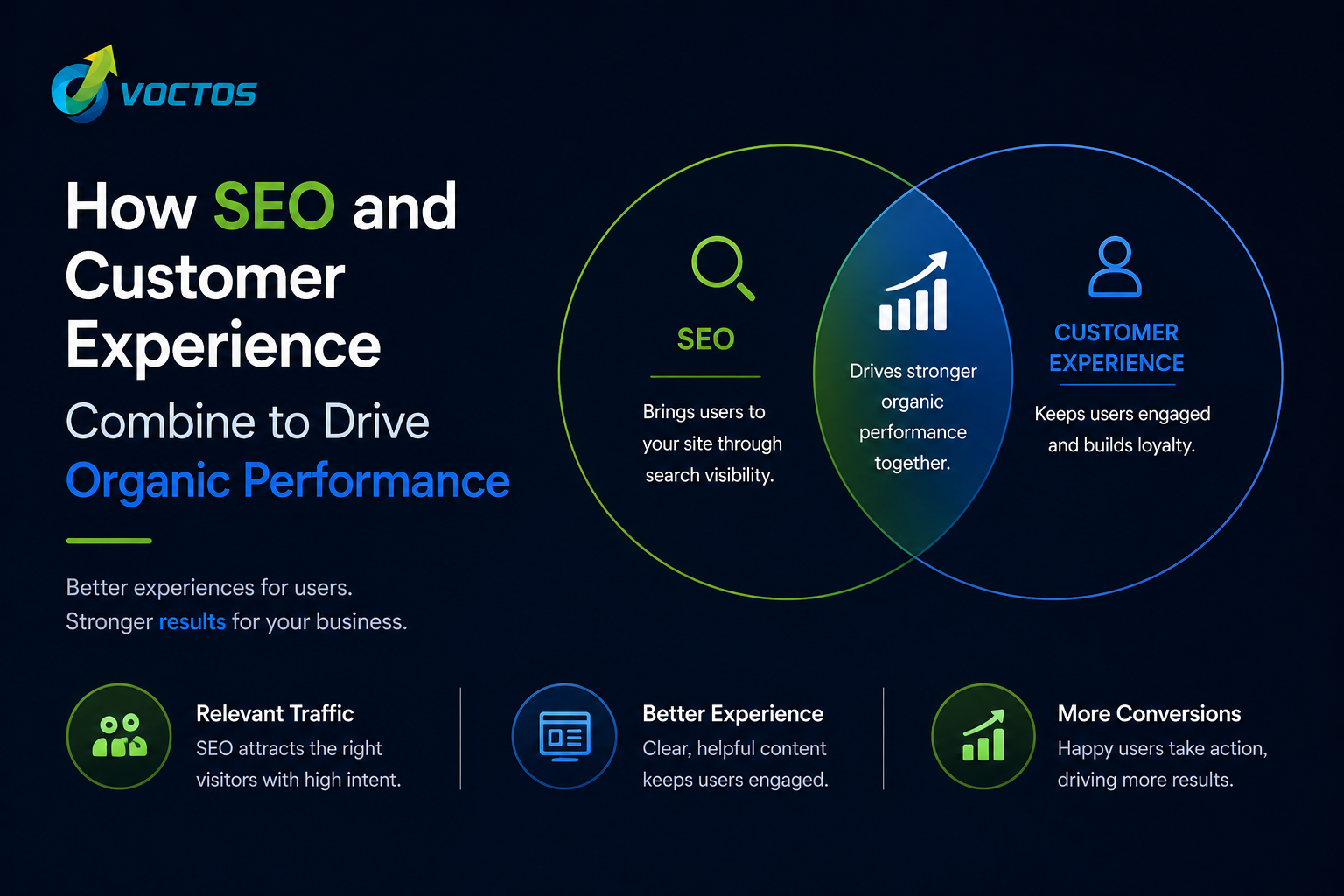
For most of SEO’s history, search optimization and customer experience were managed by different teams with different KPIs, different tools, and different definitions of success. The SEO team chased rankings and traffic. The CX team chased satisfaction scores and conversion rates. The separation felt logical — until Google and AI engines made it untenable.
In 2026, bad CX is bad SEO. Google’s signals now reward sites where the experience matches the promise made in search results. AI engines actively suppress sites that fail to deliver on user expectations. And the brands winning the highest organic visibility are the ones that have stopped treating SEO and CX as separate disciplines and started measuring them as a single performance system.
This guide explains why the two disciplines converged, the five touchpoints where SEO and CX intersect most directly, the practical workflow we use with Voctos clients, and how to measure the combined impact. For the analytics framework that makes this measurable, see our guide on The GA4 Metrics That Actually Matter for SEO in 2026.
Why SEO and CX Converged: The Three Forces
Force 1: Page Experience signals became direct ranking factors. Google’s Core Web Vitals update made load speed, layout stability, and interactivity measurable ranking inputs. For the first time, a page’s technical experience — not just its content and backlinks — directly influenced position. The SEO team could no longer hand off “experience” to a separate product team and walk away.
Force 2: The Helpful Content system rewards genuine satisfaction. Google’s Helpful Content classifier rewards pages where users demonstrably get what they came for — they stay, they engage, they convert, they do not immediately return to the SERP and click a competitor. Pages that bait clicks with misleading titles and deliver thin content are now algorithmically demoted, not just filtered. The engagement signals GA4 captures (engagement rate, scroll depth, time on page) are exactly the CX metrics that predict satisfied users.
Force 3: AI engines cite pages users trust. ChatGPT, Perplexity, Gemini, and Google AI Overviews all evaluate source credibility when choosing citation candidates. Pages that real users find satisfying — indicated by engagement patterns, brand mentions, and review sentiment — are cited more frequently than pages with technical SEO advantages but poor user experience. For the full GEO framework, see our GEO Services in Egypt: The 2026 Playbook.
The Five Touchpoints Where SEO and CX Meet
Touchpoint 1: Search Result Presentation
The user experience starts before the click. Title tags, meta descriptions, structured data rich snippets, and AI Overview appearances shape what the user expects to find on your page. When there is a mismatch between the snippet’s implicit promise and the on-page reality — the page ranks for “best CRM for small businesses” but the content leads with enterprise pricing — both rankings and conversion suffer.
The CX fix and the SEO fix are identical: align the search snippet with the page’s actual content. Audit your top 20 organic landing pages by comparing the search query that brings users to each page (from Search Console) against the page’s headline and above-the-fold content. Every mismatch is both a CX failure and a ranking risk.
Touchpoint 2: Page Load Performance (Core Web Vitals)
Pages that take more than three seconds to render meaningful content lose 40%+ of mobile visitors before they see a single word. In Egypt, where 4G connections are standard and 5G is still limited to urban centres, this threshold is lower in practice — the effective patience window is often closer to two seconds for high-intent queries.
The three Core Web Vitals metrics that Google measures as ranking factors:
- LCP (Largest Contentful Paint): How long until the main content element is visible. Target: under 2.5 seconds.
- CLS (Cumulative Layout Shift): How much the page layout jumps as elements load. Target: below 0.1.
- INP (Interaction to Next Paint): How quickly the page responds to user interactions. Target: under 200ms.
Page speed is the single highest-leverage CX fix for SEO because it moves both ranking and conversion simultaneously — and because it compounds across every page on the domain, not just the one you optimise.
Touchpoint 3: On-Page Comprehension Speed
Can a visitor find the answer they came for in the first ten seconds? This is the on-page equivalent of the snippet promise — and it is where most Egyptian brand sites fail. The pattern is almost universal: a strong H1, followed by three paragraphs of background context and brand messaging, with the actual answer buried at paragraph four.
The CX and SEO fix is identical: front-load the value. Answer the implied question in the first 60 words. Use H2 and H3 subheadings that function as signposts for scanning visitors. Structure content so that a user who spends 10 seconds on the page still gets value — because that engagement, even brief, is a positive signal rather than a bounce.
This “answer-first” structure is also the core principle of AEO content engineering. For the full framework, read our guide on AEO Services in Egypt: Win Zero-Click Search.
Touchpoint 4: The Path to Conversion
From the moment user intent is satisfied to the moment a conversion event fires, every step of friction reduces both conversion rate and the positive engagement signals that feed SEO rankings. The specific frictions that compound most damaging on Egyptian brand sites:
- Invisible CTAs: The next step is below the fold, low-contrast, or written in corporate language (“Submit your inquiry”) rather than outcome language (“Get your free audit”).
- Form friction: Contact forms asking for 8+ fields when 3 would suffice. Egyptian mobile users abandon multi-field forms at dramatically higher rates than desktop users.
- Trust gap before the CTA: No social proof, no named client references, no pricing signal — users reach the CTA without sufficient trust to convert. The fix is structural: place trust signals adjacent to CTAs, not in a separate “testimonials” section.
- Mobile conversion gap: As we document in our GA4 Reports guide, mobile conversion rates on Egyptian B2B sites are typically 60–70% below desktop. The CX failure is usually specific to mobile: small tap targets, slow form rendering, and required fields that are hard to complete on a mobile keyboard.
Touchpoint 5: Post-Conversion Experience
Brands with strong post-conversion experiences earn the brand searches, positive reviews, and word-of-mouth that compound long-term SEO performance. A client who had an outstanding experience searches for you by name, recommends you in communities, and leaves a review — all of which feed the branded search volume and off-domain authority signals that Google treats as indicators of genuine brand authority.
The post-conversion CX investment that produces the strongest SEO compounding: proactive review acquisition (asking for reviews immediately after a positive interaction) and referral programmes that convert satisfied customers into brand ambassadors. For the off-page authority framework this feeds into, see our guide on Off-Page SEO in 2026: The Tactics That Still Boost Visibility.
The Voctos SEO and CX Audit Workflow
The practical workflow we run as a quarterly audit cycle for clients integrating SEO and CX:
- Identify the top 20 pages by organic entry volume from GA4 (filtered to organic search, sorted by users).
- Score each page on five CX dimensions: snippet-to-page alignment, Core Web Vitals pass/fail, above-the-fold value delivery (does the page answer the query in the first screen?), CTA visibility and clarity, and mobile usability.
- Map the organic user journey on each page using GA4 Path Exploration filtered to organic traffic — where do organic visitors go next, where do they drop off, and where do they convert?
- Prioritise fixes by combined SEO-and-CX impact: A fix that improves both engagement rate (SEO signal) and conversion rate (business outcome) is twice as valuable as one that improves only one. Score each candidate fix by the product of its expected SEO lift and CX lift.
- Implement in sprints, measure in GA4: Deploy fixes for 4–6 pages per sprint. Track engagement rate, conversion rate, and organic ranking position before and after. Use the GA4 Reports framework to attribute impact cleanly.
How to Measure SEO and CX Together
The metrics that sit at the intersection of SEO and CX performance:
- Engagement rate by landing page (organic only): The primary indicator of CX quality as experienced by organic visitors. Below 40% = intent mismatch or CX failure. Above 65% = strong alignment.
- Conversion rate by landing page (organic only): The downstream output of both good SEO targeting and good CX execution. Pages with high engagement but low conversion have a CX failure at the path-to-action stage. Pages with low engagement and low conversion have a content-intent mismatch.
- Core Web Vitals pass rate (Search Console > Core Web Vitals report): Percentage of URLs passing Good thresholds for LCP, CLS, and INP. Track as a domain-wide metric monthly — regressions in CWV often precede ranking drops by 4–6 weeks.
- Branded search volume trend (Search Console): The downstream signal of post-conversion CX quality. Growing branded search indicates your customers are remembering you, recommending you, and returning — all of which compound organic performance over time.
Frequently Asked Questions: SEO and CX
Who should own the SEO and CX integration in an organisation?
Ideally, both report into a shared performance owner — a Head of Growth, a VP of Marketing who holds both P&Ls, or a direct reporting line to the CEO in smaller organisations. When SEO and CX report separately into different budget lines, they optimise against each other: the SEO team drives traffic to pages the CX team has not optimised, and the CX team optimises pages the SEO team is not driving traffic to. The integration needs to exist at the accountability level, not just the operational level.
What is the single highest-leverage CX fix for SEO?
Page speed on mobile — almost always. It moves both Core Web Vitals rankings and mobile conversion rate simultaneously, it compounds across every page on the domain, and for Egyptian brands serving a predominantly mobile audience on variable connection speeds, the gap between current performance and the target threshold is usually large enough that fixing it produces measurable results within 4–8 weeks. Start with LCP: identify the largest contentful element on your top 20 organic landing pages and optimise its load time.
Does CX improvement affect AI search citations?
Yes, directly. AI engines like ChatGPT, Perplexity, and Gemini evaluate source credibility when choosing citation candidates. Pages with strong engagement signals — high time-on-page, low exit rates, positive review sentiment — are treated as more trustworthy sources than pages with weak engagement signals, even if both have equivalent keyword relevance. Improving CX improves citation probability, making it a GEO investment as much as a conversion investment.
How long does it take for CX improvements to affect SEO rankings?
Core Web Vitals improvements typically appear in Google’s rankings within 4–8 weeks of the fix being deployed — Google crawls and re-evaluates CWV data on a rolling basis. Engagement signal improvements (from better content structure, CTA clarity, and mobile UX) feed into Google’s quality signals over 60–90 days as the improved engagement data accumulates in the crawl and indexing pipeline. Post-conversion CX improvements (reviews, branded search) compound over 3–6 months before their effect on rankings becomes clearly attributable.
What tools do you use to audit the SEO and CX intersection?
Core Web Vitals: Google Search Console (Core Web Vitals report) + PageSpeed Insights for page-level diagnosis. Engagement signals: GA4 with organic traffic filter + Hotjar or Microsoft Clarity for session recordings on top landing pages. Snippet-to-page alignment: manual audit of Search Console queries vs page headlines for top 20 landing pages. Mobile usability: Google’s Mobile-Friendly Test + manual testing on a mid-range Android device on a 4G connection (the median Egyptian mobile user’s setup).
Want a Joint SEO and CX Audit?
Voctos delivers integrated SEO and CX audits — scoring your top organic landing pages on all five touchpoints, mapping the organic user journey, and producing a prioritised fix list scored by combined SEO-and-CX impact. Get in touch or explore our full SEO services.
Related Reading from Voctos
- SEO Guide 2026: How to Win Search and AI Visibility in Egypt
- The GA4 Metrics That Actually Matter for SEO in 2026
- How to Use GA4 Reports to Define Your SEO Priorities for 2026
- Internal Site Search: The Hidden Enterprise SEO Lever in 2026
- AEO Services in Egypt: Win Zero-Click Search
- Off-Page SEO in 2026: The Tactics That Still Boost Visibility
- Case Study: How Voctos Grew Ogaei’s Organic Traffic by 264,233% in 9 Months