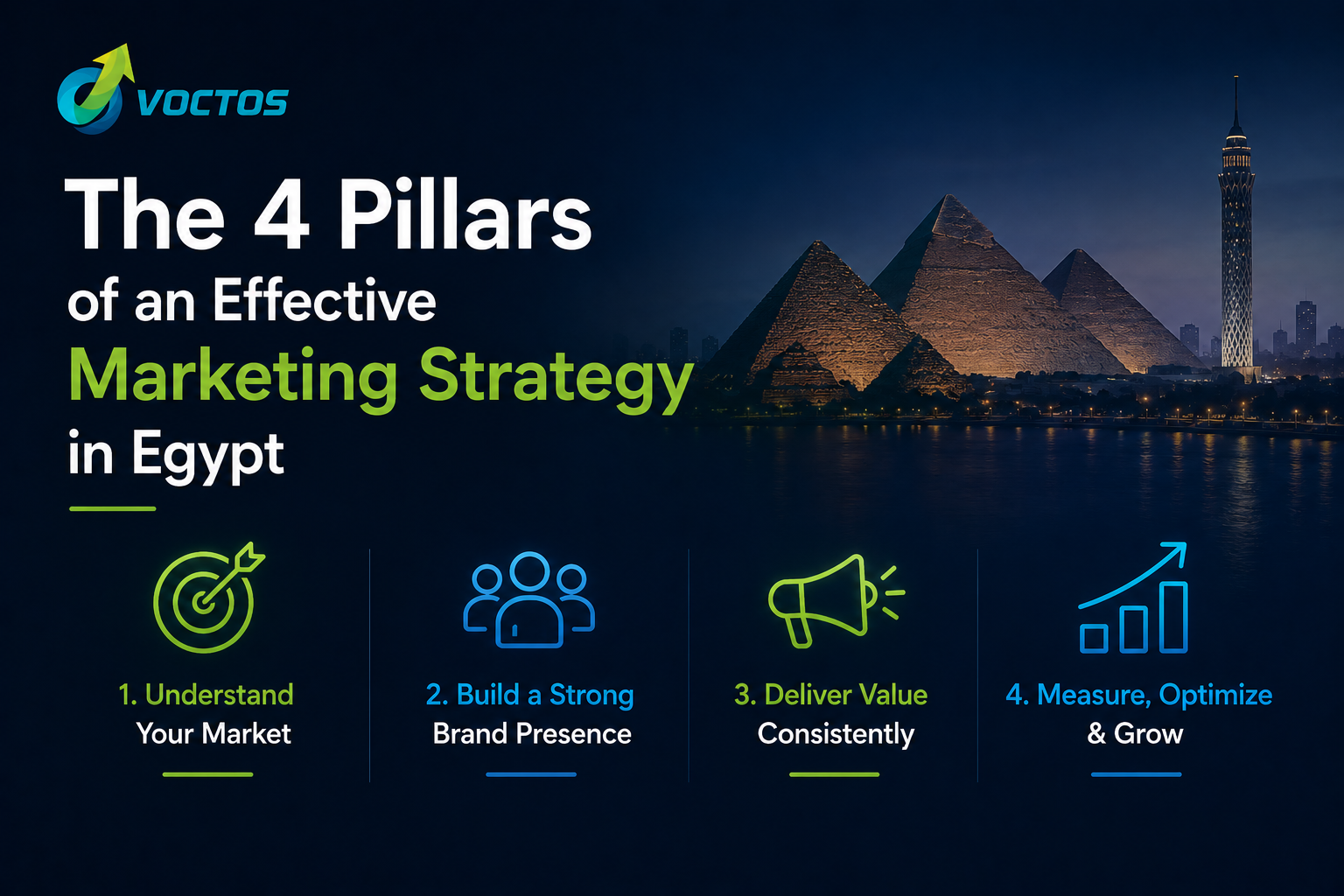
Marketing strategy in Egypt 2026 is no longer a luxury reserved for large corporations. With over 106 million Egyptians online, intensifying competition across every sector, and AI reshaping how buyers discover and evaluate brands, the gap between businesses with a structured marketing strategy and those without it has never been wider.
After 290+ client projects across 60+ countries — including hundreds of Egyptian SMEs and enterprise brands — we have identified four pillars that separate marketing strategies that compound over time from those that burn budget and plateau. This guide covers all four in depth, with the Egyptian market context our clients actually operate in.
Why Most Egyptian Marketing Strategies Fail
Before we get into the four pillars, it is worth naming the most common failure modes we see in the Egyptian market:
- Tactics without strategy: Brands jump into Meta ads or SEO without a clear position or audience definition.
- Channel obsession: The question “should we be on TikTok?” gets more attention than “who exactly are we trying to reach, and what do we want them to believe?”
- No measurement framework: Campaigns run, money is spent, but there is no clear definition of what success looks like or how to attribute results.
- Copying competitor tactics: What works for Vodafone Egypt will not work for a B2B software startup in New Cairo. Context matters enormously.
Pillar 1: Positioning — The Foundation Every Other Pillar Stands On
Marketing strategy in Egypt 2026 starts and ends with positioning. Before any campaign, your business needs a one-sentence answer to three questions: who do you serve, what specific problem do you solve for them, and why should they choose you over the obvious alternative?
If three people inside your company give three different answers, you do not have a position. You have a logo.
How to Build a Strong Position in the Egyptian Market
For Egyptian brands competing locally, the strongest positions are usually built around one of three anchors:
- Underserved segment: A specific audience that larger competitors ignore. Example: HR software built specifically for Egyptian manufacturing companies with 50-500 employees.
- Specific use case: A narrow problem you solve better than anyone. Example: not “accounting software” but “payroll compliance software for Egyptian companies with remote workers.”
- Technical capability: A genuine differentiator your competitors cannot match in the short term.
A strong position makes every downstream marketing decision easier: which channels to use, what content to create, how to price, and how to close. Weak positioning makes everything harder and more expensive.
Pillar 2: Channel Mix — Meeting Your Audience Where They Actually Are
Once your positioning is defined, the next question is: which channels will carry that message most efficiently? Egypt has some of the highest social media engagement rates in the MENA region. But high engagement does not mean every channel works for every brand.
The Egyptian Digital Landscape in 2026
- SEO / Organic Search: Best for B2B, high-intent buyers, long sales cycles. Arabic-language SEO is still underserved and represents a major opportunity.
- Meta (Facebook + Instagram): Best for B2C, brand awareness, retargeting. Around 47M active users — still the highest reach channel in Egypt.
- TikTok: Best for 18-35 consumer brands. Explosive growth with CPMs still relatively low in 2026.
- Google Ads: Best for high-intent search and local services. Competitive in real estate, legal, and medical verticals.
- LinkedIn: Best for B2B and enterprise. Growing professional base in Cairo and Alexandria.
- WhatsApp: Best for retention, nurture, and loyalty. Near-100% open rates make it the most effective direct channel in Egypt.
The 70/20/10 Budget Allocation Model
We recommend a 70/20/10 allocation model for Egyptian brands: 70% of budget on proven channels with clear attribution, 20% on growth channels where your audience is moving, and 10% on experimental channels you are testing before committing significant budget.
Pillar 3: Creative Execution — The Part Most Egyptian Brands Get Wrong
Even perfect positioning and the right channel mix will fail with poor creative. Creative execution is where most Egyptian marketing strategies lose money.
Creative Principles That Work in Egypt in 2026
- Lead with the problem, not the solution. Egyptian audiences respond more to “you have this problem” than “we have this product.” Open with the pain point.
- Use real people, not stock photos. Authenticity outperforms polish. User-generated content and real customer stories outperform studio photography by 2-4x on engagement metrics.
- Mobile-first, always. Over 94% of Egyptian internet users access content primarily via mobile. Design for the phone screen first.
- Arabic and Arabizi both work — but for different audiences. Formal Arabic performs better for finance and healthcare. Arabizi performs better for youth brands and entertainment.
- Short-form video dominates. Video content under 60 seconds generates 3x more engagement than static content across Facebook, Instagram, and TikTok in Egypt.
The Content Hierarchy for Egyptian Brands
Think of your content in three tiers. Tier 1 is Pillar Content: long-form, high-value content that establishes authority — guides, case studies, research. Publish monthly. Tier 2 is Supporting Content: articles, videos, and social posts that reinforce your pillar content. Publish weekly. Tier 3 is Amplification Content: short-form social content, Stories, Reels, and WhatsApp broadcasts that distribute your Tier 1 and 2 content. Publish daily.
Pillar 4: Measurement — The Pillar That Compounds Everything Else
The fourth pillar is what turns your marketing from a cost centre into an investment. Without a clear measurement framework, you cannot learn, optimise, or justify budget increases.
The Metrics That Actually Matter in Egypt 2026
- Pipeline value by channel: How much revenue is each channel generating in your sales pipeline?
- Cost per qualified lead by channel: Not cost per click — cost per qualified lead. This filters out the noise.
- Conversion rate at each funnel stage: Where are you losing prospects? Fixing a conversion drop at the bottom of the funnel is often more valuable than doubling top-of-funnel traffic.
- AI citation share: In 2026, what percentage of AI-generated answers about your category mention your brand? This is the new Share of Voice.
- Customer acquisition cost (CAC) vs. lifetime value (LTV): The fundamental ratio that determines whether your marketing is sustainable.
Setting Up Your Measurement Stack
For Egyptian SMEs and mid-market brands, we recommend a three-layer measurement stack: Google Analytics 4 for website behaviour and conversion tracking, Meta Business Suite for paid social attribution and audience insights, and a CRM such as HubSpot or Zoho for pipeline and revenue attribution.
How the 4 Pillars Interact: The Compounding Effect
The four pillars are not independent. They create a compounding feedback loop. Strong positioning makes your creative more resonant and your channel mix decisions more obvious. Better creative improves performance across every channel. Clear measurement tells you which elements of your positioning and creative are working — so you can double down on what wins.
This is why strategies missing even one pillar plateau. You cannot compound what you cannot measure. You cannot measure what you are not distributing. You cannot distribute effectively without creative that works. And none of it matters if your positioning is unclear.
Marketing Strategy Implementation Timeline for Egyptian Brands
Most Egyptian brands that follow this framework see meaningful, attributable results by month six. Here is a practical timeline:
- Months 1-2 (Foundation): Positioning workshop, audience definition, measurement setup.
- Months 3-4 (Launch): Channel activation, creative testing, baseline data collection.
- Months 5-8 (Optimisation): Double down on what works, cut what does not, expand winning channels.
- Months 9-18 (Scale): Budget reallocation to proven channels, new audience expansion.
Frequently Asked Questions: Marketing Strategy in Egypt 2026
Where should an Egyptian SME start if it has no marketing strategy at all?
Start with positioning. The other three pillars are wasted effort if you have not solved the position problem first. A two-hour positioning workshop with your core team is the highest-ROI marketing activity available to a business with no strategy.
How much should an Egyptian business spend on marketing?
For growth-stage Egyptian SMEs, 8% to 15% of revenue is a typical range. Below 5% rarely produces compounding results. Above 20% is usually a sign that the strategy is broken, not that you need more spend.
How long until a marketing strategy starts producing results?
Meaningful, attributable results typically appear between months four and six. Compounding results — where each month builds on the last — usually begin around month twelve. Most brands that quit at month six were never going to see the inflection point.
Does AI change the 4-pillar framework for Egyptian brands?
AI changes the execution layer — the tools, the speed of creative production, the channels (ChatGPT, Gemini, Perplexity as discovery platforms) — but it does not change the fundamentals. Positioning, channel mix, creative execution, and measurement remain the four pillars. AI is a tool within each pillar, not a replacement for strategic thinking.
Build Your Marketing Strategy in Egypt With Voctos
Voctos builds marketing strategies for Egyptian brands across SEO, GEO, paid media, and content. We have worked with 290+ businesses across 60+ countries, and we understand the Egyptian market at a depth that generalist agencies do not. If you want a strategy that compounds, book a strategy call with our team.

Related items
Last updated: June 2026 | Reading time: ~12 min | By Beshoy Adel,
Last updated: June 2026 | Reading time: ~14 min | Author: VOCTOS G
Last updated: June 2026 | Reading time: ~12 min | Author: VOCTOS G